I read somewhere that the Koine Greek word translated as “head” (as in Christ is head of the church) in most English versions of the Bible, carries the connotation of head as in headwaters.
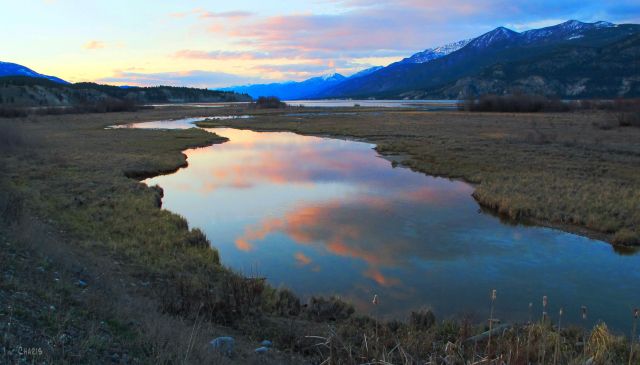
This thought came to me as I came across a photo I took at the south end of Columbia Lake. These are the headwaters the mighty Columbia River that eventually supplies water for irrigation and shipping systems for much of the western USA.
What’s behind that mighty river is a beautiful lake in our backyard that collects the abundant run-off from the mountains.
Christ taught servant leadership.
Jesus: You know that among the nations of the world the great ones lord it over the little people and act like tyrants. But that is not the way it will be among you. Whoever would be great among you must serve and minister. Whoever wants to be great among you must be slave of all. Even the Son of Man came not to be served but to be a servant—to offer His life as a ransom for others. (Mark 10: 42-45 The Voice)
It is what flows out of a person that makes them a great leader. If they are in alignment with Christ as their living head, Christ’s love can flow through them. As others join in unity of the Spirit a confluence grows that pours out in an increasingly deeper and wider outflow, providing for many downstream.
When a leader, any leader, demands homage and lords power over others the direction of flow is reversed. When it becomes all about respect for titles and offices and need for recognition coming his or her way the stream dries up. Submission to the type of leadership Jesus demonstrated is cooperation and confluence, not slavery. It produces much fruit.
We love Christ because he first loved us. Our love and worship is a response to him. Love must be voluntary or it is not love at all. It is something else entirely devoid of freedom.
“I need to worship because without it I can forget that I have a Big God beside me and live in fear.
I need to worship because without it I can forget his calling and begin to live in a spirit of self-preoccupation.
I need to worship because without it I lose a sense of wonder and gratitude and plod through life with blinders on.
I need to worship because my natural tendency is toward self-reliance and stubborn independence.”
-John Ortberg
I used to think God must either be some sort of egomaniac, or the opposite, an insecure assurance addict, that He wanted praise all the time. I learned at an early age (and to my embarrassment now) that the best way to get something from my dad was to butter him up first. It’s the go-to weapon of choice for many people when they feel powerless. I hoped the same technique would work on God.
It wasn’t until I let go of the false definition of God that I somehow picked up in my early years that I began to realize how wrong I had been. God’s self-image is just fine, thank you. He doesn’t need anyone to create one for him.
Worship is about taking my eyes off myself and focusing on who he is. In the process of gazing on his beauty and concentrating on his attributes, I can begin to see myself in his eyes. It creates perspective.
Turning all our attention on who he wants to show himself as in this season of our lives can be like having a defining-the-relationship talk with the Almighty. God is God, holy other, far above any created thing. He knows us intimately and loves us deeply.
Christ has risen! He has conquered death by death! The veil separating us from God’s presence has been torn from top to bottom! Jesus lives to intercede for us! He is our only mediator!
But whenever anyone turns to the Lord, the veil is taken away. Now the Lord is the Spirit, and where the Spirit of the Lord is, there is freedom. And we all, who with unveiled faces contemplate the Lord’s glory, are being transformed into his image with ever-increasing glory, which comes from the Lord, who is the Spirit. (2 Corinthians 3:16-18)
This was in accordance with the eternal purpose which He carried out in Christ Jesus our Lord, in whom we have boldness and confident access through faith in Him. (Ephesians 3: 11, 12)
It is for freedom that Christ has set us free. Stand firm, then, and do not let yourselves be burdened again by a yoke of slavery. (Galatians 5:1)
No condemnation now I dread;
Jesus, and all in Him, is mine;
Alive in Him, my living Head,
And clothed in righteousness divine,
Bold I approach th’eternal throne,
And claim the crown, through Christ my own.
I had something else in mind when I started writing an entry for Good Friday. I was impressed by the phrase “the time when the power of darkness reigns” in Luke 22:52-53: “Then Jesus spoke to the leading priests, the captains of the Temple guard, and the elders who had come for him. “Am I some dangerous revolutionary,” he asked, “that you come with swords and clubs to arrest me? Why didn’t you arrest me in the Temple? I was there every day. But this is your moment, the time when the power of darkness reigns.”
At that particular moment, Jesus allowed himself to be taken captive by those powers that worked in the dark, away from the eyes of the few who would insist on proper protocol, and accountability and the checks and balances that are meant to thwart the misuse of power.
This was a misuse of power.
This morning as I woke I heard: He came to set the captives free.
I’ve been too impressed by the reign of darkness. Jesus said later that his submission to those who would kill him was voluntary.
Love is always voluntary, or it is not love.
This morning the words I heard, “He came to set the captives free,” struck me with the full beauty of irony. Jesus became a captive so he could set the captives free. Jesus died to overcome death.
Jesus died so he could overcome death.
I found a photo I took in Jerusalem at Lithostrotos (Roman Paving) under the Convent of Ecce Homo (Behold the Man – Pilates words when he handed Jesus over to be crucified). In a dark low-ceiling room now underground, it is thought to be the place where Jesus’ trial was held and where the Roman soldiers tortured him.
Our guide told us it was unusually quiet that day. I sat on a stone bench and sang, “My Jesus, I love Thee… If ever I loved Thee, my Jesus ’tis now,” with tears streaming down my face.
Of all the places we visited in Israel this place had the most emotional impact on me. I could feel the darkness, and yet I could also feel the light that rose out of this powerful yet powerless environment that once echoed with the sound of whips and jibes, knowing that it is by his stripes that we are healed.
His wounds became our health.
Jesus entered darkness to bring light. He became a man of sorrow that we might share the joy set before him. He gave up his liberty to set us free. He became sin that we might be free from sin.
If believers decay in their first love, or in some other grace, yet another grace may grow and increase, such as humility, their brokenheartedness; they sometimes seem not to grow in the branches when they may grow at the root; upon a check grace breaks out more; as we say, after a hard winter there usually follows a glorious spring.
– Richard Sibbes
God is the God of restoration. If he raised Jesus from the dead he can surely raise hope from the dead.
My little flock, don’t be afraid. God is your Father, and your Father’s great joy is to give you His kingdom.
That means you can sell your possessions and give generously to the poor. You can have a different kind of savings plan: one that never depreciates, one that never defaults, one that can’t be plundered by crooks or destroyed by natural calamities. Your treasure will be stored in the heavens, and since your treasure is there, your heart will be lodged there as well.
(Luke 12:32-34 The Voice)
God’s version of prosperity may be bigger and more freeing than you think.
In this portion of the journey, when steps forward and steps backward start to resemble a cha-cha more than a foot race, I sometimes wonder what is going on. As I write this people the insurance company sent are in my house packing up stuff that, only four months ago, finally had a place. Now, after the flood, it doesn’t. Again. After all that is salvageable leaves in a truck headed to a storage facility, the deconstruction people come to tear out walls I just painted and flooring we just laid. This week I rushed about trying to figure out what I might need in the next few months that I should store in bins in corners of the house that is still habitable. I was going a little nuts.
It felt like I was wallowing in hope deferred.
Then a friend (Godsend that she is) asked me if I would join her and paint during the worship portion of a conference. I was apprehensive about doing what I do in front of real live people (as opposed to anonymous readers). I am so done with performance and stage Christianity, but I decided that hiding is not much better. Besides, I needed to get out of the house – and they let me sit in a corner of the auditorium.
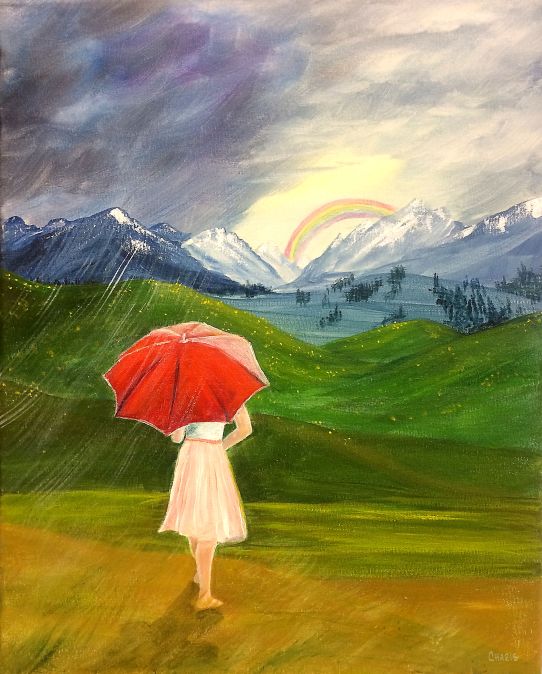
The first night I painted light streaming through the woods as the Lord spoke to me about shifting atmospheres in a way that brings light to dark places, but the idea for this painting, started the second day, formed before the first was even finished. I saw the red umbrella as a symbolic covering like the covering given by the blood over the doors at Passover and the covering given by Christ’s blood. I saw a break in the clouds. I saw a pass in the mountains with a rainbow of promise over it.
I was also aware of the unseen shadowy valleys between happy greening hills covered with the yellow sunflowers of spring and the places where winter is reluctant to let go of its hold.
As I finished details that indicated a shifting atmosphere the phrase came to me: Promise IS breakthrough.
The answers God has provided to problems friends and family and people I am praying for around the world already exist. God, in his great mercy, takes us through hills and valleys and seasons of sun and storm to prepare us for the rigors of abundance, influence, and authority, but he promises breakthrough.
This weekend I heard, “Know who you are. Know whose you are. That’s your protection, your covering. Lift your eyes and see God’s plan. Quit hiding and move. This is going to be good.”
“Well,” she said, standing in the middle of a pile of what we might call reduced circumstances, “I guess this is my new normal.”
My friend was too tired to fight the injustice that brought her to this place. In a way she accepted it as her lot in life, as a fulfillment of predictions spoken over her in the past. Teachers, social workers, and bosses didn’t always wait to be out of ear shot before they said things like, “She’ll never amount to much,” or “What do you expect from someone with her background?”
I tried to encourage her, but My words slipped past her ears as if she assumed they were meant for someone else, someone more worthy of love and respect. She shrugged and went back to unpacking her baggage.
I was thinking about the word “normal” yesterday. Her normal. My normal. God’s normal. How does our acceptance of limited expectations become normal? What if we have glimpses of possibilities that are beyond past experiences? Does seeing potential wreck our concept of normal?
Yesterday I was lying in bed exchanging text messages with my eight-year old granddaughter who is currently with her family in Africa. I wondered what my grandmother would have thought if she had seen this possibility when I was an eight-year old. A phone with no wires, that could send and receive voices, text, photos, and even video of a new house on the other side of the world in a few seconds? Impossible!
In an old trunk I’ve stored a letter my grandmother received from her mother in Ontario. Grandma’s child had died tragically in Saskatchewan. Her mother’s written words arrived weeks after the funeral. In comparison, my granddaughter was telling me about her new surroundings and their arduous two day trip from western Canada to South Africa. On the same day. As she ate breakfast. I love listening to her.
Then my wifi cut out.
We have been having problems with it lately because of the floods. I felt angry and frustrated with such unreliable service – a service that has only been available to me since I acquired a cell phone. It’s not that I feel entitled to a method of communication we never dreamed of when I was a child, it’s that I feel disappointed by the loss of a means of communication I now know exists. My sense of normal has been changed by knowledge of a device that only existed in the future of the girl I was when I talked to my grandmother as I wrapped myself in the cord attached to the telephone in the hallway. She never even dreamed of such a thing as she told me about how she used to send letters to her mother in a cabin in the bush thirty miles from the nearest road. “Normal” changes with visions of possibilities.
I was thinking about this when a line from a song began playing in my head. The song, as is often the case with songs God uses to communicate with me, came out of the blue and was one I haven’t heard in years. The line that kept repeating was, “Promises, promises, My kind of promises…”
I did an internet search and found the lyrics by Burt Bacharach and Hal David, which are, in part: Oh, promises, their kind of promises, can just destroy a life Oh, promises, those kind of promises, take all the joy from life Oh, promises, promises, My kind of promises Can lead to joy and hope and love – and love!
I asked the Lord why he was bringing this to my attention. I always thought promises were good things, but he began to remind me of bad promises that had been spoken over me the way curses had been spoken over my discouraged friend.
I promise you there will be punishment when we get home. I promise you that no one will ever love a fat girl. I promise you that you will never have friends because you don’t know how to be a friend. I promise you that no one remembers who came in second. I promise you that you are only as good as your last performance. I promise you that when those people learn you are just a poor girl from a poor family they will drop you so fast… I promise you that no one cares what you have to say. You’re just a woman. Shut up and follow the rules. I promise you God has no time for people like you who still sin and don’t earn his favour.
I wasn’t expecting a rush of these memories. Some of these “promises” I walked out on years ago. Some still sting.
I had to ask, “What are Your promises, Lord? What do you see instead? What possibilities do you want to show me that change my sense of ‘normal?’”
He is changing me. He is replacing old expectations of limits with new possibilities. He is saying, “Believe this and not this.”
So much of this journey is about learning to let go, to unlearn, to press on in the absence of the familiar, to absorb and be infused with the “insteads” that Jesus announced when he read his mandate aloud to a people living in resigned disappointment. From Isaiah 63:
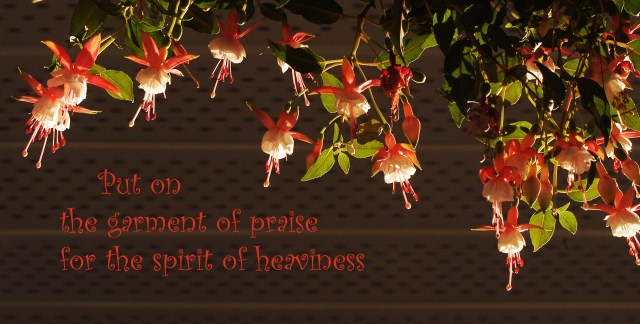
The Spirit of the Sovereign Lord is on me, because the Lord has anointed me to proclaim good news to the poor. He has sent me to bind up the brokenhearted, to proclaim freedom for the captives and release from darkness for the prisoners, to proclaim the year of the Lord’s favor and the day of vengeance of our God, to comfort all who mourn, and provide for those who grieve in Zion— to bestow on them a crown of beauty instead of ashes, the oil of joy instead of mourning, and a garment of praise instead of a spirit of despair. They will be called oaks of righteousness, a planting of the Lord for the display of his splendor.
Who does Jesus say you are? What are the promises he has spoken over you? What possibilities is he showing you that you never dreamed of before?
Ask him about your new normal. He loves that question.














 Charis: Subject to Change