“If a man just stops to think what he has to praise God for, he will find there is enough to keep him singing praises for a week.”
-Dwight L. Moody
Two years ago the leaves on our double flowering plum suddenly started shriveling up. Within a week most of them had fallen off. Many of the trees on our street suffered the same fate. Leaf miner bugs staged an invasion while we were out on the porch enjoying our ice tea.
We sprayed and fertilized and watered, but it was too late. It was a sad sight. On her way to her car after a visit, my friend Rhonda stopped and held the tip of a barren low-hanging branch in her gentle hand. I knew she was praying for the tree’s recovery. Rhonda is sensitive to nature. She could feel the tree’s pain and she had compassion.
Last spring the tree sprouted leaves, but there were no blossoms. My husband suggested cutting it down, but I couldn’t bear to let go as long as long as it still lived. I pruned it back and fertilized hoping for revival even as more leaves browned and blew away.
This morning as I look out the window above my desk, branches decked in beautiful pink blossoms wave in the breeze. I can’t see them hiding in there, but I can hear the birds singing. Buzzing bees don’t even trigger my fear of them because they are far too busy with flowers to notice me.
The thirty-five-year-old double flowering plum made a dramatic comeback this spring. We marvel in the show because we feared we had lost her.
This week also marks the fourth anniversary of our son-in-love returning home from the hospital. He was miraculously healed after doctors gave him a 0% chance of survival from flesh-eating disease. We thought we had lost him too. But God had other plans, and we still marvel.
To be honest, this has been a year of set-backs. Half of our house is still uninhabited and awaiting restoration after heavy snow-melt floods destroyed the renovation work barely finished. Just when I thought my nagging health issues had finally been dealt with, the tests say ‘not so fast.’ This will require more treatment and more recovery time.
You may be in a season of hope deferred as well.
One thing I have learned in my life: Complaining attracts spiritual forces who are quite willing to help you with dismal projections and align to undermine hope. Praise attracts the angels who live in the atmosphere of worship of the God of Love. They align to bring about God’s purpose – reconciliation between the Father and humankind and restoration of all creation.
Today the plum tree is vibrant with petal colour and birdsong and the hum of honey-makers. Today I have a reminder right outside my window that God is still in the restoration business and there is always, always something to be thankful for.
Have you ever searched online for a recipe using the ingredients you actually have in the house? Have you clicked on the suggested site and then had to plow through the details of the cook’s day before finding the instructions way down at the bottom under photos of her aunt’s birthday party? Have you ever said to yourself in exasperation, “All I want to know is how many eggs?
Have you ever been trapped by the expectation of polite silence placed on the captured pew audience and listened to a rambling sermon that seemed to include a dozen unrelated illustrations plucked at random from the Good Book. Have you wondered where this was going, if anywhere?
Have you ever said to someone, “How are you?” and they took your question as a literal invitation to recite their medical records? Have you wondered if you should send flowers now or wait for the funeral should they actually succumb to toenail fungus?
Have you ever wanted to say, “I don’t have time for this. Please just get to the point?”
I’m sure people have with me. One of the advantages of writing is the ability to edit out superfluous detail. People don’t have time to travel rabbit trails with me, and frankly, even the most caring among us does not have the capacity to listen to every detail, let alone delight in it.
Have you ever asked your child or grandchild about the classic movie a friend took them to and been delighted to hear every detail, from the story of the kid who spilled his popcorn in the lobby to a description of the hero’s father’s home planet? Our delight is not in the movie. We’ve seen it. Our delight is in the relationship. We rejoice in the child’s joy.
People who have lost spouses or friends, or have been separated from them for long periods of time, tell me the hardest part is not having anyone to share good news with. Someone who cares about the details of your day, someone who doesn’t communicate with watch checking or key jangling that they just want you to get to the point, someone who actually enjoys being in your presence is one of the greatest gifts to our souls’ well-being.
Here’s the most beautiful thing about our relationship with God. He has all the time in the world. He has an infinite capacity to care. He delights in you and every detail of your life.
When I first started on a journey to get to know God better I decided to go on a long walk with Jesus. I didn’t know what to say, so I told him about a movie I had seen. I pretended I was holding his hand like I was a child. I didn’t listen much. I didn’t know I could. After a few days of telling him about the details of my life no one else seemed interested in, he began to tell me about the things he cared about. It began with a flower in the woods, and a bird in the tree.
I began to listen. I wept with him. I rejoiced with him. Because he listens.
The Lord directs the steps of the godly. He delights in every detail of their lives.
Though they stumble, they will never fall, for the Lord holds them by the hand.
I’ve been helping friends write resumes. I’ve also been talking to friends who are looking for reliable employees. Frequently, friends who are writers (or want to be writers) ask me to read their articles and books-in-process. Others are looking for recommendations for reading material. Busy, busy, busy.
I can lose embarrassingly large huge chunks of time following links on social media. At the moment it takes over an hour to keep up with my Facebook feed in the morning (and you know I don’t limit myself to a morning perusal). Daily, I am notified of the arrival of possibly excellent blogs I probably won’t have time to read if I want time to write anything myself.
I was the kind of kid who read everything – cereal boxes, instruction manuals, and terrifying lists of side-effects tucked inside packages of tablets. I read quickly and constantly, but even I am overwhelmed by the barrage of words coming at my eyeballs lately. Like the employers who spoke to me this week, I sometimes look for reasons to scroll past and go on to the next thing. Disqualifiers. (A note to my young friends: potential employers do look at your social media party pictures and rants about unfair teachers, over-sensitive co-workers, and unreasonable cops. Just sayin’.)
The problem is that hasty judgments can be misleading. Sometimes I need to go back and look again because sometimes I have been very wrong. I know this because I have felt harshly judged and dismissed myself. That may be who I was then, but it is not who I am now.
Lately, I have been listening to the stories of people I admire, people who have developed proven character and live lives that effectively communicate the love of God and his ways. These are people who mentor the young, heal the sick, speak the truth, serve the poor, and encourage the stumbling to pick up their feet. I am amazed at how incredibly unqualified some of them would have appeared to be if I had known them twenty years ago.
This week I have also read critical dismissals of people I have learned carry a depth of understanding the shallow, fearful, and defensively religious don’t recognize. I have heard posters say they have nothing to learn from anyone who is a single parent, too young, not academically-inclined, divorced, physically weak or ill, not endorsed by an institutional church, endorsed by the wrong institutional church, unpolished, too slick, female, unattractive, fashionable, unequally yoked to an unbelieving spouse (or a spouse who voted differently), “obese” (seriously? maybe a little husky) or, in the case of a fine writer, dead.
When I listen to the stories of people I admire, both living and dead, I am impressed by the fact that nearly all of them originally presented with disqualifiers for ministry. She failed the same grade three times, she lived with an alcoholic for forty years, he drank for forty years, his wife divorced him, she failed the physical for missionary service, he was attracted to the same sex, he couldn’t carry a tune, she fainted if she had to speak in public, he lost years to depression, she was seduced by a pastor, he was diagnosed with autism, she had a criminal record, he was drowning in debt.
The Bible records many stories of those who were uniquely unqualified for the roles God gave them. We read about prostitutes, collaborators, murderers, convicts, fraud artists, and cowards rising up to become God’s secret weapons. The abandoned, abducted, emasculated, robbed, wounded, harassed, orphaned, and misunderstood eventually found themselves in positions of power and influence only God could arrange.
God’s tendency to use the weak to confound the mighty is not new, yet it is consistently surprising.
Remember, dear brothers and sisters, that few of you were wise in the world’s eyes or powerful or wealthy when God called you. Instead, God chose things the world considers foolish in order to shame those who think they are wise. And he chose things that are powerless to shame those who are powerful. God chose things despised by the world, things counted as nothing at all, and used them to bring to nothing what the world considers important. As a result, no one can ever boast in the presence of God.
God has united you with Christ Jesus. For our benefit God made him to be wisdom itself. Christ made us right with God; he made us pure and holy, and he freed us from sin. Therefore, as the Scriptures say, “If you want to boast, boast only about the Lord.” (1 Corinthians 1: 26-31 NLT)
When I am tempted to dismiss someone for lack of obvious potential, I have to look at the bitter, depressed person I was twenty years ago and remember how the grace extended to me made change possible. I am grateful for those who saw more than my list of disqualifications and offered encouragement in dark days. They saw potential when I did not. I am thankful that even now God doesn’t define me by my weaknesses.
When I listen to the stories of people I admire I realize the common element is that these are people who experienced the power of transforming grace in their lives. It is difficult to give what you have not received. They extend grace because they have known grace. Weakness was their superpower because the lack of personal qualifications for the job allowed God’s grace to multiply beyond anything they could imagine.
Is the job God is offering you beyond your ability? You’re hired!
Each time he said, “My grace is all you need. My power works best in weakness.” So now I am glad to boast about my weaknesses, so that the power of Christ can work through me. (2 Corinthians 12:9)
In the way that texting while driving is a bad idea, blogging while wrestling with anger is also a bad idea. Both are dangerous distractions with the potential to put serious dents into bystanders.
I’ve not been posting as frequently lately because anger has been flashing like a check engine light on my car’s dashboard. Something needs tending to. I submitted to self-imposed silence and listened instead (well, mostly.) With the Lord’s help, I’ve needed, again, to examine what was going on under the hood before going any further.
I think it started with reading an innocent hashtag on Twitter: #ThingsOnlyChristianWomenHear. What followed was an unexpected mass chorus of voices expressing the pain of living in a religious system that kept -or still keeps- women voiceless. I may have added a few tweets myself. A lot of dashboard lights flashed on the internet last week. Not everyone was comfortable with the spontaneous outpouring that exposed more misogyny than they realized was a normal part of many women’s lives. Exposure is embarrassing and uncomfortable for everyone. Push-back from onlookers called for cover-up or, sadly, invalidation.
Here’s the thing, you can’t forgive what you don’t acknowledge and you can’t clean up corruption when it remains covered up. (We learned that lesson when our son-in-law almost died from undiagnosed flesh-eating disease.) Sometimes healing involves mess or pain first.
I discovered I still had more forgiving to do because listening to other women’s (and men’s) painful memories triggered some of my own. There were still some lingering lies I accepted about God liking men more than women. They were planted in my soul as a result of observing the way women of my mother’s generation were treated, and their resignation to silence and subservience to men as the norm. The seeds grew as I was taught to interpret scripture in a way which ignored the character and practice of both Jesus and Paul. (Paul wrote the words to Timothy I was told imposed a gag order on all females for all time in all places, but he also praised women like Phoebe, Junia, and Priscilla who were obviously not silent.) There was still some toxic residue in the unseen corners of my heart that kept me from saying with all honesty, “I thank God he made me a woman!”
The Lord and I have been working on that together. He is the one who establishes my identity. And he likes me.
Then Christianity Today published an article which asked the question, “Who is in charge of the Christian blogosphere?” The author suggested that female bloggers who write about spiritual matters should be under the supervision of denominational or institutional authorities who are credentialed and better educated in matters of proper doctrine. (Which proper doctrine the author doesn’t say.) The article, and responses to it, triggered another memory.
One of the most difficult times in my life was when a physician who specialized in voice problems prescribed a season of silence. I was less talkative then, but people who know me will understand the enormity of the challenge.
I had finished studying, rehearsing and performing the role of Amina in Bellini’s opera, La Sonnambula, a few weeks before. I caught the flu before ensemble rehearsals began. It morphed into a long-lasting nasty cough monster that barked in a register much lower than my usual coloratura soprano range.
The role of Amina is a kind of vocal high-wire act involving agility, stamina and a lot of very high notes. I was onstage most of the opera singing not only solos but duets, trios and other ensembles. A run-through of my music took nearly 90 minutes. You can imagine how much time was involved in practice to learn the role.
My voice was not recovering fast enough. It sounded okay in short sessions, but it didn’t feel right, and I was worried about stamina. Reluctantly, I spoke to the producer and director about my doubts in my ability to perform. The response was not what I expected. The director said, “I believed in you. You disappoint me! If you don’t sing I stand to lose $10,000 of my own money I invested in this production.” I felt the pressure and forged on.
Nerves were a bigger problem than usual on opening night. I knew I was forcing at times. Except for one embarrassing note on the final night, I made it through the performances though. The standing ovation and bravas from the audience almost made up for the burning pain in my throat.
Two weeks later I sang with another orchestra and choir. I had only two solos in a Bach cantata which should have been easy, but I struggled. My voice was not responding as it should. I made an appointment with the laryngologist.
He said I had the beginning of nodules. That statement feels like a death sentence to a classical singer. I was scared. He told me to rest it completely for several weeks – no talking and definitely no singing. I followed his advice and my vocal folds did heal. I didn’t need surgery, but I learned some things in that time. 1) I yelled at my kids more than I thought I did. 2) People don’t talk to you if you don’t talk to them. 3) I didn’t appreciate submitting to authorities who were more concerned about their own project than my long-term well-being. 4) Being voiceless made me feel powerless.
You may express yourself in other ways, but perhaps you can still relate. My voice was my strength because it made me relatively unique. I could sing over a full orchestra and eighty voice choir without a microphone. My voice allowed me to comfort others and bring the joy of music into their lives. My voice was my vehicle for creativity and emotional expression. I was wrong, but at the time I felt like my voice justified my existence. People listened. They asked advice. Musicians I admired included me, gave me a place among them on the stage, and treated me as though I had value. Without a voice, I had no place in that world.
About ten years later chronic health problems meant I had to give up singing almost completely. I grieved deeply. I hated being voiceless. But my heavenly Father can use all circumstances and I grew because I learned instead to lean on the Lord as my source of justification for existence. Eventually, he led me to fill the void with other creative expressions. One of them is writing and blogging. I had a voice again, but this time it served a larger purpose.
When I read the CT article it felt like the people who were willing to sacrifice my voice to serve their own agenda had shown up again. I believe in the wisdom of an abundance of counselors. I believe in mutual submission, and yes, my husband does read and approve of my blog, not because he is my master, but because I respect his perspective. I have deleted and revised and parked articles in the draft file indefinitely on the advice of people I trust. But that’s the operative word – trust.
I wonder if the strong backlash to the article could be coming from people who have also lost their innocence when it comes to the lack of transparency of “experts” in positions of power. Yes, we need to forgive, but forgiveness does not mean trust is automatically restored. The type of servant leadership Jesus demonstrated is something we still need to strive to attain when it appears the response to error is more silencing control instead of more healing grace and better communication of love. We need more of the kind of discipleship training that encourages believers to have their own senses trained to discern right from wrong through practice.
The point of leadership is to produce competent graduates, not more dependent children in pews.
The point of the exposure of corruption in the body and submission to the kind of correction the One who loves us perfectly brings is to purify and build up this Church of living stones.
I almost posted two previous versions of this blog article. In them, I gave more evidence for the reasons for my distrust of some ecclesiastical hierarchical authorities (not all!) and defended my educational qualifications. Twice I felt the Lord saying to let it go, deal with my own heart issues, and start again. Learning to hear God for ourselves means responding in obedience. Sometimes submission to his advice means speaking up and sometimes it means hitting delete. Holy Spirit provides the fruit of self-governance in his gift basket for a reason.
The internet is like the printing press that triggered the Reformation. Blogs provide more people with the freedom to speak up. I believe we are on the brink of another Reformation in which greater numbers of the priesthood of believers will rise and raise their voices in praise to the God of our salvation who sets all the captives free.
I am not voiceless anymore. I don’t need the approval of people I don’t trust. I do need the approval of my Lord.
May the words that come out of my mouth and the musings of my heart meet with Your gracious approval, O Eternal, my Rock, O Eternal, my Redeemer.
(Psalm 19:14 The Voice)
To my fellow Christ-centered female bloggers, and to all my brothers and sisters in Christ no matter the form your expression takes, I urge you to use your voices! May your sound go out into all lands and your words unto the ends of the world.
Happiness held is the seed; happiness shared is the flower.
A truly happy person is one who can enjoy the scenery while on a detour.
Happiness is a direction, not a place.
-Sydney J. Harris
I wasn’t expecting to see my favourite wild flowers blooming so early. It’s been a harsh winter in the eastern part of the province. We all feel a bit traumatized. Spring flowers, understandably, are also reluctant to poke their heads out.
I found myself in the Okanagan this week on a bit of a detour from the usual routine. There, beside the pioneer’s cemetery on a hill overlooking the city, happiness turned its face to the sun and bloomed its heart out.
“I need to worship because without it I can forget that I have a Big God beside me and live in fear.
I need to worship because without it I can forget his calling and begin to live in a spirit of self-preoccupation.
I need to worship because without it I lose a sense of wonder and gratitude and plod through life with blinders on.
I need to worship because my natural tendency is toward self-reliance and stubborn independence.”
-John Ortberg
I used to think God must either be some sort of egomaniac, or the opposite, an insecure assurance addict, that He wanted praise all the time. I learned at an early age (and to my embarrassment now) that the best way to get something from my dad was to butter him up first. It’s the go-to weapon of choice for many people when they feel powerless. I hoped the same technique would work on God.
It wasn’t until I let go of the false definition of God that I somehow picked up in my early years that I began to realize how wrong I had been. God’s self-image is just fine, thank you. He doesn’t need anyone to create one for him.
Worship is about taking my eyes off myself and focusing on who he is. In the process of gazing on his beauty and concentrating on his attributes, I can begin to see myself in his eyes. It creates perspective.
Turning all our attention on who he wants to show himself as in this season of our lives can be like having a defining-the-relationship talk with the Almighty. God is God, holy other, far above any created thing. He knows us intimately and loves us deeply.
My little flock, don’t be afraid. God is your Father, and your Father’s great joy is to give you His kingdom.
That means you can sell your possessions and give generously to the poor. You can have a different kind of savings plan: one that never depreciates, one that never defaults, one that can’t be plundered by crooks or destroyed by natural calamities. Your treasure will be stored in the heavens, and since your treasure is there, your heart will be lodged there as well.
(Luke 12:32-34 The Voice)
God’s version of prosperity may be bigger and more freeing than you think.
“Well,” she said, standing in the middle of a pile of what we might call reduced circumstances, “I guess this is my new normal.”
My friend was too tired to fight the injustice that brought her to this place. In a way she accepted it as her lot in life, as a fulfillment of predictions spoken over her in the past. Teachers, social workers, and bosses didn’t always wait to be out of ear shot before they said things like, “She’ll never amount to much,” or “What do you expect from someone with her background?”
I tried to encourage her, but My words slipped past her ears as if she assumed they were meant for someone else, someone more worthy of love and respect. She shrugged and went back to unpacking her baggage.
I was thinking about the word “normal” yesterday. Her normal. My normal. God’s normal. How does our acceptance of limited expectations become normal? What if we have glimpses of possibilities that are beyond past experiences? Does seeing potential wreck our concept of normal?
Yesterday I was lying in bed exchanging text messages with my eight-year old granddaughter who is currently with her family in Africa. I wondered what my grandmother would have thought if she had seen this possibility when I was an eight-year old. A phone with no wires, that could send and receive voices, text, photos, and even video of a new house on the other side of the world in a few seconds? Impossible!
In an old trunk I’ve stored a letter my grandmother received from her mother in Ontario. Grandma’s child had died tragically in Saskatchewan. Her mother’s written words arrived weeks after the funeral. In comparison, my granddaughter was telling me about her new surroundings and their arduous two day trip from western Canada to South Africa. On the same day. As she ate breakfast. I love listening to her.
Then my wifi cut out.
We have been having problems with it lately because of the floods. I felt angry and frustrated with such unreliable service – a service that has only been available to me since I acquired a cell phone. It’s not that I feel entitled to a method of communication we never dreamed of when I was a child, it’s that I feel disappointed by the loss of a means of communication I now know exists. My sense of normal has been changed by knowledge of a device that only existed in the future of the girl I was when I talked to my grandmother as I wrapped myself in the cord attached to the telephone in the hallway. She never even dreamed of such a thing as she told me about how she used to send letters to her mother in a cabin in the bush thirty miles from the nearest road. “Normal” changes with visions of possibilities.
I was thinking about this when a line from a song began playing in my head. The song, as is often the case with songs God uses to communicate with me, came out of the blue and was one I haven’t heard in years. The line that kept repeating was, “Promises, promises, My kind of promises…”
I did an internet search and found the lyrics by Burt Bacharach and Hal David, which are, in part: Oh, promises, their kind of promises, can just destroy a life Oh, promises, those kind of promises, take all the joy from life Oh, promises, promises, My kind of promises Can lead to joy and hope and love – and love!
I asked the Lord why he was bringing this to my attention. I always thought promises were good things, but he began to remind me of bad promises that had been spoken over me the way curses had been spoken over my discouraged friend.
I promise you there will be punishment when we get home. I promise you that no one will ever love a fat girl. I promise you that you will never have friends because you don’t know how to be a friend. I promise you that no one remembers who came in second. I promise you that you are only as good as your last performance. I promise you that when those people learn you are just a poor girl from a poor family they will drop you so fast… I promise you that no one cares what you have to say. You’re just a woman. Shut up and follow the rules. I promise you God has no time for people like you who still sin and don’t earn his favour.
I wasn’t expecting a rush of these memories. Some of these “promises” I walked out on years ago. Some still sting.
I had to ask, “What are Your promises, Lord? What do you see instead? What possibilities do you want to show me that change my sense of ‘normal?’”
He is changing me. He is replacing old expectations of limits with new possibilities. He is saying, “Believe this and not this.”
So much of this journey is about learning to let go, to unlearn, to press on in the absence of the familiar, to absorb and be infused with the “insteads” that Jesus announced when he read his mandate aloud to a people living in resigned disappointment. From Isaiah 63:
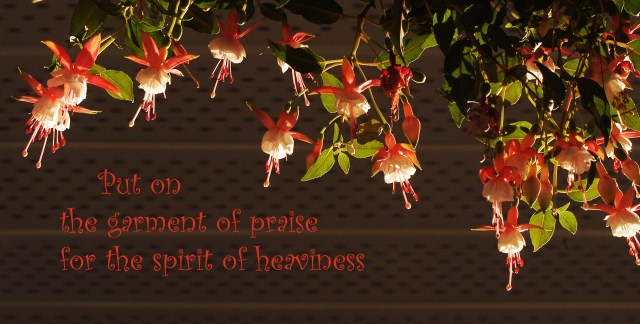
The Spirit of the Sovereign Lord is on me, because the Lord has anointed me to proclaim good news to the poor. He has sent me to bind up the brokenhearted, to proclaim freedom for the captives and release from darkness for the prisoners, to proclaim the year of the Lord’s favor and the day of vengeance of our God, to comfort all who mourn, and provide for those who grieve in Zion— to bestow on them a crown of beauty instead of ashes, the oil of joy instead of mourning, and a garment of praise instead of a spirit of despair. They will be called oaks of righteousness, a planting of the Lord for the display of his splendor.
Who does Jesus say you are? What are the promises he has spoken over you? What possibilities is he showing you that you never dreamed of before?
Ask him about your new normal. He loves that question.


 This morning as I look out the window above my desk, branches decked in beautiful pink blossoms wave in the breeze. I can’t see them hiding in there, but I can hear the birds singing. Buzzing bees don’t even trigger my fear of them because they are far too busy with flowers to notice me.







 Charis: Subject to Change