I saw these clay pots tossed in a wooden bin under the counter in a shop catering to tourists in Jerusalem. The good ones stood decently and in order on a clean glass shelf. These were chipped and dust-laden, but nevertheless not discarded. They spoke to me.
I am often bewildered and have so many questions. I keep getting to take the same tests over and over and I still haven’t got it right. I have chips and dents and scars from the poor choices I have made in times of challenge, but it absolutely amazes me that God chooses to use cracked pots like me. Unlike many organizations which worry about public image He doesn’t discard the wounded. It’s broken-ness that proves God’s goodness, because if I had any power in myself, believe me I am the first person I would fix. His grace amazes and humbles me.
But this beautiful treasure is contained in us—cracked pots made of earth and clay—so that the transcendent character of this power will be clearly seen as coming from God and not from us. We are cracked and chipped from our afflictions on all sides, but we are not crushed by them. We are bewildered at times, but we do not give in to despair. We are persecuted, but we have not been abandoned. We have been knocked down, but we are not destroyed. (2 Corinthians 4:7-9)
Every day its streets bustle with activity, but as the sun sets the tinker lays down his tools, the blacksmith’s forge goes cold, Miss Bailey balances her bell and pointer and dunce cap on the stool in the corner. The Northwest Mounted Police recruit drops his British accent and hangs his red serge on the costume rack. The inhabitants of Fort Steele leave via the employees exit to the parking lot and carpool home to the next town, because no one actually inhabits in this one.
It’s dead.
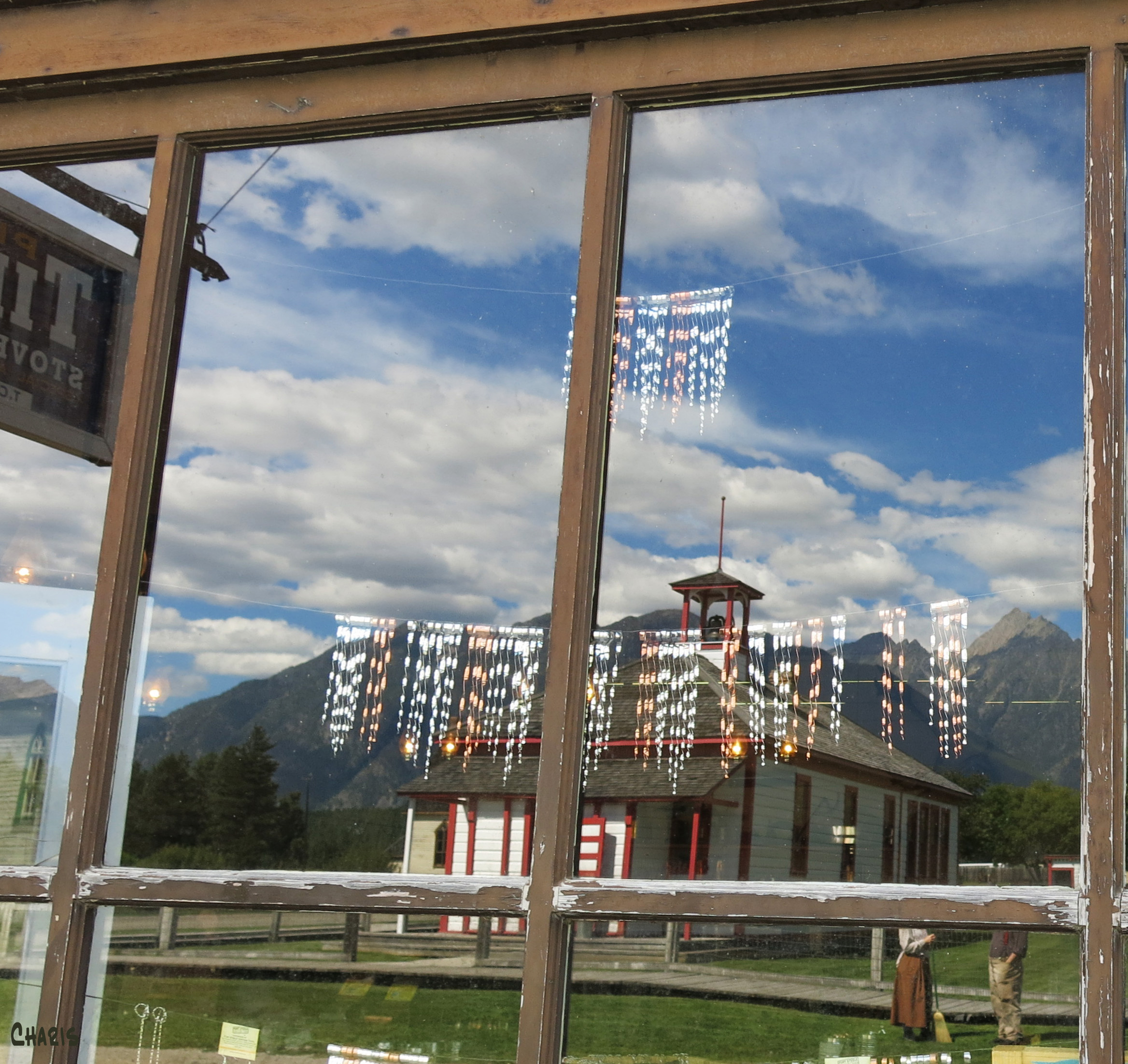
Tinsmith Shop Window, Fort Steele
Open
When pioneers built the livery and school and churches and hotel and shops Fort Steele glistened with the promise of wealth. Since gold had been discovered in the nearby Wildhorse Creek all sorts of adventurous trail-blazing men streamed in, and after a tense situation with the first dwellers in the area was settled without violence, the abundant beauty and riches of the valley convinced them to invite their wives and children to join them.
The town of Fort Steele, named in honour of Superintendent Sam Steele of the Northwest Mounted Police who settled the uprising, basked in potential. Second sons and peasant entrepreneurs who left Europe behind prospered. But prosperity has a way of being usurped and the man who represented the town’s interests in parliament, retired British army officer Colonel Baker, had a way of also representing his own interests. The promised railway changed course. The station was built on Colonel Baker’s property instead, too far away to serve a town in horse and buggy days. Eventually people started moving to be closer to the railroad life-line. Eventually shopkeepers and trades people followed.
The result was an abandoned ghost town turned living history museum fifty years later.
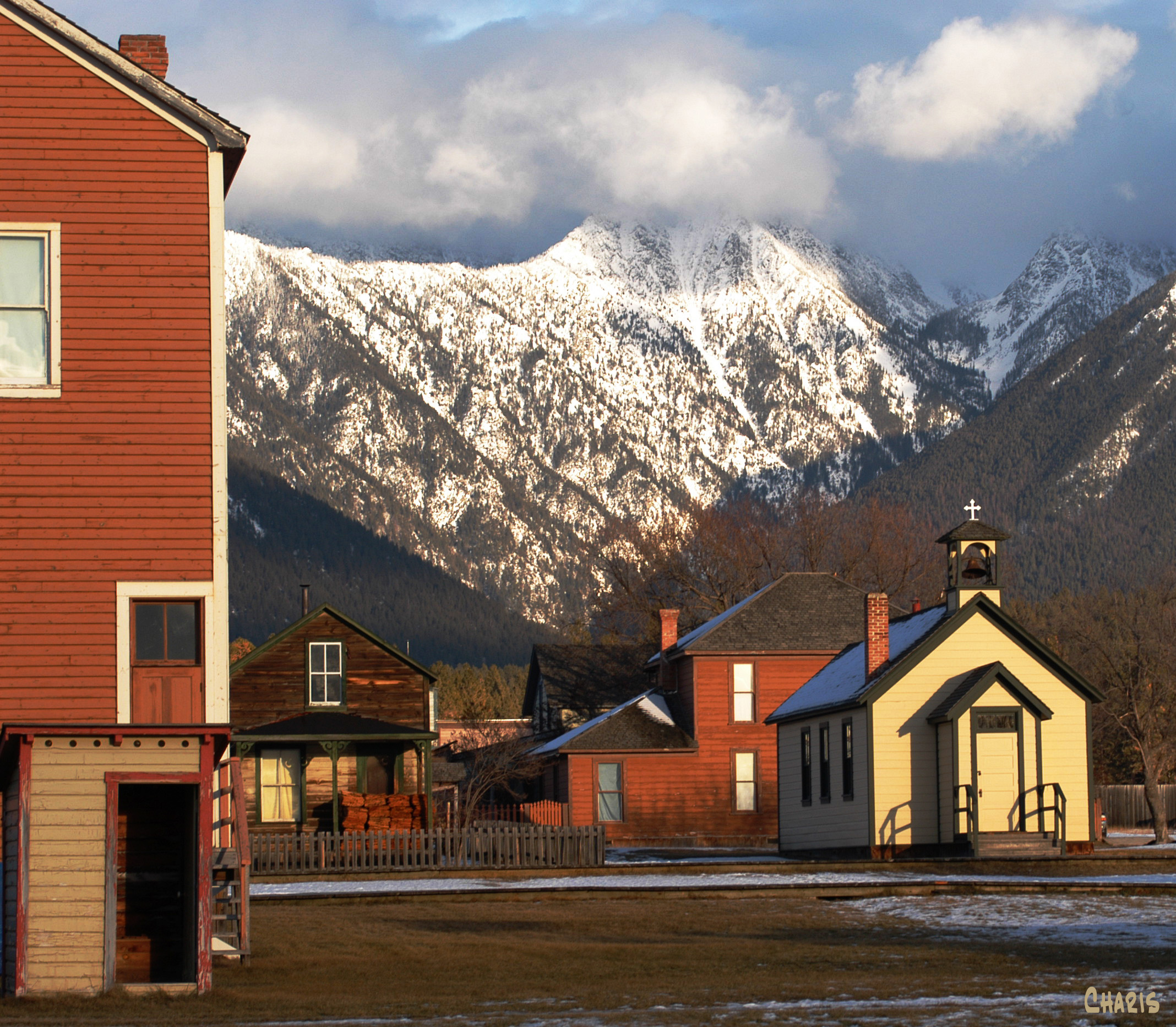
Fort Steele after the tourists go home
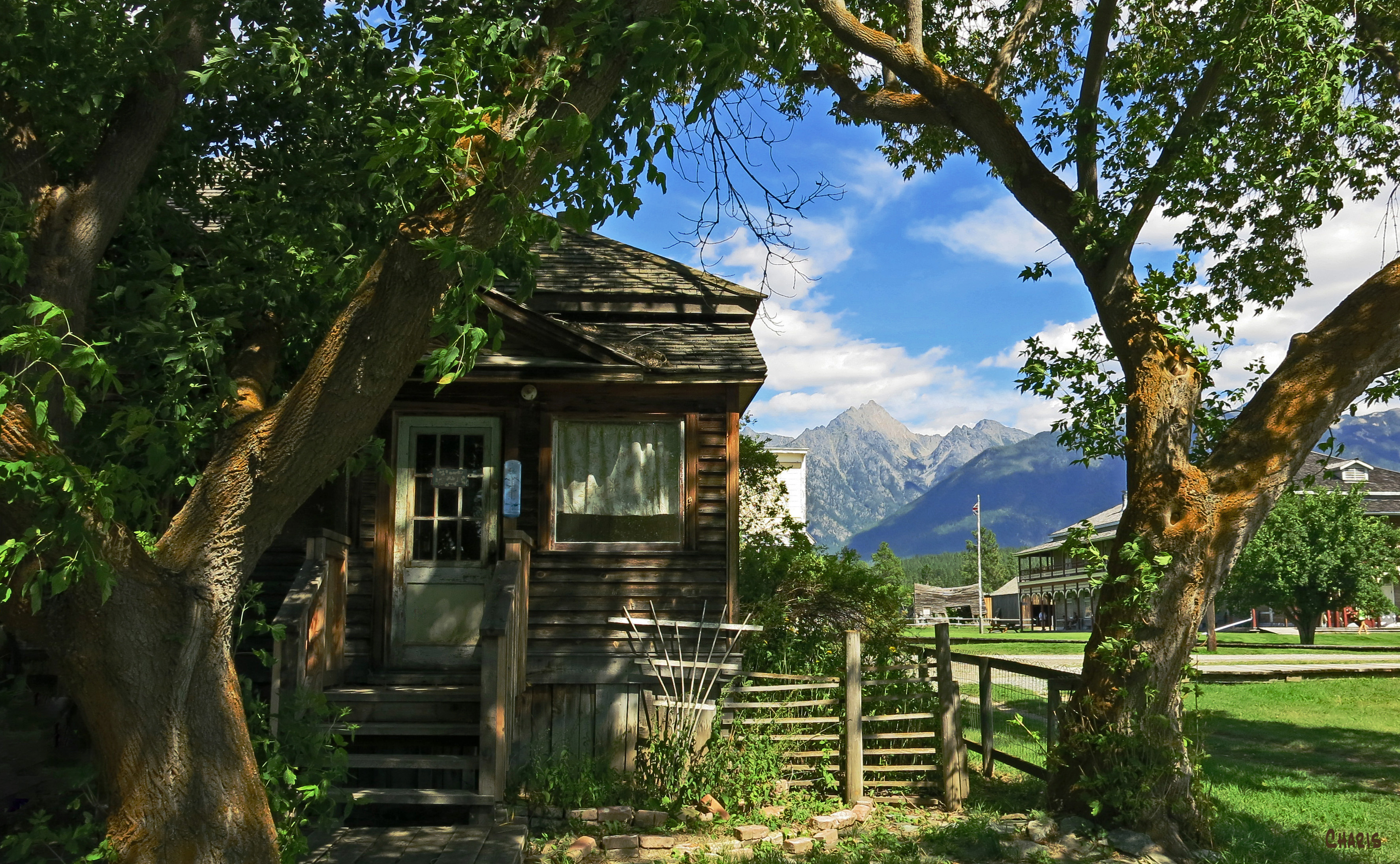
When we first moved to this area, when our children were young, we often visited the town. We warned the kids not to barge into the house in the photo at the top because someone still lived there. Now no one lives there.
This week I was reading in the book of Revelation about the church of Sardis.
“To the angel of the church in Sardis write: These are the words of him who holds the seven spirits of God and the seven stars. I know your deeds; you have a reputation of being alive, but you are dead. “
This reminded me of Fort Steele and the fun events we attend there, going to marvelous concerts in the old theatre, sharing potlucks around a pot-bellied stove in the NWMP barracks in the deep cold of winter, attending weddings seated around the huge gazebo in the hot summer sun, celebrating Thanksgiving in the garden produce-bedecked Presbyterian Church followed by a groaning table feast in the hotel. The place is full of activity –but no one lives there. It’s all an act.
No one is born there, or moves there, or grows up there, or grows old there.
This is the rest of the message to the church at Sardis: Wake up! Strengthen what remains and is about to die, for I have found your deeds unfinished in the sight of my God. Remember, therefore, what you have received and heard; hold it fast, and repent. But if you do not wake up, I will come like a thief, and you will not know at what time I will come to you.
Fort Steele Presbyterian Church
I wonder if it isn’t easier, when we are in churches that have become monuments to past moves of God, churches whose congregations are dwindling, to either practise willful blindness toward creeping death or abandon them to follow the newest thing. The church in Sardis was not given either option. They were not told to pick up and move to Philadelphia where the church was living love. They were told to wake up, strengthen what remained, hold fast, turn from deadly thinking and change. A remnant –an uncompromised scrap of the fabric that once made up this church remained to help them.
Yet you have a few people in Sardis who have not soiled their clothes. They will walk with me, dressed in white, for they are worthy. The one who is victorious will, like them, be dressed in white. I will never blot out the name of that person from the book of life, but will acknowledge that name before my Father and his angels.
When folks in the big C church at large choose to pronounce death before the Lord does (and He does do this when a group is so far gone it becomes toxic) they could be cutting off those few who still walk in victory, who faithfully live worthy of their callings right where they are, without denying the seriousness of conditions of those around them. They are beacons of hope, worthy of our prayers and support. Revival is about breathing life into that which once was thriving, but is now dying.
God is still able to revive and restore. Our part is to let go of our reputations and change our ways to match His. Jesus knows all about resurrection.
Whoever has ears, let them hear what the Spirit says to the churches. (Revelation 3:6)
(borrowed from Danny’s Song by Kenny Loggins and inspired by a friend’s dream)
Yesterday as I was outside working on my deck my neighbour came by with a bouquet of roses. She is such a giving person. She often drops by with gluten-free goodies and words of encouragement. I love this lady. She shows me everything is gonna be all right. This post is dedicated to you, Wendy.
The problem with people who want to “take God out of the box” is that they can seldom resist the temptation to stuff him in another one of their own making.
Jesus said the Holy Spirit is like a river that flows and a wind that blows. He is ever moving. To try to put constraints on him, by explaining him by how we have seen him move before is putting him in a box.
Jesus said:
Whoever believes in me, as the Scripture has said, ‘Out of his heart will flow rivers of living water.’ Now this he said about the Spirit, whom those who believed in him were to receive, for as yet the Spirit had not been given, because Jesus was not yet glorified. ( John 7:38,39)
The wind blows where it wishes, and you hear its sound, but you do not know where it comes from or where it goes. So it is with everyone who is born of the Spirit. (John 3:8)
Jesus did not heal everyone the same way each time. God did not respond to the cries of his people for deliverance the same way each time.
Recently I heard someone say that the rules and regulations surrounding practices in their denomination were put there for protection. The rules seemed to be quite reasonable when they were devised years ago. But as I was thinking about this, it struck me that the berms built around my son’s neighbourhood in High River, Alberta were also put there for the protection of the town. When the river temporarily changed course at the highest point of its rain-fed uncontrollable gush, the berms actually served as barriers that stopped the water from flowing back into the channel and turned whole neighbourhoods into a stagnant lake, a lukewarm mix of both fresh river water and disgusting sewage sitting in the summer heat. Stagnation created ideal growing conditions for mold and bacteria in the foundations of homes that were now trapped behind the man-made parameters that were “put there for protection.”
Sometimes denominations form around groups of people with similar experiences, similar understandings, similar revelations, similar aspirations, similar emphasis, or similar disgruntlements. The unity they experience can feel like a refuge and berms are built around it to protect this peaceful easy feeling. But after a few years those protective structures can serve more to keep some folks in and other folks out, and sometimes even try to confine Holy Spirit inside the berms of their definitions of themselves.
The result is stagnation.
Many of us sit in dangerous lukewarm water. We have become the comfortable church of Laodicea, thinking we are rich, when we are poor, not noticing how stinky it is getting and that all of our accomplishments are tainted by the backwash of our own waste.
Church-leavers who form tiny home groups and church-planters who organize stadium-filling mega-gatherings all face the same temptation to berm themselves in. It doesn’t work.
Why? Because God no longer lives in a box. No longer does he need to say, “Touch this box and die!” because we couldn’t approach his holiness in our sinful state. He lives in his people – living, moving, breathing people, reconciled to their Creator by the blood of Jesus Christ. We are his temple. Living stones.
Christ in us, the hope of glory.
This doesn’t mean we abandon discernment and wisdom and accept any old thing. In fact when the Holy Spirit is flowing there is greater discernment and falsehoods are swept away instead of being treasured in hidden places in our hearts’ basements.
He desires all who truly follow Jesus Christ to drop the barriers, and worship Him in Spirit and truth without anger or disputing.
We must now explain what the power of human reason is, in regard to the kingdom of God, and spiritual discernments which consists chiefly of three things – the knowledge of God, the knowledge of his paternal favour towards us, which constitutes our salvation, and the method of regulating of our conduct in accordance with the Divine Law. With regard to the former two, but more properly the second, men otherwise the most ingenious are blinder than moles. I deny not, indeed, that in the writings of philosophers we meet occasionally with shrewd and apposite remarks on the nature of God, though they invariably savour somewhat of giddy imagination. As observed above, the Lord has bestowed on them some slight perception of his Godhead that they might not plead ignorance as an excuse for their impiety, and has, at times, instigated them to deliver some truths, the confession of which should be their own condemnation. Still, though seeing, they saw not. Their discernment was not such as to direct them to the truth, far less to enable them to attain it, but resembled that of the bewildered traveller, who sees the flash of lightning glance far and wide for a moment, and then vanish into the darkness of the night, before he can advance a single step. So far is such assistance from enabling him to find the right path. Besides, how many monstrous falsehoods intermingle with those minute particles of truth scattered up and down in their writings as if by chance. In short, not one of them even made the least approach to that assurance of the divine favour, without which the mind of man must ever remain a mere chaos of confusion. To the great truths, What God is in himself, and what he is in relation to us, human reason makes not the least approach.
19. Man’s spiritual blindness shown from John 1:4-5
But since we are intoxicated with a false opinion of our own discernment, and can scarcely be persuaded that in divine things it is altogether stupid and blind, I believe the best course will be to establish the fact, not by argument, but by Scripture. Most admirable to this effect is the passage which I lately quoted from John, when he says, “In him was life; and the life was the light of men. And the light shineth in darkness; and the darkness comprehended it not,” (John 1: 4, 5.) He intimates that the human soul is indeed irradiated with a beam of divine light, so that it is never left utterly devoid of some small flame, or rather spark, though not such as to enable it to comprehend God. And why so? Because its acuteness is, in reference to the knowledge of God, mere blindness. When the Spirit describes men under the term “darkness” he declares them void of all power of spiritual intelligence. For this reason, it is said that believers, in embracing Christ, are “born, not of blood, nor of the will of the flesh, nor of the will of man, but of God,” (John 1: 13;) in other words, that the flesh has no capacity for such sublime wisdom as to apprehend God, and the things of God, unless illumined by His Spirit. In like manner our Saviour, when he was acknowledged by Peter, declared that it was by special revelation from the Father, (Matthew. 16: 17.)”
-John Calvin, Institutes, Book 2, Chapter 2, parts 18 & 19
My hope is built on nothing less than Jesus’ blood and righteousness…
Whelmed, But Not Overwhelmed
His Oath
His Covenant
His Blood
support me in the whelming flood.
(from Solid Rock by Edward Mote)
God is not a man—He doesn’t lie. God isn’t the son of a man to want to take back what He’s said, or say something and not follow through, or speak and not act on it. (Numbers 23:19)