Sing to Me


bride groom wedding ch rs

Sex stories in the Bible

God is not nearly as prudish as some of His followers are and He doesn’t avoid metaphors and imagery that make us uncomfortable. The Bible uses plenty of  stories, polite and impolite, to get a point across. English translators tidied up some of the scatological and sexual terms, but the situations are still there. (My Grandma once said if you read the whole Bible to a kid there wouldn’t be much left to tell them about sex, but a whole lot of ‘xplaining to do about why it’s not meant to be a manual.)

Some of the prophets were way out there when it came to being politically and socially correct. Jeremiah didn’t exactly hold back on his descriptions of Israel as a whore. God had his sold-out guys with eyes and ears use some pretty provocative performance art in their attempt to get His message across. Ezekiel’s mother must have rolled her eyes sometimes. I don’t imagine it was easy to parent Isaiah or John the Baptist either. (What do you do with a son who prefers grasshoppers to your brisket and wears that stinky camel skin when your friends drop by for tea?)

Sometimes a prophet’s whole life became the metaphor. I feel sorry for Hosea who was told to love a hooker who didn’t love him back. And I do believe he had a true love for her, sent from the Father and placed in his heart, that drove his life-as-metaphor.

Allured

One day, while waiting for my kids, I picked up a Bible someone left lying on the car seat. For years I found the Bible had been about as exciting as a phone book to read, but this time the words I saw on the random page stood out as if they were in neon lights. That  hadn’t happened much before that day, but that time there was no doubt in my mind Himself was talking. I read:

“Therefore, behold, I will allure her,
Bring her into the wilderness
And speak kindly to her.
“Then I will give her her vineyards from there,
And the valley of Achor as a door of hope.”

It made such an impression that later I looked up ‘Achor’. It meant ‘trouble’. Great.

I read more of that second chapter in Hosea:

“And she will sing there as in the days of her youth,
As in the day when she came up from the land of Egypt.
‘It will come about in that day,’ declares the Lord,
‘That you will call Me Ishi  [husband]
And will no longer call Me Baali [master].”

I’ve written before about my years in that valley of trouble. They were long dark years of depression and anger at a God I grudgingly acknowledged as a master –a cruel master. I missed the ‘allure’ part when I read those verses. I didn’t know he was taking me to a desolate place to remove distractions so I could hear his love song. I didn’t know he wanted to be like a lover. I never really understood the verse about singing to him other than as a job description.

The phrase translated as “she will sing there” in the version I first read is from the Hebrew word “anah”. It’s  translated differently in other versions. Some use the word answer, or respond –as to a lover and not a master/owner. Elsewhere it is frequently used in the context of ,”Oh God, hear our cries! Please answer us!  Take us seriously and come to us!”

I don’t know how to love him.

I used to teach this song from Jesus Christ Superstar to musical theater students because of the challenges of interpreting its emotional complexity.

In Lloyd-Webber and Andrew Rice’s own  fictional version of the story of the life of Jesus, Mary Magdalene is another prostitute who is used to having a power over the men she has both needed and held in contempt. She has used and been used. She has been the object of desire and the object of loathing. She, like Hosea’s wife, can go through the motions without giving her heart.  Jesus is someone who is wholly different to all her previous experience. He is “Holy Other.”

She sings, “I don’t know how to love him” because she has no idea what love is. She can’t tell love from manipulation, or fantasy, or the need to scratch an ego itch -or a physical itch, or from something to trade for a bauble that might distract from the pain for a while. Her “lovers” have always let her down. Now she faces the frightening prospect that if this man, who is more than a man, offers her his kind of pure, unselfish, un-needy love that cannot be manipulated or exploited, it would demand an authentic  response –an “anah.”

This kind of love is terrifying.

But if he said he loved me, I’d be lost, I’d be frightened. I couldn’t cope. Just couldn’t cope. I’d turn my head. I’d back away. I wouldn’t want to know.

That’s the response of most people to the pure love and goodness of Jesus. Love like that requires a response –and we know we can’t love back like that. We are entirely inadequate. We feel like we have to clean ourselves up, to earn his attention somehow. We don’t know how to love him. Yet we know deep inside we cry out for union with perfect love.

“He scares me so. I want him so. I love him so.”

When is sex not about sex?

In Christian dream interpretation people are embarrassed and often reluctant to talk about dreams with sexual content, not realizing that intercourse in a dream is usually symbolic of union or being in a covenant with whatever the other participant represents. God will use powerful, evocative imagery that we understand on a personal level to speak deeper truths. He will give us upsetting or embarrassing dreams to make a point. This symbolic response, this “anah” to God is no mere one-way intellectual nod to his sovereignty. This is a total giving of oneself. This is a promise to remain in permanent union. This is a marriage. This is an unbreakable covenant we are making when we sing to him. It’s our “anah” moment.

But look what He says further down in that passage in Hosea.

“It will come about in that day that I will respond,” declares the Lord.

I will respond to the heavens, and they will respond to the earth,
And the earth will respond to the grain, to the new wine and to the oil,
And they will respond to Jezreel.
“I will sow her for Myself in the land.
I will also have compassion on her who had not obtained compassion,
And I will say to those who were not My people,
‘You are My people!’
And they will say, ‘You are my God!’” (Hosea 2:21-23) NASB

Again he uses the sexual imagery of a husband who makes his wife a part of his people, who sees her as a rich fertile land full of possibilities, as someone who will partner with him in creation. He uses the same word “anah” when he says, “I will respond.” I will hear! I will answer! I will sing to her! I will be moved in my whole being by her response to me! I will purify her and make her the perfect bride.

It was easier for me to spend hours in intellectual debate about the attributes of God and His legal requirements than it was to hear his voice as he knocked at the door. When I began to wake to his relentless love I was terrified. A theoretical God, a master, did not require my entire self –my body, my mind, my emotion, my will, my heart; that god required only that I obey his instructions. This God, revealed in a man who has experienced everything I have, and still loves purely, is not satisfied with that. He is not be satisfied until I know the laser heat of his pure love that penetrates right to the center of my being.

Jesus has a beautiful voice

I hear Him sing to me sometimes. In the night -and in the day- I have heard him sing love songs. Don’t get me wrong; Jesus is not my boyfriend. I married mine. Jesus is not my sex partner; I have one of those – the same one I’ve been married to for over forty years, bless his beautiful heart. Jesus is the Lover of my soul. His love is far, far greater than any human can imagine and the longer I know him, the more he loves to demonstrate that no matter how wide, how high, and how deep I understand  his love to be, it is much greater still.

God is good.

Unseasonable Joy

Thaw
Chinook

The prairies that sidle up to the Canadian Rockies feel the brunt of truck-tipping winds, forehead-slapping cold and frequent horizontal snowstorms, but they also bask in sudden rises in temperature when warm winds, called Chinooks, come shooting down the leeward slopes. While folks in other parts of the country are still pulling  their heads into their down jackets like sullen turtles, kids in western Alberta ignore their cautious mothers and fling hats and mitts onto soggy piles of snow to dance and play in the sun.

For me, it’s been a long dark winter, with sudden breaks of unseasonable joy. I know God is teaching me to rest in his finished work and to trust that He is the one who wins the victory, but sometimes, when it hurt and when  negative words swirled around me like a prairie blizzard obscuring my view, all I wanted to do was retreat my head into my poofy parka and stop feeling for a while.

The problem with blocking out pain is that we also block out joy. James wrote, “Consider it all joy, when you encounter various trials, knowing that the testing of your faith produces endurance, and let endurance have its perfect result, that you may be perfect and complete, lacking nothing.”

There are times when all I have the strength to do is turtle, to work on endurance. And then there are times when I am surprised by unseasonable joy right in the middle of my winter, when it’s okay to pop my head out again and throw my parka aside.

It’s a wild road, this life with Jesus thing, with ups and downs and sudden turns, but every step is one where He is behind me and before me, above me and below me, and best of all –within me.

God is good father. It’s not all about discipline and learning new lessons. He also likes to play, because what He has done for us is already a done deal.

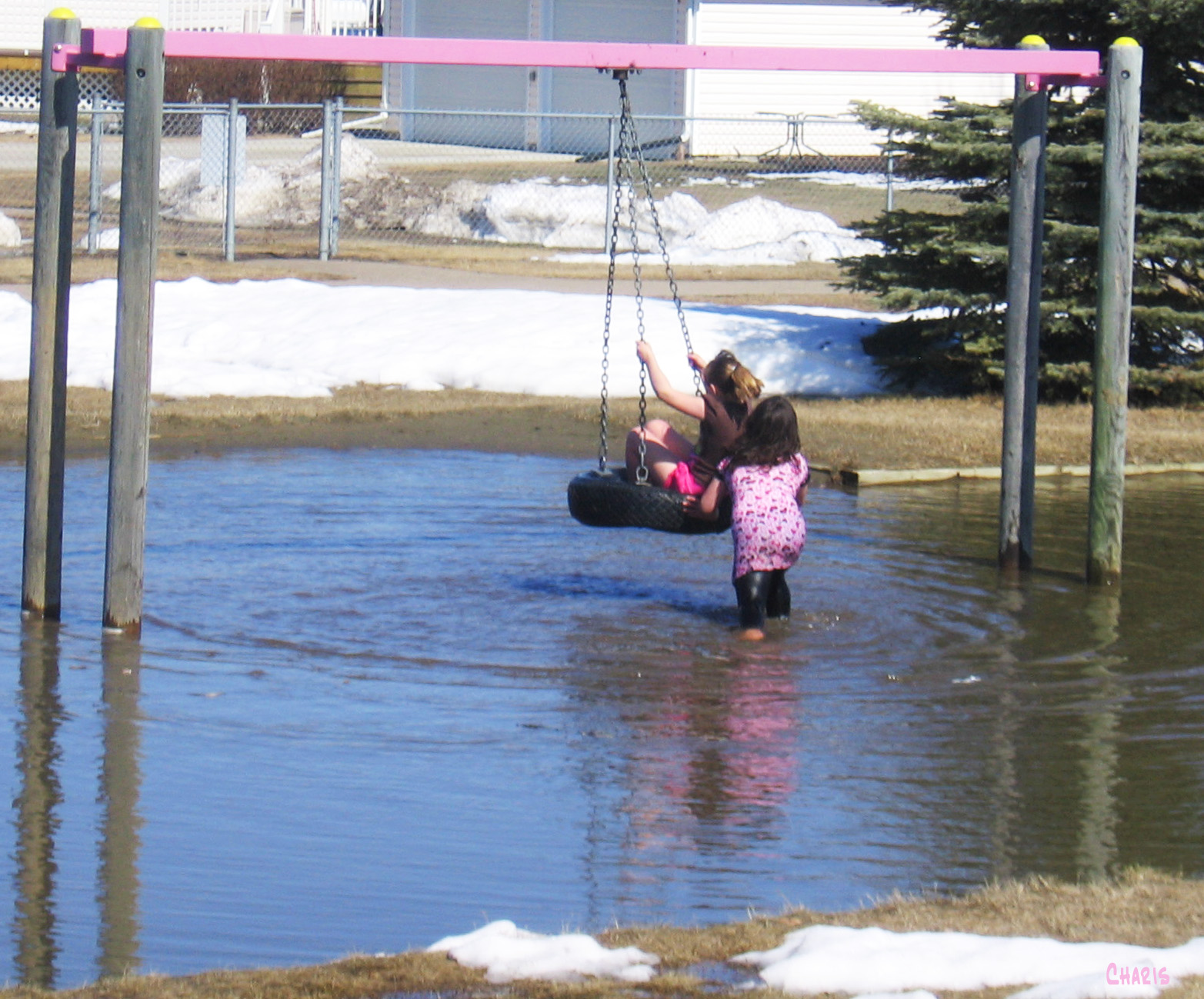
Puddle-wonderful
Puddle-wonderful

More than Words II

hospital

Owies hurt. They really do.

I promised myself, when I was I wee girl, I would remember that fact when I grew up. I would remember that when you are three years old and get a really good cry going over a sore finger pinched in an unforgiving door, it’s hard to suddenly stop, even when the finger isn’t as red as it was a few minutes ago. It doesn’t help when unsympathetic daddies offer amputation as a cure –even if you don’t know what amputation means. It’s even worse when somebody does tell you what it means.

It’s also hard to understand why some words can get you in trouble when you say them but don’t get grown-ups in trouble when they say them. And then there are the words you stumble upon that get you in trouble. I remember when my little brother was bugging me and I said, “Stop it, you person-who-bugs-people!” (well, not in those words) and got my mouth washed out with soap. It seemed perfectly grammatically consistent to me.

I was looking after my little granddaughter when such a situation repeated itself.  (What is it with daddies and the amputation cure?) That was also the week her brother was having his adenoids taken out.

“Are they going to amputate?” she asked in shock.

She was very worried about him, and cried on several occasions that she didn’t want him to get hurt. Little brother was born with exceptionally large adenoids that doctors overlooked because other illnesses usually cause the type of breathing problems he had, and they needed to be eliminated first. Finally someone clued into the adenoids problem and he was scheduled for surgery.

“What are adenoids, Mommy?” Daisy asked with deep concern.

“They are just little balls of tissue growing behind his nose that make it hard for him to breathe,” Mommy explained. “The doctor is going to put him to sleep and take them out. He will have a sore throat, but he will be okay in a day or two.”

At church the next week people prayed for Little Mighty Man’s up-coming surgery. Someone asked Daisy why her little brother was going into the hospital and she answered in her best speak-up voice, “He’s having his little balls amputated.”

The reaction to her simple statement of fact is one I have often encountered when speaking about God and my relationship to him. My words trigger a reaction I do not expect. I seem to have said something which carried a different meaning than I intended. Recently I quoted a verse for someone from 3 John 1:2, “I pray that you may prosper in all things and be in health, just as your soul prospers.” I thought it was a blessing.

“Prosper? Prosperity?” he said, face red and eyes a-popping, looking as if I just suggested he have his little balls amputated. “I hate the prosperity gospel! Do you realize the damage that kind of thinking causes?”

Huh? What it something I said?

I’ve written before about feeling like I am often caught in the cross-fire between different streams of Christianity. I love to feast at many tables and have learned, for the most part, that bone-spitting will be involved. Alas, in the midst of what I hope will be a demonstration of brotherly love, I keep running into the problem of communication and a tendency for partakers to take –or give– offense.

Long ago, as a singing student, I learned that each school of voice culture, and perhaps even every individual voice teacher, had their own vocabulary. One teacher kept talking about the bell in my mouth, another about full-throated ease. Until they gave a demonstration I had no idea what they meant. Since a singer can’t easily see the muscles and tissues and cartilage involved in making a good sound, the appeal to imagery often helps make the link to sensation. Teaching singing is a more physical activity than discussing spiritual things, but it still uses a lot of subjective language.  I believe many fields of interest are like this, especially social sciences and the arts, but the attempt to describe God and faith uses even more abstract terms than the arts. Every spiritually-oriented group seems to develop it’s own vocabulary and assigns different shades of meaning to the same words.

I’m finally figuring out that to the guy I upset, “prosperity gospel” means “bribery by means of false promises appealing to selfish greed.” Well, alrighty then, if that’s what he thinks it means I’m agin it too. To some the term thrown back in argument, “poverty spirit”, means “the inability to trust God to supply resources necessary for the task he assigns you.” Okay, I’m good with that. The church has a long history of watching endeavours based on faith eventually turn into endeavours based on more creative fund-raising techniques. (Personally I tend to pay attention to the experience of Paul who said he had learned the secret of being content in whatever condition he was in.) But unfortunately I don’t hear people carefully  listening to each other very often.

There are so many terms over which people engage in arguments. They frequently take a stand for or against their opponent’s viewpoint without ever clarifying what the other means. Often the arguments are on two separate tracks that will never make contact with each other because they assign straw definitions to each other’s words (a verbal asymptote for you math types). What is actually meant by terms like religion, doctrine, spirituality, judgment, grace, healing, abuse, love, the goodness of God, the filling of the Holy Spirit, worldly, heaven, hell, forgive?  I have no idea what “hate the sin and love the sinner” actually means to the people tossing it about like a volleyball amid signs that seem to focus more on the hate part. Add the problem of multiple languages and translations and words become a tangled mass of ropes ready to trip up even the brightest scholar.

My point, and I do have one, is that the language of God seems not to be primarily verbal –and is certainly not English, authorized or otherwise. John 1 says “the Word was God.” Noting our propensity for misinterpretation, God sent his son as a living being who encompassed love to show us what he was truly like.

Have you ever noticed how often in the gospels Jesus did not answer questions with the expected point/counterpoint response? When asked why, he said, “Me.” When asked what, he said, “Me.” When asked how he said, “Me.”

God’s poetry, his creativity, is more than words. It is summed up in Jesus Christ who went wordlessly to the cross, and stretched out his arms in love that we might know his Father really is.

The Botanist

The Botanist
The Botanist

If a child is to keep alive his inborn sense of wonder, he needs the companionship of at least one adult who can share it, rediscovering with him the joy, excitement and mystery of the world we live in.

Rachel Carson

The joy of discovery is not just for kids. When “You know what I mean?” brings a nod, another bridge connects to wider plains of wonder.

Speaking the Truth

Influencing the Cat
Influencing the Cat

There is a difference between speaking the truth in love and loving to speak the truth.

You only have as much influence in people’s lives as they have value for you. Anytime you try to have more influence than someone has value for you, you will manipulate them. -Kris Vallotton.

Mere Mortals

Cougar Creek Thinker

When I … see the work of your fingers…
     what are mere mortals that you should think about them,
    human beings that you should care for them?

(Psalm 8:3,4)

Because He Loved First

Because He First Loved Us

My Psalm

Like a child standing on tip-toe,

unable to reach the light switch,

like a girl groping cellar walls,

unable to find the stairs

I waited in the dark.

The drone of traffic in the streets

in rising and lowering songless pitch

neared my heart

then passed me by,

hope deferred yet once again.


I cried, “Oh God! Where are you?”

Pouring my effort into limp flowers

potted in desiccated soil

I watched as hope seeped through again and again

staining the white tablecloth beneath.


“I can never be good enough,” I whimpered.

But you,

Abba

Papa

Father

said, “Come.”

You placed your strong arms under mine

and lifted me up.

You tossed me high

into the sunlight

and caught me with your grace

stronger than any fear of failure.

You held me in your lap wide as a green orchard

and fed me words from your mouth.


Abba, you are my light in the hall.

Papa, you are hope like the door left ajar.

Father, I hear you in the kitchen preparing a feast for me.

You are my strength, my light, my hope, my joy.

I love you.

(re-blog from April 2, 2012)

Find Me!

Come and Find Me!
Come and Find Me!

My little grandson loves to play hide-and-seek, but he hasn’t quite got the hang of it yet. Little Mighty Man runs around my feet chanting, “Find me, Nana! Find me! I hide.”

He then makes as much noise as he can opening and closing the bedroom closet door, or shoving the potty across the floor so he can stand behind the door in the bathroom, or sneaks behind the curtains -in plain view. Sometimes I’ll call out “Little Mighty Man! Where are you? Oh, dear, I can find him!” and he will immediately drop a tiny little hint. “I’m in the closet!”

Nothing is worse than a game of hide-and-seek when the seeker is distracted by a phone call and isn’t actively looking. We want to be found.

Sometimes, when God has me in a dross-burning season in my life, I think it would be nice to just slip away for a while. “Flee as a bird,’ the psalmist said. I argue that the cost of removing contaminated, moldy ideas from my mind is too much. That which was supposed to be a simple renovation in my heart has resulted in tearing down walls and lifting flooring that has served me quite well thus far. (Well, good enough.) I just want to escape from the confusion and hide for a while.

But I’m hiding with my feet sticking out. Please look for me, Abba. Please laugh and pick me up and hug me when you lift the curtain.

You go before me and follow me.
    You place your hand of blessing on my head.
 Such knowledge is too wonderful for me,
    too great for me to understand!

 I can never escape from your Spirit!
    I can never get away from your presence!
 If I go up to heaven, you are there;
    if I go down to the grave, you are there.
 If I ride the wings of the morning,
    if I dwell by the farthest oceans,
 even there your hand will guide me,
    and your strength will support me.
 I could ask the darkness to hide me
    and the light around me to become night—
     but even in darkness I cannot hide from you.
To you the night shines as bright as day.
    Darkness and light are the same to you.

 How precious are your thoughts about me, O God.
    They cannot be numbered!
 I can’t even count them;
    they outnumber the grains of sand!
And when I wake up,
    you are still with me!

(Psalm 139:5-12, 12-18)

Love bears, believes, hopes, endures

Love suffers long and is kind; 

love does not envy; 

love does not parade itself, is not puffed up; 

does not behave rudely, 

does not seek its own, 

is not provoked, 

thinks no evil; 

does not rejoice in iniquity, but rejoices in the truth; 

bears all things, believes all things, hopes all things, endures all things.

 Love never fails.

1 Corinthians 13

sled

A prayer for my granddaughter on the day of her first breath

First Day
First Day

Oh sweet child, you have already given me such joy. There is nothing you need to do to earn my love. I have loved you since you were the hope in my own daughter’s heart, the hope that doctors told her was in vain. But God….

But God heard your Mommy’s and Daddy’s prayers, and ours, and now you, our miracle, snuggled in my arms this very day as my joy overflowed. You are the very fulfillment of the promise of the goodness of our heavenly Father and we all thank him so much for you.

There is a reason why your name means “Living Love Warrior.”

How do I pray for you, precious one? I can think of no greater prayer than this.

My response is to get down on my knees before the Father, this magnificent Father who parcels out all heaven and earth. I ask him to strengthen you by his Spirit—not a brute strength but a glorious inner strength—that Christ will live in you as you open the door and invite him in. And I ask him that with both feet planted firmly on love, you’ll be able to take in with all followers of Jesus the extravagant dimensions of Christ’s love. Reach out and experience the breadth! Test its length! Plumb the depths! Rise to the heights! Live full lives, full in the fullness of God.

 God can do anything, you know—far more than you could ever imagine or guess or request in your wildest dreams! He does it not by pushing us around but by working within us, his Spirit deeply and gently within us. (Ephesians 3:14-21 The Message)

May you know, that as much a you are loved by your Mommy and Daddy and grandparents and all your family, there is One who loves you more, loves you perfectly, has always loved you and always will love you. May you be filled to overflowing with His love from your first breath until your last.
Abba Father, I bow in grateful thanks for everything you have in store for this child of promise. You are so very, very good!