Tremble, and do not sin; Meditate in your heart upon your bed, and be still. Selah
Offer the sacrifices of righteousness, And trust in the Lord.
Many are saying, “Who will show us anything good?” Lift up the light of Your face upon us, Lord!
You have put joy in my heart, More than when their grain and new wine are abundant.
In peace I will both lie down and sleep, For You alone, Lord, have me dwell in safety.
Psalm 4: 4-8 NASB
Some things are too big for me to understand, not that I don’t try to anyway. I know what it is to tremble from fear. I also know the One who calms the storms and asks, with a gentle voice, “Why are you afraid when I am here? I’m not worried. Even the winds and waves obey Me. I’ve got this.”
I woke up this morning (a blessing right there!) with a song playing in my head. Sometimes my spirit sings while my soul is still moaning about the aches and pains of a body that is showing its wear. This is a song I have not sung since I was in a teen choir and waking to the reality that there was a God who saw me and loved me. The song is called The New Twenty-third by Ralph Carmichael.
It opens with, “Because the Lord is my shepherd, I have everything that I need.”
A line from the last stanza felt particularly sweet:
“With blessing overflowing His goodness and unfailing kindness Shall be with me all of my life.“
I took this photo yesterday evening from the condominium where we live. I saw the smoke all afternoon, but when my neighbour across the hall invited me to see the view from her balcony, I saw the flames.
A huge fire caused thousands to be evacuated from their homes across the lake from us here in Kelowna, British Columbia. I have friends and family on the west side and was very concerned for their safety. I assured concerned friends from elsewhere that the fire was over there and we were alright on this side of the lake.
Last night, the fire jumped the lake. Embers flew across the water and landed on the other side in dry vegetation ready to burst into flame. I’m hearing about people we know not far from here evacuating in the middle of the night. It’s more than an opportunity for dramatic photos now.
A couple of days ago, someone asked if you cold sing theology. I think they meant the dry theories about the study of God that people argue over, the kind of hot air balloon detached from any real experience that causes “experts” with large vocabularies to drone on endlessly. I agree that theory devoid of experiential knowledge of the Holy can just be another source of contention. I also believe that theology that is what we think about God, and doctrine that is what we believe about God enough to act on in a crisis is one of he most important considerations we will ever make.
Can I sing theology? Yes I can. I used one of my favourite hymns, How Firm a Foundation, as an example. Today, with flames consuming a nearby hillside as I watch the winds pick up and the flag over the supermarket shift directions, a verse from that song is more relevant than ever.
When through fiery trials thy pathway shall lie, My grace, all-sufficient, shall be thy supply; The flame shall not harm thee; I only design Thy dross to consume and thy gold to refine.
There is so much in those four short lines. Fiery trials happen. Our cries of “Why God?” are less likely to be answered than “What do you want me to see about you that I couldn’t see any other way?”
I’ll let you know.
In the meantime, prayers for our city and its citizens to be come through this time safely are welcome. For that matter, we need prayer for this entire country, especially the west and the northern territories were fires have raged for weeks. Prayers that we would come out as refined gold, freed from the kind of entanglements that hold us back spiritually are even more welcome.
Sometimes I hear God’s voice in unexpected places. Popular music is one of them. I wrote about it here. (Hearing God’s Voice Through Music). This morning I woke with a song in my head. It’s not one that’s on any of my play lists, but it was insistent, so I paid attention.
Recently I’ve been asking myself why it is sometimes so easy to set a God-given dream aside to collect dust for years. I could say that I’ve been distracted by the cares of life or that I chose to support another person’s dream because I believed it was a worthy and lofty dream. But I think, to be honest, after listening to the song, the Lord is telling me something. I have set the dream aside because taking steps to walk with God toward the dream he put in my heart takes courage. And I have been afraid –afraid of success, afraid of failure, afraid of what critics will think, afraid of letting friends down, afraid of letting God down, afraid of standing alone in the no man’s land in the middle of the social and political and factioned church battles we find ourselves in.
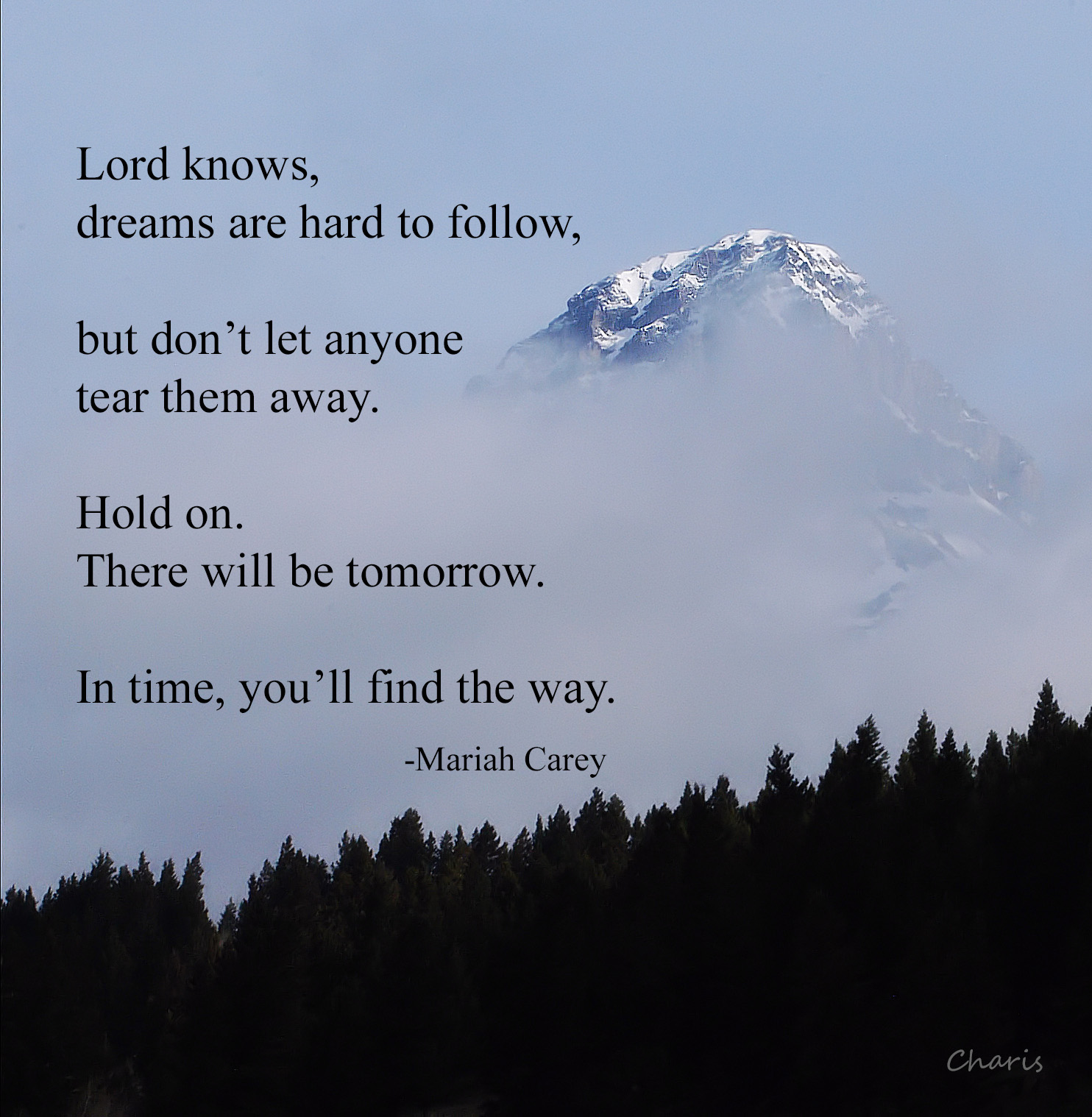
Mariah Carey’s song is called “Hero.” One of the most profound questions we can ask God is “Who do you see when you look at me?” For many years, I assumed the answer to that question was “a sinner saved by grace.” I was wrong.
It can be rather shocking when we hear his answer. It’s easy to dismiss it as a figment of an over-zealous ego. When he approached the cowardly Gideon hiding down in a winepress to thresh grain, the angel of the Lord called the guy who thought he held the lowest status in the country, “Mighty Warrior.” Gideon’s response was the equivalent of looking around and saying, “You talkin’ to me?” The way God sees us is much better than the way we see ourselves. Frankly, I discovered, the hard way, that talking about it to friends who don’t understand how God sees them can bring about a jealous response the way Joseph discovered what jealous people can do when he told his brothers about his dream of sheaves of wheat bowing to him. Candour is risky business. Very risky. But maybe it’s step one in trusting God.
As we grow in grace, God reveals more of how he sees us. I’ve been praying about an updated version of what I call an identity statement (similar to an artist’s statement). When I heard “hero” I felt like Gideon must have felt. I feel like the last person on earth that term could apply to. Then I remember that years ago the Lord spoke to me through the book of Hosea: “‘It will come about in that day,’ declares the Lord, ‘That you will call Me Ishi and will no longer call Me Baali.'” (Hosea 2:16) Ishi means hero/savior/husband. Baali means master.
It’s about relationship. Through his kindness, his gentle alluring, he has replaced the harsh image of himself as an impossible taskmaster with the image of my hero, my saviour, and the lover of my soul.
We become what we focus on. If my focus is on other humans who have merely a piece of the picture, I can, at best, become a faint copy of their traits, both good and bad. If I focus on the one who is my hero, getting to know him in a deeper sense, I will eventually become more heroic like him.
Jesus’ road to hero status involved laying down his right to respect in the ultimate demonstration of humility, but he never let go of the dream to save us and re-connect us with the Father who created us. For the joy set before him, he endured the cross.
I am very well aware of my tendency to back away when intimidated, to withdraw when stressed, and to try to change who the Lord created me to be to fit in with other people in a desire to belong (what Brené Brown calls the opposite of belonging). On my own, I can’t pursue this dream, but Jesus stood up to injustice. He’s the shepherd who goes after the lost lamb. He pulled me from a pit of guilt and shame and sang a song of grace over me. He invited me –fearful, shame-ridden, voiceless me– to partner with him to set the prisoners of spiritual abuse free. He lives in me. In a world of disappointing would-be heroes, he is my only hope.
This whole thought is too much for me, but I choose to trust him.
And then a hero comes along with the strength to carry on and you cast your fears aside…
Be still, my soul: the Lord is on thy side. Bear patiently the cross of grief or pain. Leave to thy God to order and provide; In every change, He faithful will remain. Be still, my soul: thy best, thy heav’nly Friend Through thorny ways leads to a joyful end.
Be still, my soul: thy God doth undertake To guide the future, as He has the past. Thy hope, thy confidence let nothing shake; All now mysterious shall be bright at last. Be still, my soul: the waves and winds still know His voice Who ruled them while He dwelt below.*
It’s hard to have hope and confidence when things seem dark and deep. It’s hard to leave the what-ifs behind and not allow your confidence to be shaken.
It’s hard, but grace empowers you to be who God sees when he looks at you. It is God’s abundant grace that activates hope so can say with confidence, “All now mysterious shall be bright at last.”
In every change, He faithful will remain.
*(From Be Still My Soul, music from Finlandia by Jean Sibelius, Lyrics by Catharina von Schlegel, translation to English by Jane Laurie Borthwick)
In 1975, a month after we moved across the country to Vancouver, British Columbia, I had a miscarriage.
Between October and January that year, there was only one day I remember that wasn’t made even darker by oppressively low clouds. We lived in a dark closet-less basement suite with the circulated scent of our upstairs neighbours’ love of curried cauliflower wafting through the heat vents accompanied by the sound of their favourite ethnic music crackling through an intercom that didn’t shut off.
My husband worked long hours teaching and doing post-doctoral research amid the publish-or-perish culture of the university. The new church we went to had a nursery room without a speaker connected to the sanctuary. I sat alone with a hyperactive toddler in that room week after week just for the chance to connect with someone in the foyer after the service.
I was exhausted. I was depressed. I was profoundly lonely. I was in mourning for a child no one but my husband and I knew had existed. Not one to hide my feelings easily, I’m sure I probably gave obvious nonverbal clues that I was not exactly a ball of fun then.
One person reached out to me. On impulse, Sandy, the only other young mom in the congregation, bought a record album for us. Back in the basement suite, I put on earphones and played it over and over. Her kindness made a huge difference in my life. Love Song was the name of the band made up of hippies on the fringe of society in California. A pastor opened the door that allowed these diamonds in the rough play their new music in his church.
The story of that pastor and the people affected by his choice to open the doors is featured in the movie, “Jesus Revolution” which opens next week. The message that healed my aching heart is still real. Feel the love.
Then those who sing as well as those who play the flutes will say, “All my springs of joy are in you.”
(Psalm 87:7)
There is something special about the city that King David loved. I didn’t expect my emotional reaction as we travelled up the hills to Jerusalem from Emmaus, but I found myself crying tears of joy that at last I would see this wonderful city for myself. I didn’t get to see the magnificent temple made of polished gold-toned stone that David planned and Solomon built and where the Sons of Korah sang and played instruments. I didn’t get to see Jesus’ triumphant entry into the city many years later. I do hope to see him return through those gates though.
The story of the Sons of Korah’s journey from the pit of shame to the heights of worship in the temple takes place over generations. It is a story of restoration and of grace. I hope to join them in singing my own song of restoration and grace one day too.
In the meantime, I include a link to a song of praise from my culture that I’ve often sung this time of year.
Rejoice greatly, O daughter of Zion. Behold Thy King cometh unto Thee!
For thousands of years, people who have had the most possessions have been in positions to buy power. That fact is obvious. We’ve seen evidence that “Money talks,” and, “He who pays the piper calls the tune.” We are all aware of evil around us that is financed by those who trust in themselves more than anyone else.
Before the Messiah showed up, not many people were in on the secret that God’s plan of salvation involved the poor and lowly people in this world. Young pregnant Mary was. One of my favourite pieces of music is her prophetic poem recorded in Luke 1, “The Magnificat,” which J.S. Bach set to music. It includes an aria for contralto with these lyrics: Esurientes implevit bonis et divites dimisit inanes. (The hungry he has filled with good things, and the rich he has sent away empty.)
The Sons of Korah understood before Mary did. After returning to the role intended for them, they spent their days worshipping in God’s presence in the temple. They were in a position to hear God’s voice. The introduction to Psalm 49 includes these lyrics:
My mouth will speak words of wisdom; the meditation of my heart will give you understanding. I will turn my ear to a proverb; with the harp I will expound my riddle:
The words of wisdom were these:
Why should I fear when evil days come, when wicked deceivers surround me— those who trust in their wealth and boast of their great riches? No one can redeem the life of another or give to God a ransom for them— the ransom for a life is costly, no payment is ever enough— so that they should live on forever and not see decay.
(Psalm 49: 4-9 NIV)
No one, even Solomon in all his glory, was rich enough to ransom a soul from Sheol. We all die, and our wealth is useless at the most important moment of all eternity. “This is the fate of those who trust in themselves, and of their followers, who approve their sayings.” (verse 13)
And yet the psalmists knew God had plans to pay the price and that someday they would see the manifestation of this promise: “But God will redeem me from the realm of the dead; he will surely take me to himself.” (verse 15)
I don’t know about you, but I get a bit scared when I see evidence of the days growing darker. Sometimes I feel helpless under the influence of evil people who do what they like and cover it over by buying good P.R.. But this is nothing new. I’m reassured by the Sons of Korah, who invite us to step back and see a bigger picture. In the end, material wealth and self-reliance fails spectacularly. Only God could pay the price for a soul. Only Jesus, who is both the baby crying in a manger, and the King of Kings who conquered death, could afford to give us eternal life.
“Esurientes” has a playful flute duet weaving around the sound of the voice. It feels like a dance of joy popping out in hopeful measures with the humour of an inside joke., “The hungry he has filled with good things and the rich he has sent away empty!”
As we have heard stories of Your greatness, now we have also seen it with our own eyes right here, in the city of the Eternal, the Commander of heavenly armies. Right here, in our God’s city, the True God will preserve her forever.
We have meditated upon Your loyal love, O God, within Your holy temple. Just as Your name reaches to the ends of the earth, O God, so Your praise flows there too; Your right hand holds justice.
(Psalm 48:8-10 The Voice)
When I was a young child, I thought World War II happened in a place where everything was black and white. All the stories about the war were in black and white, well grey actually, because the films were shot in black and white and shown on black and white television. Then one day I saw a colour film of the people in the Netherlands coming out of their shelters to greet the Canadian soldiers who had fought for their freedom. It seemed more real. Then my uncle, who had been there, told us what it was like then and what it was like when he returned decades later to the same demonstrations of honour. That was even more real because someone I knew had been there. I watched his face. He had seen it with his own eyes.
It’s one thing to hear stories, or read stories, or study stories. It’s another to see it with your own eyes. Generations of the Sons of Korah had heard stories about God’s greatness, but in Psalm 48 the generation of a new era sings about what they have seen and experienced in the reality of life in Jerusalem. This is the account of what happened on the first day in the temple David’s son, Solomon, built:
When the Levitical priests returned to the crowd from the most holy place (for all the priests who were present had sanctified themselves for this special occasion, regardless of their duties), all the Levitical singers (Asaph, Heman, Jeduthun, and their sons and their relatives) were wearing fine linen, standing east of the altar, playing cymbals, harps, and lyres, along with priests blowing 120 trumpets. In unison, the musicians and singers with trumpets and cymbals and instruments praised and glorified the Eternal.
Levitical Choir: He is good! His loyal love will continue forever!
At the sound of the music, the Eternal’s temple was filled with a cloud, the glory of God, which prevented the priests from continuing to minister to the Eternal. The descent of the glory of God filled the house of the God of Israel.(2 Chronicles 5:11-14)
It was a sight their ancestors never imagined when they decided to rebel in the desert. The sons of Korah knew what it was to be bereft of hope (see Psalm 43). Now the restored generation of worshipping Sons of Korah wanted not only to celebrate what they had experienced, but to tell the next generation.
So because of Your judgments, may Mount Zion be delighted! May the villages of Judah celebrate!
Explore Zion; make an accounting, note all her towers; Reflect upon her defenses; stroll through her palaces So that you can tell the coming generation all about her. For so is God, our True God, forever and ever; He will be our guide till the end. (Psalm 48:11-14)
When people ask me why I talk about God so much, I say I can’t help it. In the temple made of living stone, in the place where the Holy Spirit dwells and where I meditate on his love, I have seen the greatness of God. I have experienced his love and sensed his glory.
I want to tell what I have seen. Like the restored Sons of Korah in the temple and like the disciple Philip in Galilee who went to look for his friend, Nathaniel I want to urge, “Come and see! We have found the One. Moses wrote about Him in the Law, all the prophets spoke of the day when He would come, and now He is here—His name is Jesus!” (John 1:4)












 Charis: Subject to Change