Without Distortion

boy in window IMG_4646

This shocked me. I read a story about young women in Mauritania who were force fed to make them fat and thus more attractive to potential husbands. Apparently in that culture silvery stretch marks are particularly appealing.

None of the comments posted below the article were from people who were a part of nomadic Mauritanian culture. Outrage flowed from the keyboards of those who saw the situation from behind their own particular cultural lens. They did not have a grid that allowed for another perspective.

“How could that possibly be attractive?”
“It’s unhealthy!”

As a person who has striven to fit my body into my culture’s definition of beauty – to the point of damaging my health in a desperate effort to appear healthy, and now being cognizant of the irony of that effort – I see it differently. I’ve seen how my own culture’s lens distorts the way we treat others when they don’t fit arbitrary standards. Maintaining one’s own perspective (“our way of life”) can seem so important to us that anyone who even questions its validity can trigger angst and anger.

Another article I read provoked the same angry reaction in readers. Published medical studies seem to show that thin people do not live longer than mild to moderately plump people (based on BMI.) In fact chubbies might have the edge in the mortality game. The shared post brought out the same angry reactions in readers. One said fatness demonstrated lack of self-control and others added the “just” clause. The just clause starts with the word just and finishes with whatever eating/exercise discipline the writers assume will correct other people’s weight problems, regardless of differences in physiology and metabolism. Several commenters (ignoring the work of qualified medical researchers) concluded that the study must be wrong because, “It’s unhealthy!”

Some said, in their own words, “If you don’t heap shame on folks for not living up to standards you will be giving them permission to sin!”

Where have we heard that before? The acceptable body shape that constitutes attractiveness is merely one example of our inability to see beyond the boundaries of our own paradigm without distortion.

I’m using the weight topic as an example because many of us in North American society have an emotional investment in it. Our obsession with food, whether joyfully eating it or pointedly not eating it, takes up a great deal of our time and attention and even our money. Whatever we choose to invest heavily in can reveal where our treasure is.

But.

I don’t actually want to talk about weight so please don’t 1) advise which diet/exercise method worked for you and should work for me if I just try harder or 2) feel you need to tell me how long and hard you have struggled without resolution because 1) I’m not listening anymore or 2) I believe you.

The issue I actually want to talk about is seeing past our familiar cultural borders and instead learning to see through Jesus’ lens.

The little fellow in the photo looking at me through a bevelled and rippled glass door is actually an exceptionally good-looking cheerful kid (by my culture’s standards.) It’s the glass grid that makes him look like a morose oddity. His view of me was also warped. We have enough trouble seeing our close neighbour without adding our own judgments of normal/abnormal, let alone seeing people in other countries or times clearly. We also forget that when we read the Bible we are viewing words spoken and actions taken in another culture through our own beveled, rippled grid.

When we neglect to consider cultural context we can misread the message. Can we who live in a culture that has officially banned slavery and regards its re-appearance in the world as an evil practice understand what it was like to live in a place where people knew no other way? When Paul was inspired to write Ephesians 6 was he telling us that we ought to maintain the economy with slave labour or was he giving an insight into how relationships work when mutual respect is present? Which culture needs to be maintained, the culture of ancient Ephesus or the culture of honour?

We can also experience different cultures in different denominations. Each one says this is how to worship together, this is how to pray together, this is how to teach, this is how to serve, this is how to build an edifice, or this is how to vote. (Sometimes I think we need to be more concerned about keeping the state out of the church than keeping the church out of the state.) When we are entrenched in one way of doing church (instead of being the church) other expressions can look, well, weird.

John, one of the zealous brothers Jesus nicknamed “the sons of thunder” experienced a major shift in his own cultural paradigm. There was a time, after he returned from his first amazingly successful short-term missions trip, that he was full of himself. He had seen the demonstration of the power of the kingdom Jesus talked about flowing through his own hands. Heady stuff. In his world it was normal to expect God to smite people with punishment for not following the worship rules properly. John and his brother offered to defend Jesus with their own version of correction.

“Do you want us to call down fire on them, Lord?” they asked when passing a village that refused the Lord welcome.

“You know not what kingdom you are of,” Jesus answered. In other words, no. That is not the way things work in his kingdom.

Jesus was about to change their culture. The world would never be the same. After Jesus’ death and resurrection and the arrival of the Holy Spirit in power, John was transformed into a new man living in a new world. It wasn’t about obeying a complicated list of rules anymore. It was about living by one rule: love. This was a shocking message in a culture built on fear of punishment and the right of revenge. So shocking was this extension of the law of love that the man who later became known as the Apostle Paul set out to crush this new culture – with punishment, of course. Saul/Paul also became a changed man when he met the God of love who wanted to adopt him into his family. Then he himself set out to change cultures.

In later years John wrote:
I, the elder, to you, a lady chosen by God along with her children. I truly love all of you and am confident that all who know the truth share in my love for you. The truth, which lives faithfully within all of us and will be with us for all eternity, is the basis for our abounding love. May grace, mercy, and peace from God the Father and Jesus the Anointed, the Father’s own Son, surround you and be with you always in truth and love.

I was so filled with joy to hear stories about your children walking in truth, in the very way the Father called us to live. So now, dear lady, I am asking you to live by the command that we love one another. I’m not writing to you some new commandment; it’s one we received in the beginning from our Lord. Love is defined by our obedience to His commands. This is the same command you have known about from the very beginning; you must live by it. (2 John 1-4)

What a different tone in this gentle man compared to the rash young man who wanted to bring about judgment by calling down fire from heaven. He was subject to change in the presence of Love.

I’ve been going through a painful period of stepping outside my familiar church culture for the past couple of years. It has been a time of stripping away assumptions as the Lord has prompted me to question a lot of my former choices and habits. Sometimes my actions were fine, but my motives were wrong. Sometimes the reasons were right, but the methods did not encourage or build people up.

Sometimes I have acted on things God never actually said. Somebody else told me that was what he said and I just assumed they were right. Sometimes my prayers have not been in alignment with his purposes and sometimes what I thought was self-sacrificing love was actually a form of arrogance that did not esteem others highly enough. The revelations are somewhat shocking and I often want to defend myself and slip back into the familiar comfort zone, but God’s love is relentless and he won’t let me go.

Most of all he has been showing me that until I finally understand that He is love, that He is my source and will himself meet all my needs, physical, emotional, and spiritual, I will not be able to step out from behind my own distorted glass window and see with his eyes.

It’s a journey, but he promised to be faithful to complete it, walking with me. But just so you know, I am still subject to change. And this lecture is for me.


Save

Days of Preparation

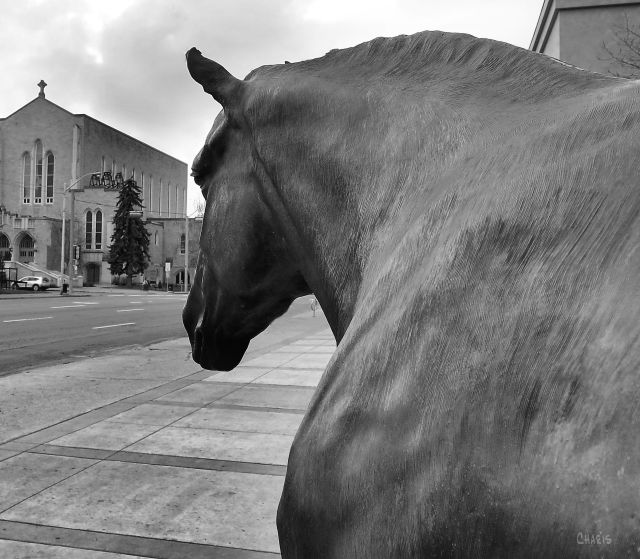
horse statue st josephs cathedral IMG_8755

The horse is prepared for the day of battle,
    but the victory belongs to the Lord.

(Proverbs 21:31 NLT)

This morning Facebook reminded me of an old post I wrote when my granddaughter was about three years old. I enjoyed her ability to give directions around her city when I was babysitting for a few days.

“Go past the tower (tall building) and wait for the green light. Then turn and go past Costco and there it is – Walmart!”

This amused me, so when we needed groceries after her swimming lessons I asked for directions to Superstore.

“Nana, have you been to Superstore before?”

“Yes, dear.”

“Then look into your memory and you can find the way there all by yourself.”

Today I face another battle where the odds are seemingly against me. I’m doing much better at avoiding panic this time, but I needed this prompt to remind me to look into my memory and acknowledge the times when we did all we could – and it was not enough. But God took what ever preparations we made and did something greater than we ever could have imagined.

Resting in the Lord is not about passively flopping on the ground and awaiting rescue. We pick up our five smooth stones, gather as many empty vessels as we can, prepare a sacrifice on an altar, stand before Pharaoh’s armies with nothing but a stick, march around a city seven times, pick up our beds, walk all the way to Damascus to pray for a guy who wants to kill us. We make preparations, we prepare the horse for the day of battle (again), but we know that the victory belongs to the Lord.

That’s resting in the Lord too.


Ahead of You

mountains lundbreck field fence ch

“God has foreordained the works to which He has called you. He has been ahead of you preparing the place to which you are coming and manipulating all the resources of the universe in order that the work you do may be a part of His whole great and gracious work.” – G. Campbell Morgan

Nevertheless

nevertheless2SC_0003 crop ch

I am crucified with Christ: nevertheless I live; yet not I, but Christ liveth in me: and the life which I now live in the flesh I live by the faith of the Son of God, who loved me, and gave himself for me. (Galatians 2:20 KJV)

Therefore we are buried with him by baptism into death: that like as Christ was raised up from the dead by the glory of the Father, even so we also should walk in newness of life. (Romans 6:4)

I don’t quote from the King James version very often, although it is the translation I grew up with. I find I end up having to explain it to people not familiar with archaic English anyway, so I might as well use a later version provided by scholars who have dedicated themselves to the task. But there is a dramatic poetry in the old language I sometimes miss.

Nevertheless

Nevertheless I live.

Words that rock the world no matter the century or the dialect.

Nevertheless I live; yet not I, but Christ liveth in me.

How deeply profound.

Tune My Heart

guitar lesson IMG_2171


For there’s nothing we can do to oppose the truth; all we can do is align ourselves with it. (2 Corinthians 13:8)

Lately I’ve run into a number of articles on sympathetic vibration in music. The other word that keeps grabbing my attention is alignment.

Sympathetic vibration can be demonstrated when a pitch fork is held near a string tuned to the same pitch. Without being touched the strings seem to come alive and respond with vibrations that play the same note.

I’ve heard it said that true worship begins in heaven and the heart that is still will pick it up. One of my favourite passages of scripture is found in the second chapter of Hosea. The Lord uses the metaphor of alluring his formerly wayward love to a desert place where there is no voice but His. He says that in that place, she will respond to Him. The New American Standard version uses the word sing.

“Therefore, behold, I will allure her,
Bring her into the wilderness
And speak kindly to her.
“Then I will give her her vineyards from there,
And the valley of Achor [trouble] as a door of hope.
And she will sing there as in the days of her youth…”

I’m beginning to see this as sympathetic vibration. When she hears The Voice singing the same pitch which she was designed to sing, the beloved comes alive. Her heart vibrates in sync with the sound that is at the heart of creation. Her heart resonates with Truth.

When we are in tune with the Father’s heart we are in alignment with His truth. When we are all in tune with Him we are also all in tune with each other.

A.W. Tozer wrote: “Has it ever occurred to you that one hundred pianos all tuned to the same fork are automatically tuned to each other? They are of one accord by being tuned, not to each other, but to another standard to which each one must individually bow. So one hundred worshipers met together, each one looking away to Christ, are in heart nearer to each other than they could possibly be, were they to become ‘unity’ conscious and turn their eyes away from God to strive for closer fellowship.”

Instruments in a symphony do not all sound the same. A violin is not a bassoon. Seldom does the composer ask an orchestra to play in unison. He asks them to play in harmony, but all the notes are based on one pure pitch and all play the same song. Worship begins in the Father’s heart. It is a gift He gives us so that we have something to give back to Him.

At the moment the divine orchestra – the Church – most often sounds a bit like everyone is concentrating on individual warm-up exercises and are all practising their own songs at the same time. Some have recently come in from the cold and their instruments are not yet in tune, but I have hope for the day when all look to the Conductor, tune to His perfect pitch, and unite to play the greatest song ever.

Soon.

Their sound will go out into all lands, even to the ends of the earth, when all creation joins to sing God’s praise.

In the meantime this is my prayer: Come play the strings of my heart, Lord. Tune my heart to sing Your praise.

Edited to add:


For the Eternal Alone

IMG_3447 monarch butterfly


I am pleading with the Eternal for this one thing,
my soul’s desire:
To live with Him all of my days—
in the shadow of His temple,
To behold His beauty and ponder His ways
in the company of His people.

His house is my shelter and secret retreat.
It is there I find peace in the midst of storm and turmoil.
Safety sits with me in the hiding place of God.
He will set me on a rock, high above the fray.

God lifts me high above those with thoughts
of death and deceit that call for my life.
I will enter His presence, offering sacrifices and praise.
In His house, I am overcome with joy
As I sing, yes, and play music for the Eternal alone.

(from Psalm 27 The Voice)

Author! Author!

alpen glow wycliffe road 2 IMG_6416

Sometimes, when alpenglow lights up the mountains for a few minutes at sunset I want to stand up and applaud, shouting “Author! Author!”

Sometimes I do.

I want to praise the Creator of all this.

I heard of a writer who tried to correct some information about his motivation for the development of a character on a Wikipedia article about himself. Ironically, the corrections he tried to make were “re-corrected” because he – the author – was not recognized as an authority on himself. (A whole other discussion about media and trust could be held here but I shall resist for the moment.)

Yesterday my son  and I were discussing theology as he helped me make dinner.  He thought there was a reason the people who marvelled at the things Jesus said recognized he that taught as one who had authority.

“It’s because he was the author,” my son said, as he mashed the potatoes. “Teachers like the scribes of Jesus’ day, can only propose theories on what they think the author meant, but Jesus spoke with authority because, as the author of the story, he knew what it meant.”

The best way to understand what the author intended is to ask the author. In Hebrews we read that Jesus Christ is the author and finisher of our faith. He is the ultimate authority on God’s intentions. Like watching a continuing saga of gigantic proportions the meaning of beginning of the story can only be fully understood in the context of the ending. This takes a brilliant author.

Therefore we also, since we are surrounded by so great a cloud of witnesses, let us lay aside every weight, and the sin which so easily ensnares us, and let us run with endurance the race that is set before us,  looking unto Jesus, the author and finisher of our faith, who for the joy that was set before Him endured the cross, despising the shame, and has sat down at the right hand of the throne of God. (Hebrew 12 NKJV)

In Christ the great mystery of the ages is revealed.

The Son is the image of the invisible God, the firstborn over all creation.  

For in him all things were created: things in heaven and on earth, visible and invisible, whether thrones or powers or rulers or authorities; all things have been created through him and for him.  He is before all things, and in him all things hold together.  

And he is the head of the body, the church;

he is the beginning and the firstborn from among the dead, so that in everything he might have the supremacy.  

For God was pleased to have all his fullness dwell in him, and through him to reconcile to himself all things, whether things on earth or things in heaven, by making peace through his blood, shed on the cross. (Colossians 1: 17-20)

He speaks as one having authority.


Wisdom in an Upside-down Kingdom

norbury ripples ch upside down kingdom

“But what is liberty without wisdom, and without virtue? It is the greatest of all possible evils; for it is folly, vice, and madness, without tuition or restraint.”

– Edmund Burke

Wisdom is an overlooked but very necessary gift from God.

Wisdom is often the missing element when trying to communicate liberty and love. Wisdom includes knowledge, but knowledge does not necessarily include wisdom. How often do we hear the phrase, “I’m sure he meant well?” whilst cleaning up a human relations fiasco.

There is a difference between wisdom that comes from above and wisdom gained from years of study and experience. Like words of knowledge mentioned in Romans 12, words of wisdom go beyond the natural ability of a person to perceive without the aid of the Holy Spirit. The wisdom that comes from God “is first utterly pure, then peace-loving, gentle, approachable, full of tolerant thoughts and kindly actions, with no breath of favouritism or hint of hypocrisy.” (James 3:17 Phillips)

The gift of wisdom is a spiritual gift, and is closely connected with hearing and understanding God’s perspective. Sometimes Godly wisdom is counter-intuitive because it has a different goal in mind than what we think is in our best interest. While reading about Godly wisdom I was surprised to learn that the greatest hindrance to using this gift is rivalry, jealousy and envy.

“Are there some wise and understanding men among you? Then your lives will be an example of the humility that is born of true wisdom.” (James 3:13)

It reminds me of the time a man with a sword stood before Joshua as he was about to lead his men into battle. Joshua asked, “Are you for us or for our enemies?”

“Neither,” he replied, “but as commander of the army of the Lord I have now come.”

The real question is not whether or not God is on our side. The question is about whether or not we are on His.

Someone told me once that presumptive sin is the unquestioned idea that God is a kind of Santa Claus who exists to serve our desires. Our desires can look quite noble. We want a family we can be proud of. We want our country to be free, peaceful, and prosperous. We want our own church gathering -the one that meets under a particular steeple or gymnasium roof – to be a beacon of light in the community. We want our mission to bear fruit.

Secretly, however, we want our congregation to shine more brightly than others. We want to be able to say we have the greatest growth, the widest influence, the finest music, the biggest outreach, the most political influence, the finest sermons, the most popular programs, the most prosperous, healthy, well-taught, well-behaved attendees and the best thought-out forms of governance with leaders well-schooled in the art of business administration. We want our mission to be blessed in stead of blessing God’s mission. We want our team to win.

Wisdom is understanding how to apply all the other gifts in a way that will be to the benefit of others and will honour God.

The Bible says wisdom is connected to humility, not ambition – and definitely not pride. The fastest way to shut down the operation of wisdom in our midst is to fail to recognize the gifts and callings in others or to encourage them or promote them as being more important than ourselves.

Spiritual growth that screens knowledge through wisdom and love is often counter-intuitive in an upside down Kingdom where the last shall be first and the first shall be last.

James goes on to write in chapter four of the book named after him that the greatest cause  – no, the cause – of division and disgruntlements in the church is competitiveness and jealousy.

“But about the feuds and struggles that exist among you—where do you suppose they come from? Can’t you see that they arise from conflicting passions within yourselves? You crave for something and don’t get it, you are jealous and envious of what others have got and you don’t possess it yourselves. Consequently in your exasperated frustration you struggle and fight with one another. You don’t get what you want because you don’t ask God for it. And when you do ask he doesn’t give it to you, for you ask in quite the wrong spirit—you only want to satisfy your own desires.”

Since we were just told in chapter three that rivalry and jealousy shut down the ability to receive wisdom, perhaps what we ought to be praying for is not the things we can spend on our own pleasure, or for things that improve our own reputation or attract admiration. Perhaps the gift we need to be asking for is wisdom and grace we can lavish on others to God’s glory.

God promised He will give wisdom liberally -all we have to do is remain humble and ask with the right motives.

Save

In the Midst of Mysteries

sepia snow forest path bw ch IMG_9195

The walk of faith is to live according to the revelation we have received,
in the midst of the mysteries we can’t explain.

– Bill Johnson