So here it is October and they are finally opening up. Most of the flowers the deer didn’t eat in their autumn munchies fest have already succumbed to early morning frost. But the asters? They’ve got the garden to themselves, and they are loving it. Go for it, ladies!
They will still bear fruit in old age, they will stay fresh and green, proclaiming, “The Lord is upright; he is my Rock, and there is no wickedness in him.”
God has a great sense of humour. He seems to get a kick out of sending his most powerful messages through some of the most unlikely people. He delights in annoying the religious establishment with folks my mom would call “characters.”
Amongst his own disciples Jesus included Simon the zealot and Matthew the tax collector. This was the equivalent of including a gun-totin’ anti-government survivalist and an IRS auditor on the same camping trip. That alone would be worth the price of admission just to hear conversations around the campfire.
I don’t imagine John the Baptist smelled that good, dressed as he was in camel-hair in the desert heat in pre-deodorant days. And some of those other messenger boys were pretty weird too. I have a feeling that if you had a gathering of Old Testament prophets it would look like a blooming asperger’s convention.
God’s habit of using the non-mighty makes me wonder if Samson looked more like Woody Allen’s Alvy Singer than Kevin Sorbo’s Hercules –and that’s why the Philistines demanded to know the source of his strength — because it obviously wasn’t his own steroids. (Judges 14)
Ehud, another unlikely hero whose name means “praise”, was sent to bring down a fat despot who oppressed the people. Ehud was left-handed. He was weak on the side where most soldiers were strong, but strong on the side where most other warriors were weak. His strength was overlooked and he walked right into Eglon’s bathroom with an unconventional weapon strapped to his thigh. Where armies could not rise up enough to free the people, a “weak” man could. (Judges 3)
Another time Barak told the judge Deborah that he would attempt to rid the country of the oppressor by going after Sisera only if she would go with him. She agreed, but said the victory would go to a woman. In that time, when women were regarded as property, this was humiliating to a man. The victory did go to a woman. The tent-wife Jael finished Sisera with the unconventional weapons of a tent-peg and hammer. (One scholar goes as far as saying the word used here implies Jael was a not even a regular wife, but a sex-slave captured from another people group. The lowest of the low.) (Judges 4)
Eowyn from Lord of the Rings reminds me of Jael and Deborah. The Nazgul had her pinned down and intimidated her with the known fact that he could not be killed by a man. She herself became the unexpected weapon when she removed her helmet and cried, “I am no man!” and thrust her sword into the enemy’s face.
I heard a story once of how a janitor became the leader of a group of high-powered CEOs when he bashed through the wall with his broom handle and rescued the entire group from a burning building. Because he had the knowledge of where the weak spot was in the wall and unconventional weapons, and wisdom and foresight to do what needed to be done, he became the instant leader.
The battle is heating up. Have you noticed? This very week powers of darkness twist communication and seek to divide and confuse people who are meant to be examples of love, grace, and freedom to live holy lives.
This song has been going through my head over and over for the past few days. (I’ve learned to pay attention to insistent songs that wake me up in the night.) It’s about those who dwell in the tents of the Lord, who are made strong by grace and carry the unconventional weapons of deeds of love and mercy.
Lead on, O King eternal,
the day of march has come;
henceforth in fields of conquest
your tents will be our home.
Through days of preparation
your grace has made us strong;
and now, O King eternal,
we lift our battle song.
Lead on, O King eternal,
till sin’s fierce war shall cease,
and holiness shall whisper
the sweet amen of peace.
For not with swords’ loud clashing
or roll of stirring drums
with deeds of love and mercy
the heavenly kingdom comes.
Lead on, O King eternal;
we follow, not with fears,
for gladness breaks like morning
where’er your face appears.
Your cross is lifted o’er us,
we journey in its light;
the crown awaits the conquest;
lead on, O God of might.
-Henry Smart
While men jockey for positions of power in government and church hierarchies, it is often the janitor in the elevator, the odd student, the refugee with limited language skills, the grandmother on her knees, and even the slave who become the generals in this fight against sin and unbelief that would block God’s goodness and hurt the ones He loves so much. Their weapons are not rhetoric or guns but whatever God has placed in their hands with which to demonstrate love and mercy. They receive their orders from the King of heaven himself and they follow Him alone. He has been bringing them through a tough school of preparation, teaching them to respond to his grace, live holy lives and rely on His faithfulness.
Over them, gladness breaks like morning, because they look to his face. The joy of the Lord is their strength.
For you see your calling, brethren, that not many wise according to the flesh, not many mighty, not many noble, are called. But God has chosen the foolish things of the world to put to shame the wise, and God has chosen the weak things of the world to put to shame the things which are mighty; and the base things of the world and the things which are despised God has chosen, and the things which are not, to bring to nothing the things that are, that no flesh should glory in His presence. But of Him you are in Christ Jesus, who became for us wisdom from God—and righteousness and sanctification and redemption— that, as it is written, “He who glories, let him glory in the Lord.” (1 Corinthians 1)
I would love to have the satisfaction of knowing that I am right. There is a wonderful sound a golf ball makes when it falls in the hole after a long putt. Being right feels like that sound.
But sometimes I miss it. Sometimes I miss it so badly I’m not even on the right fairway. Sometimes I’m on the green in one and then…, putt, putt, putt, putt…
Some things in the Bible are crystal clear -like the fact that God loved us so much he gave his only son so that anyone who believes in him could be saved.
Other things are not so clear. My understanding requires constant correction.
Depending on where you are standing the reflections in a pond might appear differently to different people. The chapter that talks about love (placed in the middle of instructions on how to properly use the gifts/tools that the Father has given us to build each other up and encourage fellow travellers on this road) says that what we perceive this side of being face to face with perfection is like seeing a blurred reflection. It uses the word ainigma -a riddle or puzzle to be pursued.
It’s frustrating. I want that satisfaction of having clear instructions. I want to know I am right -frankly so I can “prove” to others that they are wrong -and maybe “fix” them by goading them with a cattle-prod of truth. How can I poke anyone (or bludgeon or whip or tear down) with blurry understanding of details?
Ainigma
For now we are looking in a mirror that gives only a dim (blurred) reflection [of reality as in a riddle or enigma], but then [when perfection comes] we shall see in reality and face to face! Now I know in part (imperfectly), but then I shall know and understand fully and clearly, even in the same manner as I have been fully and clearly known and understood by God]. (1 Corinthians 13:12 Amplified)
One night, after a frustrated prayer asking for exact directions, I heard a still, almost silent voice, “If I showed you where I was going with this it would remove the element of faith.” (If you don’t believe that God talks to ordinary imperfect people sometimes, then you may just want to move along. This is not the blog for you.)
The point of asking riddles is to keep a person engaged. The Lord wants a closer relationship with us. When we have glimpses of another way in which he expresses himself we have the option of pursuing that fleeting flicker of colour or turning back to the world of black and white where everything appears to be more decently in order.
I wonder too, if this pursuit of the Holy in blurred reflections requires us to admit we don’t know everything and that very act of humility draws us closer to the One who does know everything. I wonder if it is in those teachable moments of meekness that we can hear his voice most clearly, that he whispers his secrets to us.
It’s His kindness that leads us to change how we think.
Indeed I can put it, finally, like this; the ultimate cause of all spiritual depression is unbelief, for if it were not for unbelief even the devil could do nothing. It is because we listen to the devil instead of listening to God that we go down before him and fall before his attacks. -Martyn Lloyd-Jones
Christ never failed to distinguish between doubt and unbelief. Doubt is can’t believe. Unbelief is won’t believe. Doubt is honesty. Unbelief is obstinacy. Doubt is looking for light. Unbelief is content with darkness. -Henry Drummond
There are those who insist it is a very bad thing to question God. To them “why?” is a rude question. That depends, I believe, on whether it is an honest search, in faith, for His meaning, or whether it is the challenge of unbelief and rebellion. -Elizabeth Elliot
Ignorance asks for understanding. Unbelief asks for proof. -Bill Johnson
Unbelief is actually perverted faith, for it puts its trust, not in the living God, but in dying men. -A.W. Tozer
There is no worse screen to block out the Spirit than confidence in our own intelligence. -John Calvin
All unbelief is the belief of a lie. -Horatius Bonar
Jesus said to him, “Thomas, because you have seen Me, you have believed. Blessed are those who have not seen and yet have believed.” (John 20:29 )
to roads where truth and righteousness echo His name.
Even in the unending shadows of death’s darkness, I am not overcome by fear. Because You are with me in those dark moments, near with Your protection and guidance, I am comforted.
You spread out a table before me, provisions in the midst of attack from my enemies; You care for all my needs, anointing my head with soothing, fragrant oil, filling my cup again and again with Your grace.
Morning Fog
Certainly Your faithful protection and loving provision will pursue me where I go, always, everywhere. I will always be with the Eternal, in Your house forever.
“Live creatively, friends. If someone falls into sin, forgivingly restore him, saving your critical comments for yourself. You might be needing forgiveness before the day’s out. Stoop down and reach out to those who are oppressed. Share their burdens, and so complete Christ’s law. If you think you are too good for that, you are badly deceived.
Make a careful exploration of who you are and the work you have been given, and then sink yourself into that. Don’t be impressed with yourself. Don’t compare yourself with others. Each of you must take responsibility for doing the creative best you can with your own life.
Be very sure now, you who have been trained to a self-sufficient maturity, that you enter into a generous common life with those who have trained you, sharing all the good things that you have and experience.
Don’t be misled: No one makes a fool of God. What a person plants, he will harvest. The person who plants selfishness, ignoring the needs of others—ignoring God!—harvests a crop of weeds. All he’ll have to show for his life is weeds! But the one who plants in response to God, letting God’s Spirit do the growth work in him, harvests a crop of real life, eternal life.
So let’s not allow ourselves to get fatigued doing good. At the right time we will harvest a good crop if we don’t give up, or quit. Right now, therefore, every time we get the chance, let us work for the benefit of all, starting with the people closest to us in the community of faith.” (Galatians 6:1-10 The Message)
“Tribulation worketh patience; and patience, experience; and experience, hope.” That is the order. You cannot put patience and experience into a parenthesis, and, omitting them, bring hope out of tribulation.
High River, Alberta is still under a cloud. It may not be the same dark heavy rain cloud that dumped more water than the Highwood River could hold on that horrible day in June, but it’s a cloud. And even though there is light on the horizon, for many people living with the consequences of the first day of summer disaster, it is still dark and heavy. The children will tell you.
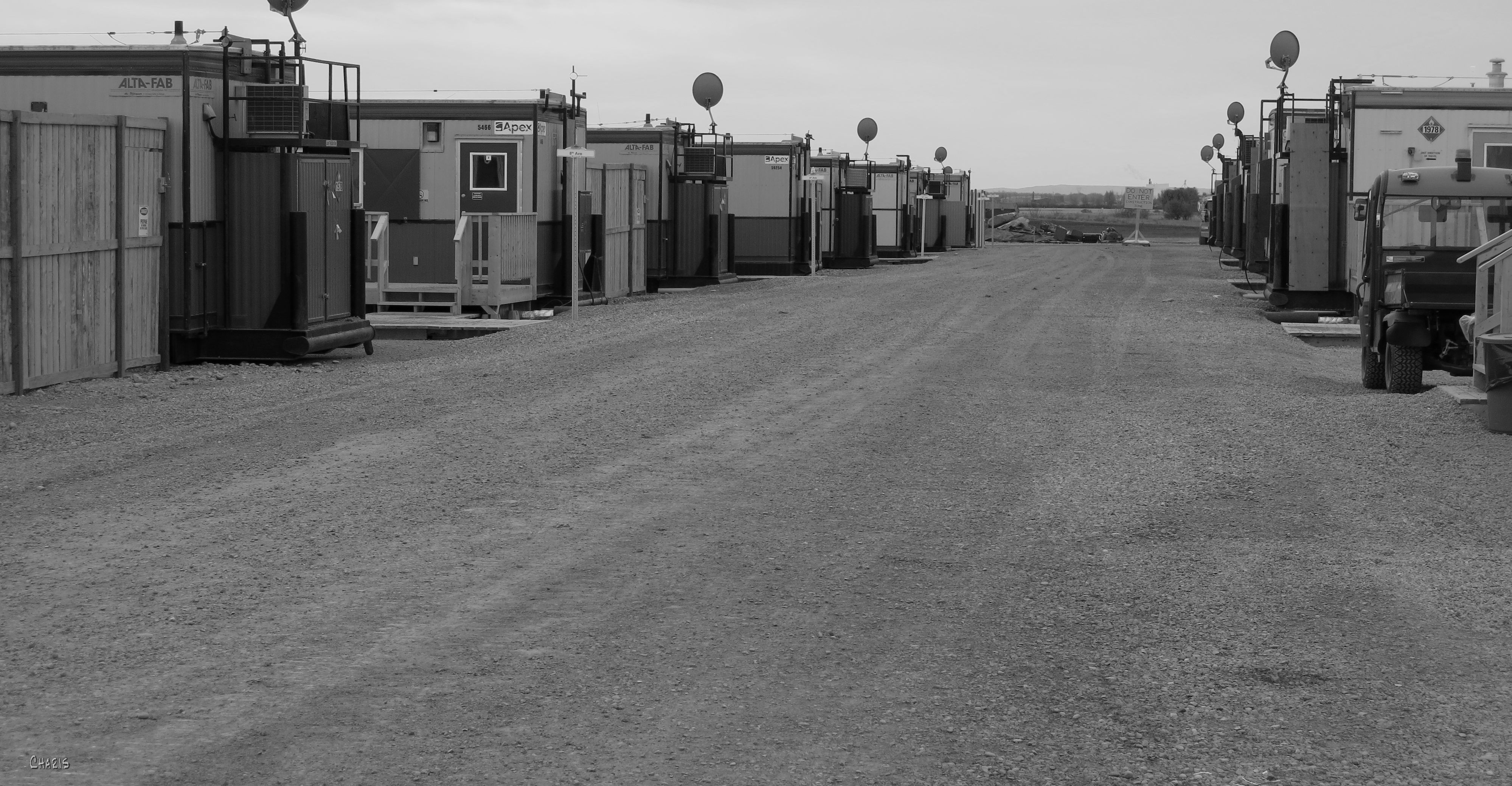
I stayed in Saddlebrook camp this week, caring for my grandchildren while their parents were away on business. Saddlebrook is the trailer town out in the country on the road to Okotoks built to house those whose homes are not habitable. There are many kind, encouraging, generous people there –especially in the food service areas (residents are not permitted to use the unconnected stoves). Visitors to the camp are strongly discouraged, but as a substitute parent I was permitted to stay (after paper work and getting photo I.D.) The government has generously provided housing to those still affected by the flood, but due to logistics problems there are often a lot of rules and regulations that communicate a big brother/victim disparity in such situations. (I’ve noticed that when people who already feel a loss of control are treated like incapable victims, they start to act like helpless victims –and angry victims need someone to blame. Just sayin’.)
Saddlebrook
I cannot possibly understand what it is like to suddenly lose everything but the mortgage. I don’t really know what it is like to wait, fill out forms, and wait some more and still not have answers. All I can do is listen –and pray.
I listened to where-were-you-when stories. I listened to you-think-that’s-bad stories. I listened to survivor guilt stories from folks who didn’t have much damage. I listened to a job list a mile long from an exhausted young father who sat on the front steps of his broken house, too tired to put one foot in front of the other anymore. There is so much to do in his “spare time” before winter.
The gardenWatermarksThe front doorThe kitchen
I listened to a young mother who longed to correct her children in private when they misbehaved at the dinner table in the café at Saddlebrook. “Don’t misunderstand. I’m very grateful,” she said. “The food is good, but it is not what I would choose to make for my toddlers. I just want to go home and cook for my family again. It’s hard to explain.”
Someone told me, “People have been really kind and have wanted to give us things, but we have nowhere to put them. And I sound awful and l hate myself for it, but I don’t want your stuff! I want my stuff! I liked my stuff! I want my baby pictures. I want my Grandma’s teapot. I want my old music. I want to go home!”
I think my granddaughter expressed it best when she was telling me about children on the school bus arguing over who was most deserving of sympathy: the ones who lost everything, the ones who knew people who died, the ones who lost their school and still don’t have classrooms and are trying to study en masse with other traumatized kids and teachers in a single chaotic banquet hall room without an outside play area, the ones who don’t have dads to help them fix their houses, the ones living in a fenced refugee camp with security guards checking their every move….
She stomped her foot and cried, “They don’t understand! You don’t understand! Nobody understands!” then plopped on her bottom bunk bed in the tiny “kitchen” and pulled a blanket over her head because that’s as close as she can get to running to her room and slamming the door.
She’s right. Every heart has its own sorrow. And this was definitely not the time to remind her of Syrian refugees or Pakistani Christians being blown up in their churches. She can’t understand their sorrow any better than they understand hers.
Only the heart can know its own resentment; likewise no stranger can experience its joy.(Proverbs 14:10)
I admit I feel my own rage rising and want to stomp my foot and scream every time I read another heartless online comment about “the foolishness of people who build on a flood plain and then want the government to pay for their stupidity.” Our son’s house is more than two kilometers from the river in an area that is still marked on the maps as being far outside any risk for flood. They are hard-working responsible people who checked before buying. This flood was way beyond anything a prudent planner could have predicted. The history of this country is that nearly all towns and cities are built on waterways. According to the maps millions in this country are at greater risk of flood than they were. Do we blame people for building in areas where tornadoes, or forest fires, or earthquakes, or blizzards or ice storms or tsunamis occur? I guess my heart has its sorrow too and I’ve got some forgiving to do. No, these know-it-alls don’t understand –and why should they? If a person has never faced adversity or experienced feeling out of control of their circumstances it is easy to maintain the illusion of being sufficient unto oneself. They don’t know what it is like for others –not really.
I saw signs of recovery though –like a chinook arch of clear sky rising on the horizon. People were trimming hedges and mowing lawns or raking leaves in some areas of town. Businesses were re-opening. Folks were discussing the choosing of new paint colours and flooring options for re-builds. My grandson was thrilled with a patch of grass in the camp big enough for him to practise throwing his new football. There is talk of an off-leash dog park going up nearby -somewhere near the beep beep beep sounds of backing-up earth movers.
I saw people laughing.
I saw kids showing off donated clothes and backpacks.
I saw a group of loving people whose church building was not damaged. They moved their own service to less-than-convenient early hours on Sunday to make room for others to use their building for the rest of the day.
I saw grateful tears in the eyes of an older woman as she clutched a handmade quilt my friend sent. (Rose gave a dozen of her gorgeous handcrafted quilts to the folks in High River).
Quilts
“I waited until the families took what they needed,” she said. “But I’m so glad this one is still here. It’s so beautiful. You don’t know what it’s like to lose everything and have to start again at my age. It means so much to have something this nice!”
No, sweet lady, I don’t know what it’s like. But I see joy in your face and you give me hope.
I dare to believe that most of the people of High River will not only survive, but that this beautiful windy mountain-edged prairie town will thrive and remember the sorrow of this tough season without bitterness. They will also remember the joy. My prayer is that they will know what it is to need help and how to give help in a way that preserves dignity. They will use this opportunity to develop the skills that untangle red tape; they will know from experience how to plow through unwieldy bureaucracy, how to organize volunteers, how to establish a grass-roots just-folks-helping-folks attitude that can stand firm when disaster hits another Canadian town. They will know how to be grateful, thoughtful, helpful and compassionate because, unlike the nasty commentators on the sidelines, they get it. Right now they are hurting and need more time to heal, but they will rise up again.
They will rise up.
It’s people like these beautiful folks, the ones trained by adversity, who build up this country. They are the wise ones. They are the strong ones.
I believe when the dark cloud blows away, the town will see it has a purpose and a higher calling in the grand scheme of things.
Higher Calling
High River will be a city of refuge, of peace, of caring –and of love.
He consoles us as we endure the pain and hardship of life so that we may draw from His comfort and share it with others in their own struggles. (2 Corinthians 2:4)