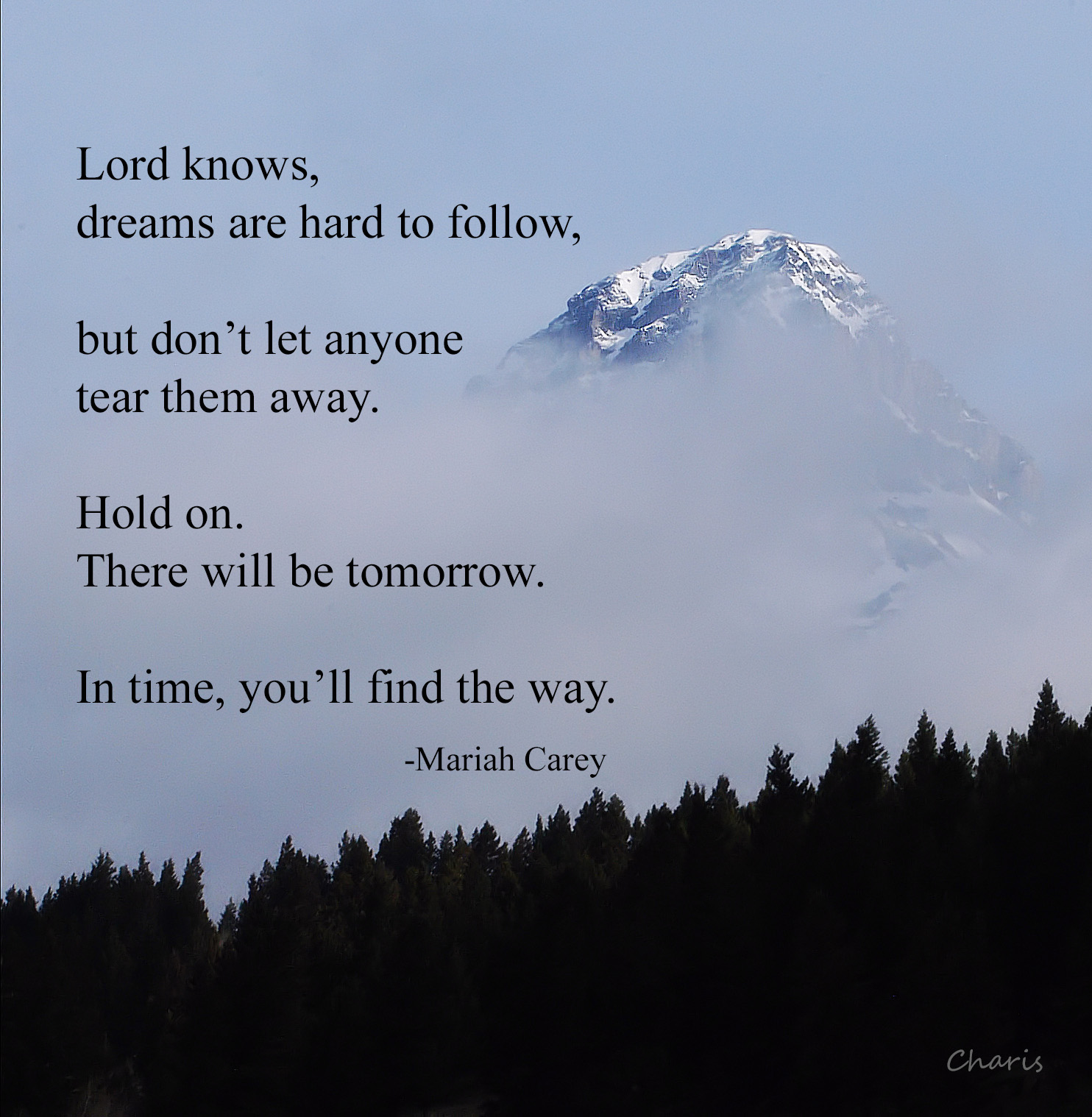
In Time

Sometimes I hear God’s voice in unexpected places. Popular music is one of them. I wrote about it here. (Hearing God’s Voice Through Music). This morning I woke with a song in my head. It’s not one that’s on any of my play lists, but it was insistent, so I paid attention.

Recently I’ve been asking myself why it is sometimes so easy to set a God-given dream aside to collect dust for years. I could say that I’ve been distracted by the cares of life or that I chose to support another person’s dream because I believed it was a worthy and lofty dream. But I think, to be honest, after listening to the song, the Lord is telling me something. I have set the dream aside because taking steps to walk with God toward the dream he put in my heart takes courage. And I have been afraid –afraid of success, afraid of failure, afraid of what critics will think, afraid of letting friends down, afraid of letting God down, afraid of standing alone in the no man’s land in the middle of the social and political and factioned church battles we find ourselves in.

Mariah Carey’s song is called “Hero.” One of the most profound questions we can ask God is “Who do you see when you look at me?” For many years, I assumed the answer to that question was “a sinner saved by grace.” I was wrong.

It can be rather shocking when we hear his answer. It’s easy to dismiss it as a figment of an over-zealous ego. When he approached the cowardly Gideon hiding down in a winepress to thresh grain, the angel of the Lord called the guy who thought he held the lowest status in the country, “Mighty Warrior.” Gideon’s response was the equivalent of looking around and saying, “You talkin’ to me?” The way God sees us is much better than the way we see ourselves. Frankly, I discovered, the hard way, that talking about it to friends who don’t understand how God sees them can bring about a jealous response the way Joseph discovered what jealous people can do when he told his brothers about his dream of sheaves of wheat bowing to him. Candour is risky business. Very risky. But maybe it’s step one in trusting God.

As we grow in grace, God reveals more of how he sees us. I’ve been praying about an updated version of what I call an identity statement (similar to an artist’s statement). When I heard “hero” I felt like Gideon must have felt. I feel like the last person on earth that term could apply to. Then I remember that years ago the Lord spoke to me through the book of Hosea: “‘It will come about in that day,’ declares the Lord, ‘That you will call Me Ishi and will no longer call Me Baali.'” (Hosea 2:16) Ishi means hero/savior/husband. Baali means master.

It’s about relationship. Through his kindness, his gentle alluring, he has replaced the harsh image of himself as an impossible taskmaster with the image of my hero, my saviour, and the lover of my soul.

We become what we focus on. If my focus is on other humans who have merely a piece of the picture, I can, at best, become a faint copy of their traits, both good and bad. If I focus on the one who is my hero, getting to know him in a deeper sense, I will eventually become more heroic like him.

Jesus’ road to hero status involved laying down his right to respect in the ultimate demonstration of humility, but he never let go of the dream to save us and re-connect us with the Father who created us. For the joy set before him, he endured the cross.

I am very well aware of my tendency to back away when intimidated, to withdraw when stressed, and to try to change who the Lord created me to be to fit in with other people in a desire to belong (what Brené Brown calls the opposite of belonging). On my own, I can’t pursue this dream, but Jesus stood up to injustice. He’s the shepherd who goes after the lost lamb. He pulled me from a pit of guilt and shame and sang a song of grace over me. He invited me –fearful, shame-ridden, voiceless me– to partner with him to set the prisoners of spiritual abuse free. He lives in me. In a world of disappointing would-be heroes, he is my only hope.

This whole thought is too much for me, but I choose to trust him.

And then a hero comes along with the strength to carry on and you cast your fears aside…

The Road Back; Psalms of the Sons of Korah, Psalm 43


Have you ever experienced the cold judgment in this statement? “Oh. You’re one of those.”

The Sons of Korah knew what it was like to be maligned as descendants of a disgraced ancestor.

In Psalm 43, they plead for vindication. They have been falsely accused. They know what it is like to be misunderstood. When others rejected them, particularly people who carried religious authority, they may have felt that God rejected them too. When it happens often enough, the subjects of dismissal may start to question their own perceptions. Sometimes they may doubt their value and place in society. At other times they protest their innocence. It’s confusing. They need clarity on their journey to the place of worship. They write:

Plead for me; clear my name, O God. Prove me innocent
    before immoral people;
Save me from their lies,
    their unjust thoughts and deeds.


You are the True God—my shelter, my protector, the one whom I lean on.
    Why have You turned away from me? Rejected me?
Why must I go around, overwrought, mourning,
    suffering under the weight of my enemies?

O my God, shine Your light and truth
    to help me see clearly,
To lead me to Your holy mountain,
    to Your home.

Psalm43:1-3 The Voice

I wonder if this is why one of the first people to whom Jesus revealed his true identity as Messiah was a shamed, rejected woman from an ethnic group held in contempt by Jews – the Samaritan woman at the well. He told her that soon the place of worship would not be a physical location, but in spirit and in truth. What a difference that encounter made in the way she saw herself! That joyful moment instantly transformed her into a bold missionary. “Come and see!” she urged neighbours back in the town. She was no longer avoiding anyone.

Hiding is a characteristic of people who carry shame. It’s hard to be yourself among those who would judge you for your associations. Worship that is pure and holy requires a level of trusting candour. It makes us uncomfortably aware that others have said they don’t consider members of a shamed tribe as acceptable. It’s easy to subconsciously wear their judgment after years of disrespect.

Our mothers taught us as very young children that to be polite and considerate we need to keep some parts of ourselves hidden in good company. I am in no way advocating public nudity! I’m just saying there is no point to wearing metaphorical masks or costumes in God’s presence. It’s not as if he doesn’t know everything already. In a sense honest, humble prayer means praying naked (metaphorically!).

When we invite God to shine his pure clarifying light on our lives, it will expose things we need to acknowledge, confess and allow the Lord to clean up. It shows us how to change direction. That purifying light will also expose lies we have believed. It reveals the difference between false identity and true identity. We are not who the accuser says we are. We are who our Heavenly Father says we are. We have nothing to hide. This is freedom. It is a freedom the Sons of Korah long for. Verse 4:

Then I will go to God’s altar with nothing to hide.
    I will go to God, my rapture;
I will sing praises to You and play my strings,
    unloading my cares, unleashing my joys, to You, God, my God.

Psalm 43 ends with the same declaration as Psalm 42. I’ll leave verse 5 here in The Voice paraphrase.

O my soul, why are you so overwrought?
    Why are you so disturbed?
Why can’t I just hope in God? Despite all my emotions, I will hope in God again.
    I will believe and praise the One
    who saves me and is my life,
My Savior and my God.

The journey continues.

The Humble Flower

If a little flower could speak, it seems to me that it would tell us quite simply all that God has done for it, without hiding any of its gifts. It would not, under the pretext of humility, say that it was not pretty, or that it had not a sweet scent, that the sun had withered its petals, or the storm bruised its stem, if it knew that such were not the case.

-Therese of Lisieux

Humility is seeing ourselves as God sees us. No more. No less.

Shield

I’m using an old photo today because it fits so well. One day I was up in the woods praying, well complaining to God, actually.

“I feel like no matter which way I move, the way is blocked. I don’t understand what is going on. It’s like my hearing is muffled and I can see clearly enough or far enough to have a sense of which direction I should take. Everything I know to try is inadequate. I feel stifled and cramped in this place, and I don’t know what to do. What is this dark confining place? And what am I doing here? Where am I?

A still quiet, but firm voice answered, “Under my wing.”

I try to remember this when I feel the need to do something – anything, to fool myself into feeling like I’m in control, like I can rely on my own wisdom and see the eternal repercussions of a decision. Sometimes God is protecting me from the world, and sometimes I think he might be protecting the world from me — especially when I’m sputtering outrage.

Sometimes the safest place is when I am not insisting on being control and instead, I’m invisible to “fans” and “foes,” known and unknown. There’s a time to explore and there’s a time to run home. Sometimes, in those intense moments of choosing to respond to God, of choosing to agree to stay hidden in Him, and not giving away my position with a random self-defensive squawk, I remember this song using St. Patrick’s words. God’s love is a shield that has us covered front, back, side to side, and above and below. The song is called St. Patrick’s Breastplate. It’s also called the Deer’s Cry.

Christ with me, Christ before me, Christ behind me

Christ in me, Christ beneath me, Christ above me

Christ on my right, Christ on my left

Christ when I lie down, Christ when I sit down

Christ in me, Christ when I arise

Christ in the heart of everyone who thinks of me

Christ in the mouth of everyone who speaks of me

Christ in every eye that sees me

Christ in every ear that hears me

Christ with me

Voces8 sings Arvo Part’s setting. https://www.youtube.com/watch?v=Ir3htl3UlBk&list=RDIr3htl3UlBk&index=1

March 17, 2022 seems like a good day to pay attention to it.

Creative Meditations for Lent, Word prompt: Shield

Grace/Disgrace

green vase limp flowers

I was known as the kid who asked too many questions. I remember one exasperated church lady saying, “Questions! Questions! Why do you have to ask so many questions? Why can’t you just have faith?”

I felt reprimanded and like I was about to be assigned to the lower decks of the good ship Faith. I thought about it for a while, then realized that if I didn’t have faith that God is good and has an answer waiting discovery, I wouldn’t be brave enough to ask questions.

I still ask impertinent questions, but now I have a somewhat better sense of where and when it’s safe to ask them. Maturity or pragmatism? I’m not sure.

I ask God a lot of questions. Sometimes I get a direct answer in sundry ways. Sometimes all I get is a nudge to rephrase or ask a better question. Sometimes God asks me a question.

I woke up to the clear question, “What’s the opposite of grace?” (I was too focused on how wonderful my pillow still felt to come up with it myself.) Two mugs of coffee later I contemplated the opposite of grace. The question, “What does grace feel like?” (here) took months to start to recognize an answer. I’ve learned not to rush when my heavenly Father asks something he already knows. Something important this way lies. This time it didn’t take as long.

What is the opposite of grace? Disgrace, I guess.

And what is disgrace?

Help me out here, dictionary. The prefix dis means to do the opposite, to deprive, to exclude, expel, annul. If we put the prefix dis on a word it changes the meaning to the opposite. To empower is to give power to someone. To dis-empower is to remove power. Dis-ease is a medical condition that negates ease. When a lawyer is dis-barred, he is not called to the bar, he is sent away from the bar. It’s like a “not” added to the word. Dis-agreeable means not agreeable. When we say something is a disgrace it is not grace. It is without grace. It is loathsome, unhelpful, shameful. When we say someone has been disgraced, they have been dis-honoured, shamed.

I think that’s it. When someone has been disgraced, when there is no grace for them, they have been shamed. When someone is a disgrace, they are an embarrassment, a source of shame, an object to be rejected. (Guilt comes from something we have done wrong. Shame is the feeling that we are something wrong.)

There you have it. The opposite of grace is shame.

Why are you asking me this, Lord?”

So then, what is grace?

Your grace is the empowerment to become the person You see when You look at us.*

Grace is not an excuse to be content with dis-obedience or dis-function. Grace empowers transformation. Ah! I get it. Dis-grace wraps a wounded soul in a trash bag, hides it in the trunk, and hauls it to the dump when no one is looking.

I realized how many times I have seen dis-grace masquerading as grace: unrequested preachy prayer or presumptive “prophetic words” that mislabel, unfaithful “wounds of a friend” that leave deep gashes, demands to maintain “standards” that are really about them maintaining power, discipleship training that instills dependence on a leader, sermons emphasizing sin-focused “shoulds” that dis-courage, or traditions that make putting on a façade of respectability more important than enjoying the freedom found in a loving, honest relationship with God.

I realized that although I write about grace, I still have areas of my life in which I have believed the lie that I didn’t just do something wrong, I am something wrong. Every time the enemy of my soul wants to make me less effective, he tugs on the lie like yanking on a rug and I topple over. Sometimes I even hide under the rug. I have not always soaked in the grace God lavishes on us, but rather have self-applied dis-grace, mistakenly thinking that shame could motivate anything other than temporary change.

My prayer in the days before I heard the Lord’s question was like David’s in Psalm 139:
Search me, O God, and know my heart;
Try me and know my anxious thoughts;
And see if there be any hurtful way in me,
And lead me in the everlasting way. (verses 23, 24 NASB)

After I asked to be shown any place where a lie had taken residence in my heart, I saw an area of my life in which I felt like I was still a failure, even after years of effort to measure up. For the next few days, I felt sucked into a familiar vortex of shame and anger. (But God! It’s not fair!! I have tried so hard!) I wanted to hide. I realized later, that in his kindness God was not just showing me some hurtful way at the root of so much frustration; this time he was showing me the shame that kept me bound to the lie that I expected him to reject me like so many others have.

He hasn’t rejected me. Instead, in his kindness, he is showing me a little more of who he is, and a little more of how he sees me. Shame is what he intends to remove by his grace. He is not ashamed to be seen with me. He says I am a person he enjoys walking with. He continues to lead in the everlasting way.

*via Graham Cooke.

My Tower of Rescue

crowsnest light dark ch rs DSC_0017

I thought, briefly, about bopping her on the nose. Had I not been aware that doing so would have proven her right about my lack of holiness, I may have thought about it more seriously.

A woman, who will remain nameless, dropped by my house to comfort me after I broke my leg. Opening night for the opera, in which I had a lead role, was in a few days. There I sat with my leg propped on pillows and encased in a cast of a different sort.

“Do you know why God did this?” she asked.

“God broke my leg?”

“He broke your leg to teach you to praise him.”

I don’t remember if I smiled politely or returned blank-faced stunned silence.

“You are not using your gift for his glory,” she added. “You are using it for your own praise. That is why he broke your leg – to teach you to praise him.”

“Well, thank you for stopping by…”

Even before she drove away, I started shaking. A part of me didn’t believe her, but a part of me did. I was afraid God was disappointed and angry with me because I did something wrong again. What if I was being punished? Spending the next painful weeks and months praising God was not an appealing plan in those days. Heartfelt praise didn’t exactly pour from my lips at the thought of God going around breaking legs to make us acknowledge his supremacy. That sounded more like the modus operandi of mobsters.

The problem was that I didn’t know what praise was, and worse, I didn’t know who God was, although at the time I thought I did. I’d been going to church all my life and even aced some seminary courses. Frankly, my faith was less faith than duty.

I thought visible praise (that would satisfy my visitor) meant repeating, “Praise the Lord,” and “Hallelujah,” interspersed with the occasional “Glory!” from some deep-voiced extrovert in the back row in one of those churches where people didn’t gasp at irreverence of such things. In other words, an introvert’s nightmare.

When I confided in some churchy friends that I was struggling with a lack of sleep and the stresses of caring for sick, squabbling children, they responded with, “Praise the Lord, Charis!” as if it was a magic formula that would make everything all better. I wondered if God even cared. I was pretty sure they didn’t.

I finally reached a breaking point. If God was love, I wasn’t seeing it. If Jesus’ burden was light, I wasn’t feeling it. If the gospel was good news, I wasn’t hearing it. I walked away.

Over the next few years I let go of the image of God as an impossible-to-please task master who needed me to be the kind of salesman whose life depended on talking up a disappointing product.

Amazingly, God never walked away from me. Instead, as I unlearned, he showed me what was missing in my experience of him. Since then, he continues to teach me one step at a time about who he is. Many of the circumstances I’ve found myself in are not about punishment or condemnation; they are a holy set-up to see something about him I could not see before. Each crisis is an invitation to come one step closer.

Last week I heard a line in a song: “Way-maker, miracle worker, promise keeper, light in the darkness. My God! That is who you are.”

In my spirit I heard him ask, “Who am I to you?” I began to write.

You are my saviour hero
my confident security
my righteousness
my healer
my keeper
my hope
my peace
my comforter
my encourager
my source of creativity
my source of identity
Lover of my soul…

The list, easily two pages long, flowed while the song played. Each one of these aspects of God I had read or heard about, but it wasn’t until he showed up in a real-life situations that I understood them. They are part of who he is and he wanted to show me through relationship. I realized my list was worship. Each word on the page was praise. It was spontaneous. It was unforced and sincere. It was heart-felt. It was about him and not another “supposed to.”

I love David’s psalms because he doesn’t put himself in charge of God’s public relations. His emotions are honest. He had a promise that he would be king, then he faced situations that made him despair of even surviving the next night. Psalm 18 is his victory song in which he writes about who God was to him after all he had been through.

Lord, I passionately love you and I’m bonded to you,
for now you’ve become my power!
You’re as real to me as bedrock beneath my feet,
like a castle on a cliff, my forever firm fortress,
my mountain of hiding, my pathway of escape,
my tower of rescue where none can reach me.

My secret strength and shield around me,
you are salvation’s ray of brightness shining on the hillside,
always the champion of my cause.

All I need to do is to call to you,
singing to you, the praiseworthy God.
(Psalm 18:1-3 TPT)

Did God break my leg to teach me to praise him? No. My leg broke because I was wearing high heeled dress boots on sheer ice. But he was patiently waiting right there, with me in the circumstance, which was actually more about the pain the visitor stirred up in me than a shattered tibia. Looking back, I can see God encouraging me to let go of the false image I carried around. I needed to see him in Jesus, the one who came to show us what the Father is truly like.

The journey continues.

My question for you. What aspect of himself does God want to show you now, in your current circumstances?

Looking At the Yesterdays

old farm cowboy trail ch bw DSC_0015

For as long as I can remember, I have wanted to be a godly person. Yet when I look at the yesterdays of my life, what I see, mostly, is a broken, irregular path littered with mistakes and failure. I have had temporary successes and isolated moments of closeness to God, but I long for the continuing presence of Jesus.

I want a lifetime of holy moments. Every day I want to be in dangerous proximity to Jesus. I long for a life that explodes with meaning and is filled with adventure, wonder, risk, and danger. I long for a faith that is gloriously treacherous. I want to be with Jesus, not knowing whether to cry or laugh.

~Mike Yaconelli

Looking back I can see the path of my spiritual journey. It looks like a haphazard trail created by a person lurching from crisis to crisis interspersed with resting places called “Good Enough.”

It’s a looking back kind of day. My Daddy died on this day three years ago. I call him Daddy today because the space between now and the day he took his last breath is like a vista where time is less sequential and light shines on foreground, midground, and background equally. Today I can look up to my confident Daddy standing in the field at the same time as I look down on my confused father lying in the hospital bed.

My Daddy always told us stories, but he didn’t leave the good enough safety of a job he hated to become a writer and professional story-teller until he was nearly sixty. He said his tales of a Saskatchewan boyhood had just enough truth in them to make them believable but enough fiction to right the wrongs of people broken by hardship. He wrote and published his stories, saw his book become a best seller (by Canadian prairie province standards), then settled in a cottage called Good Enough that looked out on the past. The future caught him by surprise. It’s hard to re-write the future.

Sometimes I envy those who are content to stay as they are, where they are. But I also feel a need to run from those who shrug and say, “It is what it is.” I joke about my addiction to potential and tendency to collect more artistic “raw material” than I will live long enough to use, but I don’t want to look into my grave and ask, “Is that all there is?” I know there is more for us both here and beyond the horizon.

I have taken up residence in places called Good Enough for long stretches in my life, but eventually I catch a glimpse of the future me — the way God sees me outside of the sequence of time – and I long for more. It’s a holy discontent that wants to partner with God. I hear him whisper, “Come away with me and I will show you things you never knew before.”

The advantage of having a diagnosis of cancer is receiving the fulfilment of David’s prayer in Psalm 90: Teach us to number our days, that we may gain a heart of wisdom. Cancer is not a death sentence that people without cancer do not also have. It’s like a mileage sign post to give you a heads up that you will be approaching an exit ramp sometime in the future — but not yet.

God’s not finished with me yet. When I look at my yesterdays I know that’s who I was but it is not who I am going to be. I am still changing. Like Mike Yaconelli, I feel that holy discontent rising up. The desire to be in dangerous proximity to Jesus and whatever he is doing is growing again. I hear Holy Spirit say, “Get your coat. Let’s go. There is more.”

Speaking the Truth in Love

foothills sky ch IMG_1132

But what I would like to say is that the spiritual life is a life in which you gradually learn to listen to a voice that says something else, that says, “You are the beloved and on you my favour rests.”… I want you to hear that voice. It is not a very loud voice because it is an intimate voice. It comes from a very deep place. It is soft and gentle. I want you to gradually hear that voice. We both have to hear that voice and to claim for ourselves that that voice speaks the truth, our truth. It tells us who we are.

~ Henri Nouwen

I Am No Victim

little boy sun beam bw sm

For many years I followed a disciplined scheduled daily reading of the Bible, but sometimes “discipline” can get in the way of learning. Sometimes you need to pause and stay with a passage or phrase or even just a word in scripture for a while, giving it time to show more facets than those that shine with first light. Sometimes you need more than an intellectual grasp of a concept. Sometimes you need to feel it in your bones, hear it in your ears, taste it on your tongue and stomp it out in frustrated walks in the woods before it moves from your heart up to your decision-maker. Then you can move on. This passage in Psalm 139 in The Passion Translation has been like that for me.

With your hand of love upon my life,
You impart a Father’s blessing to me.
This is just too wonderful,
Deep, and incomprehensible!
Your understanding of me brings me wonder and strength.

Where to start? It looks straight forward enough, but this sword tip has penetrated my soul and spirit more deeply than earlier races to the reading quota finish line permitted.

Christians tend to throw around the word blessing at lot imbuing it with their own definition. I’ve been trying to find a way to describe the word blessing as it is used here. Perhaps one way is to mirror its opposite. Benediction (blessing in Latin) means good speaking. It’s opposite is malediction – bad speaking. Mal at the beginning of a word with Latin roots means bad, sick, dysfunctional, evil: malady, malaise, malnourished, malice, malpractice, malcontent. Malediction means curse.

Bene, on the other hand means good, helpful, enriching, empowering, visionary. Compare words beginning with bene: benefit, benevolent, benefactor, beneficiary. When the  fathers of ancient times gave their children blessings they officially gifted them with the recognition of who they were as individuals and imparted a vision for their future.

One day I witnessed the opposite. An event I would call a soul assault took place in the produce aisle. An adult publicly dishonoured a child by shouting (in much harsher words than these): “You are a huge disappointment. You have no positive qualities and will amount to nothing in life – ever.”

Every parent blows it sometimes. To this day I could cry when I remember one particular incident when I said something in fear and anger, which was entirely untrue, to a child I loved dearly. I have apologized, but my disappointment in myself helped me forgive my own parents for words spoken in frustration, or under stress I was too young to comprehend. But, you know, when it comes to pain, whether someone drives over your foot intentionally or accidentally, it still leaves a mark. Words have power and when you are young they can leave marks — often in the form of signs stuck to our foreheads where everyone can see them.

Have you heard this expression? A sweater is something you wear when your mother feels cold. I laughed when I heard this, but I know a lot of us can relate to this statement. Experience has taught us what it is like to be bound by another person’s priorities and tastes or swaddled in another person’s perceptions, well-meaning though they may be. My own daughter has been known to say wisely, “That’s your fear, Ma, not mine.”

How we long to be understood. How we long for someone who can help us understand ourselves. We yearn to hear good words about our true identities and true destinies. This is particularly true for people who had absent or emotionally distant fathers.

Someone who was an important and intimidating influence in my youth came to visit after I was married and had children. I was excited to see her and wanted her to be impressed with my choices in life. I longed for her approval.

“Well, I see you stopped developing your talent,” she said. “Tell me, what are your aspirations for your son?”

I answered, “That he will be free to replace my aspirations with his own.”

She was not impressed. She thought my answer was rude and flippant. That’s when I realized that seeking the blessing of someone who had an agenda and a plan for how I could continue to fulfill her aspirations would only lead to disappointment for one or both of us.

It did. One of the last things she expressed to me before she died a few years later was her disappointment that I had not lived up to her expectations. I felt like the child in the grocery store with a label slapped on my forehead. FAILURE. At the time it didn’t occur to me that I could seek God’s blessing, his hand of favour that ripped off the labels other people’s maledictions had placed there since I was a child.
VICTIM
WEIRDO
LAZY
UGLY
GULLIBLE
OUTSIDER
EMBARRASSMENT
WEAK
FAILURE

But my heavenly Father’s blessing changes labels.
VICTOR
CREATIVE
INSPIRED
BEAUTIFUL
WISE
CHOSEN
CHERISHED
STRONG
DELIGHT

Our Saviour understands who we are. That’s how he can say his yoke is easy. When we take on a yoke to work beside him we can learn from him how to move with ease. This is like the difference between losing track of time as we work in the creative zone and checking the time as we labour in the pits (unless, of course, you find pit work fulfilling.) He said he has prepared tasks and destinies for us that fit our makeup. He gets us! He understands us and cares like no one else ever can.

It’s not easy for us to get this though. Letting Him replace labels we have worn for years and displayed for the powers around us to read and exploit requires the daring choice of acting on what we do not yet see. Acting on what we do not yet see is called faith. Without faith transformation doesn’t happen.

The way God sees us and His thoughts about us can feel too good to be true. After all the years of allowing ourselves to be defined by people who are often also disappointed in themselves, words of blessing seem “too wonderful” and “incomprehensible.” Dare we actually believe the many ways God communicates and the scripture that confirms his kind intentions? Sometimes we are tempted to question if we are dipping into self-centered, self-actualizing, self-aggrandizement. Yet, as we begin to test out new labels and divest ourselves of the old, we find his good words – the Father’s blessing – bring us strength.

I bought a new album this week. My daughter suggested it when she came to help me when I had surgery for cancer three weeks ago. It would have been easy to smile and say thanks, but musically it’s not my style. She said the lyrics are powerful, and I trust her, so I bought it, downloaded it on my phone, put my earphones on and went for a wobbly walk.

This song has ended up on repeat all week as I physically march to it. In my last blog I wrote about picking the fruit-provision that God cached in advance in places we would find it along the journey. This song is like a luscious plum ready to grab and eat.

I am no victim.
I live with a vision.
I am who He says I am.
I am defined by all His promises.

I’m covered by the force of love.

He is my Father, and with his hand of love upon my life He imparts a Father’s blessing.

Breakthrough

Painting umbrella ch IMG_1452


In this portion of the journey, when steps forward and steps backward start to resemble a cha-cha more than a foot race, I sometimes wonder what is going on. As I write this people the insurance company sent are in my house packing up stuff that, only four months ago, finally had a place. Now, after the flood, it doesn’t. Again. After all that is salvageable leaves in a truck headed to a storage facility, the deconstruction people come to tear out walls I just painted and flooring we just laid. This week I rushed about trying to figure out what I might need in the next few months that I should store in bins in corners of the house that is still habitable. I was going a little nuts.

It felt like I was wallowing in hope deferred.

Then a friend (Godsend that she is) asked me if I would join her and paint during the worship portion of a conference. I was apprehensive about doing what I do in front of real live people (as opposed to anonymous readers). I am so done with performance and stage Christianity, but I decided that hiding is not much better. Besides, I needed to get out of the house – and they let me sit in a corner of the auditorium.

The first night I painted light streaming through the woods as the Lord spoke to me about shifting atmospheres in a way that brings light to dark places, but the idea for this painting, started the second day, formed before the first was even finished. I saw the red umbrella as a symbolic covering like the covering given by the blood over the doors at Passover and the covering given by Christ’s blood.  I saw a break in the clouds. I saw a pass in the mountains with a rainbow of promise over it.

I was also aware of the unseen shadowy valleys between happy greening hills covered with the yellow sunflowers of spring and the places where winter is reluctant to let go of its hold.

As I finished details that indicated a shifting atmosphere the phrase came to me: Promise IS breakthrough.

The answers God has provided to problems friends and family and people I am praying for around the world already exist. God, in his great mercy, takes us through hills and valleys and seasons of sun and storm to prepare us for the rigors of abundance, influence, and authority, but he promises breakthrough.

This weekend I heard, “Know who you are. Know whose you are. That’s your protection, your covering. Lift your eyes and see God’s plan. Quit hiding and move. This is going to be good.”