The Road Back; Psalms of the Sons of Korah, Psalm 43


Have you ever experienced the cold judgment in this statement? “Oh. You’re one of those.”

The Sons of Korah knew what it was like to be maligned as descendants of a disgraced ancestor.

In Psalm 43, they plead for vindication. They have been falsely accused. They know what it is like to be misunderstood. When others rejected them, particularly people who carried religious authority, they may have felt that God rejected them too. When it happens often enough, the subjects of dismissal may start to question their own perceptions. Sometimes they may doubt their value and place in society. At other times they protest their innocence. It’s confusing. They need clarity on their journey to the place of worship. They write:

Plead for me; clear my name, O God. Prove me innocent
    before immoral people;
Save me from their lies,
    their unjust thoughts and deeds.


You are the True God—my shelter, my protector, the one whom I lean on.
    Why have You turned away from me? Rejected me?
Why must I go around, overwrought, mourning,
    suffering under the weight of my enemies?

O my God, shine Your light and truth
    to help me see clearly,
To lead me to Your holy mountain,
    to Your home.

Psalm43:1-3 The Voice

I wonder if this is why one of the first people to whom Jesus revealed his true identity as Messiah was a shamed, rejected woman from an ethnic group held in contempt by Jews – the Samaritan woman at the well. He told her that soon the place of worship would not be a physical location, but in spirit and in truth. What a difference that encounter made in the way she saw herself! That joyful moment instantly transformed her into a bold missionary. “Come and see!” she urged neighbours back in the town. She was no longer avoiding anyone.

Hiding is a characteristic of people who carry shame. It’s hard to be yourself among those who would judge you for your associations. Worship that is pure and holy requires a level of trusting candour. It makes us uncomfortably aware that others have said they don’t consider members of a shamed tribe as acceptable. It’s easy to subconsciously wear their judgment after years of disrespect.

Our mothers taught us as very young children that to be polite and considerate we need to keep some parts of ourselves hidden in good company. I am in no way advocating public nudity! I’m just saying there is no point to wearing metaphorical masks or costumes in God’s presence. It’s not as if he doesn’t know everything already. In a sense honest, humble prayer means praying naked (metaphorically!).

When we invite God to shine his pure clarifying light on our lives, it will expose things we need to acknowledge, confess and allow the Lord to clean up. It shows us how to change direction. That purifying light will also expose lies we have believed. It reveals the difference between false identity and true identity. We are not who the accuser says we are. We are who our Heavenly Father says we are. We have nothing to hide. This is freedom. It is a freedom the Sons of Korah long for. Verse 4:

Then I will go to God’s altar with nothing to hide.
    I will go to God, my rapture;
I will sing praises to You and play my strings,
    unloading my cares, unleashing my joys, to You, God, my God.

Psalm 43 ends with the same declaration as Psalm 42. I’ll leave verse 5 here in The Voice paraphrase.

O my soul, why are you so overwrought?
    Why are you so disturbed?
Why can’t I just hope in God? Despite all my emotions, I will hope in God again.
    I will believe and praise the One
    who saves me and is my life,
My Savior and my God.

The journey continues.

The Road Back: Psalms of the Sons of Korah, Part II

All your waves and breakers have swept over me.

Thinking about hidden stories to be found in the genealogies of the Bible that I once thought boring (Part I) made me think about my own. Unexpectedly, I discovered research that someone else had done on my family’s ancestry. What a thrill when I opened a page full of the symbols of royal heraldry! Some ancestors were leaders and innovators and heroes. Some were not. I also found despots, drunks, and deadbeat dads.

Children are more perceptive than we realize. I picked up a sense of shame when I was a kid. Over time, I gathered clues to the unspoken story that leaked out in photo albums, overheard conversations, and hints like the fact my grandfather forbade the mention of his father’s name. Recently, with the help of archived newspapers online, I discovered the family fortunes took a drastic downturn after an incident of criminal negligence that resulted in the death of mothers, children, a fiancée, and shop workers heading home on Christmas eve. My great grandfather failed to attend to a safety matter on a tram system in a large eastern city. He was drunk. The family lost their big house, their wealth, and their status. Old photos no longer featured my grandfather as the child dressed in velvet and ruffles. He became the dirt darkened boy clad in worn overalls. Instead of the elegant brick house, his mother stood in front of an unpainted shack. Her husband was not with her.

My great grandfather’s father was the illegitimate son of someone with money in England who paid for him to go away. Like many others whose mere existence was an embarrassment, he was given cash and passage to the colonies when he was old enough. He wasn’t a good father either. When his wife died, he gave his children to someone else to raise.

We all carry inherited shame since our first forebearers chose to believe the serpent’s lies. Some are more aware of rejection and the mark of shame than others. In shame/honour societies like the culture of Biblical times, being kicked out of the tribe is the ultimate punishment. Until recently, western culture has been based on guilt and forgiveness. A person who has broken a law can be redeemed after anything from issuing an apology, or making restitution, to a fine, or serious jail time. It’s possible to come back after “paying his debt to society.” In a shame/honour society, there is no forgiveness, no yellow ribbon ‘round the old oak tree. There is only shunning.

One way to tell if you are still operating under the guilt/forgiveness system is if you find yourself being dismissed or “cancelled” and respond with, “But I didn’t do anything wrong!” In a shame/honour society you don’t have to be guilty of breaking any law to suffer rejection; you merely need to have said or done something that identifies you with other rejects. In this system once a person has “lost face,” especially in public, there is no coming back. In this system the outcasts didn’t just DO something wrong; they ARE something wrong – and so are their families and their dog.

But God’s plan for the outcasts is different.

Sometimes victims of injustice form new tribes like David and his Mighty Men – re-echoed in the story of Robin Hood and his Merry Men. Those who band together often maintain a common sense of being shamed, but still long for vindication and restoration. Perhaps this is why the Sons of Korah still carried their identity as the descendants of a traitor. Perhaps David learned something from being on the run.  In the rocky terrain of the desert he took physically gifted rejects from society and turned them into a band of warriors fighting for justice. Perhaps this is why, after his vindication, he took a band of artistically gifted poets and musicians and gave them a public position back in the tent of worship.

But it takes more than a new job and fancy clothes to change how a person sees themselves. Psalm 42 reveals that the Sons of Korah still struggled with discouragement and shame and depression. This psalm is a cry of longing for personal revival. It begins:

 As the deer pants for streams of water,
    so my soul pants for you, my God.
My soul thirsts for God, for the living God.
    When can I go and meet with God?
My tears have been my food
    day and night,
while people say to me all day long,
    “Where is your God?”

Jesus said in the Sermon on the Mount, “Blessed are the poor in spirit, for theirs is the kingdom of heaven.” Step one on the road back to a closer relationship with God is admitting that all is not well with one’s soul. It’s responding to the question “How’s that workin’ for ya?” with an honest assessment of, “Not very well. In fact, not well at all. I am consumed with longing to stop hiding in shame and walk with God again.”

Verse 4 says:

These things I remember
    as I pour out my soul:
how I used to go to the house of God
    under the protection of the Mighty One
with shouts of joy and praise
    among the festive throng.

We can be doing all the religious things but still feel like we’ve lost something. The joy of the Lord may feel illusive. We don’t want to stay like this.

Then the Sons of Korah take another step. They recognize their poverty of spirit but dare to hope. There is a moment between overwhelming waves of emotions of loss and despair when we start to take charge of them by declaring a truth we may not yet feel.

Why, my soul, are you downcast?
    Why so disturbed within me?
Put your hope in God,
    for I will yet praise him,
    my Savior and my God.

But the struggle is real. It’s a life and death back and forth battle in the heart between old lies and new truths.

By day the Lord directs his love,
    at night his song is with me—
    a prayer to the God of my life.

I say to God my Rock,
    “Why have you forgotten me?
Why must I go about mourning,
    oppressed by the enemy?”

The psalm ends with an act of faith by choosing to do what God has made them for and a repetition of the declaration.

Then I will go to the altar of God,
    to God, my joy and my delight.
I will praise you with the lyre,
    O God, my God.

 Why, my soul, are you downcast?
    Why so disturbed within me?
Put your hope in God,
    for I will yet praise him,
    my Savior and my God.

The journey back has begun.

By day the Lord directs his love. At night his song is with you, even if you can’t quite hear it yet.

Things to Do

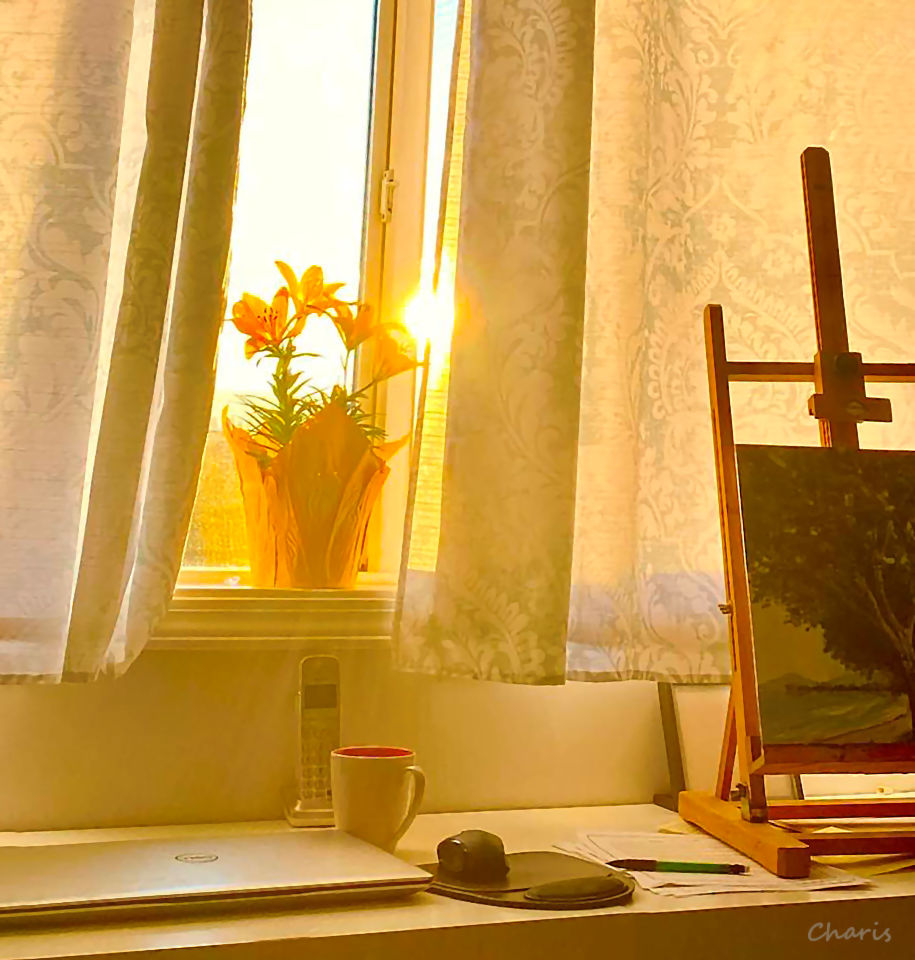
This may be the ultimate in lazy photography. I woke up and saw the sun shining through the window. I liked the way it looked, even without my glasses. I grabbed my phone and snapped a photo –still without my glasses. Who needs focus when the light is right?

Those flowers on the ledge were meant for someone else, but they started dropping petals before I could take them to her. They looked a little past their prime, but not dead yet, so I stuck them on my own window ledge with plans to get her something else. Then the sun lit them, and the whole room, a golden yellow.

I put my glasses on and sat on the edge of the bed. That’s when lines from a song by Kristene Demarco started playing in my head (and heart).

Let me show you what I see.
You can’t dream too big for Me.
So get up, get on your way.
We’ve got things to do today.
Fear not!
If I could say it any louder, I would!

I’ve been feeling discouraged lately. My body can’t keep up to the pace it used to. I’m behind schedule. I should be much further ahead in in spiritual and emotional maturity by now. People around me are excited about new projects and I feel like I’m still knee-deep in mop-up operations. There are things that have been the focus of my prayers for such a long time that are still a mess.

Then I remember that “dis-couraged,” like “dis-graced,” is description of lack, the removal of something that was once there. My heavenly Father no more deprives me of courage than he deprives me of grace. He is the source of courage as much as he is the source of grace — and I have already experienced his lavish grace in weakness.

Thank you, Lord for comfort in the form of a sunbeam and a song. Tears of joy come in the morning.

Invitation

We are confident that God is able to orchestrate everything to work toward something good and beautiful when we love Him and accept His invitation to live according to His plan. (Romans 8:28 NIV)

I’m not a morning person. I never have been. Lately, it’s becoming more difficult to get moving in the morning, but my husband needed me to drive him to an early meeting. On the way home, I impulsively decided to see if my favourite garden was open. It was, by a minute or two. The sun revealed colours I hadn’t seen on the gate before.

“Come away with me,” I heard.

I hadn’t planned to go. In fact, I was grumbling about pushing through the pain to get moving and accommodate another person’s agenda.

I heard the invitation.

I said yes.

It was so beautiful!

Every Movement of My Heart

Lord, you know everything there is to know about me.

You perceive every movement of my heart and soul,

and you understand my every thought before it even enters my mind.

You are so intimately aware of me, Lord.

You read my heart like an open book

and you know all the words I’m about to speak

before I even start a sentence!

You know every step I will take before my journey even begins.

Psalm 139:1-4 TPT

I took one of those personal trivia quizzes that pop up every once in a while on social media. Yes, I know they are designed to search for data that sells us (the product) to potential advertisers. They might think they know me, but they don’t. Not really.

The test asked about hidden talents. I wrote “invisibility.”

Not long before, I ran into some people I had grown up with. We were either in the same class at school or in the same Sunday School class or youth group for years. One person I had known well and spent time with a couple of times a week for sixteen or seventeen years, couldn’t remember me, although she remembered my cousin with the same surname who had only lived in the same town for two years. Another guy vaguely remembered me as the really quiet girl who was the friend of the really brainy girl. That was at the same school where a teacher insisted to my parents that I wasn’t in his class. When they pointed out my name on the register he said, “Well then, she ought to learn to speak up.”

I have learned to speak up, much to the chagrin of those who complain that now I talk too much. They are right, but my response to that criticism tends to be to want to put on the invisibility cloak of my childhood again and try to content myself with watching life from the shadows like I did before I let God heal the shame that held me there so long. Sitting in the dark singing another chorus of “Nobody Likes Me” is not nearly as uplifting as singing a chorus of “Jesus, Lover of My Soul.” It’s not a healthy response.

The truth is nobody but God really knows us; we don’t even know ourselves. The search for connection comes from the search for our Creator who knows everything about us and still loves us. He is not disappointed in us because he had no illusions about our state in the first place. It has always been his intention to save us from the messes we have made and the resulting consequences of guilt and shame.

To be known and understood and loved is joy. Without God we are in a constant state of looking to other imperfect people or inanimate things to fill our built-in need for love from someone all-knowing and totally trustworthy, someone who truly knows us, someone who sees the ugliness but moves to bring out the beauty he placed there.

Steffany Gretzinger sings about the joy and hope in being known and loved by Love Himself.

Today

There is something particularly precious about the last flowers in the garden at the end of the season. We know the frost will show up one of these nights.

Sometimes we can sense a change in the atmosphere, a shifting in the angle of light, a different scent in the air. Change is coming.

Change means we eventually may need to let go of the rewards of past efforts, but today we stop and admire the beauty in this moment. Today we thank God for his faithfulness. Today we sing.

Golden

I went for a walk down in the lakeshore district this week. It’s getting harder to walk very far, but as I passed under a bower of heart-shaped golden leaves in the warm golden sun beside a golden house, I looked up and smiled.

The golden years are not a time to measure accumulated losses of youth and potential. The golden years are a time to celebrate the accumulated goodness of God and give thanks for his continued faithfulness.

Golden hearts? Yes, I see them. They are lovely! Thank you, Lord! I love you, too.

Oh Thou In Whose Presence My Soul Takes Delight

Only a few weeks ago, this patch of lavatera flowers springing forth like a delightful fountain of pink joyfulness was a barren patch of dirt.

I didn’t plant them, nor did I water them. I saw them growing in the community garden next to our building. A gardener who rents the plot planted them in amongst practical and edible kale and beans and tomatoes. These flowers don’t have 300 uses like the peanut or end up in a myriad of product like corn. Their only role is to simply be beautiful and to lift the spirits of those who pass by.

I am learning to stop and appreciate beauty when I see it. I also appreciate those who develop varieties of plants suitable for local environments and resistant to pests and disease. I appreciate the tillers and planters and waterers. I love the ingenuity and creativity of inventors and developers.

I most appreciate a God who created beauty to inspire us to create beauty. I appreciate soaking in the beauty of his presence when it serves no other purpose than show me I am loved and that a good Father loves to give good gifts.

When affliction comes (and he said it would) a patch of pink flowers, rising up from the soil that lay dormant for so many months, can remind us that God is good. Beauty says hope restored is a tree of life.

The song in my head today:

Even When Bad Things Happen

I am thankful for Facebook. There. I said it. (I’ll skip the ubiquitous qualifying note here because this is about what I am thankful for.) Today I am simply thankful for the “Memories” feature. I keep a journal, but not like my dear aunt who kept daily records of weather, newsworthy events, and activities that included extended family members. Someone needed to keep track of my adventurous Grandmother’s whereabouts.

I write in my journal about ideas, dreams and visions, observations, questions, word studies, encouraging sayings, potential projects, scripture passages that catch my attention, prayers, and concerns (aka obsessive worries). Some days I write nothing. The blank page may be the consequence of busyness or idleness – or worries on repeat. It may be because I am avoiding processing something that messes with my theology or reveals lies I have told myself. Consistent with my meandering ways, my journal is like a disorganized collection of sticky notes inside a cover. Sometimes I post these thoughts somewhere in a gesture meant to ask readers, “Do you know what I mean? Am I the only one?”

Facebook Memories organizes my random posts by date. I can see where I was on the journey in mid-July from year to year. It allows me to check progress and notice patterns. I am surprised by how often the same topics appear around the same time of year. What truly surprised me this week was how often I have faced serious challenges (aka utterly terrifying Oh God Oh God Oh God days) in mid-July. It’s like my personal Tish B’av, the traditional time of disastrous occurrences in Jewish history.

Stories from the past fourteen years that showed up in Memories this week:

  • My friend’s child was killed when a tire blew on their vehicle while the family was on vacation.
  • In the midst of helping my father downsize for his reluctant move to an assisted living suite, I received word that my husband was extremely ill with a pancreas that was digesting itself and he would need to be flown to another city for emergency surgery.
  • A friend of a friend lay dying in hospital from sepsis. He wasn’t expected to make it through the night.
  • My daughter-in-law posted a photo of muddy belongings removed from their flood-ravaged house and piled in the street for removal by dump truck.
  • I was making the rounds between radioactive claustrophobia-inducing scans and specialist surgeons and anesthetists in different cities finding out that the “little tumour in my tummy” was going to be much more complicated to remove than I was first told.
  • I was recovering from surgery on my toe which, bizarrely, was more handicapping and painful than the cancer symptoms at that moment.
  • My friend’s child’s heart stopped on the operating table while undergoing surgery for severe lung infection in a country on the other side of the world. Doctors revived him, but his prognosis was very poor.
  • My two precious grandchildren and their equally precious parents parted for their new home on other side of the continent. I did not know how long it would be before I would see them again.
  • We spent a traumatic day in yet another hospital watching my husband’s younger brother suffocate to death from lung cancer.
  • My friend was in constant agony after an accident five years earlier. After begging him for help, a surgeon was willing to try one more thing.
  • I was in the fourth month of a five-month long “atypical” headache. It left me unable to travel or do much of anything but learn to moan quietly.
  • Injury to my knees and arthritis in multiple joints made it difficult to live in our house with stairs or tend the garden or go for hikes in the mountain forests I loved. We knew we needed to move, but I couldn’t work longer than ten minutes at a time to downsize and prepare the house for sale. The task felt overwhelming.

As I looked back, this part of Psalm 34 came to mind: “The Lord is close to all whose hearts are crushed by pain, and he is always ready to restore the repentant one. Even when bad things happen to the good and godly ones, the Lord will save them and not let them be defeated by what they face.

July may be my traditional disaster month, but it is also the month of learning dependence on God and watching him come through for me — and the people I love. Remembering how God came to our rescue after the event is so much easier than feeling the shock and pain of the moment when bad news plops itself on the doorstep.

Sometimes answers to prayer come quickly. Sometimes it takes so long it feels like God’s whereabouts are unknown and I can’t call my aunt to tell me where he is now. Sometimes the challenge itself is an answer to prayer because we’ve gained skills and the ability to endure through perseverance and deeper faith in God’s faithfulness. Sometimes the situation is the means to open our eyes to how God sees us and his confidence in us. Sometimes challenges result in better definitions of success than we assumed before.

  • The friend of a friend with sepsis, the child on life-support, and the woman with severe back pain were all healed within days. My husband’s dire condition suddenly improved and he didn’t need surgery after all. The problem never came back.
  • With a lot of work and help from people who demonstrated practical love, our son’s family’s house was restored to better than new condition within two years.
  • The tumour in my gut (and other places the cancer had spread to) were removed without complication and there has been no progression for five years. The toe is still attached and doing its job. The doctor prescribed a medication that successfully prevents the headaches from starting.
  • Our grandchildren and their mother visited us this week after 941 days of separation.
  • Many wonderful friends stepped in to help us move. We sold our house before it was even listed to a couple who will continue to fill it with songs of praise to a good, good Father.
  • A man I met from a country where Christians face death from persecutors daily said, “You Christians in North America sing about the joy of being with Jesus and meeting him in Paradise, but none of you seem to be willing to go there. We rejoice for those who now know what eternal life looks like from a higher place. My father, my friend’s son, and my brother-in-law were trusting Christ to be their saviour. I believe they are all happy and healed in the presence of the Lord. I’ve learned that God heals the broken-hearted and grants peace.

The life of a Jesus-follower is not always easy. He said we could expect the same kind of reception he had. We can also expect the teaching and discipline of a good Father who knows the difference between love and indulgence. If we want Jesus’ peace that passes understanding, there will be times we have to relinquish the right to understand.

I’m facing challenges again in this month of July, 2022. For the sake of privacy of others involved I will just say this much: I agree with Paul’s prayer for myself, for my loved ones, and for you: “… I always pray with joy because of your partnership in the gospel from the first day until now, being confident of this, that he who began a good work in you will carry it on to completion until the day of Christ Jesus.” (Philippians 1:5 – 6 NIV)

Yet when holy lovers of God cry out from all their troubles

The Lord is close to all whose hearts are crushed by pain,

and he is always ready to restore the repentant one.

Even when bad things happen to the good and godly ones,

the Lord will save them and not let them be defeated

by what they face.

(Psalm 34:17-19 TPT)