
Has it ever occurred to you that nothing occurs to God?
– Adrian Rogers


It’s raining. Again.
This may be the coolest, wettest July I have experienced in years. Our grandchildren are here and we have not been able to hike or go to the beach even once. The sun comes out and by the time we get our act together it’s raining again.
Now when you live in the middle of thousands of hectares of fuel in the form of forest summer rains are usually welcome – except when you want to go to the beach with the kids. This is unseasonable. Different.
This morning I read about an explanation of the Greek words of a phrase in Romans 5:20 – “but where sin increased, grace abounded all the more.” The tense here means sin that is continually increasing. It also means grace that is continually increasing exponentially more.
Grace upon grace upon grace…
This has been a week where we have seen sin increase. Shootings, riots, the murder of innocents, the fall of trusted leaders, the exposure of faulty foundations, division, exploitation, panic…
It’s horrible actually. To all appearances sin is increasing and there is nothing we can do about it except (as some propose) to await for for evil to gain so much control over the world that God will zap his people off the planet and leave the rest to their own devices.
The good news is: grace is also increasing – faster and bigger. He has plans for our good. He is not defeated.
(And no. I do not define grace as license to sin so let’s just get that out of the way right now. Grace is the means by which we are changed to become fully who God intended us to be.)
I asked the Lord (trying not to use my pouty voice), “What’s with all this unseasonable rain? At the moment it is so loud on the roof it’s drowning out our conversation about how terrible the news is today.”
Then I hear a line from a song:
“Hallelujah! Grace like rain falling down on me…”
Thank you, Lord! Grace in abundance like showers that keep coming and coming and coming is available when sin in abundance keeps coming. But grace is greater. Greater than evil. Greater than despair. Greater than pain and loss. Grace that is greater than all our sin.
When we are tempted to return hate for hate grace enables us to return good for evil. The fruit of the Spirit has to be a supernatural response from heaven or it is merely more human effort. And seriously, how have our own efforts been working for us in this season?
It’s time to turn from our own methods, access the grace for change that flows from the throne of God. It’s time to see the salvation of our God. This is the season of abundant rain.

God has more for us than we can ask or even think.
Just ask.

I know now, only one summer later, why this outdoor bench was on sale. I need to scrape it down and re-paint it already.
At first it fit the landscape plan perfectly. Now? I really need to paint it.
Sometimes the Lord gives us places to sit and enjoy the scenery on this spiritual journey and they are good places to settle – for a while. Sometimes we discover, when the paint chips off, that we need to get up and pursue a closer relationship with God, a better understanding, a sturdier orthodoxy and more effective orthopraxy that can handle new situations we encounter.
I overheard this discussion between sisters, one three-years old and the other seven-years old.
“I came out of Mommy’s tummy!”
“No. You came out of her uterus.”
“Tummy!”
“A stomach is for digesting food. You couldn’t have been in her tummy or you would have come out like poop.”
“I am not poop!”
“That’s because you grew in her uterus not her tummy!”
“Mommy said! I was in her tummy and you were in her tummy too!”
“Uterus. Or sometimes they call it a womb, but it’s not a tummy.”
“Mommy! Daisy is lying!”
I’ve seen a lot of discussions between Christian adults take a similar turn lately. When we are learning the basics of life the knowledge that babies come from mommies’ tummies is profound enough and a good place to settle. There is grace for that level of understanding when we love and respect each other. There is also grace for people who have settled on the next bench, and the next, however temporary those positions may be as they continue to journey.
You should have seen the expression on my grandson’s face after his dad told him how babies got in there. “Oh Grammie, it’s nasty! Just nasty! You wouldn’t believe it!”
Some information is too heavy for toddlers. It’s hard enough to hear when you are school aged – or even grandmother-aged. But you can’t avoid that knowledge forever, and it’s best you hear it from parents who are vested in your long-term well-being.
Simple explanations are good enough for babes in faith. Some people are happy to settle there indefinitely and will insist you agree with them. The explanations they are contented with are not untrue (tummy can be a pretty general term), but there is more to be learned in time. When the Lord teaches me something new I am sometimes shocked. I feel unsettled, unsure. I don’t have a grid for it. There is a period of letting go of old incomplete concepts to make room for things I just don’t get yet. For a person who has had trust issues and accepts change slowly this can be a challenge. What do you mean it’s a little more complicated than what I thought?
As the Lord is giving me a more in-depth picture of his holiness and the utter horror and ugliness of sin and how it leads to death, he is also giving me an increasingly overwhelming picture of his majesty, grace and a love I cannot comprehend. It’s a shocking paradox that only makes sense when viewed from where he sits. This requires some adjustment to my thinking. It’s too massive a concept to grasp all at once.
You go before me and follow me.
You place your hand of blessing on my head.
Such knowledge is too wonderful for me,
too great for me to understand!
(Psalm 139:5,6 NLT)
I want to understand more. I need much better insight. How can God continue to love people who reject him and hurt each other? How can I do that when I’m disgusted by my own attitude sometimes, let alone the attitude of people who hate me for not agreeing with them? How do I love? What IS love, anyway?
This morning I pray with the cry of the Psalmist:
Let my cry come before you, O Lord;
give me understanding according to your word!
Let my plea come before you;
deliver me according to your word.
and
The unfolding of your words gives light;
it imparts understanding to the simple.
I open my mouth and pant,
because I long for your commandments.
Turn to me and be gracious to me,
as is your way with those who love your name.
(Psalm 119: 169, 170, 130 – 132 ESV)
I don’t understand, but You do, Lord. I trust You.
Maybe I should use a hardier paint on the bench this time. Boat paint?
As the reflections of our pride upon our defects are bitter, disheartening, and vexatious, so the return of the soul towards God is peaceful and sustained by confidence. You will find by experience how much more your progress will be aided by this simple, peaceful turning towards God, than by all your chagrin and spite at the faults that exist in you.
– Francois Fenelon
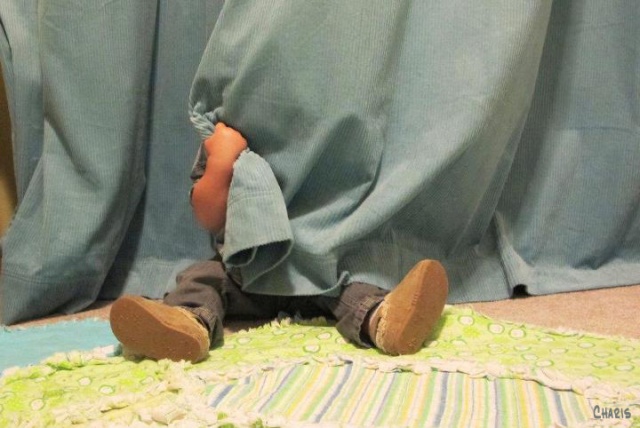
A few years ago, when he was a wee lad, a child I know and love was becoming accustomed to the concept of both freedom and taking increasing responsibility for his choices. I watched him as he encountered one of the first steps to maturity: potty training.
Spiderman underwear was fun to wear and all, but sometimes the burden of getting up and walking away from the sandbox or the Lego blocks when he was in the creative zone was too heavy. Sometimes you don’t know what your limits are until you’ve passed them. And he passed them.
We noticed (eventually) that in moments like these the little guy disappeared. We went looking for him. His daddy called and called but he made no response. Finally, following his nose, his father found him hiding, sometimes in the closet, sometimes behind the furniture, sometimes behind the drapes.
You see, part of the problem was that he had an older sibling, a sibling who taunted him with, “You’re in trouble now! Wait until Daddy gets home! You’re in for it.”
Daddy was perhaps disappointed, but not angry. He understood the weakness of little boys. He did not expect perfection in the learning stages. He wanted his son to succeed and he loved this little boy with a love so big he would have laid down his life for him. Poopy pants was not a deal breaker.
I realized one day that this is often our reaction when we fail to live consistently with changes we want to make in our lives. Like the wee lad we run and hide in shame from the only One who is able to clean us up and set us back on our feet in a refreshed state. Sometimes we sit alone in the closet in poopy pants for days, or even years, avoiding the very One who offers us mercy and forgiveness. Our heavenly Father loves us so much. He is not surprised by our weaknesses but wants to help us gain freedom from stinky habits by showing us a better way.
Lately I’ve been aware of older sibling-type people who get out their social media megaphones and preach the bad news of “Wait until Daddy gets home! You’re in for it now!” For some reason they are surprised when people don’t run in the direction they suggest. Instead of encouragement older brother-types tend to heap on larger and larger piles of shame that keep those who cannot keep up to standards hiding in dark places.
Jesus Christ says, “Come to me if you are weak. Come to me if you find the burdens placed upon you too heavy. Come to me and I will give you rest and peace in your lonely souls because I am meek and lowly of heart. I am willing to get down to your level and put my arms around you and love you just as you are, poopy pants and all. Let me clean you up. There is so much more I want to show you! Let’s do this together.”
It’s called grace. Amazing grace.

I bought my granddaughter a jewellery-making kit with 25,000 colourful beads. When I took it out to wrap for her birthday, I thought a while, then put it back in the closet and bought her something else. I was pretty sure she would like it, that was not the problem. The problem? A little sister who got into everything and sometimes put those things in her mouth. Depending on a child’s age this box contained either 25,000 pieces of potential pretty jewelry or 25,000 potential choking hazards.
I was also an eldest child. I know what it’s like to have younger kids’ needs veto mine, but I looked at my granddaughter’s harried mother and her incredibly curious toddler sister and decided to choose safety this time.
But it bugged me. It wasn’t just the memories of having to forego activities because of offendable siblings (because as a mother and grandmother I’ve done this many times without complaint); this time it triggered something else. I realized it represented another problem I am struggling with – when potential choking hazards limit older believers’ spiritual growth, when topics are kept simple to avoid offending people who are still toddlers in their spiritual growth (and I do love toddlers).
Many years ago I volunteered to help a large family. I assumed the mother must really like kids to have so many.
“Actually it’s the babies that I love,” she told me. “When they start getting independent my arms feel empty. I just adore cuddling babies. I can’t imagine home without little ones. They are so much easier to manage than teenagers. If they don’t want to move you just pick them up and move them yourself.”
I looked around. This home was completely centered on the needs of the youngest children. No potentially dangerous toys or tools and definitely no boxes of beads or junior chemistry sets. The older children were expected to look after the younger. Some of them were remarkably responsible. But some of the teenagers were unhappy and rebellious. No one had time to encourage their individual interests and talents or listen patiently to questions that would lead to long that-depends kinds of conversations. They were set adrift to learn on their own. Some of the older kids did not fare well. They left home as soon as they could, but lacked preparation for life outside the nursery.
I realized that some church communities I have been part of could be a bit like this. When the emphasis is on producing new Christians and teaching them only to the point where they can turn around and serve the needs of the less mature, a kind of stunted growth becomes the norm for some and restlessness begins to emerge in others. Often those who fit into the niche of evangelism and service giftings are happy. Often those who tend to pose hard questions are not.
Service is a very worthwhile undertaking. The problem arises when older “children” in the family lack the opportunity to go beyond the basics, to learn about and explore everything Jesus said and the apostles taught, when they are expected to be satisfied with milk because meat is a choking hazard. They don’t develop discernment because the messy stuff and complicated stuff is kept on a high shelf in the back of the closet, or out of the house completely. The result is often apathy, vulnerability to the world’s philosophy, learned helplessness, and a whole bunch of people dependent on an overworked pastor/parent figure who is just trying to maintain a safe environment where everyone can play nicely.
The writer of Hebrews expresses it this way when trying to explain a deeper understanding of Christ-centered faith: We have much to say about this, but it is hard to make it clear to you because you no longer try to understand. In fact, though by this time you ought to be teachers, you need someone to teach you the elementary truths of God’s word all over again. You need milk, not solid food! Anyone who lives on milk, being still an infant, is not acquainted with the teaching about righteousness. But solid food is for the mature, who by constant use have trained themselves to distinguish good from evil. Therefore let us move beyond the elementary teachings about Christ and be taken forward to maturity… (Hebrew 5:11-14; 6:1 NIV)
Some of the “elementary teachings” mentioned later in this chapter are not even taught as basics in a lot of church family circles these days. More complex concepts can’t be packaged in a Sunday morning twenty-minute sermon or a week day Bible study with accompanying fill-in-the-blank, tell-me-what-the-author-thinks-verse-six-means study guides. Some questions have answers that require years-long conversations and don’t fit into blanks designed for one sentence. Not even close.
Research shows that a large category of people leaving institutional churches are the ones who have served for years. They are actually looking for more God. (A.B. Simpson called it “The Deeper Life” and in his day had to leave the established church in which he was ordained to pursue it.) These folks are not saying “I’m done with faith.” They love the Church – the body of Christ, the family of God. They are just saying, “Hey, wait a minute. Is this the glorious church, or is there more, Lord?” They often feel torn between love for family and a drive to pursue more.
If you’re looking for an answer to the question of how to be considerate of people yearning to learn and grow to maturity as well as nurturing new believers vulnerable to choking on hazards or frightened by voices who don’t agree, I don’t have one – only more questions: What is love? What does grace look like in a household of faith? When do we emphasize security and when do we exemplify freedom? How does honour build everyone up to become God’s temple of living stones?
All I know is that a loving family is concerned about making disciples and equipping all its members to be everything God intended them to be. And we have room to improve.

The Lord is my Fierce Protector and my Pastor.
I always have more than enough.
He offers a resting place for me
In His luxurious love.
His tracks take me to an oasis of peace,
The quiet brook of bliss.
(Psalm 23:1-2 The Passion Translation)
“Pastor” means shepherd. This translation of the beloved twenty third psalm made me think about the Good Shepherd who is, of course, the The Good Pastor.He is the model for ministry.
Until his retirement we were blessed by one of the best pastors I have ever known. He didn’t draw attention to himself, but rather always pointed to the Lord. He worked hard to create a peaceful, safe place for those in his care to rest, to be comforted, nurtured, healed and to grow in the luxurious grace and love of Jesus Christ.
Thank you, Ron.

The sinner is not the one who uses a lot of grace…
The saint burns grace like a 747 burns fuel on take off.
-Dallas Willard

It’s not winter and it’s not spring and in the valley the fields are pretty ugly (oxymoron intended).
Signs of spring are few; some crabgrass is getting a head start on the gardeners, a few little crocus pop up close to the house, and tiny tiny yellow buttercups bloom in the meadow. I take my camera and go out looking for evidence of change, but to be honest, in this shoulder season, it’s very drab out there.
The deer like our garden in the winter. They come late at night and bed down under the bare plum tree. You can tell this is a favourite place because when the snow melts the brown grass harbours dozens of piles of deer poop. (I’ll spare you the photo.)
Brown rotten leaves that I never got around to raking, or that fell after the first snows made raking pointless, gather in the hollows. They lodge between grey branches and add to the dullness of barren bushes and empty flower beds.
Shrinking piles of snow in the corners of parking lots in town look like speckled black slag heaps from old movies about miserable coal miners. The accumulated garbage of a season once blanketed by pristine white snow emerges on the boulevard like guilty memories of junk food binges after you realize your jeans are too tight.

Don’t get me wrong. I see hope. There is nothing finer than the first afternoon warm enough to sit in the sun and enjoy a good cup of coffee. But the reality of once hidden things that need to be dealt with is hard to ignore, especially the day the ground in the stockyards thaws out.
It’s an ugly season, but it too is a season of grace.
Sometimes God sends us a gift we are not sure that we want after a while. A revealing season is one of them. Sometimes he melts the blanket of lovely white snow that has been covering a lot of nastiness. He reveals what has been hiding under there all along. Transitions can be ugly.
Sometimes he sends people (and attached circumstances) who seem to promise great things. When they come into our lives we welcome them eagerly only to discover that the great things are not so great – at least not yet. Their purpose (of which they are probably totally unaware) may merely be to reveal debris and garbage and piles of poop in our lives that need to be cleaned up so they don’t distract from the great things when they do happen. They may just be part of the unwitting transition team.
My friend and I were praying for a ministry which was having an important meeting. We prayed that God would move mightily. He did. The meeting fell into shouting-match chaos when old resentments and bitterness were revealed like piles of poop that had been under the cover of cool politeness for years. It got ugly. They could not move on until things were cleared up. The board members, being thoroughly humbled, set about to do that.
 We don’t always appreciate that a promising new boss, who turns out to be more difficult to work with than the last one, or a new political leader, who seems to be more inept than the former office-holder, may actually be in our lives for a reason. Their whole purpose (of which they are probably totally unaware) may be to be the agent that reveals the garbage we need to deal with and the brokenness that God wants to heal next. They may also be a part of an unwitting transition team.
It can be an ugly season when unpleasant stuff is revealed, but we don’t need to lose hope. In time the valley will bloom again. Watch for the signs.


I find languages fascinating. Why is it that some languages have big fat dictionaries and some have thin? Why do some people need more words than others?
A woman I knew who worked for an international charity learned after one year in language school that she was being assigned work in a different country. Most people would have groaned and been upset with time wasted. She was relieved.
“That language has no polite words!” she said, exasperated. “There is no please, no thank you, no sorry, no kind way to express sympathy. I will be glad to move on.”
In the next language she studied greetings took ten minutes. “And how is your father-in-law? Are your she goats pregnant? Is your second nephew well? And your third nephew, is he well?” Since she is a people person she was much happier and didn’t find these rituals cumbersome at all.
I stayed with my daughter while she was living on a tiny Caribbean island. I never got used to the accepted phone etiquette there.
Ring.
“What you want?”
“Oh, um, hello. I hate to bother you, but is Tina there please?”
“Tina not here.”
Click.
The first time I used the phone I thought Tina’s father was an angry man. Then I discovered nearly all the people born on the island spoke the same way, even in the marketplace. They had no problem with it. They wondered what was wrong with me.
My husband spent some time in the deep south of the United States as a guest lecturer. “Not only do they talk slowly, they act like they’ve got all day. They’ll tell you story after story and offer more drinks until you can’t hold it anymore, then they will finally say what they intended to when they offered you a seat,” he told me when he got home. “Great folks, but how do they ever get anything done?”
“What did they want to tell you?” I asked.
“That I am too blunt with the students and I need to be more sensitive.”
I laughed. My parents both spoke English but they came from cultures with different communication styles. In my father’s hometown no one broached the subject they came to talk about until the second pot of coffee was on the stove or until a hand was on the door knob on the way out. My mother’s ethnic background required a person to make their point quickly and clearly so a person could get on with their work – and there was always work. Dad thought Mom’s family was shockingly blunt. Mom thought Dad’s family was frustratingly long-winded. (I take after my Dad, but I can switch and be ruthlessly direct when under pressure.)
Mom, bless her heart, set herself to the task of learning “tact.” It was not a skill that came naturally, especially since she didn’t understand why some people took offense so easily. “She asked me if I liked her new hat and I said it looked silly on the side of her head like that. It made her head look crooked. I straightened it for her. Well, she asked me. Did she want me to lie? She didn’t have to go off in a huff!”
Mom meant well.
There are two sides to communication: what was intended and what was perceived. If only they were the same.
I’ve run into people who really have to work at understanding that other people perceive differently. Whenever I hear them start with “I don’t have time to say this nicely so I’m just going to say it,” I know it’s time to raise the shields. Incoming! Sometimes “I don’t have time to say this nicely” means “I don’t know how to say this nicely,” and sometimes it means “I can’t be bothered with going to the effort of caring about your feelings.”
They may have meant well. Or they may not. The message could have been a valuable one, but it was lost in translation either way.
Then there are people who enjoy getting a rise out of folks. Their words are intended to be like pokes, or even like the rash thrust of a sword. They are meant to provoke an angry reaction, because to them, an angry reaction is better than no reaction at all.
Then there are those who go on and on and never notice polite smiles starting to droop or eyes furtively checking watches. The message is as lost as a misfiled book in a four story library. (Sorry about that.)
Words seasoned with grace have the hearer in mind. Speaking with grace means honouring the hearer, taking the time to consider how they perceive the message and bringing healing to a heart. It’s about love. Grace usually is.
Let your speech always be with grace, as though seasoned with salt, so that you will know how you should respond to each person. (Colossians 4:6 NASB)
There is one who speaks rashly like the thrusts of a sword,
But the tongue of the wise brings healing. (Proverbs 12:18)
A gentle answer turns away wrath,
But a harsh word stirs up anger.
The tongue of the wise makes knowledge acceptable,
But the mouth of fools spouts folly. (Proverbs 15:1,2)

Then he came to his senses and cried aloud, ‘Why, dozens of my father’s hired men have got more food than they can eat and here I am dying of hunger! I will get up and go back to my father, and I will say to him, “Father, I have done wrong in the sight of Heaven and in your eyes. I don’t deserve to be called your son any more. Please take me on as one of your hired men.”’
So he got up and went to his father. But while he was still some distance off, his father saw him and his heart went out to him, and he ran and fell on his neck and kissed him.
– Jesus, from his story of The Father’s Prodigious Love.


 Charis: Subject to Change