Change my heart, oh God
Make it ever true
Change my heart, oh God
May I be like You


Photo: Colouring in and outside of the lines

I have the joy of caring for two of my grandchildren this week. They teach me so much.
The three-year old (I’ll call her Daisy) is full of profundities and observations on life. When she said she was hungry I suggested we could take a peek in Nana’s pantry to see if we could find something good for a snack. She looked at me suspiciously, then said softly to her mommy, “But I don’t want to take a peek in Nana’s panties.” (Please read the scenario again carefully if you feel the need to accuse this red-faced granny of improprieties.)
Daisy teaches me about the importance of clarification and that people do not always perceive our offerings the way we intend them to be perceived.
When Daisy told me about all the things she could do on her little white table and chair set –like put puzzles together, play with her tea set, and play the matching game– I asked her if she coloured on her table too.
Again she gave me her patient look as she explained, “No. I don’t colour on the table. Mommy doesn’t let me colour on the table. She says I have to use paper or a colouring book.”
Yesterday she taught me about the difference between making a mistake, and sinning. Making a mistake is colouring outside the lines when you are learning to colour because sometimes even when you try hard your hand slips. Being seriously in error — or sinning is when you know Mommy said to colour in the colouring book, but your crayon doesn’t just slip outside the lines. It slips right off the table and across the room and colours on the glass door to the patio. When that happens you need to take responsibility for your deliberate choice and use the damp cloth Nana hands you to scrub the door until your mess is cleaned up.
I read a book review this week by a popular Christian blogger that upset me for some reason. Usually I shrug that sort of thing off, but this felt like an irritating hangnail that kept snagging on my peace for days.
People have differing opinions on literature, of course. Not everyone appreciates a poetic imagery-bound gift. I’ve heard enough left-brained friends bewail subjective marking styles of English teachers to know poetry baffles them. I hear their frustration with trying to guess what they need to do to get an A when there are no answers in the back of the book. It drives them as crazy as the just-the-facts-ma’am, right-or-wrong-answer-at-the-bottom-of-the-page writing style that bores me into a nap on the desk. I get it. Tomayto/tomahto
The critic later issued an apology on his blog, admitting he lost sight of the fact there was a sensitive human behind the words in the book. Wow. A critic issues an apology? There is a God.
He didn’t back down on his stance on “not recommending” the book, however, because he found some things that did not line up with his theological viewpoint based on his and Et Al’s interpretation of scripture. He also used the guilt by association marking pen when the author admitted to receiving helpful glimpses of insight from people and institutions who did not have evangelical seals of approval stamped on their undersides.
Here’s my problem: this book, like many other books, (or youtube videos) experienced unanticipated popularity. It was not written as a theological treatise at the end of a lifetime of study. Should a book presented for use as a textbook in seminary be subject to rigorous doctrinal examination? I should hope so. Should a book that was intended to be a sharing of the author’s personal experience of endeavouring to change her attitude be subjected to the same scrutiny?
I remember having to fill out a workbook for Sunday School class when I was about eleven years old. It had a lot of those frustrating what-am-I-thinking-of-in-verse-six kind of questions, (I always seemed to see something different from my teacher) but at the bottom of the page there was a big open box which allowed room for “sharing” how I felt about concepts covered in the lesson.
I shared.
My teacher marked it with a red X. WRONG.
Wow, that hurt. I remember telling my dad that I would have understood that red X if I answered the other questions wrong, but who gave her the right to mark my feelings as wrong? My feelings and opinions were my feelings and opinions. Should I lie? (Alas I did learn to lie to pastors and teachers. I told them what they wanted to hear for many years after that. Not a good idea. That habit set me up for a lot of wasted time.) What I needed was a loving, mature person to come along side and help me to reach for a higher goal -not to invalidate my attempts at expression.
Art is an attempt to connect with others. A creative writer’s intent may be more about making connection with fellow sojourners than lecturing on doctrine. It strikes me that when communicating some aspect of experience of God in a deeper way, we need to have a little grace space. To grow in grace we need to be in an atmosphere of grace. Does a child’s work need to be perfect before it may be displayed on the fridge? Are we in the family of God not all children in a process of learning? Did Jesus ever say, “Except ye all become as big old experts ye cannot see the kingdom of God?’ (in archaic English just like that.)
Ideas about God and how he created us to relate to him which ignore the manual handed to us (the Bible) raise alarms all over the place for me too. Indeed, there are times when artwork can be the result of a sinful rebellious attitude, when inappropriate scribbles appear on the patio doors, for example, and when those in a position of caring authority need to lovingly hand the author a wet rag and say, “Seriously? Come on, clean up your mess, sweetie.”
While I do not agree with every thing in the reviewed book, and some ideas are definitely discussion-worthy, I relate to the experience of the writer and appreciate the extremely important discovery of having a grateful heart. I do not believe it is motivated by self-seeking rebellion.
One of the hazards of popularity is that works of people in progress can be suddenly elevated to the level of works of studied authority. (The Bible says “Let not many of you become teachers knowing you shall incur a stricter judgment.” It just doesn’t tell you that most of the critical stricter judgment comes from people who consider themselves more studied teachers.)
My point? Art is an expression of where we are at the moment we create it. It is not the final conclusion of a lifetime of learning. Art fills in the big empty box at the bottom of the page where we have a chance to share how we feel about what we have learned. Art asks the observer, “You know what I mean?” If it goes viral on a giant public fridge with greater exposure than we anticipated when we created it, if it becomes extremely popular because a million people connect with it as a familiar stage of learning in their own lives, the onus is still on the reader or observer to use discernment. I wonder about the need of self-appointed guardians of perfect theology to tear it down publicly and give it “not recommended” status because they do not like the creator’s style or question whether it has stayed within lines the artist may not know about.
Worship of anything or anyone other than God is always idolatry. Yes, pop culture can promote idols, but to assume that a popular work will become an unexamined object of idolatry to other believers is to assume people observing the art are far less discerning than the critic. In an attempt to protect the naive by issuing a public judgment and condemnation of a work for failing to be something it never claimed to be, the present handed to us may not necessarily be a gift tied up in ribbon. It maybe just be an arrogance-bound box of envy.
In my humble imperfect opinion.

Photo: Dogs have masters; cats have staff.

This morning I read in Romans about how God used Pharoah. It says God actually raised Pharoah up to that position for a reason. I wonder if God allowed a megalomaniac to rise to a position of power because it was time for a public show-down with a human who actually believed he was in charge. God told Moses what to do and what to say, then added, “Oh, by the way, Pharoah won’t listen.” Moe probably felt like middle management.
Pharoah refused to change because he refused to learn. He arrived at the point of contact with Moses and Aaron in a state of being incapable of changing his mind.
It just so happens this cat in the photo is named Ramses, after a Pharoah of Egypt. He is an exceptional cat because he does play fetch — with an alarmingly realistic replica of a dead mouse — but he deigns to participate in this exchange with us mere humans on his own terms and in accordance to his mood swings only. He performs for no man.
His demeanor reminds me of people who consider themselves to be experts in all fields which matter. If they are not experts in a particular field, it is because that area, in their opinion, is not of importance.
Like most cats, Ramses is not known for his eagerness to learn new tricks. (Can you tell I’m a dog person –although I admit a certain admiration for his regal bearing and alluring appearance.)
The Bengal breed is beautiful. Their markings remind us they are not that far removed from the wild. They are gorgeous animals and tend to be more aloof than the typical house cat, but like most cats they are not compliant. They are not meek. Woe betide if breakfast is late.
I don’t think , when meekness is mentioned as a positive character trait in the Bible, that it refers to a doormat, a milk toast, or a namby pamby, wishy washy victim. I think it refers to a person who humbly admits he or she is not an expert, but is confidant in her or his potential and knows she or he is capable of learning.
I love this description of meekness. A meek person knows how to lose nobly at chess. He does not distract his opponent and tip the board or demand best of three or twenty-three or a hundred twenty-three grudge matches. When confronted with a check he lays down his queen and says, “You are better than I am, but I can learn. Teach me.”
Don’t mistake meekness for mildness or timidity. True meekness is unswervingly honest, ferociously courageous and undauntedly thorough. Meek people are never resigned to hopeless stagnation in mental, emotional or spiritual slavery. They realize that gain comes through the willingness to let go of lies which have remained unexamined for too long.
A lack of meekness was the central weakness in Pharoah’s character. He was the victim of an attitude that was not teach-able. It was an arrogant attitude that mistook stubbornness for perseverance. I believe the attitude developed as his own original choice, but after it became entrenched, God chose to exploit it, and hardened his heart further. Only God knows at what point some people’s rebellion solidifies into unmovable arrogance. Not my job. Not going there.
My job is to remain soft-hearted, malleable, willing to admit ignorance, and to be confidant that I am capable of learning — meek. My job is to be honest about my weakness and co-operate in the mind renewing process.
But his reply has been, “My grace is enough for you: for where there is weakness, my power is shown the more completely.” Therefore, I have cheerfully made up my mind to be proud of my weaknesses, because they mean a deeper experience of the power of Christ. I can even enjoy weaknesses, suffering, privations, persecutions and difficulties for Christ’s sake. For my very weakness makes me strong in him. 2 Corinthians 12:9, 10
Photo: Railroad tracks near Bummer’s Flats

I had tea with a friend this morning who told me this story. She and her husband were sitting on their lawn chairs enjoying the beauty of a warm evening last week when her husband had an urge to pray for the safety of the visitors coming to the area in the next few days. So he did. She asked him why he did that; he’s never prayed for tourists before. (Locals are more likely to complain about being stuck behind stubble-jumpers hauling enormous trailers on our winding mountain roads. The poor folk seem to be afraid of any drop-off deeper than their gum boots.) He shrugged and said he didn’t know. He just felt he should. Then they went on enjoying the beautiful quiet together.
The next day their friend, who is a train engineer, was bringing a train through the valley. A young man from Alberta had apparently become so drunk he sat down on the train tracks, then fell asleep right there. The engineer immediately tried to stop the train when he saw him and realized it was a person, but of course could not do it in time. When it did finally stop he and another rail road employee reluctantly climbed down from the engine to go look for body parts. What they found absolutely astonished them. The man was alive and still sleeping. 26 loaded cars had passed over him. When they called to him he woke up! 26 freight cars with screeching brakes passed over him and didn’t wake him up -which is just as well. If they had and he had moved his head or a limb even slightly they would have been chopped off, but he was totally unharmed.
Wow. Wow. Wow. God is good. Pray for this guy. I do believe God preserved him for a reason. Apparently he survived another accident in the same place last year.
We also praise God for the conductor who is due to retire in a few weeks and has never had an accident. God preserved him and his assistant as well.
And pay attention to those urges to pray.
Photo: Kananaskis country
 Behold the kindness and severity of God. Romans 11:22
This phrase doesn’t sound like praise, but I mean it to be.
A person cannot truly appreciate this mountainous country until they have a healthy respect for it. This is no tame amusement park to be entered without consideration; life & death consequences await one who strays from the trails without proper equipment and understanding of the back country. But for one familiar with it’s ways, hiking here is a joyful walk in overwhelming beauty.
So it is with our relationship with God. Awesome, kind, severe, merciful, loving, life-altering beauty so much greater than my ability to comprehend.
His creation, His truth, His rules.
As my husband says, He’s a good listener, but He doesn’t take my advice well – for which I praise Him.
“Because of Your great glory“
Photo: Manitoba highway

While on a recent road trip my husband and I were discussing how discernment should operate in an atmosphere of love and grace. Just then a car pulled out in front of us as it turned left onto the highway. My husband had to hit the brakes to avoid a collision. He let out a heart-felt, “Whew! Lord, help that guy!!”
I felt the Lord say, “Like that.”
As I thought about it, it came to me that our vehicle had the right of way. We were in the right. The vehicle that pulled out ahead of us was clearly in the wrong and it was his responsibility to yield. Had we continued going the speed we were going, and had there been a collision the other driver would have been charged –but we both would have been wounded -probably very seriously.
I realized the Lord is teaching me that in discerning wrong teaching or a wrong spirit we have the option of restraining ourselves, even if we are perfectly right, to makes allowances for a brother or sister’s error in judgment.
I think this person driving the other vehicle just made a bad judgment call. Perhaps they were inexperienced, or tired, or just plain inconsiderate; perhaps they had an emergency we knew nothing about. Now had it been obvious that they were drunk and careening about the road in a grossly unsafe fashion, obviously being a threat to their own or others safety, we would have gotten their license number and called the police. Had the driver been someone under our authority, one of our kids or a student we were teaching to drive, we would have made a u-turn and followed them until we could have pulled them over, found out what on earth they were thinking (or not) and given them a kind but honest talking-to, or even taken their keys if the situation called for it. Had the driver been a close friend we may have done the same, but perhaps would have appealed to them to be more careful.
Sometimes, in the church Body, we are called to do that, but not often. Sometimes we need to warn others, but most of the time we need to apply the brakes, make concessions, let them by, pray for them and trust Holy Spirit to police the roads. He’s the one who brings conviction. Neither party would gain anything by ramming them to teach them a lesson. In fact, both would lose and the journey would be greatly hindered.
It’s not as if no one has ever had to apply the brakes for me. As much as it hurts I’d rather have a friend come along side, pull me over, speak kindly and honestly to me, and bring the consequences of my choices to my attention, than to read about “some people” on Facebook or read a rant about my heretical beliefs on a blog, or overhear “concerns” in a hallway. “Faithful are the wounds of a friend; profuse are the kisses of an enemy.” Proverbs 27:6
Today I read, “…pursue righteousness, faith, love and peace along with those who call on the Lord from pure heart. Have nothing to do with foolish ignorant controversies; you know that they breed quarrels. And the Lord’s servant must not be quarrelsome, but kind to everyone, able to teach, patiently enduring evil, correcting his opponents with gentleness. God may perhaps grant them repentance leading to a knowledge of the truth and they may come to their senses and escape the snare of the devil after being captured by him to do his will.” 2 Timothy 2: 22b-26.
There are, indeed, some reckless, inconsiderate, inexperienced people with too much power out there on the road. Be alert. Be ready to step on the brakes. Drive carefully. Pray.
Painting: Soon

I was sitting at my computer, performing some boring task like deleting old emails, when I heard this word in my head: CAMBIUM LAYER.
Well, that was weird. I ignored it.
A little later I heard it again. CAMBIUM LAYER. It was quite clear. I hadn’t run into that word since biology class nmpfm years ago.
Sometimes God talks to me (and no the TV doesn’t talk to me and I don’t wear a foil hat.) I’ve only recently stopped apologizing for it. If that upsets you, just move along. This is not the post you are looking for.
I think He talks to a lot of people, but when we ignore the message, or dismiss His still small voice as stress or too much pizza, He stops talking to us that way and moves on to plan B. This time I knew it wasn’t pizza talking. I’m allergic to pizza –both crust and cheese. Haven’t eaten it in years.
But like Peter, the devil has lied to me, and although I’m getting better at telling the voices, dreams, and loud thoughts that seem to come out of nowhere apart, nevertheless it is wise to judge this offering with the spiritual discernment God has given you and check to see if it lines up with scripture.
I answered this word with my usual deeply reverential response.
“What???”
I was surprised to read a footnote in my study Bible. In 1 Corinthians 13 (yes, the love chapter) a Greek word used in the verse about seeing “through a glass darkly “ is ainigma (enigma). My margin notes said, “As in a riddle”. J.B, Phillips translates it: At present we are men looking at puzzling reflections in a mirror.
I consulted a Koine Greek expert and he said the word implies a puzzle that needs to be pursued and is worthy of study. So I pursued, puzzled and studied “cambium layer.”
The cambium layer is the new growth layer of a tree. It carries the sap to the leaves, flowers and fruit. The cambium layer, when its season is done, forms another ring which is added to the wood of the trunk and branches.
A few days later I had an urge to take my camera to my friend’s orchard. Their orchard is quite unique; this friend’s specialty is growing as many varieties of apples as space and our climate will permit. He preserves old varieties of apples as well as experimenting with new hybrids. “Jake” has one tree with six varieties of apples growing on the same tree. He showed me how he grafts them in. All his trees are grafted onto old hardy roots that have proven ability to withstand Canadian winters.
“When I graft in a new branch I cut down to the cambium layer in the trunk or in a thick branch.” He said.
“Cambium layer, you say?” He had my attention.
“Yes. The new branch must form a connection to the growth layer or it won’t receive any sap and will starve.”
I leaned in for a better look. Some grafted branches looked like sprained ankles, strangely swollen, protruding at odd angles and supported by what looked like bandages and even crutch-like sticks which held up them up.
“It’s tricky,” he said. “If you put it in too deeply, into the old wood, the graft will fail to take. If it’s not deep enough the bark won’t form enough scar tissue around it to hold it in.”

“Tell me more about the cambium layer,” I said.
“You can make quite a few cuts into the cambium layer. Even a huge long gash will heal, but you can’t restrict it horizontally all the way around the trunk. If you bind wire around it, for example, the tree will die.”
He fingers rested on the trunk almost affectionately.
“That’s also the part of the tree bugs want to get into. The bark is what protects the growth layer from attack. It needs to present a unified front.”
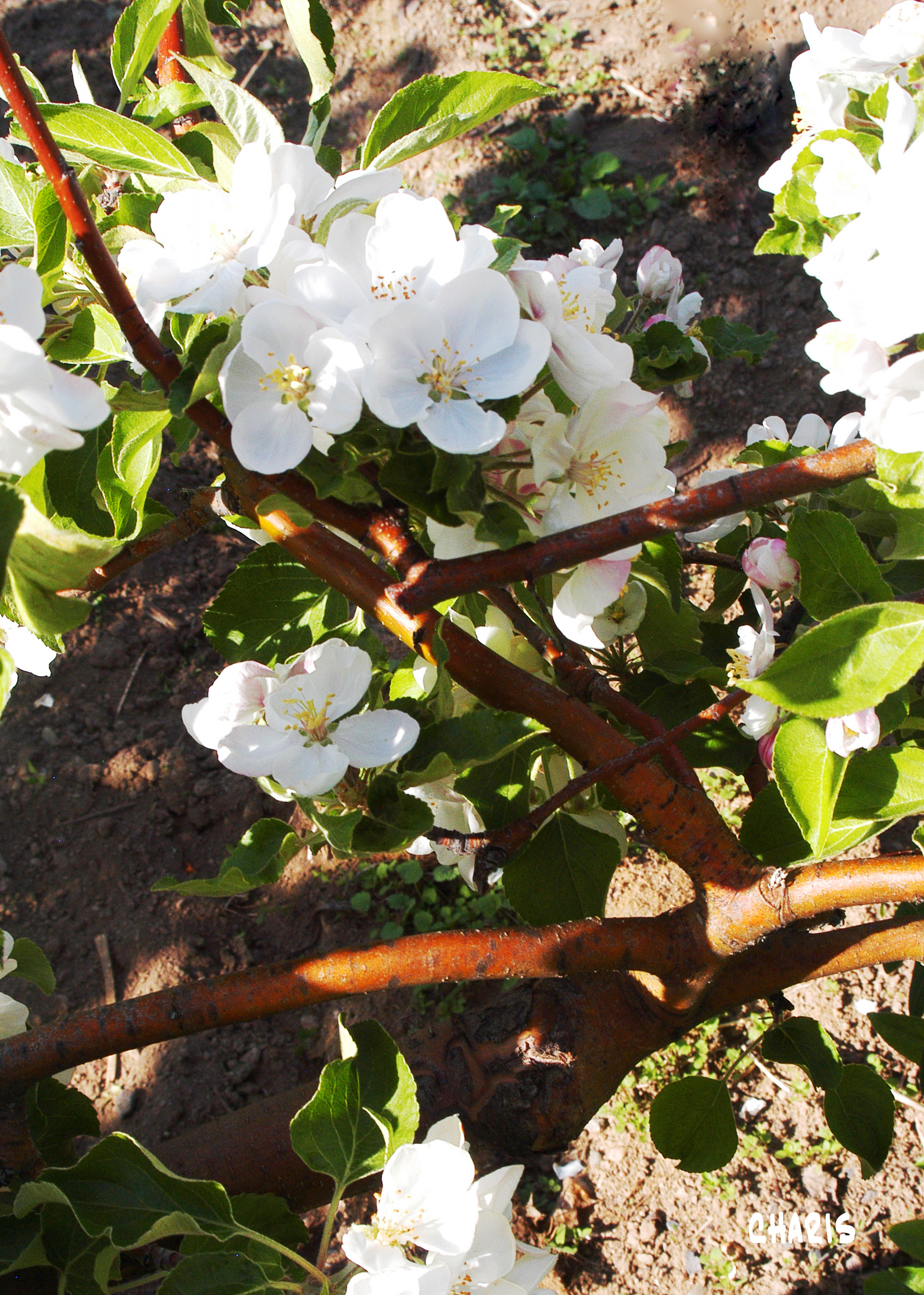
“It’s interesting,” he added, “that in tough years, or really dry years, the rings left in the tree are thinner, but a number of dense rings will make the tree stronger. You can’t always tell by looking at the size how much fruit a tree will produce. Some of these little ones can give you a ton of apples. And of course we need to be out there every year to prune back to just the essential branches to direct the tree’s energy into making fruit.”
I went away praying, “So, Lord, what are you showing me?”
This is what I feel I learned:
An apple tree can be a picture of the Church. The big C Church –the real Church made up of all followers of Jesus Christ — not just the buildings where folks plop their weary bones on a pew after the cows are milked on Sunday morning (the historical reason behind why most churches meet at the time they do.)
I have observed areas of active growth in the Church, where people are encountering God in all his goodness, being filled with the knowledge they are loved, and having an increasing desire to glorify him and to reach out to the needy with the good news. It’s a place where new believers are drawn to Christ, where there is a hunger and thirst to know him more deeply and a desire to go beyond the experience of parent’s and grandparent’s comfortable pews, and where lovers of Jesus are being empowered to be a positive influence that brings justice and salvation and healing to the suffering. These are places where lives are changing and the fruit of the spirit is beginning to fill out.

There is also a tendency for a lot of these groups, who are experiencing bounding spiritual growth, to become objects of harsh criticism and to feel restricted by the limits of “old wine skins”. They often end up disassociating themselves from former movements.
Every week new denominations start up with creative names reflecting the facet of the God-experience which best expresses their current focus. (In my opinion even “non-denominational” churches and home churches are mini-denominations. Within two or three generations, open-armed fellowships, meant to embrace like-minded people, have a tendency to morph into closed institutions whose function is to exclude those who have not had the same experience, or do not agree on every point.) They miss the stability that can only come about through years of weathering storms and drought and winter wind. Their roots are shallow and they quickly become victims of the climate.
If the growth layer in a tree is restricted the tree will die. If the old established “organized” tree attempts to restrict the growth of a movement to the parameters of its own previous experience, it will kill the tree. Tradition and history remind us to remember the goodness of God’s faithfulness, to encourage faith in what the Lord will do and not just in what he has done. By establishing sound doctrine based on the Word of God year after year, and pruning back unproductive offshoots, our forefathers and foremothers have maintained the shape and integrity of the church. I’m not saying we should overlook unscriptural teaching; essential doctrine is essential. Yes, sometimes it has run seriously wild, but God sends reformers along every once in a while to dig around the roots, lop off dead branches, kill the insects, and dump a load of fertilizer on it, to keep it in check.
The point of the solid structure of the tree is to support new growth that will produce fruit. Power-hungry jealousy and competitiveness is like a wire tied around the trunk that chokes off life. It is not the job of the cambium layer to support the woody layers. Young believers cannot be grafted into old wood with which they can make no connection. If communication fails, they will not receive adequate nurturing; they will shrivel up and fall away.
I wonder if the bark might represent the ones who are called to intercede, or the forerunners – the cutting edge spiritual warriors who bear the scars, the ones who face threats and are willing to lay down their lives to protect both the old stable wood, the new growth layer, and to gather around new grafts to support them securely. Without them, the whole tree is vulnerable to attack and can be destroyed by one annoying, invading insect at a time.

The roots of my friend’s trees are hardy. We are rooted and grounded in the love of Christ and build on a foundation of the apostles and prophets.
In Ephesians 2 we read: 13 But now in Christ Jesus you who once were far off have been brought near by the blood of Christ. 14 For he himself is our peace, who has made us both one and has broken down in his flesh the dividing wall of hostility 15 by abolishing the law of commandments expressed in ordinances, that he might create in himself one new man in place of the two, so making peace, 16 and might reconcile us both to God in one body through the cross, thereby killing the hostility. 17 And he came and preached peace to you who were far off and peace to those who were near. 18 For through him we both have access in one Spirit to the Father. 19 So then you are no longer strangers and aliens, but you are fellow citizens with the saints and members of the household of God, 20 built on the foundation of the apostles and prophets, Christ Jesus himself being the cornerstone, 21 in whom the whole structure, being joined together, grows into a holy temple in the Lord. 22 In him you also are being built together into a dwelling place for God by the Spirit.
By faith we sink our roots deep into the love of Christ and Holy Spirit flows up producing fruit that is obvious to the world –love, joy, peace, patience, kindness, goodness , faithfulness, gentleness and self-control .
A tree with many varieties of branches grafted in will not produce fruit which all looks and tastes totally alike. Cultural differences may make this tree church look odd, lacking in homogeneity. Accepting new branches may involve an uncomfortable period of wounding to make room –but it is a wonderful thing, this Church universal.
Without the new growth layer and connections to where the Holy Spirit is flowing now, the old woody layer is a merely a dying monument to the past. Without clinging to the stability gained through perseverance and enduring hope grown throughout a 2000 year old history of good seasons and tough seasons, the strength and stability secured through adversity and persecution is not available to the new layer; it flips and flops all over the place, tossed about by every wave of doctrine. With both it is strong, and continues to grow stronger producing enough fruit to feed a hungry world.
Honour your father and mother. Do not quench the Spirit. Both.
We need each other. Jesus said, “By this shall all men know that you are my disciples -that you have love for one another.”
-for your discernment


 Charis: Subject to Change