Joy in Disappointment

“The difference between shallow happiness and a deep, sustaining joy is sorrow. Happiness lives where sorrow is not. When sorrow arrives, happiness dies. It can’t stand pain. Joy, on the other hand, rises from sorrow and therefore can withstand all grief. Joy, by the grace of God, is the transfiguration of suffering into endurance, and of endurance into character, and of character into hope–and the hope that has become our joy does not (as happiness must for those who depend up on it) disappoint us.”

-Walter Wangerin

Sometimes people disappoint me.

Sometimes I disappoint myself.

I think disappointment is one of the things we fear most.

What if I trust this person with my sacrificial donation to a worthy cause and he absconds with it for his own personal pleasure?

What if I trust this woman with my story, but her tongue twists truth like a knotted cherry stem that becomes a mocking joke at my expense?

What if I trust these caregivers to protect my precious child and they return him with a bruise in the shape of a hand and a flimsy excuse pinned to his onesie.

These examples are hypothetical (mostly); however, many people understand the suffering that comes from a sense of betrayal and discovering people they trusted were not who they said they were. That kind of pain is real. Some of us add to the suffering by feeling ashamed for being gullible, but there is also the fact that sometimes we didn’t see the red flags sooner because we didn’t want to. They were inconvenient.

But what if the culprit is me? What if in my exuberance to illustrate a point, I break a confidence and share a story I promised not to share?

What if I accept the polite gesture of driver allowing me to merge onto a busy road as if I was entitled to it, then, only a block later, slam on my brakes, sloshing my hot coffee everywhere. What if I mutter the curse, “idiot!” at an obviously drug- impaired woman who stumbles onto the road in front of me. (Ok. That one really happened. I almost ran over her! But God forgive me, in that moment I was more upset about what an enormous inconvenience that would have been to me more than I was about how devastating it would have been to her. )

I was not who I thought I was. I felt ashamed and stupid for my choices.

I’ve been thinking a lot about scenarios like this and worse lately. A lot of people, including myself, have been deeply disappointed by betrayals of trust by people we thought we knew. I suffer with victims who have been treated as if they are expendable in the kingdom of God. Some of the substantiated reports coming out sent me into deep mourning. I lost my joy.

As a foster mother I often held inconsolable weeping children who had been abused. I rocked them for hours. As a friend I’ve listened to stories of abuse and the consequences both women and men didn’t disclose until decades later. I never thought I would see so much dishonour for the powerless in a church setting. It’s been a season of anger and mourning, but I don’t want my angry tears to congeal into bitterness, nor do I want to enable systemic corruption.

I’ve also seen the tears in the eyes of friends I treated cruelly with impatient, judgmental, or dismissive words. I am not without sin. In recent months I felt compelled to find two estranged friends from many years ago who I needed to apologize to. Eventually I learned that both had passed away. I regret not making things right sooner.

This season of sorrow has prompted me to look at things I don’t want to see. It has made me realize that even though I can’t fix anybody, I can’t afford to carry a grudge either. It may take a while to get there, but the goal is forgiveness. It has made me ask questions.

What if we confront the people who wronged the innocent or the trusting, and by holding them accountable, protect more vulnerable lambs from abuse? What if we go further? What if we are all honest with each other? What if we come humbly, together, recognizing our own vulnerability to falling, and extend grace to help them in the long process of rebuilding trust as they learn to become the people God created them to be?

What if I thank God for revealing when I miss the mark? (Publicly, if need be.) What if I apologize, make amends, and (here’s the hard part) forgive myself as I cooperate with Holy Spirit as he works in me so I can become the person he created me to be?

My examples are (mostly) hypothetical. Disappointment is real. In the past few months, I have struggled with the consequences of disappointment in Christians I felt I, or fellow-believers ought to be able to trust. Then I realized I was also in need of grace to let go of self-made comforting idols. What if godly sorrow that temporarily removes our happiness leads to an awareness of the permanent joy the author of our faith wrote into the script of his plan for our lives?

What if joy means knowing that He who began a good work in us will be faithful to complete it? What if the pain and grief-filled times are gifts of grace that motivate us to develop endurance leading to good character that can carry increased hope? What if it’s really true that God loves us as we are, but also loves us too much to leave us this way?

What if we can say –with joy– our Heavenly Father’s discipline is not fun at the time, but as we respond to his voice, and take time to sit in his presence, we discover he is actually good? What if it is his kindness that leads us to want to change? What if the sorrow of godly suffering leads us through the valley of the shadow of death to self where he prepares a feast for us where the enemies of our soul can watch but dare not touch us? What if the evidence of transformation in our lives is being able to say. with sincerity, I trust you Lord, for only you have the words of eternal life?

In you is fullness of joy, even in sorrow.

The Wind Blows

I’m coming out of a year of more disappointment and loss than I have experienced in most of the past decade. The losses were not as dramatic as the death of my father, or moving away from a city full of friends I loved. The losses have been like an incessant, low, slow prairie wind blowing away a summer garden bit by bit. I’ve lost more friends, relatives, and former colleagues to death in the past few months than through the entire time of the pandemic. The count is at fourteen since spring flowers bloomed. Many were not as close as immediate family, some I spoke or wrote to regularly, and some I had not spoken to in months, if not years, but they still had an influence in forming who I am and we had a connection. The degree of pain from their loss surprised me. I want another deep conversation, another project to work on together, another evening of laughter.

This past month, I have taken time to process these and other losses before heading into the new year. Recently, I have also been disappointed by people, including myself, (especially myself) who promised more than they could deliver. I’ve seen exciting possibilities fade and blow away like dried leaves of grass and brittle browning petals. It’s hard to let go.

Usually I head into a New Years Day with optimism and a declaration that this is the year of breakthrough into greater things. I do believe that greater capacity to hold on to love and the empowering grace of God lies ahead. I do believe that his unfailing kindness will be with me all the days of my life and that I will see more of his goodness in the land of the living, but there is a bittersweet aspect to the view from here. In this place of the now and the not yet, there is a reconciling with the fact that all of us eventually die and the world goes on without us.

When my father was old and knew he didn’t have much time left on this earth, he talked to me about feeling the responsibility of keeping memories of dear ones alive. He was the last one who remembered his little brother and baby sister who died the same year and whose wooden grave markers in an untended cemetery have long since disintegrated in the harsh northern climate. He reminisced about characters who were old when he was just a lad. One time, without realizing it, he reached down to pet the dog, long since gone, who saved his life once. He warned me to prepare my heart to let go when I reached an age when old friends departed more frequently. “All flesh is grass,” he said, “but our spirits live on. I know I will see them again.”

It’s in seasons of leaving the past behind and choosing to move on that we realize how much comfort comes from knowing that whether we live or die, the Lord never forgets us. He never leaves us. His love is eternal. His mercies are ever new. Because He lives, I can face tomorrow.

As a father has compassion on his children,
    so the Lord has compassion on those who fear him;
 for he knows how we are formed,
    he remembers that we are dust.
 The life of mortals is like grass,
    they flourish like a flower of the field;
 the wind blows over it and it is gone,
    and its place remembers it no more.
 But from everlasting to everlasting
    the Lord’s love is with those who fear him,
    and his righteousness with their children’s children—
 with those who keep his covenant
    and remember to obey his precepts.

(Psalm 103:15-18 NIV)

Sorrow and Joy

From then on Jesus began to tell his disciples plainly that it was necessary for him to go to Jerusalem, and that he would suffer many terrible things at the hands of the elders, the leading priests, and the teachers of religious law. He would be killed, but on the third day he would be raised from the dead. (Matthew 16:21 NLT)

Sometimes I wonder what it must be like for people coming to Canada from tropical countries. If you have never seen it, would you believe it if someone told you, “There is a season coming when all the trees and plants and grasses will die? The world will be too cold for them to live and if you are not careful to find shelter and a source of heat you could die too. But don’t worry. After a few months of cold and long nights, they will come back to life again.”

I wonder if someone who has never heard of this or experienced it before would respond, “How exciting!’ or would they say, “No way! We will protect our gardens nd fields!” Many immigrants have told me their first winter was a shock and felt like it was never going to end.

Jesus told his disciples clearly, and more than once, precisely what was going to happen. When it did, they were shocked and dismayed. For all his declarations that Jesus would not be mistreated and killed under his watch, Peter had to face the fact that he was dead wrong. Jesus was arrested, humiliated, abused, and killed. The shock was so traumatizing it took a time before they remembered that he told them he would be raised after three days.  But how? They still had no grid for that.

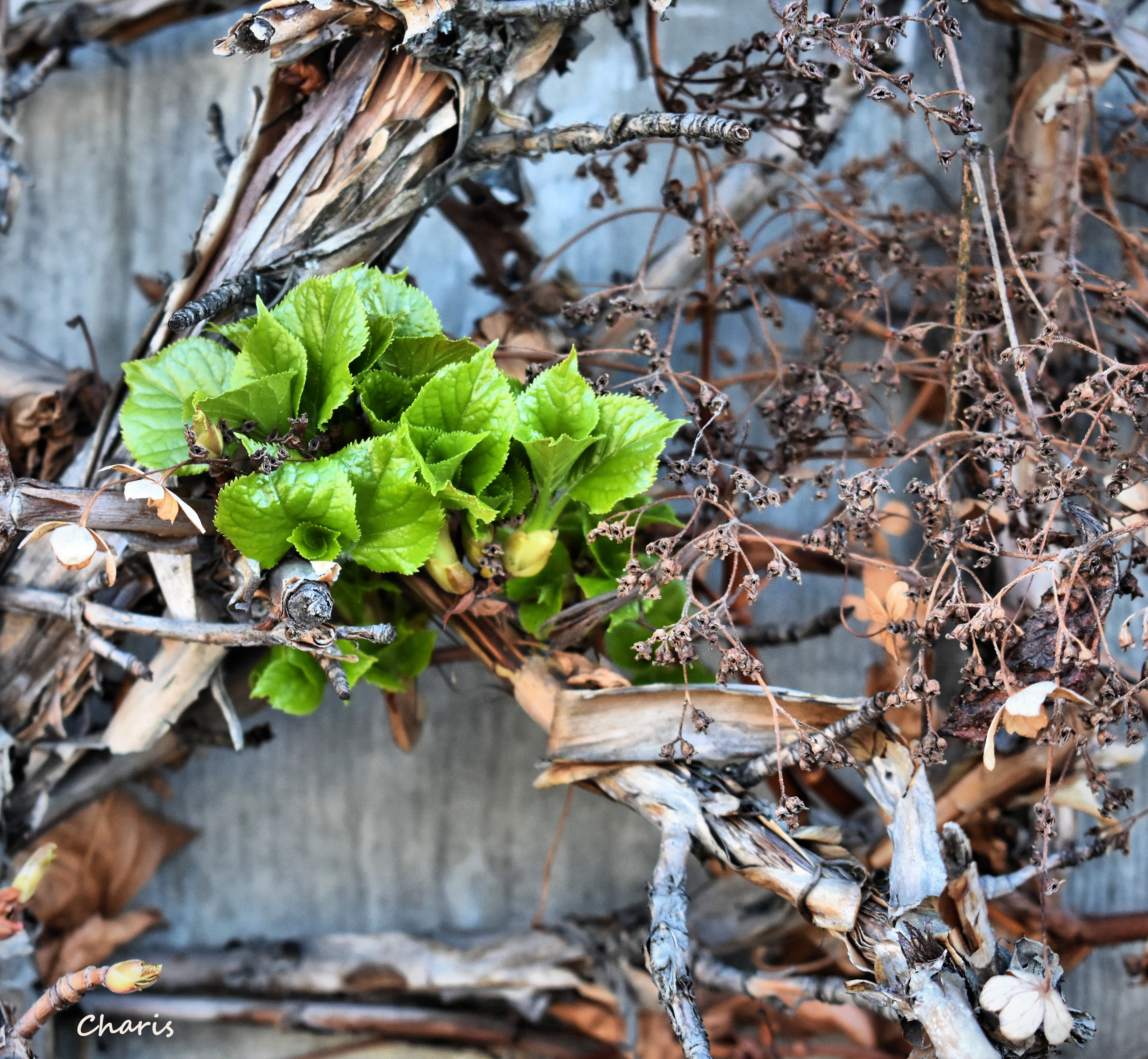
Yesterday, I passed by a vine-covered wall. There has been no sign of life on those bare branches for months. Now there is. What appeared to be dead is awakening to new life.

Today’s prompt word for Creative Meditations for Lent is Sorrow/Joy. Sometimes terrible things happen. We reel with the shock of photos of bodies in the streets in the Ukraine. We wail at the news of friends dying of Covid and other afflictions after we prayed with fervour and declared they would not die. We make plans for next week, next year, and the next decades and deny as much as possible that we live in mortal bodies that 1 Corinthians 15 reminds us are perishable, even though as believers in Christ we are promised eternal life.

Perhaps the lesson we can learn from new green leaves on a bare vine is this: Even though we have no grid for resurrection from the dead in new bodies, it will happen. There is more to the passage on running the race than I quoted earlier this week.

Therefore, since we are surrounded by such a great cloud of witnesses, let us throw off everything that hinders and the sin that so easily entangles. And let us run with perseverance the race marked out for us, fixing our eyes on Jesus, the pioneer and perfecter of faith.

For the joy set before him he endured the cross, scorning its shame, and sat down at the right hand of the throne of God. Consider him who endured such opposition from sinners, so that you will not grow weary and lose heart. (Hebrews 12: 1-3)

Oh, how I love the spring! What a harbinger of much greater joy!

A Season of Hardship

snow ranch bw ch

It snowed again. It’s hard in this season when one day is full of the promise of spring and the next throws us back into more time of waiting. Yesterday I worked in the garden, waving to neighbours as I cleaned up dead branches and winter debris, and made plans for planting. Today I’m back in the house, in isolation, wondering when this cold, lonely season will end.

Weather forecasts from several sources differ only slightly on when the weather will warm up again. Forecasts about when voluntary and increasingly forced isolation will end vary much more widely. Health and economic experts seem to be at a loss themselves. Many people are asking, “What is actually going on?”

It’s hard when you don’t know what is happening.

The followers of Jesus must have been at a loss themselves the day after the Messiah died. Only a few days earlier, songs of joy and elation rang out in the streets. Now Jesus was dead. How crushed their hopes! The greatest disappointment in history! They could not see what was being accomplished during that time. From the vantage point of isolation in hiding from fearful opposition they had no idea what was actually going on.

I don’t know what’s going on right now. I don’t know which experts to believe, which news sources are fake, which are reliable, or who is exploiting whom in this situation. It appears many people are suffering physically and financially as the whole world cries out for deliverance from this evil.

This much I do know. God hears and he can take what was intended for evil and turn it to the advantage of those who trust him. He can also use it to reveal himself to those who deny who he is.

Wait, my soul. Take courage. Wait and learn. Remember the Father’s words.

How compassionate he will be
when he hears your cries for help!
He will answer you when he hears your voice!

Even though the Lord may allow you
to go through a season of hardship and difficulty,
he himself will be there with you.

He will not hide himself from you,
for your eyes will constantly see him as your Teacher.
 
When you turn to the right or turn to the left,
you will hear his voice behind you to guide you, saying,
“This is the right path; follow it.”

Then you will see your idols as they are—unclean!

(Isaiah 30:19b-22a TPT)

Doubt and That Time Jesus Got a Gun

box pencil ch crop IMG_0934

“I don’t see him that way,” my friend said. “He’s more like a desert rose.”

“That’s what I always thought,” I told him, “But in the dream I was talking on the phone when I heard a gun go off. In my ear! It was so shocking and so loud everyone else in the banquet room heard it too. They dropped their desserts and scattered in every direction.”

“I don’t think Jesus would do that,” my friend insisted. “He has certainly never been like that for me. Perhaps you should pray some more about it.”

“Well,” I continued, not wanting to argue about how much prayer was sufficient, “the next thing I did in the dream was to run to the place where the phone call originated to make sure everyone was alright. I saw a gun leaning up against the cupboards in the kitchen. “

I could tell my friend had already lost interest, but I kept going.

“You did it!” I said to the man who I knew represented one aspect of Jesus in my dream symbolism. “You shot the gun! Why would you do that?”

“Got your attention!” he said. “And you did quit talking and came looking for me.”

My friend shrugged, “I still don’t think Jesus would use a gun.”

This is part of a much longer dream that came to mind this week, not just because of all the discussion about guns in the media (although that may be a backdrop), but because God is again grabbing my attention in unexpected ways.

Earlier this week another friend mused about what Jesus was doing on the days he didn’t use to go see Lazarus, after being told his beloved friend was deathly ill.

Jesus was acting unpredictably, that’s what he was doing. He may have been doing something we don’t know about in his private conversations with his Father and his compassionate heart may have been in deep pain (we know he wept in public later) but whatever he was doing he was not bowing to the will and expectations of people around him, as much as he loved them. He listened only to his Father and his Father said, “Wait.”

When I was a kid we sang a song with the line, “Gentle Jesus, meek and mild, look upon this little child.” I have experienced Jesus’ gentleness. I have seen demonstrations of his meekness, but desiring to follow him on a trail that just gets steeper has taught me he is anything but mild. He will kick the sides out of any box we design to define him. He will grab our attention by shocking or offending us if he has to.

The roots of word define mean to determine the ends or limits of something. You can’t define God. His majesty has no limits.

Jesus loved Lazarus and his sisters, Mary and Martha. I can imagine the women running outside to see if Jesus was coming yet. I imagine Lazarus asking where Jesus was as he gasped for breath. I can feel hope dying like a sputtering candle as they realized it was too late and disappointment growing like a monstrous dark shadow that filled the room. Where was he? Why wasn’t he coming?

When Jesus did finally show up Martha’s first words were an accusation. “If you had been here, my brother would not have died!” Mary stayed behind in the house. Was she too devastated to move? When she did speak to him, her first words were the same as her sister’s. “If you had been here, my brother would not have died!”

When I have found myself in situations where the Lord didn’t grant me what I asked when I asked for it, I heard my own voice cry out, “If you had been here, things would have been different.” Then the truth at the root of my pain: “You are not who I thought you were!”

Can I admit that moments in which I have discovered people were not who I thought they were, have been by far the most painful events in my life? Of all the stories in the Bible, this is the moment in which I sympathize with Bible characters’ dismay the most: Mary and Martha deep in grief and baffled that their friend and master did not come until it was too late. Intentionally.

In such moments doubt forces me to ask, “What if he is not who I think he is? What do I do with the profound sense of insecurity and fear that disappointment triggers in me?”

I throw myself at his feet and weep.

Where were you? Why did you let this happen?

He doesn’t answer. These are not the questions he is waiting for.

Who are you? What am I supposed to do now?

Yes. These are the questions he will answer.

In order to see the majesty of God, Mary and Martha had to let what they thought they knew about him die. Dying to self means acknowledging that God is God and I am not. I get to let go of my right to define him by my own limited understanding, or to use him to fulfill my own agenda.

The women only said what everyone was thinking. In John 11 we read, “Yet others said, ‘Isn’t this the One who opens blind eyes? Why didn’t he do something to keep Lazarus from dying?’”

Jesus let his disciples in on his purpose before they started the journey the Bethany. He made it plain to them, “Lazarus is dead. And for your sake, I’m glad I wasn’t there, because now you have another opportunity to see who I am so that you will learn to trust in me. Come, let’s go and see him.”

They didn’t understand.

Jesus told Martha her brother would live, but she didn’t believe him. She thought he was talking about the afterlife. When he asked for the tomb to be opened she protested that his corpse was unapproachable because he had been dead four days. She didn’t have a grid for what he was about to do.

Jesus looked at her and said, “Didn’t I tell you that if you will believe in me, you will see God unveil his power?”

Their concept of who Jesus was, even though the women believed he was the Anointed One, was too limited. He was about to show them something about himself they could see in no other way. He offended them to reveal more powerful love than they had ever imagined.

The period of time between losing the surety of what we think we know about God and the revelation of something greater can disorient us to the point of wailing. In the beginning of my dream everyone was partying, enjoying the abundant life. Then the gun went off. When I returned to the banquet hall, the dessert table was empty and the crowds were gone. Basic nutritious food was on a high shelf. I had to stretch to reach it.

The gun has not only gone off for me lately, it’s blasted for a number of people I care about as well. Life changes due to car accidents, divorce, loss of careers, loss of reputation, loss of property, loss of health, loss of loved ones or betrayal of all kinds can all cause us to cry out, “Where were you? If you had been here…

Sometimes we can be in this disorienting pain for a long time. Battles with doubt occur daily. We don’t always win.

But Jesus said we have the choice to stop doubt in its tracks. We can remember. What did Jesus say after the biggest most confusing disappointment of all when he lay dead in a tomb himself only a short time later, when he entered the room full of stunned, disoriented, grieving disciples?

Be at peace. I am the living God. Don’t be afraid. Why would you be so frightened? Don’t let doubt or fear enter your hearts, for I AM! Come and gaze upon my pierced hands and feet. See for yourselves, it is I, standing here alive. Touch me and know that my wounds are real. See that I have a body of flesh and bone.”

Did Jesus just kick the sides out of the box you had him in? Did a gun just go off beside your ear? Doubt need not win. You can have faith because the Faithful One has no limits.

What aspect of Himself is He about to show you next? Annie J Flint, the hymn writer penned:

His love has no limits, His grace has no measure,
His power no boundary known unto men;
For out of His infinite riches in Jesus
He giveth, and giveth, and giveth again.
~Annie J. Flint

Limitless.

The Valley of Trouble

Photo: Valley on the Jasper Parkway

After spending the week with my two wee grandchildren I am even more convinced one of the greatest challenges we face as humans is the tyranny of “the wants.”

The little guy is not quite two years old, and for a not quite two-year old is adorable, affectionate and pretty considerate. But he is discovering he has a will.

I am learning to phrase my questions in a way to make “No!”  the desired answer.

“You don’t want to stay awake all afternoon, do you?”

“No!”

“Do you want to leave your toys out of the toy box like this?”

“No!”

Even so there is the problem with the abundance of choice. His latest favourite phrases this week are, “Another one,” and “Something else.” Two bites into a snack it occurs to him that there are other fruits in the fridge and other crackers in the cupboard.

“Something else” also tends to be the something else his sister is playing with. I tried to explain to her that the easiest way to get a toy back is to offer him something even more attractive than what he is trying to seize.

That worked really well until she noticed that he now had something better than she did and the grabbing began again. When I tried to play mediator she said, “But I WANT it.” That’s her trump card. But I WANT it!

She looks at me with that desperate victim of craving look I have seen too many times. WANT is here. It must be satisfied. Don’t you understand, Nana?

Oh sweetie. Do I understand? The truth is, although I have learned not to say it out loud, at least not in a whiney tone that could make wallpaper want to curl itself back up the wall, inside I still want to stomp my plump little feet and whine, “but I WANT it!” It is so easy to stand knee-deep in a room full of abundant choices and cry, “But I WANT the one he has.”

What  I want:

I want you two to play quietly and safely together so I can chase rabbit trails on my laptop.

I want a new cordless mouse. This one is annoying.

I want to eat a bowl of almonds and chocolate chips and drink a real cream full fat caffeine-laced latte after 2 in the afternoon.

I want to play MY music –loudly– if only to get the “Yes my name is Iggle-Piggle” song out of my head.

I want to be loving and persevering and patient and merciful and compassionate and good without any challenges in my life.

I want faith without ever having to wrestle with doubt.

I want joy in the morning without weeping in the night.

I WANT it!

But my little granddaughter said something very mature for her three years yesterday. She said she would rather take her nap a little early so she would have more time with her Daddy later in the day when he was finished his work –even though she really, really wanted to stay up longer and had that option. She was willing to ignore the WANT monster for the greater reward of relationship with her father. I love this kid.

I’ve heard it said we need much more preparation to survive times of abundance than we do to survive hard times. Hard times teach us that God is our provider. Only those who understand where true wealth lies can handle abundance and not be distracted by it.