Things

The fear of lack has always been with me. I was born in the days before Canada made healthcare available to everyone. My parents’ health insurance disappeared with my father’s former job just before I was born. My mother had many complications from my birth that left many bills. Both my parents worked hard to pay those bills, as well as bills from a failed business venture, but at ten years old I overheard a conversation I wasn’t meant to hear. It was about how much my birth had cost and how debt payments were still setting the family back compared to other people. Like kids tend to do, I thought the tension on bill paying day was my fault for being born in a way that caused my mom and dad way more suffering than it should have.

I developed a fear of lack as well as anxiety around asking for what I needed. That kind of fear can lead to an obsession with earning money and displaying what it can buy. It can also lead to not wanting to spend money and bragging about money-saving DIY skills and finding things at lower price than anyone else in the room. And sometimes both expressions manifest simultaneously in ways that thoroughly annoy others. Most of my life, I have tended to take the penny-pinching, make-do means of coping with fear of poverty.

Don’t get me wrong. We always had enough for necessities when I was a kid. Compared to most of the people in the world, we had a lot. Compared to neighbours in our community, “Things,” as the expressions goes, “were tight.”

The sense of being poor or rich often comes only in comparison to others.

Compared to my grandparents when they were living through the Great Depression, we were rich. We had indoor plumbing, more than two changes of clothes, nutritious food, a vehicle, and heat for the house that didn’t require scooping dirty coal or hours of chopping wood when you could find it. Come to think of it, we had a house, which was more than my grandparents, who spent some tough years living in two uninsulated granaries pulled together, could boast of. It seems tiny house living is most attractive to people who have options.

Families in our circle had ski hill memberships in Banff, two cars, lots of toys and sports equipment, college funds for all the kids (girls included), a mom who didn’t have to go to work, and cash in hand at the end of the month. Since I didn’t actually know anyone who still lived in a granary, this was my concept of the average family. Compared to other kids at school or at church in my affluent city in Canada, I was from a poor family.

My husband is a naturally generous person. I’ve had to work at it. I’ve had to learn to trust God with my needs by giving things away as an act of faith and obedience. I’ve often spoken Psalm 37:25 out loud as a reminder of God’s keeping power: “I was young and now I am old, yet I have never seen the righteous forsaken or their children begging bread.”

Discussions of run-away inflation and shortages in the news lately make me want to buy more things than we need before the price goes up or they are not available. I fight the urge to hit the bargain shops and buy things to stuff into bins in the closet in case we will need them someday.

(A note to clarify: I’m not talking about either unwise spending or lack of planning. Ask the Lord for wisdom and for his leading in your own life, then obey and go for it -as long as you do it in faith. For me, at the moment, the temptation to hoard is a left-over manifestation of fear that there will not be enough, that God will not be there to provide for our needs. I understand he’s giving me an exercise in trust.)

Realizing that sometimes fear is often the root of negative self-fulfilling prophecy, I asked God for wisdom. Then I had a dream. In this dream a heroic warrior looking person gave me a marvelous pair of skates just before I went into a grocery store. People in the store were fighting over items on partially empty shelves. They blocked the aisles as they argued. Somehow (I don’t know how because I haven’t been skating since I was a teen and my skills never progressed beyond moving across the rink without falling down, not to mention that skates only work on ice), I put them on and skated around all these people with issues. With these special skates on my feet I was like an Olympic figure skater accomplishing amazing leaps over freezers and spins in the produce section. I picked up the few things I needed without upsetting anyone, paid, and left. When I saw the hero outside, he gave me a hero’s welcome.

I believe the dream is telling me I can trust that my Hero will provide what I need when I need it. (Hosea records in chapter two that on the day the unfaithful woman responds to God instead of going after material symbols of insincere forms of attention, she will call him Ishi –Hero/husband and no longer Baali –Master.)

Today I read Hebrews 13:5 in the Passion Translation: “Don’t be obsessed with money but live content with what you have, for you always have God’s presence. For hasn’t he promised you, ‘I will never leave you, never! And I will not loosen my grip on your life.’”

That’s a promise that’s safe without a safety deposit box in the bank.

The Opposite

It is in the dark that God is passing by. The bridge and our lives shake not because God has abandoned, but the exact opposite: God is passing by. God is in the tremors. Dark is in the holiest ground, the glory passing by. In the blackest, God is the closest, at work, forging his perfect and right will. Though it is black and we can’t see and our world seems to be free-falling and we feel utterly alone, Christ is most present to us.

Ann Voscamp

Unlock My Heart

Lord God, unlock my heart, unlock my lips,

and I will overcome with my joyous praise!

For the source of your pleasure is not in my performance

or the sacrifices I might offer to you.

The fountain of your pleasure is found

in the sacrifice of my shattered heart before you.

You will not despise my tenderness

as I bow down humbly at your feet.

Psalm 51:15-17 TPT

There’s a setting on the photo editing software I use that lets me make a kaleidoscope-style image using bits and pieces from my own photos. The photo I used here was of a barren tree in a snow-covered field at sunset. It feels like spiritual transformation to me.

Have you noticed that God gave many people their assignments in his Kingdom when they were at their lowest? God is more impressed by our willingness to offer him the broken pieces of our failures than the efforts that made us successful in other people’s eyes. A shattered heart? Now that he can use. He takes our locked hearts and disappointments in ourselves, tosses them around, and lets us see through a lens that transforms and multiplies our offering into something beautiful.

He takes our limitations and opens our eyes to limitless possibilities. He’s good that way.

Praying Naked

When I was a child, I used to have a secret place where I would go to talk to Jesus. I told him things that weren’t safe to say out loud where someone might hear. I didn’t know that was praying. I thought praying was when people recited rhymes at meal times or before bed or stood on a platform and shouted at God in King James English as if he were as hard as hearing as some of the folk in the pews (who some of us thought may have been as old as King James).

I talked to Jesus because he was someone who loved the little children. I could be very open and honest with him. Somehow, I had picked up the notion that God the Father was angry and disappointed with me like so many other people in my life. I couldn’t let him see the confusion and pain in my heart. It seemed ungrateful –and perhaps dangerous.

I’m realizing, all these years later, even though I have learned that God the Father is not who I thought he was and is loving and kind and inviting, I still don’t feel comfortable praying out loud in front of people. When someone asks, “Does anyone want to close in prayer?” I’m already avoiding eye contact.

You see, when I pray, I am very aware the moment requires total transparency. I call it praying naked. It comes from a time when the Holy Spirit spoke to me while I was in the bathtub. He’s not dismayed by my many imperfections in body and soul. Other people on the other hand…

Someone, who I’m sure meant well, once told me she had heard me pray a few good prayers in an intercessor’s group we belonged to. Then she suggested I listen to some of the more well-seasoned women’s prayers to see how it was done. I didn’t know I was being graded. Suddenly I was back in Jr. High.

It was the last day of the dreaded “Extemporaneous Speech Unit” in English class. I could no longer hide behind Big Bob or make an emergency trip to the restroom. I rose. I faced the class. I pulled the topic from the hat. I spoke. I tried to be humorous. My joke fell flat. Sigh. The teacher asked me to explain it. Sigh. I did. She still didn’t get it. Sigh. Neither did the other students. Sigh. The students were invited to submit their evaluations. Can you die from humiliation?

People who know me now, can tell you I have no trouble talking about almost any topic. That’s probably because I am an introvert who learned to function as an extrovert to avoid the humiliations of youth. It’s a skill I needed when I became a singer and later a teacher. But performing can be exhausting.

Some good friends have helped me learn to pray together with them. They don’t judge. They don’t hide their weaknesses. They encourage. They challenge. They support. They give me freedom to be myself. How beautifully precious they are.

I walked down by the lake thinking about this. I love how clear the water is here. Its transparency reminds me of the hope that someday I can feel less self-conscious when praying out loud in public. I hope for unity in spirit with fellow believers who will be safe, where judgment is replaced by encouragement, where we are recognized by our love for each other, and where our focus when we pray is on God and not ourselves.

Devotion

Someone told me I should write a devotional. I didn’t take kindly to the suggestion. For those of you out of the North American Protestant/Evangelical/Charismatic lingo loop, a devotional is a collection of meditations and suggested Bible readings attached to dates on the calendar. Some of them are published as monthly booklets and some as hardbound classics.

The problem for me is that “devotional” did not bring up fond memories of pleasant times of focusing on God. It brought up memories of one more thing I had to do before I could shut off the lights and go to sleep, one more tense morning around the breakfast table while Dad quickly read to us from the booklet with one arm already in the sleeve of his coat, one more packaged sermonette from the camp counsellor before we could go down to the lake to swim, one more occasion to cease the fun and get serious at youth group. In short, I associated “doing devotions” with religious duty that interfered with stuff I valued more. I needed deep healing from the ravages of godless religiosity. I’m realizing, when negative reactions like this pop up, that I still do.

I know I’m not the only one, because a brief online search for devotional material revealed a number of titles bragging about brevity. The Ten Minute Devotional. Quick Daily Devotions for the Busy Mother. Seven Minutes to Starting Your Day Right. Five Minute Devotions. I think the winner of this genre had it down to one minute. That’s what happens when a once good idea becomes an obligation. Let’s get this thing out of the way and get on with life.

The other use of the word “devotion” means a heart set apart and acting out love, loyalty, and care for a person or object. Being devoted to something or somebody means making the object of that devotion a high priority. Imagine Moses saying to his brother Aaron, “I’d love to stay with you and listen to these people complain, but I have to go up on a mountain top and watch the goodness of the Creator of the universe go by.” Imagine Mary of Bethany saying to her sister Martha, “I’d rather wash pots with you, but I have to put in ten minutes of listening to Jesus talk about his Father in heaven first.” Imagine Paul telling the Holy Spirit, “Fine. You can explain the mystery of the ages to me, but be brief. I’ve got a boat to catch.”

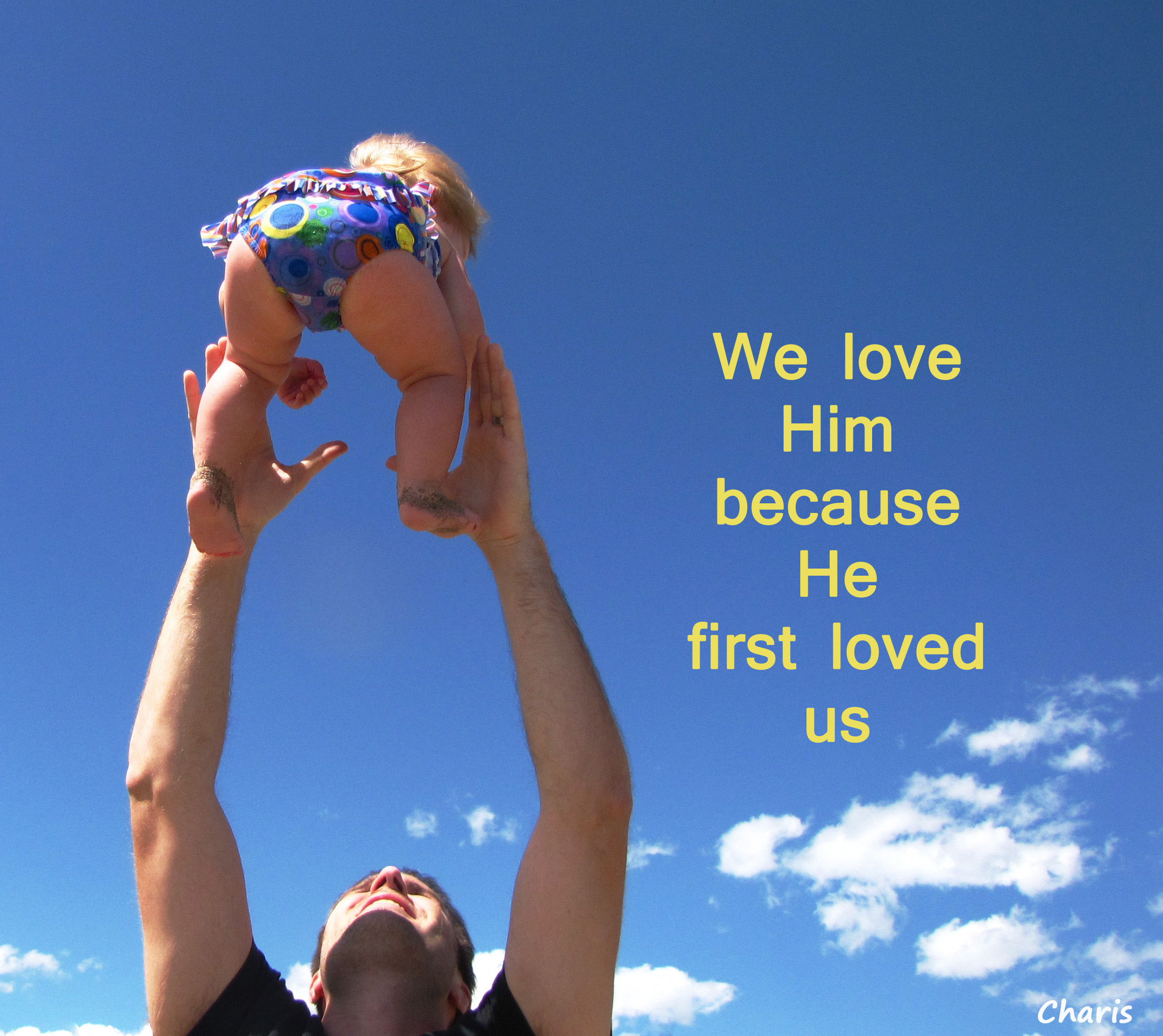
Here’s the thing it has taken me far too many years to realize: we cannot love God without receiving his love first. Without his love, without his grace, without revelation of his purposes since time began we have nothing to give but grudging obedience to rules and a quick prayer that nothing bad will happen to us, or our kids, if we miss occasionally. From the beginning he planned for our salvation. He has always been devoted to our well-being, our spiritual spiffing up, and satisfying eternal life with him. We can love him because he loved us first. We can respond from the heart to his invitation to go for a walk with him and ask him our questions, or we can choose to go for the record and see if we can cut down the doing devotions thing to thirty seconds next time.

One day, some years ago now, with the ugly voice of depression whispering that I would just be disappointed again, I chose to get up and go for a walk with the Lover of my soul. I’ve never looked back. Sometimes we talk about how much we value each other, but he always wins. His love is stronger. His devotion to the objects of his love is from everlasting to everlasting.

Whatever It Takes

I’ve been thinking about gain and loss today. I’ve been reading about persecution around the world. It’s one thing to choose to follow Jesus in a culture where family, friends and colleagues are also believers, or there are, at least, no serious consequences. It is quite another thing when choosing to be a disciple of Christ means rejection by beloved parents, brothers, sisters and community. In places where not having a seat at the table is the result of shame dumped on a new Christian, choosing to walk a lonely path requires a courage few of us can raise on our own.

More than once I have spoken to sincere seekers who faced a hard choice.

“I want to leave my guilt and shame behind and believe in Jesus,” one young woman told me, “But I couldn’t hurt my father that way. It would disappoint him so much.”

“It would break my mother’s heart,” said another with tears in his eyes.

I don’t know what they decided.

A man I met in the U.K. in a class we both took told me, “My family said I brought dishonour upon them by my choice to become a Christian. They have tried to kill me more than once. My own mother fed me poison,” he said, his voice growing softer. “I know they will try to kill me again if I go back to my home country, but they need to know God loves them. Jesus died and overcame death to show them that he is not angry with them. I can’t turn back. Jesus loves me. I am his servant. Whatever it takes…”

What struck me was that none of these dear ones were rebellious by nature, nor were they angry with their families. In fact, they were the opposite. They cared deeply about loved ones. The issue they all wrestled with was the question of how to love God first, then others. Sometimes I feel like avoiding relatives who merely disapprove of my fashion choices and taste in music. Would I be willing to be misunderstood, to be disinherited, to lose everything and everyone dear to me to love them with the love of the Lord?

That kind of love, that kind of faith, can only come as a gift of empowering grace from the One who sees the beginning from the end. How I admire those with the determination to hold tightly to the Saviour and find their true home in the family of God.

“And everyone who has left houses or brothers or sisters or father or mother or wife or children or fields for my sake will receive a hundred times as much and will inherit eternal life.” (Matthew 19:29 NASB)

“Therefore, having been justified by faith, we have peace with God through our Lord Jesus Christ, through whom we also have obtained our introduction by faith into this grace in which we stand; and we celebrate in hope of the glory of God.” (Romans 5:1,2 NASB)

Greatest

Jesus called a little child to his side and set him on his feet in the middle of them all. “Believe me,” he said, “unless you change your whole outlook and become like little children you will never enter the kingdom of Heaven. It is the man who can be as humble as this little child who is greatest in the kingdom of Heaven.

Matthew 18:2-4 Phillips

Have you noticed that children do not possess many of the things that many people assume will earn positions of influence or power? They don’t have tons of money, or a impressive resumé, or outstanding talent. Even cuteness has an expiry date and doesn’t help much when it comes to gaining status. A child actually holds very little status in society. A little kid may try to throw their weight around, but since they have little to throw, an adult can easily pick them up and instantly change their plans.

A child doesn’t need any of these things when they are loved perfectly by a good father. What a child possesses, that most adults do not, is a drive to learn and grow, enough confidence to try new things, and trust in the one who loves them and lifts them to see the world from Papa’s perspective.

A child doesn’t work at being humble or put herself down. A child looks to the one who loves him most, lifts his arms and asks, “Up?”

And that’s the heart attitude where greatness resides.

Feelings

I learned about a word I wasn’t familiar with — orthopathy.

“Orthodoxy” is thinking in alignment with God.

“Orthopraxy” is acting in alignment with God.

“Orthopathy” is feeling in alignment with God.

It comes from ortho – right, and pathos – emotion. For those accusing people experiencing personal encounters with God in places like Asbury University as mere “emotionalism,” may I remind you that Jesus himself wept with compassion, cried out in agony, and danced in ecstasy -in front of God the Father and everybody? I’d rather follow his example than a stoic heresy hunter’s.

After this long season of crisis, all of us, but children and youth especially, have been subject to a campaign of fear, disappointment, and negativity. The result is rampant depression and anxiety. I continue to pray with weeping for emotional healing and freedom for this generation. I sing for joy when I see it starting to happen.

Love Song

In 1975, a month after we moved across the country to Vancouver, British Columbia, I had a miscarriage.

Between October and January that year, there was only one day I remember that wasn’t made even darker by oppressively low clouds. We lived in a dark closet-less basement suite with the circulated scent of our upstairs neighbours’ love of curried cauliflower wafting through the heat vents accompanied by the sound of their favourite ethnic music crackling through an intercom that didn’t shut off.

My husband worked long hours teaching and doing post-doctoral research amid the publish-or-perish culture of the university. The new church we went to had a nursery room without a speaker connected to the sanctuary. I sat alone with a hyperactive toddler in that room week after week just for the chance to connect with someone in the foyer after the service.

I was exhausted. I was depressed. I was profoundly lonely. I was in mourning for a child no one but my husband and I knew had existed. Not one to hide my feelings easily, I’m sure I probably gave obvious nonverbal clues that I was not exactly a ball of fun then.

One person reached out to me. On impulse, Sandy, the only other young mom in the congregation, bought a record album for us. Back in the basement suite, I put on earphones and played it over and over. Her kindness made a huge difference in my life. Love Song was the name of the band made up of hippies on the fringe of society in California. A pastor opened the door that allowed these diamonds in the rough play their new music in his church.

The story of that pastor and the people affected by his choice to open the doors is featured in the movie, “Jesus Revolution” which opens next week. The message that healed my aching heart is still real. Feel the love.