In the middle of the first letter sent to the new believers in Corinthians (with instructions on how to use the gifts or tools the Holy Spirit gives) Paul gives is this warning:
Without love, it’s all a gong show (my loose translation).
As Christians we talk about love. We urge people to take the job of showing love seriously. We quote the verse about turning the other cheek, but who knew the charge to love our neighbours as ourselves could turn into a burden that keeps people weighted down with disappointment in themselves and in other less-than-gentle-and-consistently-kind members of the church that is supposed to lead in this area? Who knew our efforts to respond to the instruction to love could make us feel less loveable?
I used to think that love meant I should be able to conjure up feelings of affection on demand. I thought if I tried hard I could. I learned I can’t. I know I’m not the only one. With very little effort I can give you hundreds of examples of my failure to feel loving in spite of my best efforts.
I even fail to love people who, like me, mean well, but leave a mess to clean up in their short-sighted efforts to demonstrate it.
I can’t even imagine what it is like for the victims of extreme persecution to hear sermons about extending love to those who hate them.
Love is all very good in theory, but, as is evident in nasty posts on various media platforms, people who differ on political ideas, or even styles of music or fashion have a hard time showing it. Love, real love and not merely feel-good, self-serving, or erotic love, is hard to come by. There are some days when I wonder if it is even possible.
And yet Jesus is clear about the command to love.
“’Teacher, which is the greatest commandment in the Law?” Jesus replied: ‘”Love the Lord your God with all your heart and with all your soul and with all your mind. This is the first and greatest commandment. And the second is like it: ‘Love your neighbor as yourself.’ All the Law and the Prophets hang on these two commandments.’” (Matthew 22: 37-40)
Jesus told us the identifying mark of the church was this: “By this shall all people know that you are my disciples – that you have love for one another.”
Recently I hear another full-voiced charge from a pulpit that we should love like Jesus. I wanted to stand up and yell back, “Don’t keep telling us we should love without showing us how!”
People know the difference between genuine caring and marketing. They have a word for it. Hypocrisy.
Then the Lord reminded me he is not dependent on my efforts to do this without him. It’s about His love, not mine. He loved us first. When I respond with that little bit that I can grasp before it falls through the holes in my heart and give it back to him, he pours more love into me. He heals the wounds I’m willing to let him touch so I have an increasing capacity to hold on to love.
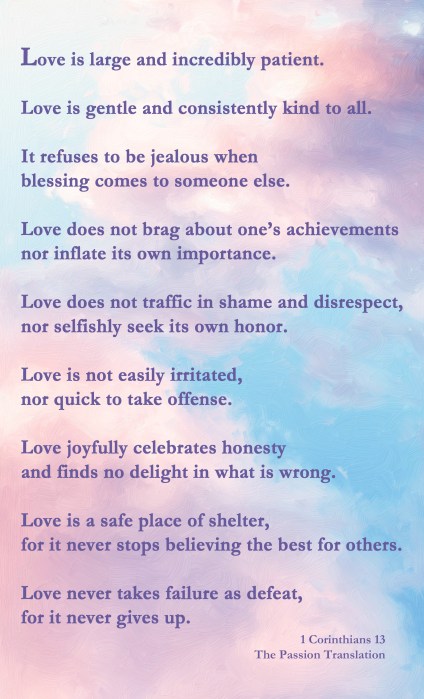
Paul described this kind of love in the passage in 1 Corinthians 13– agape love, unselfish nurturing love from a perfect Father. I like to read it in different translations. The Passion Translation, which seeks to include emotional communication, calls this kind of love “large.” This is what Jesus came to show us. This is what Christ in us, the hope of glory, looks like and feels like. L A R G E.
I need to soak in it. As I write this I am soaking my foot in a sterilized water and salt solution as part of the healing plan for an ingrown toenail. In the same way, metaphorically speaking, I need to soak in God’s love for continuous healing of soul wounds. Abiding in his company purifies and removes distractions so I can know that I am the object of this love and that the Creator of the universe values me enough to never quit loving me. Only then can I give the love I have received without risking burn-out or spiritual bankruptcy.
Developing a relationship with God and learning to abide, rest, dwell, and take up residency in the place of intimacy where we learn to accept a love we can’t earn is not merely for mystics who seldom descend from euphoric experiences to set foot in muddied streets. It is the essential source for anyone who prays, “Your will be done on earth as it is in heaven.”
God is not stymied by our failures. He never fails. He is incredibly patient. He never gives up. He IS love.
A hand-painted ceramic plaque hung, at various times, on various walls in our house. I was always surprised when it appeared in the bathroom or kitchen after previously filling a blank space in the hallway or dining room. Maybe Mom was trying to remind us of the message written on it. To be honest, my reaction was usually, “Yeah, I know. I should spend more time in Bible study. I should pray more. I should pay more attention in church. I should try to appreciate family devotions in the morning. I should stop groaning when it’s time to stop having fun and settle down and get serious for ‘the devotional’ at youth group. If I did I might be a nicer, less anxious teen, or at least less moody.”
After Mom died and Dad moved into the senior’s facility I took the plaque off the bedroom wall and brought it home with me. I think it’s in the memorabilia trunk that’s in storage until our house is repaired.
I thought about it when a song started playing in my head the other day. I have been praying for peace. Distractive worries have messed with my ability to concentrate lately. The words in the simple repetitive chorus were:
Thou wilt keep him in perfect peace, whose mind is stayed on Thee.
I’m learning to pay attention, and I know the Lord is reminding me of Isaiah 11:26 for a reason. I decided to meditate on it. First I looked it up in several translations. Then I checked the meanings of key words in a Hebrew lexicon. I found a great deal more hidden in the short passage than an annoying wheelbarrow load of ‘should.’
Keep
‘Keep’ comes from the word that means to protect, shield from danger, surround with a blockade, watch, or guard with fidelity. Natsar describes a security detail like the secret service agents we often see guarding VIPs in news stories.
Perfect Peace
‘Perfect peace’ is written in the original language as shalom, shalom. Double shalom. Shalom is more than a greeting or wish for peace without conflict. Shalom calls for everything to align in perfect harmony to bring about physical and spiritual well-being. Nothing missing, nothing broken, nothing in the way. We have no word in English for a concept of peace this big, so most translators just call it ‘perfect.’
Mind
The word translated ‘mind’ in the olde King James Version means much more than the organ that analyzes and stores sensory input. Yetser refers to a framework, a construct, a mindset if you will. It’s the control center that addresses why we choose to believe and act the way we do. More than that, it means imagination, like the purpose that exists before a creator’s hand forms an object, or writes a description of a character in a work of fiction, or makes a grand gesture in a dance.
Before I started writing today’s entry I had an idea. I collected information, I mused over illustrations from my life, I found photos, I made notes and formed a loose outline. I wasn’t sure how it would turn out but, in essence, the words you are reading here formed first in my yetser – my imagination.
Imagination can be in vain and lead us in a destructive direction when it is not connected to God’s truth, but the Creator of the universe created us to be creative, not merely to follow directions as if we were assembling furniture from a Swedish big block store. If the most important thing in life is what we think about God, imagination is central to spiritual well-being – shalom.
Stayed
I learned the word ‘stayed’ represented the concept of being sustained, supported, upheld, propped up, borne, established, rested, braced, set, revived and refreshed. Camak carries so much more meaning than ‘stay’ (which reminds me of the plastic whalebone ‘stays’ in my grandmother’s formidable corset – the device which restrained Grandma’s ample flesh with the message it could go no further than the boundaries they defined.)
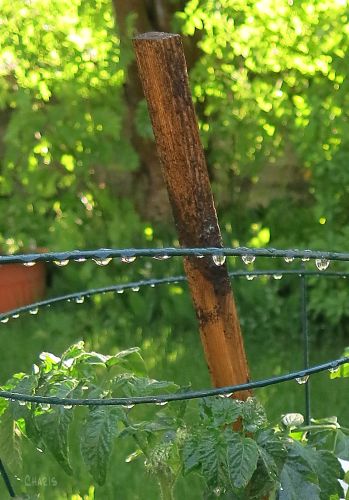
Yesterday I planted tomatoes which, up until now, have happily resided at Casey’s Greenhouse. I prepared and enriched the soil, then placed them in holes I dug for them in my garden beds. I put stakes and wire cages around them to prop them up and protect them from the wind and, I hope, stray balls when the grandchildren come to play. These varieties can grow heavy fruit; they need support.
My hands were gently tying the stems when the song containing the verse began to play in my head again. Thou wilt keep him in perfect peace, whose mind is stayed on Thee. But now I understood it better. I want my tomatoes to grow. I did all the work. Their job is to receive water and sun and soil nutrients and produce fruit. I thought about my Heavenly Father as my protector, my propper-upper, my provider.
Unlike passive plants, we have the choice to stay or walk away. We can easily fill our imaginations with dismal forebodings, angry reactions or alternative coping strategies. We can choose to give away our authority to other voices with other plans. God has given us the right to reject his embrace.
I remembered a time when I felt supporting arms upholding me and bracing me in a tough time. Our son-in-law was in the intensive care unit. His condition was so dire surgeons decided the risk of moving him across the hall to the operating room was too great. In a last ditch effort to stop the hemorrhaging in his lungs and to remove more infected fascia from his leg they prepared to operate in right there in his room.
A nurse with tears in her eyes called for his wife, parents, and brother. We all knew by the atmosphere this was to give them a chance to say goodbye. I watched my dearly loved daughter walk down the hallway in a daze. My knees buckled and I slid down the wall I had been leaning against. I had been brave all week but now I sobbed.
We had seen miraculous answers as people prayed day and night. We saw blood circulation restored to his feet as children prayed for his toes. We saw thousands of people respond to a call to pray in unity. And now this.
He was bleeding out and in danger of throwing clots at the same time. He was on 100% oxygen. He couldn’t breathe. He was dying.
I felt so abandoned. So helpless. So weak. I was embarrassed by my inability to keep it together. I wanted to be strong for others, but I wasn’t.
Then two of our daughter and son-in-law’s friends came out into the hallway and stood on either side of me. I didn’t want to be touched but they lifted me to my feet. Each one held an elbow and literally held me up, sustained, supported, propped up, bore my weight, and held on until I felt steadied.
I remember telling Debbie that I knew God was doing something, but at that moment it was just too hard. She and John Murdo comforted and encouraged me. They reminded me of God’s faithfulness no matter what happened.
Some months before he was in a coma, our son-in-love told me about meeting an amazingly accurate prophetic guy. Shawn Bolz told Bruce about the plans God had for his life – and those plans did not include dying at a young age. He said he had never said that to anyone before but the Lord impressed on him that he needed to know.
My daughter and I knew we had to take those prophetic promises and go to war with them. Feeling stronger now I marched up and down the hall in the opposite spirit that prevailed in the hospital wing. I sang praises (softly -–this was a hospital). I sang in English and I sang in the Spirit, something I had always kept very private. I know people passing by must have thought I was insane, but I didn’t care what they thought. This was war. I was standing on those prophetic promises. My imagination chose to see them being fulfilled. My trust in God’s goodness grew with every lap.
My eyes were closed a lot of the time and I was so focused I didn’t notice the hospital halls filling with people who had come to pray that Good Friday morning. Many more in the ICU waiting room, including my husband, had already been there for hours. Hundreds more prayed in churches and home groups when they received text messages. Then thousands around the world joined. We declared he would live.
He did.
On Easter morning he responded to his name and opened his eyes briefly. On Pentecost Sunday he walked into church a whole man with no loss of limb, or brain damage, and with better kidney and lung function than before he became ill. God had a plan and it included miraculous revival.
I was listening to an album by Selah on my iPod as I finished working in the garden and recalling that day. The song medley, “Standing On the Promises/Leaning on the Everlasting Arms” began to play.
“What are you saying, Lord?” I asked. “Put the pieces together.”
I rewrote the verse on Mom’s plaque in my own words.
You, Abba, my Father, will faithfully guard and surround with shalom, shalom, those whose mindsets and imaginations are planted, sustained, upheld, supported, braced, embraced and borne by You, because they trust You. They stand on your promises. They lean on your mighty arms – and You provide everything they need to produce abundant fruit.
“We must learn to cast off our anxieties because we have so many of them. The world destroys spiritual life by generating constant anxiety. Jesus said that the life of the gospel is choked out by the cares of this world. We know this to be true yet we are more chained and tethered to the world than ever before in the human race.”
-John Ortberg
I’m still cleaning out corners of the garden. The old dead growth needs to go. I need the space for healthy plants.
I’m still cleaning out corners of my mind. Old ways of thinking need to go. I need the space for healthier thoughts.
Have you ever searched online for a recipe using the ingredients you actually have in the house? Have you clicked on the suggested site and then had to plow through the details of the cook’s day before finding the instructions way down at the bottom under photos of her aunt’s birthday party? Have you ever said to yourself in exasperation, “All I want to know is how many eggs?
Have you ever been trapped by the expectation of polite silence placed on the captured pew audience and listened to a rambling sermon that seemed to include a dozen unrelated illustrations plucked at random from the Good Book. Have you wondered where this was going, if anywhere?
Have you ever said to someone, “How are you?” and they took your question as a literal invitation to recite their medical records? Have you wondered if you should send flowers now or wait for the funeral should they actually succumb to toenail fungus?
Have you ever wanted to say, “I don’t have time for this. Please just get to the point?”
I’m sure people have with me. One of the advantages of writing is the ability to edit out superfluous detail. People don’t have time to travel rabbit trails with me, and frankly, even the most caring among us does not have the capacity to listen to every detail, let alone delight in it.
Have you ever asked your child or grandchild about the classic movie a friend took them to and been delighted to hear every detail, from the story of the kid who spilled his popcorn in the lobby to a description of the hero’s father’s home planet? Our delight is not in the movie. We’ve seen it. Our delight is in the relationship. We rejoice in the child’s joy.
People who have lost spouses or friends, or have been separated from them for long periods of time, tell me the hardest part is not having anyone to share good news with. Someone who cares about the details of your day, someone who doesn’t communicate with watch checking or key jangling that they just want you to get to the point, someone who actually enjoys being in your presence is one of the greatest gifts to our souls’ well-being.
Here’s the most beautiful thing about our relationship with God. He has all the time in the world. He has an infinite capacity to care. He delights in you and every detail of your life.
When I first started on a journey to get to know God better I decided to go on a long walk with Jesus. I didn’t know what to say, so I told him about a movie I had seen. I pretended I was holding his hand like I was a child. I didn’t listen much. I didn’t know I could. After a few days of telling him about the details of my life no one else seemed interested in, he began to tell me about the things he cared about. It began with a flower in the woods, and a bird in the tree.
I began to listen. I wept with him. I rejoiced with him. Because he listens.
The Lord directs the steps of the godly. He delights in every detail of their lives.
Though they stumble, they will never fall, for the Lord holds them by the hand.
I’ve been helping friends write resumes. I’ve also been talking to friends who are looking for reliable employees. Frequently, friends who are writers (or want to be writers) ask me to read their articles and books-in-process. Others are looking for recommendations for reading material. Busy, busy, busy.
I can lose embarrassingly large huge chunks of time following links on social media. At the moment it takes over an hour to keep up with my Facebook feed in the morning (and you know I don’t limit myself to a morning perusal). Daily, I am notified of the arrival of possibly excellent blogs I probably won’t have time to read if I want time to write anything myself.
I was the kind of kid who read everything – cereal boxes, instruction manuals, and terrifying lists of side-effects tucked inside packages of tablets. I read quickly and constantly, but even I am overwhelmed by the barrage of words coming at my eyeballs lately. Like the employers who spoke to me this week, I sometimes look for reasons to scroll past and go on to the next thing. Disqualifiers. (A note to my young friends: potential employers do look at your social media party pictures and rants about unfair teachers, over-sensitive co-workers, and unreasonable cops. Just sayin’.)
The problem is that hasty judgments can be misleading. Sometimes I need to go back and look again because sometimes I have been very wrong. I know this because I have felt harshly judged and dismissed myself. That may be who I was then, but it is not who I am now.
Lately, I have been listening to the stories of people I admire, people who have developed proven character and live lives that effectively communicate the love of God and his ways. These are people who mentor the young, heal the sick, speak the truth, serve the poor, and encourage the stumbling to pick up their feet. I am amazed at how incredibly unqualified some of them would have appeared to be if I had known them twenty years ago.
This week I have also read critical dismissals of people I have learned carry a depth of understanding the shallow, fearful, and defensively religious don’t recognize. I have heard posters say they have nothing to learn from anyone who is a single parent, too young, not academically-inclined, divorced, physically weak or ill, not endorsed by an institutional church, endorsed by the wrong institutional church, unpolished, too slick, female, unattractive, fashionable, unequally yoked to an unbelieving spouse (or a spouse who voted differently), “obese” (seriously? maybe a little husky) or, in the case of a fine writer, dead.
When I listen to the stories of people I admire, both living and dead, I am impressed by the fact that nearly all of them originally presented with disqualifiers for ministry. She failed the same grade three times, she lived with an alcoholic for forty years, he drank for forty years, his wife divorced him, she failed the physical for missionary service, he was attracted to the same sex, he couldn’t carry a tune, she fainted if she had to speak in public, he lost years to depression, she was seduced by a pastor, he was diagnosed with autism, she had a criminal record, he was drowning in debt.
The Bible records many stories of those who were uniquely unqualified for the roles God gave them. We read about prostitutes, collaborators, murderers, convicts, fraud artists, and cowards rising up to become God’s secret weapons. The abandoned, abducted, emasculated, robbed, wounded, harassed, orphaned, and misunderstood eventually found themselves in positions of power and influence only God could arrange.
God’s tendency to use the weak to confound the mighty is not new, yet it is consistently surprising.
Remember, dear brothers and sisters, that few of you were wise in the world’s eyes or powerful or wealthy when God called you. Instead, God chose things the world considers foolish in order to shame those who think they are wise. And he chose things that are powerless to shame those who are powerful. God chose things despised by the world, things counted as nothing at all, and used them to bring to nothing what the world considers important. As a result, no one can ever boast in the presence of God.
God has united you with Christ Jesus. For our benefit God made him to be wisdom itself. Christ made us right with God; he made us pure and holy, and he freed us from sin. Therefore, as the Scriptures say, “If you want to boast, boast only about the Lord.” (1 Corinthians 1: 26-31 NLT)
When I am tempted to dismiss someone for lack of obvious potential, I have to look at the bitter, depressed person I was twenty years ago and remember how the grace extended to me made change possible. I am grateful for those who saw more than my list of disqualifications and offered encouragement in dark days. They saw potential when I did not. I am thankful that even now God doesn’t define me by my weaknesses.
When I listen to the stories of people I admire I realize the common element is that these are people who experienced the power of transforming grace in their lives. It is difficult to give what you have not received. They extend grace because they have known grace. Weakness was their superpower because the lack of personal qualifications for the job allowed God’s grace to multiply beyond anything they could imagine.
Is the job God is offering you beyond your ability? You’re hired!
Each time he said, “My grace is all you need. My power works best in weakness.” So now I am glad to boast about my weaknesses, so that the power of Christ can work through me. (2 Corinthians 12:9)
God’s Kingdom is a place of abundance where every generous act overflows its original bounds and becomes part of the unbounded grace of God at work in the world.
“Teach believers with your life: by word, by demeanor, by love, by faith, by integrity. Stay at your post reading Scripture, giving counsel, teaching. And that special gift of ministry you were given when the leaders of the church laid hands on you and prayed—keep that dusted off and in use.
Cultivate these things. Immerse yourself in them. The people will all see you mature right before their eyes! Keep a firm grasp on both your character and your teaching. Don’t be diverted. Just keep at it. Both you and those who hear you will experience salvation.”
(Paul’s first letter to Timothy 4:10 – 16 MSG)
Four of my grandchildren are in French Immersion schools. They all speak better French than I do, even the five-year-old.
I attended a school where French was taught conversationally and where only French was allowed to be spoken in French class. The experimental “immersion” method tested on us turned out to be much more effective than the traditional memorization of conjugation tables. I’ve used the words learned in that class to sing and to teach singing, but not as a part of regular conversation. Most of it has slipped away like the names of people from the past with vaguely familiar faces. I couldn’t assemble a grammatically correct essay en français if my life depended on it, not without supernatural intervention anyway.
When my granddaughter was only six, and in her second year of speaking only French all day at school, she asked me not to speak to her in my broken second language anymore. Part of the problem was the difference between my Parisian pronunciation and her Quebecois teacher’s accent, but more than that, she was simply more proficient.
“Grammie, do you mind not speaking French to me?” she said one day as I drove her to school. “I’m only a little kid and it’s embarrassing for me to correct a grown-up.”
She’s in high school now, writing short stories, giving speeches, and mastering courses in biology and mathematics, all in French. She has been immersed in the culture for ten years and doesn’t need to translate her thoughts like I do. She thinks in French as well as she thinks English. Perhaps better.
Last year I asked the Lord for a word that would show me where he was taking me now. In a dream, I saw the word “instill.” It means “to cause to enter, drop by drop.” I read and study as much as I am able. The quest for knowledge still provokes me to leave smoking pots of food on the stove while I look something up.
I believe the concepts the Lord has been teaching me about himself but, at times, they feel awkward and foreign. Effort is required to sit still as he instills a language of grace, love, and trust at a level where I can think differently and respond more automatically. (The delete key is the most worn key on my keyboard, I think.) I am learning a new language in which my actions are motivated by God’s love and not fear of condemnation. I’m learning to live in the freedom Jesus gave his life to get back for me.
This year, beyond the concept of instilling something into me, I realize there is more: the concept of instilling myself into the depths of his love. An immersion into his heart. A stepping into deeper experiences of his grace. Abiding in the place of rest he has prepared right in the middle of trying circumstances.
Standing on the familiar shore of rugged debate, theoretical platitudes, and pebbly doctrinal pickiness feels comfortably normal. What if I stop trying to understand everything and give up the need to prove myself “right” and instead trust Him to surround me and lift me up. What if I step into God’s culture and totally immerse myself in his grace. Will he hold me up? Teach me to breathe under water? Send a boat?
Sometimes I float. Sometimes I thrash about in a panic when I realize I’m in over my head and I don’t have all the answers. Then I remember Paul’s advice to Tim. “Just keep at it. Stay at your post. Read the scriptures. Don’t neglect the gifts God has given you.”
Maturity is something he brings about as I yield to his ways. For a person learning to let go of the baggage of a lifetime of trust issues, this is deep water.
This part of the journey is about more than the occasional Bible study class. This is about living, all day, with a new language, in a different culture than the one more familiar to me. At the moment I feel more quasi-lingual than bi-lingual. I’m trying not to compare myself to much younger people who are more advanced in understanding than I.
But I am learning.
And it’s true, you know. God is love.
Were the whole realm of nature mine, That were a present far too small: Love so amazing, so divine Demands my soul, my life, my all.
In the way that texting while driving is a bad idea, blogging while wrestling with anger is also a bad idea. Both are dangerous distractions with the potential to put serious dents into bystanders.
I’ve not been posting as frequently lately because anger has been flashing like a check engine light on my car’s dashboard. Something needs tending to. I submitted to self-imposed silence and listened instead (well, mostly.) With the Lord’s help, I’ve needed, again, to examine what was going on under the hood before going any further.
I think it started with reading an innocent hashtag on Twitter: #ThingsOnlyChristianWomenHear. What followed was an unexpected mass chorus of voices expressing the pain of living in a religious system that kept -or still keeps- women voiceless. I may have added a few tweets myself. A lot of dashboard lights flashed on the internet last week. Not everyone was comfortable with the spontaneous outpouring that exposed more misogyny than they realized was a normal part of many women’s lives. Exposure is embarrassing and uncomfortable for everyone. Push-back from onlookers called for cover-up or, sadly, invalidation.
Here’s the thing, you can’t forgive what you don’t acknowledge and you can’t clean up corruption when it remains covered up. (We learned that lesson when our son-in-law almost died from undiagnosed flesh-eating disease.) Sometimes healing involves mess or pain first.
I discovered I still had more forgiving to do because listening to other women’s (and men’s) painful memories triggered some of my own. There were still some lingering lies I accepted about God liking men more than women. They were planted in my soul as a result of observing the way women of my mother’s generation were treated, and their resignation to silence and subservience to men as the norm. The seeds grew as I was taught to interpret scripture in a way which ignored the character and practice of both Jesus and Paul. (Paul wrote the words to Timothy I was told imposed a gag order on all females for all time in all places, but he also praised women like Phoebe, Junia, and Priscilla who were obviously not silent.) There was still some toxic residue in the unseen corners of my heart that kept me from saying with all honesty, “I thank God he made me a woman!”
The Lord and I have been working on that together. He is the one who establishes my identity. And he likes me.
Then Christianity Today published an article which asked the question, “Who is in charge of the Christian blogosphere?” The author suggested that female bloggers who write about spiritual matters should be under the supervision of denominational or institutional authorities who are credentialed and better educated in matters of proper doctrine. (Which proper doctrine the author doesn’t say.) The article, and responses to it, triggered another memory.
One of the most difficult times in my life was when a physician who specialized in voice problems prescribed a season of silence. I was less talkative then, but people who know me will understand the enormity of the challenge.
I had finished studying, rehearsing and performing the role of Amina in Bellini’s opera, La Sonnambula, a few weeks before. I caught the flu before ensemble rehearsals began. It morphed into a long-lasting nasty cough monster that barked in a register much lower than my usual coloratura soprano range.
The role of Amina is a kind of vocal high-wire act involving agility, stamina and a lot of very high notes. I was onstage most of the opera singing not only solos but duets, trios and other ensembles. A run-through of my music took nearly 90 minutes. You can imagine how much time was involved in practice to learn the role.
My voice was not recovering fast enough. It sounded okay in short sessions, but it didn’t feel right, and I was worried about stamina. Reluctantly, I spoke to the producer and director about my doubts in my ability to perform. The response was not what I expected. The director said, “I believed in you. You disappoint me! If you don’t sing I stand to lose $10,000 of my own money I invested in this production.” I felt the pressure and forged on.
Nerves were a bigger problem than usual on opening night. I knew I was forcing at times. Except for one embarrassing note on the final night, I made it through the performances though. The standing ovation and bravas from the audience almost made up for the burning pain in my throat.
Two weeks later I sang with another orchestra and choir. I had only two solos in a Bach cantata which should have been easy, but I struggled. My voice was not responding as it should. I made an appointment with the laryngologist.
He said I had the beginning of nodules. That statement feels like a death sentence to a classical singer. I was scared. He told me to rest it completely for several weeks – no talking and definitely no singing. I followed his advice and my vocal folds did heal. I didn’t need surgery, but I learned some things in that time. 1) I yelled at my kids more than I thought I did. 2) People don’t talk to you if you don’t talk to them. 3) I didn’t appreciate submitting to authorities who were more concerned about their own project than my long-term well-being. 4) Being voiceless made me feel powerless.
You may express yourself in other ways, but perhaps you can still relate. My voice was my strength because it made me relatively unique. I could sing over a full orchestra and eighty voice choir without a microphone. My voice allowed me to comfort others and bring the joy of music into their lives. My voice was my vehicle for creativity and emotional expression. I was wrong, but at the time I felt like my voice justified my existence. People listened. They asked advice. Musicians I admired included me, gave me a place among them on the stage, and treated me as though I had value. Without a voice, I had no place in that world.
About ten years later chronic health problems meant I had to give up singing almost completely. I grieved deeply. I hated being voiceless. But my heavenly Father can use all circumstances and I grew because I learned instead to lean on the Lord as my source of justification for existence. Eventually, he led me to fill the void with other creative expressions. One of them is writing and blogging. I had a voice again, but this time it served a larger purpose.
When I read the CT article it felt like the people who were willing to sacrifice my voice to serve their own agenda had shown up again. I believe in the wisdom of an abundance of counselors. I believe in mutual submission, and yes, my husband does read and approve of my blog, not because he is my master, but because I respect his perspective. I have deleted and revised and parked articles in the draft file indefinitely on the advice of people I trust. But that’s the operative word – trust.
I wonder if the strong backlash to the article could be coming from people who have also lost their innocence when it comes to the lack of transparency of “experts” in positions of power. Yes, we need to forgive, but forgiveness does not mean trust is automatically restored. The type of servant leadership Jesus demonstrated is something we still need to strive to attain when it appears the response to error is more silencing control instead of more healing grace and better communication of love. We need more of the kind of discipleship training that encourages believers to have their own senses trained to discern right from wrong through practice.
The point of leadership is to produce competent graduates, not more dependent children in pews.
The point of the exposure of corruption in the body and submission to the kind of correction the One who loves us perfectly brings is to purify and build up this Church of living stones.
I almost posted two previous versions of this blog article. In them, I gave more evidence for the reasons for my distrust of some ecclesiastical hierarchical authorities (not all!) and defended my educational qualifications. Twice I felt the Lord saying to let it go, deal with my own heart issues, and start again. Learning to hear God for ourselves means responding in obedience. Sometimes submission to his advice means speaking up and sometimes it means hitting delete. Holy Spirit provides the fruit of self-governance in his gift basket for a reason.
The internet is like the printing press that triggered the Reformation. Blogs provide more people with the freedom to speak up. I believe we are on the brink of another Reformation in which greater numbers of the priesthood of believers will rise and raise their voices in praise to the God of our salvation who sets all the captives free.
I am not voiceless anymore. I don’t need the approval of people I don’t trust. I do need the approval of my Lord.
May the words that come out of my mouth and the musings of my heart meet with Your gracious approval, O Eternal, my Rock, O Eternal, my Redeemer.
(Psalm 19:14 The Voice)
To my fellow Christ-centered female bloggers, and to all my brothers and sisters in Christ no matter the form your expression takes, I urge you to use your voices! May your sound go out into all lands and your words unto the ends of the world.






 Unlike passive plants, we have the choice to stay or walk away. We can easily fill our imaginations with dismal forebodings, angry reactions or alternative coping strategies. We can choose to give away our authority to other voices with other plans. God has given us the right to reject his embrace.








 Charis: Subject to Change