Joy in Disappointment

“The difference between shallow happiness and a deep, sustaining joy is sorrow. Happiness lives where sorrow is not. When sorrow arrives, happiness dies. It can’t stand pain. Joy, on the other hand, rises from sorrow and therefore can withstand all grief. Joy, by the grace of God, is the transfiguration of suffering into endurance, and of endurance into character, and of character into hope–and the hope that has become our joy does not (as happiness must for those who depend up on it) disappoint us.”

-Walter Wangerin

Sometimes people disappoint me.

Sometimes I disappoint myself.

I think disappointment is one of the things we fear most.

What if I trust this person with my sacrificial donation to a worthy cause and he absconds with it for his own personal pleasure?

What if I trust this woman with my story, but her tongue twists truth like a knotted cherry stem that becomes a mocking joke at my expense?

What if I trust these caregivers to protect my precious child and they return him with a bruise in the shape of a hand and a flimsy excuse pinned to his onesie.

These examples are hypothetical (mostly); however, many people understand the suffering that comes from a sense of betrayal and discovering people they trusted were not who they said they were. That kind of pain is real. Some of us add to the suffering by feeling ashamed for being gullible, but there is also the fact that sometimes we didn’t see the red flags sooner because we didn’t want to. They were inconvenient.

But what if the culprit is me? What if in my exuberance to illustrate a point, I break a confidence and share a story I promised not to share?

What if I accept the polite gesture of driver allowing me to merge onto a busy road as if I was entitled to it, then, only a block later, slam on my brakes, sloshing my hot coffee everywhere. What if I mutter the curse, “idiot!” at an obviously drug- impaired woman who stumbles onto the road in front of me. (Ok. That one really happened. I almost ran over her! But God forgive me, in that moment I was more upset about what an enormous inconvenience that would have been to me more than I was about how devastating it would have been to her. )

I was not who I thought I was. I felt ashamed and stupid for my choices.

I’ve been thinking a lot about scenarios like this and worse lately. A lot of people, including myself, have been deeply disappointed by betrayals of trust by people we thought we knew. I suffer with victims who have been treated as if they are expendable in the kingdom of God. Some of the substantiated reports coming out sent me into deep mourning. I lost my joy.

As a foster mother I often held inconsolable weeping children who had been abused. I rocked them for hours. As a friend I’ve listened to stories of abuse and the consequences both women and men didn’t disclose until decades later. I never thought I would see so much dishonour for the powerless in a church setting. It’s been a season of anger and mourning, but I don’t want my angry tears to congeal into bitterness, nor do I want to enable systemic corruption.

I’ve also seen the tears in the eyes of friends I treated cruelly with impatient, judgmental, or dismissive words. I am not without sin. In recent months I felt compelled to find two estranged friends from many years ago who I needed to apologize to. Eventually I learned that both had passed away. I regret not making things right sooner.

This season of sorrow has prompted me to look at things I don’t want to see. It has made me realize that even though I can’t fix anybody, I can’t afford to carry a grudge either. It may take a while to get there, but the goal is forgiveness. It has made me ask questions.

What if we confront the people who wronged the innocent or the trusting, and by holding them accountable, protect more vulnerable lambs from abuse? What if we go further? What if we are all honest with each other? What if we come humbly, together, recognizing our own vulnerability to falling, and extend grace to help them in the long process of rebuilding trust as they learn to become the people God created them to be?

What if I thank God for revealing when I miss the mark? (Publicly, if need be.) What if I apologize, make amends, and (here’s the hard part) forgive myself as I cooperate with Holy Spirit as he works in me so I can become the person he created me to be?

My examples are (mostly) hypothetical. Disappointment is real. In the past few months, I have struggled with the consequences of disappointment in Christians I felt I, or fellow-believers ought to be able to trust. Then I realized I was also in need of grace to let go of self-made comforting idols. What if godly sorrow that temporarily removes our happiness leads to an awareness of the permanent joy the author of our faith wrote into the script of his plan for our lives?

What if joy means knowing that He who began a good work in us will be faithful to complete it? What if the pain and grief-filled times are gifts of grace that motivate us to develop endurance leading to good character that can carry increased hope? What if it’s really true that God loves us as we are, but also loves us too much to leave us this way?

What if we can say –with joy– our Heavenly Father’s discipline is not fun at the time, but as we respond to his voice, and take time to sit in his presence, we discover he is actually good? What if it is his kindness that leads us to want to change? What if the sorrow of godly suffering leads us through the valley of the shadow of death to self where he prepares a feast for us where the enemies of our soul can watch but dare not touch us? What if the evidence of transformation in our lives is being able to say. with sincerity, I trust you Lord, for only you have the words of eternal life?

In you is fullness of joy, even in sorrow.

More Than What

Have you been asking God what He is going to do? He will never tell you. God does not tell you what He is going to do; He reveals to you Who He is. -Oswald Chambers

Clean, Pure

Who can possibly ascend the mountain of the Eternal?

Who can stand before Him in sacred spaces?

Only those whose hands have been washed and hearts made pure…

Psalm 24:3,4 (The Voice)

Heading Home

Photo: Heading home, Springfield Road, 5:00 p.m.

As I walked home, heading into the sunset at the end of a relatively warm February day, I was thinking about events of the past few months. I have seen so many false starts and travelled down so many fascinating, but distracting rabbit trails that these months have needed to be a time of prioritizing and realigning with what is truly important.

I love the razzle dazzle of experiences of signs and wonders beyond anything I thought I’d see in my lifetime, but signs point to something. What do they point to? This, for me, is a time of going back to the basics of the good news, and the nourishment of simple truth.

God said he has a plan and a purpose. What is it? Yesterday, a man from a place where it can be very costly to follow Christ, reminded me of a passage of scripture. It was written by John the Beloved, the man who rested his head on Christ himself at their last meal together before Jesus was crucified.

I remember how profound 1 John 5 was to me as a teenager when I first read it in a paraphrase by J.B Phillips. As one who felt like I never fit in, this gave me assurance that I belonged.

Everyone who really believes that Jesus is the Christ proves himself one of God’s family. The man who loves the Father cannot help loving the Father’s own Son.

The test of the genuineness of our love for God’s family lies in this question—do we love God himself and do we obey his commands? For loving God means obeying his commands, and these commands of his are not burdensome, for God’s “heredity” within us will always conquer the world outside us. In fact, this faith of ours is the only way in which the world has been conquered. For who could ever be said to conquer the world, in the true sense, except the man who really believes that Jesus is God’s Son?

Jesus Christ himself is the one who came by water and by blood—not by the water only, but by the water and the blood. The Spirit bears witness to this, for the Spirit is the truth. The witness therefore is a triple one—the Spirit in our own hearts, the signs of the water of baptism and the blood of atonement—and they all say the same thing. If we are prepared to accept human testimony, God’s own testimony concerning his own Son is surely infinitely more valuable. The man who really believes in the Son of God will find God’s testimony in his own heart. The man who will not believe God is making him out to be a liar, because he is deliberately refusing to accept the testimony that God has given concerning his own Son. This is, that God has given men eternal life and this real life is to be found only in his Son. It follows naturally that any man who has genuine contact with Christ has this life; and if he has not, then he does not possess this life at all.

I have written like this to you who already believe in the name of God’s Son so that you may be quite sure that, here and now, you possess eternal life.

What is truth? The Spirit is truth.

What is God’s purpose? To give us life now and eternally.

What is his plan? Jesus. From the beginning it has been Jesus. In him alone we live and move and have our being.

If we learn nothing more, this is enough.

No and Yes

God loved the birds and invented trees. Man loved the birds and invented cages.

Jaques Deval

I don’t think we truly understand the nature of God or the immensity of the implications of the free will he gave us until we are tempted to make little gods of ourselves by removing free will from people we say we love.

Unless you have the freedom to say no, your yes means nothing.

Wrestling with God

Genuine trust involves allowing another to matter and have an impact in our lives. For that reason, many who hate and do battle with God trust Him more deeply than those whose complacent faith permits an abstract and motionless stance before Him. Those who trust God most are those whose faith permits them to risk wrestling with Him over the deepest questions of life. Good hearts are captured in a divine wrestling match; fearful, doubting hearts stay clear of the mat.

Dan B. Allender

I’m a verbal processor. This, plus a tendency to take up causes before I have all the information from all sides, has landed me in more trouble than anything else. A verbal processor says things right out Ioud that they may toss away later. They are on the way to something else, but for people who don’t operate this way, it’s hard to tell what’s process and what’s conclusion.

I was thinking out loud in the presence of someone who not only did not understand my struggle with an issue, she did not understand why it should even be an issue, nor why I was saying such disturbing things.

“Why do you have to ask so many questions? Why can’t you just believe?”

I looked at her sweet face and said nothing. What I wanted to say was, “Because it matters. Because this is a piece of the puzzle that other pieces labeled “choices” need to make connection to to understand who God really is. Because who God really is what really matters.”

I’ve heard people say that they can’t be bothered with doctrine (which, ironically, is a doctrine in itself.) For some it’s true that deeper study is not necessary. I think of a lovely friend with Down’s syndrome. Her entire theology could be summed up in her statement, “Jesus loves me and I love Jesus.” True and beautiful. So why can’t I just believe everything I’ve been told? Why have I gone through periods in my life when I need more?

I believe it’s about relationship. One of the ways I connect with God is when he gives me a puzzle or presents a question I can’t answer. I had a dream once where I was a child sitting on the floor with a kind person who was helping me connect shaped metal puzzle pieces into a mat about a meter square. I thought we were done and congratulated myself by clapping my hands like a preschooler. Then he started building the puzzle pieces upwards into an incredibly complex cube. I protested. That was entirely too hard and too much work. He looked at me kindly and said, “Stop thinking in two dimensions.” I recognized him at that moment. It was Jesus. Then he disappeared.

I’ve been in a time of puzzling with God lately. It feels too hard. There are too many pieces, too many levels, too many parts that have been forced to work when they don’t really fit and that could throw the structure off balance later. I’ve also been talking out loud a lot as I wrestle with this thing. Sweet people look at me with the same expression as the impatient woman who said, “Why do you have to ask so many questions? Why can’t you just believe?” (Now that I think of it, she wasn’t asking for my answer. She had no questions that sent her running to God in frustration and an answer without questions is just another boring lecture.)

When I read Dan Allender’s quote, I realized I am one of those who is called to wrestle with God. I know I can never comprehend his vast majesty with my tiny mind. It’s like a microbe in a match with a universe of galaxies. Wrestling is about engaging. It’s about responding to an invitation to join him on the mat and play a demanding, frustrating, multi-leveled complex game that’s probably going to trigger some anger. Maybe a lot of anger.

He comes quietly, almost silently beside me, then flips my entire perspective and triggers overwhelmingly deep and difficult questions. Then he asks if I want to play.

I say, “Are you kidding? This is way too hard for me.”

“I know,” he says. “Your move.”

Getting Along

Don’t worry about having the right words; worry more about having the right heart. It’s not eloquence he seeks, just honesty.

Max Lucado

I remember, as a child, listening to two women disagree about the proper way to do something in church. Both believed that if something was worth doing, it was worth doing well. Both believed there was a right and wrong way to do things. Both believed their way was the right way. Voices were rising, but not in praise. Finally one said, “Well, we’ll just pray about that and see who God listens to.” She stomped off.

That scenario stuck with me. Even as a child I knew something was off. I didn’t know how to pray properly. In fact, nothing scared me off praying with other people more than being told I was doing it wrong by those who seemed to be in God’s favour. (I wrote about that here in Praying Naked).

Today I was reading this passage in the fourth chapter of Philippians. Amusingly (to me anyway), it comes right after the Apostle Paul urges two women, Euodia and Syntyche, to make more of an effort to be of the same mind as the Lord and get along with each other. Immediately I the memory of the two “prayer warriors” from my childhood.

Rejoice in the Lord always. I will say it again: Rejoice! 

Let your gentleness be evident to all.

The Lord is near. 

Do not be anxious about anything, but in every situation, by prayer and petition, with thanksgiving, present your requests to God. 

And the peace of God, which transcends all understanding, will guard your hearts and your minds in Christ Jesus. (verses 4 to 7)

I’ve been in a lot of religious settings in my life. Sadly, I’ve witnessed a lot of broken hearts in the wake of “doing things right” when right was defined by a person or institution whose need to be right surpassed the need to be gentle and extend love and grace to those who didn’t measure up to their standards. Even the disciples argued amongst themselves about who Jesus liked best and who would be greatest in the kingdom.

Servants, slaves, and employees may jostle for positions of greater trust and authority through superior performance. It’s their way of trying to earn security by being the most useful and therefore most valued asset. There’s a reason why Jesus told them, before he was crucified and rose again, that he considered them friends. Their position was secure because he loved them. That’s it. It’s all based on love. And he asked them to love one other as he and the Father love.

I am so painfully aware of the number of wounded believers rejected or left behind or still scrambling desperately for approval by those who determine themselves to be most loved. Somedays it feels like grief. Someday I just want to weep, but I am reminded that I am guilty myself of turning this whole prayer thing into some sort of me-first competition too.

There is so much more to this one-anothering thing than we think. All I know is that we are urged to be one in the Spirit. Unity is not to be found in our efforts or methods. Unity is found in God. God is love. He cannot love us any less than he already does, nor can he love us any more than he already does.

I am loved. You are loved. Let’s start praying together by rejoicing in that fact.

Control and Freedom in Troubled Times

The fires are still raging in British Columbia, but the closest one to us is mostly contained. Today’s smoke is from controlled burns. Fighting fire with fire. We hope.

I’ve noticed a strange mix of emotions in people right now. The apostle Paul wrote that people who show mercy need to learn to weep with those who weep and rejoice with those who rejoice. I was in a place this week where I listened to three different people in different circumstances on the same day. It was a day of weeping and rejoicing.

One was rejoicing that her prayers were answered. Their property in West Kelowna was in a pocket the fire skipped over. Their house and neighbourhood remain untouched. Another woman, a single mother with four children, lost everything except the items they grabbed and stashed in the car as they fled the encroaching flames. She loves the Lord and prayed just as much, but the fire didn’t skip over her neighbourhood. In fact, the area that included 150 rental units was totally destroyed. Another family is still awaiting word on the condition of their property and has not yet returned home.

Then there is our own story. We watched the progression of the fire from a safe distance in our steel and concrete building in a mostly commercial area of the city. We suffered from the smoke and considered joining the thousands who fled the area on both sides of the lake, but decided that sitting in stop-and-go traffic for hours in heavy smoke might be harder on our health than staying home with windows closed and AC on. (I wish now I had bought that air purifier when I saw it on sale last March.) I guess we suffer from a bit of survivor’s guilt.

Conversations with virtually everyone after a dramatic disaster like the Grouse Complex Wildfire in the Kelowna area usually begin with the question, “Are you alright?” and “Did you see it when the giant flames reflected in the water? Where were you when it jumped the lake?” We tell our stories as a way of processing something we hoped to never experience. For some, faith in God, no matter what, has increased. Others struggle to believe that God cares or that anything good could come out of this. They feel abandoned. This is trauma in real time.

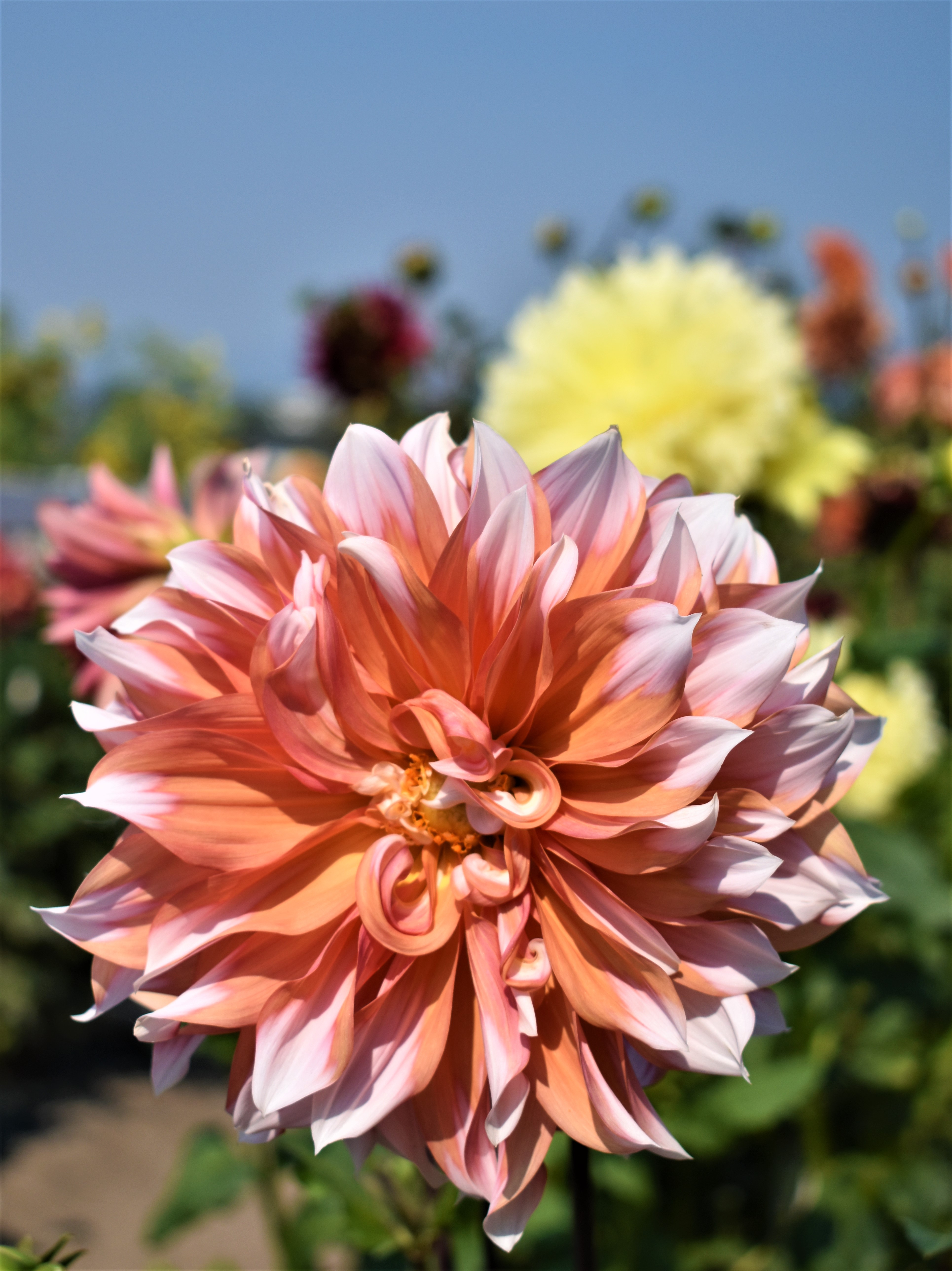
I was planning to visit my cousin’s flower farm when she posted photos of the huge plume of smoke that drifted over their place on the first day of the Westside fire. They postponed their annual public tour until conditions improved. This past Sunday, I told my dear cousin and her gardener husband about the conversations I had been having as we walked in the garden. I guess weeping and rejoicing were still on my mind when they gave me permission to take my camera and stay as long as I wanted in the area where they grow many varieties of dahlias.

This is what the flowers reminded me of. We all experienced the falling ash from trees and structures going up in flame but on this day, I was ready to shake off the ashes like the gardener shook ashes off the flowers. It’s time to be who God made me to be. I’ve learned from experience to pay attention to the condition of my heart as soon as I am able after a time of trouble. It’s possible, even necessary, to bracket feelings and tend to practical needs at first, but setting them aside indefinitely leads to problems later. I need to process.

All of the flowers in this garden are dahlias, but they can be quite different in their expression of dahlia-ness. Some are small, tidy domed bundles in sedate colours with mathematically determined petal distribution. Some are exuberant semi-chaotic displays of bold colors Mom would have warned me to never to wear side by side. The flowers were all dahlias. They all had similar structure, but I was amazed by the diversity on display. They reminded me of the different types of people I have listened to this week.

Some people respond to times of fear-inducing uncertainty with a need for decently-and-in-order control. Some seem to display a limited range of emotions like a black and white photo. Just-the-facts people. Many of our friends and neighbours who’ve watched fire devour memories and investments in their now destroyed homes are weeping, stunned by the magnitude of loss. They are wondering what they did wrong and struggling to get back a measure of control. Others, freed from the restraints of police-enforced evacuation orders, or triggering isolation behind closed doors and windows whilst wearing those wretched face masks (again), react to the signs of increasing freedoms with relief. They may experience a sudden flurry of creative expression with the messiness of a little adult ADD distraction mixed in.

I can do both and often do. Alternately and simultaneously. In times of trouble, organization is essential to survival. I make lists. When the crisis is over, freedom is essential to creative re-building and emotional expression. I might paint a chair or take photos and write an article for my blog while I ask, “What does all this mean, Lord? How should I respond? How do I relate to you and others without letting disappointment taint everything?”

The problem in our relationships often occurs when we are transitioning from crisis to healing in different ways and on different timetables. The helpless can become the hopeless. Some people tend to follow a drive to create order and want to try to control as much as possible. They set more rules, guidelines, protocols, or whatever works for them so this doesn’t happen again. They want to impose discipline via flow charts on both the somebody-look-after-me types and the don’t-fence-me-in types. Disappointed creative freedom lovers, on the other hand, tend to resent restrictions. They may avoid energy-sapping overt battles over control by going all passive/aggressive –in a original way, of course. What we don’t understand is that both extremes are responding to fear – fear of being out of control and fear of being controlled.

Either way, living in fear opens the door to conflict and unhealthy ways of thinking that come after disappointment and a loss of innocence. Bad things can happen to good people. Prayers do not always receive the answer we want. What now? When the devil senses vulnerability, he says, “Oh. You are disappointed and angry. I can help you with that.” Listening to his prompts stirs up anger and unforgiveness that, when it sits around too long, can congeal into bitterness as hard as concrete.

Needing to be in control, needing to be controlled and needing to avoid being controlled become the habits of fearful bitter people. Over-controlled people feel disrespected and fall into resentment and distrust. Controlling people, especially those who seek positions of power, also feel disrespected. They distrust uncooperative types and respond with tighter controls. Over-controlled people respond to more control with more distrust while the hopeless watch… We see that cycle playing out far too often in the world around us.

There is no peace in the garden until we take responsibility for turning to the the One who knows us best and loves us most. He is the one who offers healing for our own wounds. In the process, we need to stop to recognize that our way may not the right way or the only way. Our way may inflict more wounds and contribute to the distrust/control cycle and the growing snowball we would dearly love to heave at someone someday. We need to acknowledge that we do not live in a vacuum and our behaviour does affect others.

It is so easy to discard people who don’t see things the same way we do. Much of the division so many of us have seen become entrenched in our communities is based on fear of pain or loss. We may have a diminishing store of grace for people who fail to read the room and instead rejoice while others weep or weep while others rejoice.

The answer? I believe the Holy Spirit’s character is revealed by the fruit of the Holy Spirit – love, joy, peace, patience, kindness, goodness, faithfulness, gentleness, and self-governance. His grace empowers us to break the cycle by supplying the necessary qualities to respond his way when we seek it instead of relying on our own strength. He gives us love that counteracts fear, and kindness to return for lack of caring, and the ability to govern ourselves faithfully while allowing others the freedom to make choices the way he does.

Anyway, that’s what the Creator of beautiful people in community and lovely flowers in a garden communicated to me through diversity in dahlias. My opinions, as usual, are subject to change as I learn and heal and grow. I leave you with photos taken in the garden. What do you see?

Fiery Trials

I took this photo yesterday evening from the condominium where we live. I saw the smoke all afternoon, but when my neighbour across the hall invited me to see the view from her balcony, I saw the flames.

A huge fire caused thousands to be evacuated from their homes across the lake from us here in Kelowna, British Columbia. I have friends and family on the west side and was very concerned for their safety. I assured concerned friends from elsewhere that the fire was over there and we were alright on this side of the lake.

Last night, the fire jumped the lake. Embers flew across the water and landed on the other side in dry vegetation ready to burst into flame. I’m hearing about people we know not far from here evacuating in the middle of the night. It’s more than an opportunity for dramatic photos now.

A couple of days ago, someone asked if you cold sing theology. I think they meant the dry theories about the study of God that people argue over, the kind of hot air balloon detached from any real experience that causes “experts” with large vocabularies to drone on endlessly. I agree that theory devoid of experiential knowledge of the Holy can just be another source of contention. I also believe that theology that is what we think about God, and doctrine that is what we believe about God enough to act on in a crisis is one of he most important considerations we will ever make.

Can I sing theology? Yes I can. I used one of my favourite hymns, How Firm a Foundation, as an example. Today, with flames consuming a nearby hillside as I watch the winds pick up and the flag over the supermarket shift directions, a verse from that song is more relevant than ever.

When through fiery trials thy pathway shall lie,
My grace, all-sufficient, shall be thy supply;
The flame shall not harm thee; I only design
Thy dross to consume and thy gold to refine.

    There is so much in those four short lines. Fiery trials happen. Our cries of “Why God?” are less likely to be answered than “What do you want me to see about you that I couldn’t see any other way?”

    I’ll let you know.

    In the meantime, prayers for our city and its citizens to be come through this time safely are welcome. For that matter, we need prayer for this entire country, especially the west and the northern territories were fires have raged for weeks. Prayers that we would come out as refined gold, freed from the kind of entanglements that hold us back spiritually are even more welcome.

    Summer Night

    When I consider the heavens,

    the works of your fingers,

    the moon and the stars that you have made,

    who am I that you are thinking of me?

    Psalm 8