Grace, Peace, Trust

amiee's way rs ch

“To rest in God’s power when your own weaknesses seem to be screaming at you – that’s grace!

To be confident in who God is for you when you feel overwhelmed by odds against you – that’s peace!

To stand alone against massive intimidation – that’s trust!”

– Graham Cooke

Am I Hearing You Right?

geese mountain sky IMG_2415

While there are birds, birds to fly…

I heard that Mother Teresa said “I know God will not give me anything I can’t handle. I just wish that He didn’t trust me so much.”

I’m no Mother Teresa, and I already know that God will give me things I can’t handle. I also know that he gives me things that He can handle if I learn to do only what He asks and let Him do the heavy lifting. (“Will You Be My Alligator” link here.) But sometimes I wonder…

I didn’t feel like driving to Alberta again yesterday when I have so much to do at home. But the Lover of my soul knew I needed a break, so I ended up going. I spent the time in the car talking to God, pouring out my feelings to Jesus, and sitting quietly with Holy Spirit. I have evidence of transformation in my life because I have much more peace than I used to when my list of concerns to pray about gets longer and longer. But still I wonder if I could have done things differently (or sooner), if I said something I ought not to have said (or failed to say), if I am following the right path or if I have missed some crucial heavenly download somewhere. Am I doing this right?

Change is messy, I know, but it looks like I may have to exchange my rubber boots for hip waders soon. I cried out, “Lord! I really need to hear your voice about now! Just talk to me! What should I do?!” (I may have raised my voice.)

I was listening to music on my phone as I drove. (Gotta love a car with a USB port.) Road conditions demanded my attention so I left it on shuffle. The songs played in random order. Most of the music on my phone is a peaceful worshipful style aimed at reducing stress in city traffic. My other more eclectic collections are on a road trip sticks or CDs.

A song came on just as I asked my question. I tell you the truth. I do not recall ever hearing this song before or downloading on my phone. It was in a large, but inexpensive collection of classic jazz tunes I bought a few months ago, but I had only listened to a few familiar favourite songs on it.

This is what I heard: Trust in Me.

I think I have a new favourite.

moon-leaves-silhouette-img_4692

“While there’s a moon, a moon up high…”

Save

Save

Save

After the Rain, After the Flood

hallway water IMG_1378

Can I be honest? I am disappointed. Not devastated, but disappointed.

Only four months ago we finally finished a big renovation project. My Dad, who perfected the art of frugality, left me a little money after he passed away. We used it to do long needed repairs to our house and to completely re-finish the lower level. It’s taken nearly three years, but by Christmas it was finally done and I loved it. Our son spent many long hours away from his own wife and children to use his creative carpentry skills and give me the home I always wanted.

And now? Now, like many people in our town, I stand in my own house in rubber boots and wade through water that ought not to be inside our beautiful warm home with its new flooring and freshly painted walls and white trim. Water swirls around the new freezer and washer and dryer.

I’ve not been writing much this week because I have, with friends, been pumping water out the back door for seven days. When the huge dump of snow we had this winter began to melt, it had no escape route. Many of the houses in our town are filling with icy cold water flowing into low places and bubbling up from sewers. It seems the only place the water has not ventured is into the room with the drain installed in the floor to deal with such things.

Wonderful friends jumped in to help last Saturday. Then one by one our friends jumped out to bail out their own homes when the water reached them. Some of them are now in  deeper water than we have been. One brave guy came over and emptied an 1100 square foot pool with two shop vacuums all by himself – two days in a row! I am so grateful. But it filled up again within a couple of hours.

My husband’s mother is ill and needs help, so he flew up to her place in Alberta on Sunday. I am here. I’m still supposed to take it easy after surgery last month but there is really not much choice but to bend and lift and bail and do the best I can.

It’s not enough. There is really nothing I, or anyone else, can do. I have to let it go.

My Facebook friend has been posting pictures of the horrendous flood in Peru, where he lives in Lima – without access to water, ironically enough. Another friend posts photos from a famine in Africa and another pictures of the destruction in the Middle East. My problem is pitifully insignificant in comparison. No one has died here. It’s just property damage.

Yet as I heard a young woman say, “If you have no right to be sad because someone has it worse, you have no right to be happy when someone has it better.” Feelings are feelings. Like the feeling of thirst the feeling of disappointment carries no shame. It’s what I do with that disappointment that matters. If I fail to hold these things in an open hand and give my right to own nice stuff back to God it could congeal into bitterness. I’ve known that heavy entrapment before. I lost years to it.

The night before my husband first stepped on an unexpectedly cold soggy rug in the middle of the family room I had a dream. In this dream I was driving on the top of a snow-covered dike that ended near the river. I needed to turn around, but the trail was very narrow and a deep pool of water surrounded the dike like a flood plain. I almost made the turn, but then my car began to slide into the water. I knew there was nothing I could do. I felt annoyed and resigned, but not particularly upset or panicky.

As my vehicle began to sink I knew I had to give it up. (I love my little Honda Insight). I exited through the window and swam toward the snowy dike. By the time I touched the shore it had become a solid rock beach. People who hadn’t been there before waited with warm blankets to cover me. I saw men attaching cables to my car and salvaging it before it was completely submerged. Someone behind me, wrapping a warm hand-made quilt around my shivering body, whispered in my ear, “This looks very dramatic and like it’s a big deal, but it’s not. You’re going to be okay.”

~~~~~~~~~~~

My feet are wet and cold. I watch the water lap up against the new library shelves. They are already warping. It’s only stuff, I know that. But it’s a loss, and I’m sad. And that’s okay.

In January I asked the Lord to give me a word about what aspect of himself he wanted to show me in this season. In a vision in the night I saw the word “berit” written in the sky. I wrote it down and looked it up in the morning. The first article I found said it was a form of the Hebrew word for covenant promise – a one way promise from God that is not conditional on his people conforming to a code of behaviour to bring about fulfillment. It’s simply part of his faithfulness to keep it.

rainbow square mountain pass IMG_9852 chSomeone asked me if I’ve seen any rainbows lately, considering all the rain that was melting mounds of snow. I remembered seeing this word written in the sky. In Genesis a rainbow is a berit. I saw a literal word of promise taking the place of a rainbow in the sky.

You know, it shouldn’t surprise me that as I write this I am remembering that today is the anniversary of the day our daughter was told she couldn’t have children. It’s also her daughter’s birthday, the first of three miracle babies.

Today is also the anniversary of a terrible day when our son-in-law crashed after surgery for flesh-eating disease. The doctors didn’t think he would live. On this date a year after that he and our daughter celebrated his miraculous better-than-before recovery by going on a mountain bike adventure.

Shortly after that our son and family experienced a flood far worse than this one. Their house sat in a lake of water and they were displaced for months. This week marks the completion of the restoration of their house to better-than-new condition, it’s sale, and the beginning of a new project.

I guess if you want to see miracles you’re going to find yourself in situations that call for them. I am disappointed, yes, but not beaten down, not without hope, not without other treasures. We have wealth in caring friends, in family, in the laughter of grandchildren. We also know that God never allows something to be removed without replacing it with something better. I am anticipating that he will do it again.

A song has been going through my head this week. One line in particular seems to be on repeat:

After the rain
After the flood
You set your promise in the sky…

God is good. Still good. Always good.

Though the fig tree should not blossom
And there be no fruit on the vines,
Though the yield of the olive should fail
And the fields produce no food,
Though the flock should be cut off from the fold
And there be no cattle in the stalls,
Yet I will exult in the Lord,

I will rejoice in the God of my salvation.
The Lord God is my strength,
And He has made my feet like hinds’ feet,
And makes me walk on my high places.

(Habakkuk 3:17-20 NASB)

Save

Save

Hammered Vessels

metal bowls vessels silver hammered ch bw IMG_6625

When God wants to drill a man,
And thrill a man,
And skill a man
When God wants to mold a man
To play the noblest part;

When He yearns with all His heart
To create so great and bold a man
That all the world shall be amazed,
Watch His methods, watch His ways!
How He ruthlessly perfects
Whom He royally elects!

How He hammers him and hurts him,
And with mighty blows converts him
Into trial shapes of clay which
Only God understands;
While his tortured heart is crying
And he lifts beseeching hands!

How He bends but never breaks
When his good He undertakes;
How He uses whom He chooses,
And which every purpose fuses him;
By every act induces him
To try His splendor out-

God knows what He’s about.

-Author Unknown

Quoted by Ravi Zacharias in “God will use you; don’t underestimate what you can do.”


Save

Decisions, Decisions, Decisions

goals fog snow ch rs DSC_0268

Decisions. We face them constantly. Shall I get out of bed now, or can I try to stretch the night to last another ten minutes? Should I open that unwelcome letter or have a coffee first? Should I say something, or bite my tongue once again? Since I no longer have a micro-manager hovering over my desk, shall I dedicate my morning to writing, or cleaning, or playing, or resting?

Decisions, large and small, reflect what we truly believe and reveal our values and the state of our developing character. Decisions, large and small, can also precipitate major changes in our lives – not all of them anticipated. Decisions to turn right or left, to take the stairs or the elevator, or to accept an invitation can all have life-altering consequences.

Sometimes the options spread before us entice with the frustrating pleasure of a candy shop full of delights and the limits of just enough coins in a child’s pudgy hand for one treat.

Sometimes the options range from really bad to frankly terrible. It feels like sitting in a sterile examining room, listening to a doctor ask us to choose between amputation and unrelenting pain.

Some days we face looming deadlines and the need to make a major decision without all the information we want, without any clear, well-advised course of action, or a sense of where this could lead.

We can ask God for guidance and wisdom. In fact he invites us to ask, but then we have to wait and pay attention under pressure. Sometimes we want a particular problem to go away while He, in His wisdom and from His perspective, sees how the problem can become a means to a greater end. The answer may not be as straight forward as we want. Here’s the thing: if we are going to ask the Creator of the Universe for His wisdom it’s not wise to turn it down to look for something we like better.

Ask, but ask in faith, believing in a way that transforms God’s advice into acts of faith.

If you don’t know what you’re doing, pray to the Father. He loves to help. You’ll get his help, and won’t be condescended to when you ask for it. Ask boldly, believingly, without a second thought. People who “worry their prayers” are like wind-whipped waves. Don’t think you’re going to get anything from the Master that way, adrift at sea, keeping all your options open.

(James 1:5-8 MSG)

Save

Save

My Heart May Fail, But God…

red cloud descends sunset ch rs IMG_3009

Whom have I in heaven but You?
And besides You, I desire nothing on earth.

My flesh and my heart may fail,
But God is the strength of my heart and my portion forever.

(Psalm 73:25-26)

As Different as Chalk and Cheese

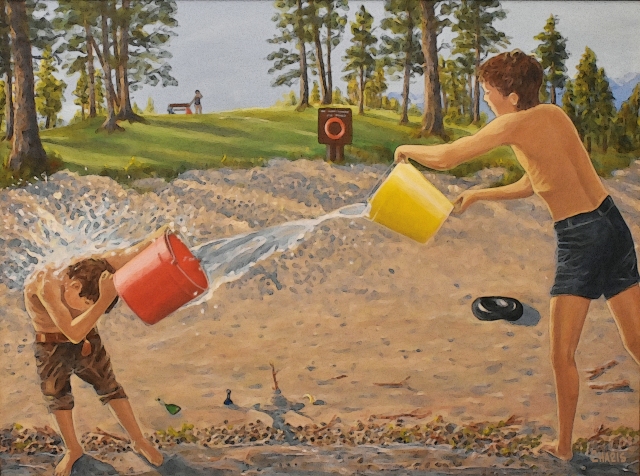
boys buckets painting ch rs DSC_0204

I grew up in a family where teasing was a form of affection. Wrestling, practical jokes, funny stories that revealed weaknesses in each other? All normal (to us). To those not accustomed to this way of relating, such play appeared intimidating and offensive. Most of the time we knew where the line was, but in the background, we often heard someone warning, “You had better stop now before someone gets hurt!”

And then someone got hurt. A line was crossed. For one of the participants the action wasn’t fun anymore. Teasing became bullying (to them). Fights ensued.

Like many parents, we discovered our children’s individuality early. One liked to cuddle. The one who had to move-it move-it move-it resented the restraint of adult arms. One cried easily, one bounced back like an inflatable clown punching bag, one treasured solitude, and one was happiest when surrounded by 27 of her closest friends.

Not only did their teasing/offense lines not line up, they all responded differently to discipline. A raised eyebrow could send one child into paroxysms of guilt, while the arrival of the correction Cavalry, with swords drawn, would prompt another kid to say, “What? I didn’t do nothin’.”

Another parent, describing her boys, said, “They’re as different as chalk and cheese.”

I understand her. Add the dynamic of parents who married their opposites and it’s a wonder we ever agreed on a restaurant.

This week my social media is flooded with differing opinions -strong opinions- from people who claim to be part of the same family of God. I admit, I also have opinions and preferences. Try as I might there are some folks I just can’t seem to get along with. Why don’t other people see things the way I do? Is there something wrong with me or something wrong with them?

I went to bed talking to the Lord about this. By morning he brought to mind the crazy mix of personality types and viewpoints of the disciples Jesus chose to walk closely with him. The Lord reminded me he went on the road with both Simon the Zealot and Matthew the tax collector in his crew.

I followed this rabbit trail and learned some fascinating details about what it meant to be a Zealot or a tax collector. In short, it meant they were ideological enemies.

Zealot is our English word. Simon belonged to a political group called the Kanna’im which comes from the second commandment term for God, El Kanna – jealous God. They fashioned themselves after the zeal of the priests Phinehas and Levi who resorted to the sword in efforts to maintain the purity of the law. In their opinion, the other major parties, the Sadducees and the Pharisees, were not doing enough to uphold Jewish standards in the midst of a barrage of corrupt foreign propaganda.

The infiltration of foreign ideas, and especially idolatry, into Jewish culture incensed them. They despised the Romans for imposing their ways on the populace. When the great census was taken under Quirinus (the reason Joseph and Mary were in Bethlehem when Jesus was born) their anger boiled over. The census was about taxes. Taxation represented everything despicable about the occupation; now the people felt forced to support idolatry financially. The Kanna’im considered King Herod the Great to be a sycophantic pawn of the Romans and a fake Jewish convert.

The Kanna’im traveled to troubled areas and stirred up riots while they destroyed property and anything they considered to be a graven image. Some began to carry concealed daggers in case the opportunity to take out an infidel arose. Zeal consumed them and many died, either in the skirmishes or by execution later. Their plan was to replace Herod (and his descendants) with a real king, and for this they needed a Messiah – or at least a Messiah-like figure. Jesus fit the bill. (When he refused to play the game, saying his kingdom was not of this world, they found others, the “false Messiahs” Jesus warned his followers would arise after he left.)

Depending on which side is issuing a label, they could be called either terrorists or resistance fighters. Herod called them “robbers.” Simon (sometimes called Levi) was part of the Kanna’im. Jesus chose a violence-advocating activist to be one of his closest companions.

Matthew, on the other hand was a publican. A publicanus collected duties, excise, and taxes for the Roman occupiers (The use of the word “publican” as the proprietor of a drinking establishment came later in England). He was a Jew who was detested by the Zealots for being a collaborator. Most of the Jewish population simply hated him for taking their money or goods in kind.

Zacchaeus, who demonstrated remarkable transformation after meeting Jesus, was part of the publicani, chief tax collectors, who were like district managers for the government revenue ministry. As such he was truly hated. Not only did he take money and give it to the Romans, he had the authority to set fees for collection and confiscation “services.” The fees, of course went into his own account. Matthew and his colleagues were lesser officials, but their methods involved blocking roads, bridges and gates until people needing to pass paid up – adding of course, their own “fees.”

Capernaum, a town near the point where the Jordan flows into Lake Galilee, was a border town on the edge of Decapolis territory which had become a district of Roman settlements. Perhaps this is why the Roman Centurion who asked Jesus to heal his beloved servant told him he need not bother coming back with him. Crossing the border was a hassle because it meant running the gauntlet of tax collectors and other red tape types.

Jesus understood the burden of reputation Matthew brought with him. He knew he was subjecting himself to guilt by association and that he would be called “the friend of publicans and sinners.” Nevertheless, he approached Matthew the Tax Collector at his installation at the gate and gave him the opportunity to become a follower. We know Jesus was not naive about the relationship challenges involved. He illustrated his story about humble prayer by using the example of a Pharisee with excellent public status and a Publican with a poor social rating.

When I think about Jesus’ deliberate inclusion of these two men holding extremely different ideas about politics and methods of surviving tense times, my reaction is, “Are you kidding, Lord? How could there be any unity in this “band of brothers?”

I remembered the band also included Nathanael the prejudiced (“Can anything good come out of Nazareth?”), Judas the embezzler, Thomas the cynic (“Unless I touch the wounds…”), Peter the filter-less impulsive (“I’ll never forsake…”), and James and John the holier-than-thou social climbers (“Do you want us to call down fire on them?”). They all argued about who would be greatest in the kingdom.

Add to the outer group of followers some stage mothers, embarrassed siblings, spies, and what’s-in-it-for-me merchant opportunists and he had a congregation no sane pastor would envy no matter how much pressure he is under to improve his stats. Perhaps one of the greatest miracles Jesus performed was to keep them from killing each other.

How did you do it, Lord? Just this week I witnessed people who have unfriended each other over arguments about which businesses or movies or evangelists to boycott. When it comes down to questions about the best way to run the country the opinions are even more sharply divided, even among Christians who have been in formal fellowship for years.

The gospels mention squabbles between disciples. They also tell us that Jesus spent time with his heavenly Father praying about who to choose to be one of the twelve disciples. Here’s the thing: The Father didn’t judge them by their current resume and curriculum vitae. He saw who they would become.

When the instruments of an orchestra tune to the same pitch they are in harmony, even when their sections play very different instruments and follow music in the score that doesn’t resemble anyone else’s part. The one thing early followers of Jesus had in common was the response to his question if they wanted to leave: “Where else can we go? You have the words of life.”

Not everyone is going to feel they have the same exact instructions to follow. For example, a person with a Holy Spirit granted motivational gift of prophecy tends to see a big picture with few gray areas. They move boldly and purposefully toward a goal. A person motivated by a mercy gift will tend to see the people falling through the cracks and respond with gentle compassion. Many gifts. Many perspectives.

After Christ died and rose and ascended to heaven the Holy Spirit came in power upon the disciples. That’s when they began to remember what Jesus told them and put it all together. It’s interesting that Matthew’s written account is the one that emphasizes that Jesus was the Messiah and therefore qualified to rule as King of Kings forever, something the Zealots were hoping to fulfill by political means. It’s also interesting that the Kanna’im who didn’t follow Jesus stayed part of a movement that provoked the violent fall of Jerusalem, while Simon went on to declare the saving love and grace of Christ for a world beyond the confines of Mosaic law.

How do we live in harmony with people as different as chalk and cheese? We tune to Jesus. We keep our eyes on the author and finisher of our faith who saw the joy that lies ahead. He who was willing to lay down his life and conquer death for us, He has the words of life. We can do no better than extend the same grace to others that he has extended to us.

I may not agree with all your opinions or methods, and I might yell ouch and need time to calm myself if you cross the friendly line and hurt me, but if you and I are both centered on Christ and know that he loves us, we are family. It’s his kindness that makes us want to change. I’m willing to listen to what God shows you and adjust and hope you are too. It’s called love.

(Note: This is not intended to be an in-depth academic study. Scholars differ on details. If you are interested I challenge you to explore the topic further.)

Save

Save

Save

Save

Save

Save