The problem with people who want to “take God out of the box” is that they can seldom resist the temptation to stuff him in another one of their own making.
Jesus said the Holy Spirit is like a river that flows and a wind that blows. He is ever moving. To try to put constraints on him, by explaining him by how we have seen him move before is putting him in a box.
Jesus said:
Whoever believes in me, as the Scripture has said, ‘Out of his heart will flow rivers of living water.’ Now this he said about the Spirit, whom those who believed in him were to receive, for as yet the Spirit had not been given, because Jesus was not yet glorified. ( John 7:38,39)
The wind blows where it wishes, and you hear its sound, but you do not know where it comes from or where it goes. So it is with everyone who is born of the Spirit. (John 3:8)
Jesus did not heal everyone the same way each time. God did not respond to the cries of his people for deliverance the same way each time.
Recently I heard someone say that the rules and regulations surrounding practices in their denomination were put there for protection. The rules seemed to be quite reasonable when they were devised years ago. But as I was thinking about this, it struck me that the berms built around my son’s neighbourhood in High River, Alberta were also put there for the protection of the town. When the river temporarily changed course at the highest point of its rain-fed uncontrollable gush, the berms actually served as barriers that stopped the water from flowing back into the channel and turned whole neighbourhoods into a stagnant lake, a lukewarm mix of both fresh river water and disgusting sewage sitting in the summer heat. Stagnation created ideal growing conditions for mold and bacteria in the foundations of homes that were now trapped behind the man-made parameters that were “put there for protection.”
Sometimes denominations form around groups of people with similar experiences, similar understandings, similar revelations, similar aspirations, similar emphasis, or similar disgruntlements. The unity they experience can feel like a refuge and berms are built around it to protect this peaceful easy feeling. But after a few years those protective structures can serve more to keep some folks in and other folks out, and sometimes even try to confine Holy Spirit inside the berms of their definitions of themselves.
The result is stagnation.
Many of us sit in dangerous lukewarm water. We have become the comfortable church of Laodicea, thinking we are rich, when we are poor, not noticing how stinky it is getting and that all of our accomplishments are tainted by the backwash of our own waste.
Church-leavers who form tiny home groups and church-planters who organize stadium-filling mega-gatherings all face the same temptation to berm themselves in. It doesn’t work.
Why? Because God no longer lives in a box. No longer does he need to say, “Touch this box and die!” because we couldn’t approach his holiness in our sinful state. He lives in his people – living, moving, breathing people, reconciled to their Creator by the blood of Jesus Christ. We are his temple. Living stones.
Christ in us, the hope of glory.
This doesn’t mean we abandon discernment and wisdom and accept any old thing. In fact when the Holy Spirit is flowing there is greater discernment and falsehoods are swept away instead of being treasured in hidden places in our hearts’ basements.
He desires all who truly follow Jesus Christ to drop the barriers, and worship Him in Spirit and truth without anger or disputing.
Wow! The little counter over on the left says this is my 500th blog entry. And I was worried I would have nothing to say after the first month.
I never knew, when I dared to overcome my technophobia to find an outlet for my poems, paintings, photos and musings, that God would have so much more to teach me than overcoming fear of computerese. I sometimes questioned the wisdom of writing about events of this annus horibilis before there was any evidence of it becoming annus mirabilis. And who knew it was going to be an annus horibilis anyway?
What if things don’t work out? What if I die of ovarian cancer? What if the depression comes back? What if our miracle grandbaby doesn’t make it to term? What if our son-in-love dies of necrotizing fasciitis? What if our son and his family never recover losses from the flood? Maybe I should wait before I write about them, to make sure God answers our prayers.
Then it occurred to me that I am not in charge of God’s P.R.. This is what it is like to walk in faith, not knowing how the cliff-hanger ends. (And honestly I did not make this stuff up. It has been a horrible time -and a miraculous time.) I have also noted that my anxious questions starting with “what if” seldom come in God’s tender voice.
So to celebrate 500 posts I have chosen not the five most popular blogs but five with the most meaning to me -some of them written in blood and some of them written in tears of joy. Five, because the number 5 is symbolic of grace, and Charis, my chosen name, means grace in Koine Greek, the language of the New Testament. (Psallo means song, and since I have lived a life full of songs it seemed appropriate.)
Right off the bat I’m going to cheat on my own rules because these two posts are part of one story that cannot be separated (and I can do that -my blog, my rules, and my bending of rules) This is about how God took something utterly horrible and turned it into something miraculously wonderful. These were written during the time many excellent doctors expected our son-in-love to die from multiple overwhelming complications after contracting an extremely severe case of flesh-eating disease. He has been restored to full health and the story is just too too too good not to tell over and over -so it goes first. Love is Louder and Love is Louder part II
For the second I am going back into history. After spending decades drowning in soul-crushing depressive mental illness, I was raised up out of the depths. Bluer than Blue
One of the hardest parts in co-operating with Jesus’ healing work and recovering from the prison of the past is the struggle with forgiveness. Letting Go is a poem about stepping away from practised anger and entrenched bitterness.
Red Button, Yellow Button is one of my favourites because the older I get the more I appreciate the insightful wisdom of children before we educate it out of them.
I saw a bumper sticker once that said: He who dies with the most toys wins.
Ha!
We are part owners of a house, still partially under water, and not covered by insurance with an “act of God clause”, that is tagged “no entry.” That’s not a good sign.
We we also spent the weekend with some of our grandchildren, a daughter and son and our son-in-love who doctors gave a 0% chance of survival to just this spring. As we sat in the shade of the house (because our big shade tree blew over in a sudden micro-burst storm last summer) watching the children laughing as they played around the little inflatable swimming pool, I felt tremendous joy. Shade trees, houses, baubles? It all pales in comparison to life. It pales even more compared to eternal life in Christ.
Baubles
Don’t love the world’s ways. Don’t love the world’s goods. Love of the world squeezes out love for the Father. Practically everything that goes on in the world—wanting your own way, wanting everything for yourself, wanting to appear important—has nothing to do with the Father. It just isolates you from him. The world and all its wanting, wanting, wanting is on the way out—but whoever does what God wants is set for eternity. (1 John 2:15-17 Msg)
“And you, because of my blood covenant with you, I’ll release your prisoners from their hopeless cells. Come home, hope-filled prisoners! This very day I’m declaring a double bonus— everything you lost returned twice-over!”
If I let them my anxious thoughts will spin out of control so fast they become a blur like a ride at the West Edmonton Mall. So many conflicting what-ifs cry out for attention it’s like standing at that point of ultimate cacophony where the music of multiple amusements collide -and then a roller coaster thunders overhead. Some people enjoy that kind of atmosphere. I guess I’ve become a country girl.
I need to remind myself, when anxious thoughts begin to multiply, that I can stop and choose to think differently.
I tell myself, “Self? Self! Don’t be hard-hearted, remember and give thanks for all the grace that has brought us safe this far.”
And there has been so much grace! That’s why I chose Charis as a pen name. It is Greek for grace.
The great thing about impossible situations is that we know that we have no way to wriggle out of the problem ourselves, so when the Lord answers with power and provision and peace beyond anything we could muster, we cannot take credit. To God alone be glory.
God is creative and not reactive and none of the things that grab us and try to shake the peace out of us cause him the least concern. He IS peace. And he promises his peace to those who will take refuge in him.
And since that peace comes in the middle of crazy circumstances and not necessarily in relief from them, we may even learn to enjoy the ride.
The voice of the Lord is over the waters; the God of glory thunders, the Lord thunders over the mighty waters. The voice of the Lord is powerful; the voice of the Lord is majestic.
The Lord sits enthroned over the flood; the Lord is enthroned as King forever. The Lord gives strength to his people; the Lord blesses his people with peace.
So stand strong for our freedom! The Anointed One freed us so we wouldn’t spend one more day under the yoke of slavery, trapped under the law…
Dead Sea Fence
We, on the other hand, continue to live through the Spirit’s power and wait confidently in the hope that things will be put right through faith. Here’s the thing: in Jesus the Anointed whether you are circumcised or not makes no difference. What makes a difference is faith energized by love. (Galatians 5: 1, 5,6 The Voice)
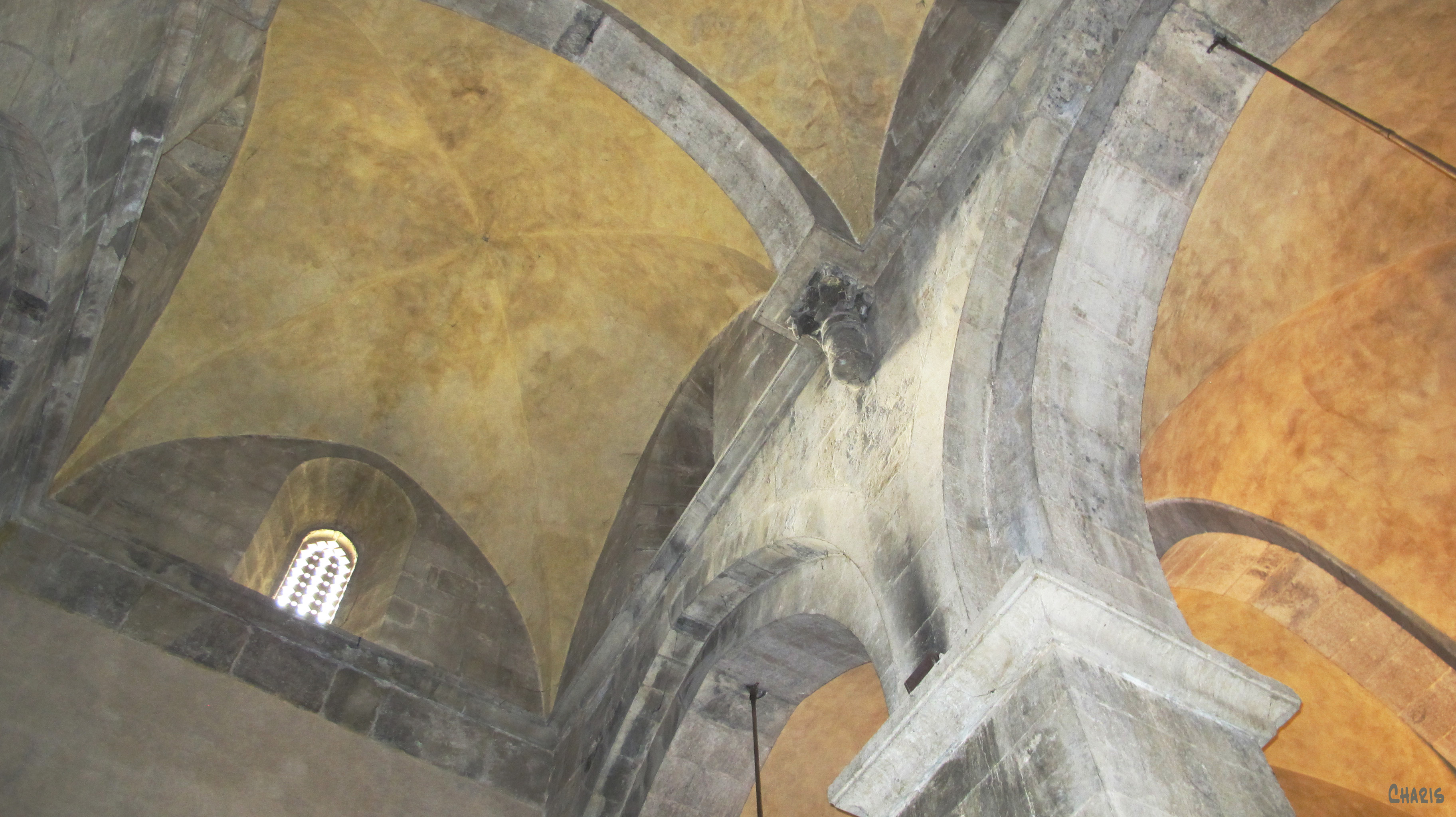
A chapel and garden still standing from the time of the Crusaders marks the traditional place in Emmaus where two of Jesus’ followers experienced one of the greatest eye-openings in history. We were welcomed by a kind smiling Benedictine monk with a warm honey-smooth tenor voice. As he sang and invited us to join him the vaults filled with praise.
Emmaus
Anyone who has had to adapt to new eyeglasses will understand what I am saying, particularly if the change is a big one, like the switch from regular glasses for myopia to bifocals or progressive lenses. New glasses may give you improved vision, but first they will give you a three-week headache.
Anyone who has had their world shaken by the unexpected, especially unexpected tragedy, knows the ambivalent feelings of not wanting to hear the story of the event again and yet feeling the need to compulsively give an account of everything that happened to anyone who shows the least bit of interest. If there is more than one witness everyone will need to say where they were and how they experienced the accident, the surprise verdict, the sudden destruction, the unexpected death. There seems to be a drive in folks to make sense of things. All sorts of floated theories birth platitudes.
I imagine this is what the two disciples leaving Jerusalem for the village of Emmaus were doing, after the news of Jesus’ crucifixion and rumours of his missing body circulated. When the stranger traveling the same direction joined them and asked what was up they immediately launched into their versions of what happened to this Jesus, this miracle-working man from the north who they hoped would free them from political oppression, and their profound disappointment in the way things turned out. No doubt the short-sightedness of the government and religious establishments received some scathing criticism -but quietly. No doubt they were also frightened about the implications for his followers. Perhaps that is why they were in a hurry to leave the city.
The stranger first asked some leading questions, then reminded them of things the prophets had written, which they had probably set aside as for another time in the future.
As I stood under the vaulted ceiling of the chapel I thought about the roller-coaster of emotion they have felt when Jesus opened their eyes and they realized who he was, I mean Who He actually was! That must have been the grandest paradigm-shifting moment of all time! They got it! God’s plan for the ages was much greater than their own hopes.
Emmaus Chapel Vault
“Were not our hearts burning within us as he spoke?” they asked each other as incredulousness turned to praise. On a deep level, in their spirits, before they knew, they somehow knew.
I had a moment like that this week. I was telling someone that the Sea of Galilee or Lake Kinneret, as it is called now, reminds me so much the Okanagan in central B.C., except that it’s wider. It is also surrounded by orchards and hills. (Although I’ve never seen date or mango groves in Canada.) We talked about how most of Jesus’ outdoor classroom for his followers was within a thirteen mile stretch on the lake.
South end of Lake of Galilee
I went away thinking about Jesus calming the storm on the lake.
We had just come out of a sudden unexpected crisis when it looked like someone very dear to us was going to die, and of course we rehashed events and told everyone who would listen the story. Honestly, I’ve often thought it would be easier to be in the hospital bed myself than to see my children or grandchildren suffer. My children and their spouses and my grandchildren are the loves that I hold closest to my heart. Many times I have come to the point of handing them back to God, because even though family is such a high priority I want God to be the highest priority. Then I take them back; it’s a struggle sometimes. This time God took me up on my offer.
The Lord heard our cries and calmed the storm, but it wasn’t until this week I realized in both the disciples’ situation and ours, the real miracle wasn’t that Jesus restored peace to the waves that threatened to swamp us, (although that was absolutely marvelous!!!!) it was that God himself was in the boat with us. He so desired to communicate His love that He laid down everything and came as a human being to go through everything we do -with us. He never left us to work it out on our own.
I began to think about the place of suffering. Our son-in-love helped me understand when he spoke about his perception of his experience. Mostly he just tears up and talks about how much deeper the love of Jesus is than he ever imagined. I so admire this man who has been through hell physically, yet has absolutely no bitterness.
Waves of Galilee
Then the Lord spun my head around by reminding me of the verse I have quoted so often: Yet indeed I also count all things loss for the excellence of the knowledge of Christ Jesus my Lord, for whom I have suffered the loss of all things, and count them as rubbish, that I may gain Christ and be found in Him, not having my own righteousness, which is from the law, but that which is through faith in Christ, the righteousness which is from God by faith; that I may know Him and the power of His resurrection, and the fellowship of His sufferings, being conformed to His death, if, by any means, I may attain to the resurrection from the dead. ( Philippians 3:8-11)
that I may know him and the power of His resurrection and the fellowship of his sufferings
He was willing to enter our suffering, and to relieve it, that we might have a glimpse of what the Father is like by calming the storm and healing our diseases. But when we are willing to lay down everything and enter into his suffering in order to know him, he pours out a level of love and grace and reveals himself in a way that is like suddenly realizing the Creator of the Universe is actually the One breaking bread at our own kitchen table.
Red Dawn on Galilee
Therefore, having been justified by faith, we have peace with God through our Lord Jesus Christ, through whom also we have access by faith into this grace in which we stand, and rejoice in hope of the glory of God. And not only that, but we also glory in tribulations, knowing that tribulation produces perseverance; and perseverance, character; and character, hope. Now hope does not disappoint, because the love of God has been poured out in our hearts by the Holy Spirit who was given to us. (Romans 5: 1-5)
Hope does not disappoint. God is good. God is love.
Earlier this month we were in Jerusalem at the pool of Bethesda. It’s down a few layers in the city now, but it is still possible to see that it was an impressive place. Partial excavations show that in the time of Christ Bethesda pool was probably the size of an Olympic swimming pool.
The story of the man with a debilitating chronic illness who Jesus healed there has always caused me wonder because of the question the Healer asked him: “Do you want to be made well?” or as the Amplified version suggests, “Are you really in earnest about getting well?”
What an odd question. He was obviously disabled and obviously in a place where people went to be healed. Why the question?
I like the Amplified version’s telling of the story in John 5 (perhaps because of my own tendency to expand a thought in parentheses –a tendency an old English prof strongly disliked, but there you go. I’m not looking for a good mark.)
Now there is in Jerusalem a pool near the Sheep Gate. This pool in the Hebrew is called Bethesda, having five porches (alcoves, colonnades, doorways).
In these lay a great number of sick folk—some blind, some crippled, and some paralyzed (shriveled up) waiting for the bubbling up of the water.
For an angel of the Lord went down at appointed seasons into the pool and moved and stirred up the water; whoever then first, after the stirring up of the water, stepped in was cured of whatever disease with which he was afflicted.
There was a certain man there who had suffered with a deep-seated and lingering disorder for thirty-eight years.
When Jesus noticed him lying there [helpless], knowing that he had already been a long time in that condition, He said to him, Do you want to become well? [Are you really in earnest about getting well?]
The invalid answered, Sir, I have nobody when the water is moving to put me into the pool; but while I am trying to come [into it] myself, somebody else steps down ahead of me.
Jesus said to him, Get up! Pick up your bed (sleeping pad) and walk!
Instantly the man became well and recovered his strength and picked up his bed and walked. But that happened on the Sabbath.
So the Jews kept saying to the man who had been healed, It is the Sabbath, and you have no right to pick up your bed [it is not lawful].
He answered them, The Man Who healed me and gave me back my strength, He Himself said to me, Pick up your bed and walk!
Bethesda
When I was still ill from more than one chronic condition that caused my body to fall apart, a couple of women prayed with me. In the middle of my adding to their prayer and trying to sound as spiritual as they did, one of them stopped me and said, “Wait. Do you want to be healed? What would it cost for you to be well?”
Frankly I thought that was a bit of an insulting question. My life and plans and dreams had gone down the tube because of illness. People who knew me “before” didn’t even recognize the “after.”
Now I am not a person who blames victims of the evil one –the one who came to steal kill and destroy -for not receiving healing because of a lack of faith. How horrendously cruel is that? I don’t know why some are healed and, at the time of writing, most are not. My heart aches with frustration when I see a person suffering and I don’t know what to do. I hate it! Sometimes it feels like a capricious angel comes down and stirs the water and then goes back to harp-strumming on a cloud or something. All I know is that people who pursue Jesus see more healing than people who accept illness as the natural order of things.
For many years I believed that illness was my lot in life, that my calling was to accept it graciously as “my cross to bear,” as “God’s will” and forge on. I actually became rather proud of my reputation as an overcomer.
The problem with people who label themselves “overcomers” is that their identity becomes permanently attached to whatever victimized them in the first place. Overcomers need things to overcome. It’s hard to let go.
Here’s the thing: God understands what is deep in our hearts. His purpose is to restore our hearts at least as much, if not more, than our bodies. He wants to go deeper. He wants to restore our relationship with him and renew our thinking. Healing and miracles point to something bigger; they are not the destination.
I realized then that if I were miraculously healed I would have no excuse for avoiding commitments. An illness that went in and out of remission unpredictably gave me an excuse. If I were healed I would need to tell people how it happened. The active, living Jesus would be more than a comfort in my preparation for death. Healing would require me to live, a prospect that was more daunting than I could admit out loud; it could delay my pie-in-the-sky day. (Silly girl! But I didn’t know Abba as a good daddy then.) If I were healed I would need to take up my responsibilities and walk out of that place –publicly. I would need to pick up my comfortable familiar bed and get on with life. I could face uncomfortable conflict with friends who held to different doctrines.
Since those days, when he did heal me, I have asked others if they want to be healed. Sometimes they say, “I have learned so much from this condition and have had it for so long that I have adapted and don’t want to be healed anymore. This is who I am,” or “I need more time to grieve for my losses,” or “I am sick of having hope deferred. I can’t take another disappointment,” or, if they are very honest, “If I were well nobody would bother to pay attention anymore. My life is a disappointment, but at least I have doctors and therapists and lab technicians and care-takers who talk to me on a regular basis and tell me how brave I am.” or even, “I have nothing to live for anyway.” (Notice the Bethesda man said he was alone, so he had no relationships to live for either.)
I hear something else in the Bethesda man’s response. When asked if he wanted to be healed, he didn’t say yes. He gave an excuse for why he had not been. Perhaps I am projecting here, but I wonder if he had become comfortable with self-soothing and resigned to being alone. I wonder if the bed he had made for himself was a poor-me bed. I wonder if he secretly thought, like I sometimes did, that there must be something special about me that God would assign me to a life of suffering because he knew I could take it. I wonder if that was sin Jesus warned him not to go back to.
Bethesda
I wonder sometimes if we graciously accept the “impossibility” of reaching the stirred-up pool method of healing when the Saviour Himself is holding out his hand to us, because that alternative is just too scary. I wonder, as was the case of several other biblical characters, like blind Bartemeaus, or the Syrophoenician woman with the tormented daughter, or the woman with the perpetual period, if we need to exercise the bit of faith granted to us by pursuing him, by impolitely crying out to him, by barging in to contend for our child, by breaking social taboos and going after the healing he provided with His bloody striped back.
The enemy of our souls has not yet admitted defeat. We are in a conflict with an enemy who, although defeated and stripped of legal authority, is still powerful and fighting, and in such a conflict there are still casualties.
I don’t know why some are healed and some are not and I admire the lack of bitterness in many people who face huge physical challenges and the things they can teach us. Sometimes, in the course of bringing in the kingdom of Christ, we will lose battles and we mourn. But sometimes, when we work our way past disappointment, when we “find the gold” gained through suffering and put our foot down, when we realize the authority Christ gives the ones totally dependent on His goodness, then we can dare to declare, like Gandalf on the thin bridge, “You shall not pass!” Then we see the Saviour turn his face to us as he smiles and raises us up to battle again.
Then, like the Bethesda man, we can let go of our familiar spot under the five stone colonnades, get up, move the inadequate beliefs we have been resting on, and follow Him.
How grateful I am for the ones who stood with our family when our loved one faced certain death. They put their collective foot down, reconciled petty differences to band together and declared, “He shall not die!” This week he encouraged the ones who battled for him when he walked into church, unaided, stood before the congregation and gave glory to God.
Today as I was reading in Corinthians about pulling down strongholds I remembered this stronghold I saw in Sepphoris/Tzippori in Israel. It would be very hard to pull down. It has been there for a very long time. You can see from the depth of the window openings how thick the walls are.
Our guide told us it was built by the Crusaders on the top of the hill the Roman city sat on (about an hour’s walk from Nazareth) and later rebuilt by the Ottoman Turks. What fascinated me was that the builders scrounged stones and sarcophagi (stone coffins) from previous dynasties to use in the construction.
Stronghold at Sepphoris/Tzippori
A cornerstone is the most important stone in a building because the other walls line up with the angles it establishes. In the photo the long rectangular stones are sarcophagi. These walls aligned with receptacles for the dead. Soldiers holed up inside fortifications like this would rain down arrows, and later bullets, on anyone daring to approach.
In 2 Corinthians Paul talked about the believers’ need to rely on different weapons than the ones used by human armies to tear down these seemingly impossibly strong fortifications.
For though we walk in the flesh, we are not waging war according to the flesh. For the weapons of our warfare are not of the flesh but have divine power to destroy strongholds. (2 Corinthians 10:3,4)
He explains the metaphor of stronghold in verse 5: We destroy arguments and every lofty opinion raised against the knowledge of God, and take every thought captive to obey Christ…
The Greek word translated “arguments” here is logismos, which means just what you think it would: reckoning, reasoning, computation, conclusion –all the things those of us educated in the West hold as the gold standard for decision-making. We gather data observable by our physical senses, make logical deductions, theorize, debate and come to a conclusion. Some of us hold this process in such high regard we require faith and the ways of God to pass through the same intellectual sieve. We have so elevated logic and our own intellect and reasoning ability that anything God does outside of the every day observable repeatable data-gathering experience is often rejected as myth or explained away as a re-telling of a misunderstood event by the superstitious.
Any theory is only as good as the presupposition it is built upon. Sometimes some of the old false ideas we have as foundational beliefs are so protected by thick-walled strongholds that no amount of argument, or ridicule or cannon balls or plastic explosives can tear down our defences.
Sometimes the behaviours based on these assumptions are the result of our acceptance of the death of dreams or an expectation of disappointment as the norm rather than on life and hope in the goodness of God being normal. Sometimes the strongholds of our own personal brand of logic and our ability to reason away experiences that are outside our dismal expectations are lifted higher than God’s word –especially when He says “Nothing is impossible for Me.”
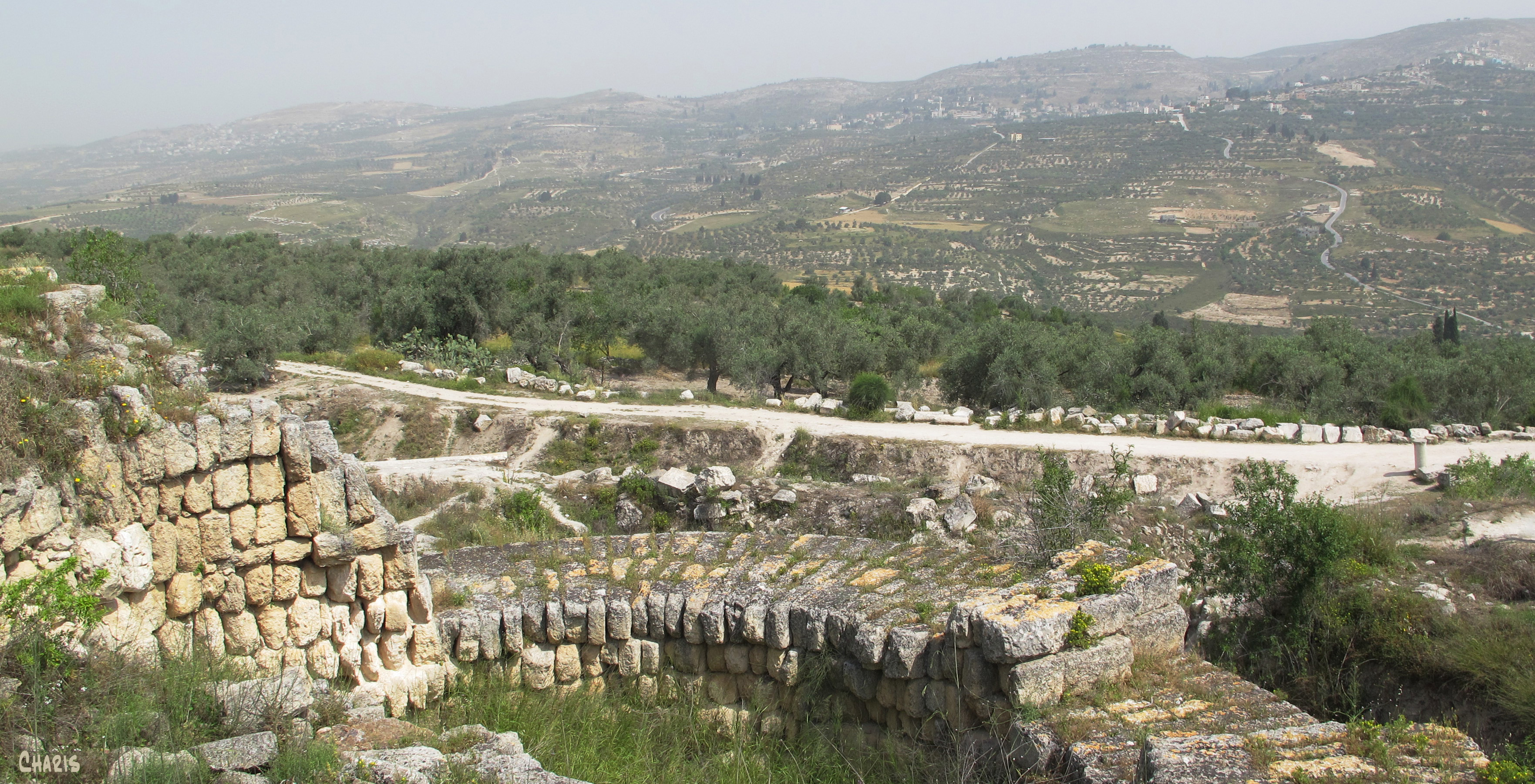
Shortly after we visited Sepphoris we explored the ruins of the ancient city of Samaria. The fortifications in the photo were built by Herod upon the foundation of the city where control-freak Jezebel’s left-over bits were buried after zealous Jehu convinced disgruntled eunuchs to toss her out the window and the dogs had her for breakfast.
Herod’s tower at Samaria
The story is told in 2 Kings 7 that when this city was under siege and the people were desperate with fear and hunger, to the point of killing and devouring their own babies, the prophet Elisha told the king’s right hand man that the next day food would be cheap.
The king’s officer replied, “That couldn’t happen even if the Lord opened the windows of heaven!”
Elisha told him he would see it, but not get to eat it because of his unbelief. The next day he was trampled in the gate when the inhabitants rushed out to grab the provisions the confused enemy had left behind when they heard frightening noises in the night. God arranged the impossible.
I wonder if we miss out on a lot of provision because we exalt our past disappointments and reasoning ability above the promises of God. Unlike the lepers in the story, we never bother looking beyond the gates.
I wonder if the spiritual armour offered for our use in this war of the mind — the helmet of salvation, the breastplate of righteousness, the belt of truth, the shoes that come from the preparation of the gospel of peace, the sword of the spirit of the word of God, and the shield of faith– free us up to recognize God’s way of thinking. What if our most effective weapons are the fruit of the spirit: love, joy, peace, patience, kindness, goodness, faith gentleness and self-control?
I wonder how much more of God’s perspective we would be able to perceive if we pulled down those thick walls that make “It couldn’t happen,” look like the only reasonable premise.
Jesus said, “In this world you will have trouble.”
True. But He didn’t stop there, as we often do.
“But I have overcome the world,” He said.
Edited to add: In the process of checking the spelling of the plural of sarcophagus (everything looks good until I hit publish) I had a surprise. The word sarcophagus comes from sarx meaning flesh and phagein meaning to eat. The word means literally flesh-eating. It was a pay-attention moment.
Some of you may have followed the story of how our son-in-law was on the brink of death from flesh-eating disease and how many people, some of whom had never done this before, took up the call to pray for his healing.
I will never forget the day (Good Friday) when he was too unstable to be moved into the O.R. for his second surgery, the day his doctors now admit they thought his chances of survival were 0%, the day his little four-year old daughter asked me for a different song to be played other than the favourite she had wanted for the previous three weeks. I will never forget that as fear of what looked like his certain death nearly engulfed me she sat in the van singing, “I believe that You’re my healer…Nothing is impossible for You! Nothing is impossible! Nothing is impossible for You, Jesus!”
On Pentecost Sunday, amid cheers and spontaneous outright bawling, our son-in-love walked into church on his own two legs, with his feet and all his toes attached and with kidneys and lungs functioning like a healthy twenty-year old.

 The problem with people who want to “take God out of the box” is that they can seldom resist the temptation to stuff him in another one of their own making.
















 Charis: Subject to Change