Absalom: When Rebellion Thwarts Reformation

gates people jerusalem ch rs IMG_9840

Twice this week I heard this question: What makes you angry?

Both times the men posing the question suggested paying attention to the circumstances that raise a flood of righteous indignation.

“It could be a clue to your calling.”

I didn’t have to think long. What makes me angry? When the cries of the victims of injustice, when the wounds of the abused, when the silent tears of those imprisoned in mental anguish or in circumstances they cannot control are ignored or downplayed by people who have the capacity to help, I feel rage rising. When people who brag about leading a loving community misuse their power by exploiting their charges, I am livid.

Recently I read a rant by a popular writer who can obviously relate to my anger. He blasted away at hypocrisy and corruption and cover-up within the institutional church.

“Wow, Lord! This is good. I totally agree. This guy is absolutely right.”

God’s still small voice response shook me.

“So was Absalom.”

“Absalom? The son who rebelled against his father the king?” I asked.

“Beware the man who calls victims of injustice to follow him saying, ‘If I were in charge…’”

I re-read the story of Absalom in 2 Samuel 13 to 18.

David harp statue IMG_9841Absalom was right about injustice and corruption being covered up within the kingdom. He had first-hand knowledge of this. The prophet Nathan exposed King David’s crime of taking what was not his – Bathsheba, the daughter of one of his valiant friends and the wife of Uriah, who was out fighting for him. It couldn’t have been easy for a faithful servant to tell the king that his decision to cover up his sin by committing a greater one, arranging Uriah’s murder, would have serious consequences in his family for a very long time. David admitted fault. Psalm 51 records his feelings of deep remorse, but there were still consequences set in motion by his acts.

Later David’s eldest son, Amnon, also abused his power when he took what was not his. He raped his half-sister, Tamar, Absalom’s full sister. David was very angry, but he did nothing that gave the appearance of justice being done on behalf of his daughter.

Some say David couldn’t act because Amnon and his cousin/adviser made sure there were no witnesses, and in those days, and often in these, a mere woman’s testimony was not enough. Some suggest David did not take action because he was still in the throes of depression over his own sin. Some pose that Amnon, as first-born, was in a position of privilege, and even though God continually broke the expectations of society by choosing a younger son for a task, David was still intimidated by primogeniture culture (the eldest son inherits everything) – and because Amnon was still his boy.

Maybe David hoped that if he ignored it someday the whole thing would just go away.

It didn’t go away. It became worse. Absalom took things into his own hands. He arranged for Amnon’s murder. Then he fled.

David mourned for two sons.

The story of David and Absalom’s uncomfortable estrangement, and eventual quasi-reconciliation is told in 2 Samuel 14. By this time, Absalom was a full-fledged manipulator. He used appearance, charm, popularity, intimidation — whatever it took– to move himself toward a position of power. He sat at the gate and listened to people’s complaints of unjust treatment, something the king had apparently been failing to do. garbage streets Jerusalem IMG_1241Injustice was piling up like garbage in the dark corners of Jerusalem. The failure of authorities to listen to the common people and deal with injustice is fuel for rebellion. How many times is this lesson repeated in history?

Absalom began to build an army of malcontents.

But wait? Didn’t David do the same after he fled from Saul? He did, but there was a difference. Although he wailed loud and long about unjust treatment, David never took justice into his own hands. He would not touch God’s anointed. He honoured the office, even when King Saul was reduced to a dangerously unbalanced giant wounded ego. David knew he himself was more popular. He could have made a bid for the hearts of the people to back him up in military take-over. But he waited for God to hand him the scepter. He honoured the position of the king who was trying to kill him.

Absalom couldn’t wait. Absalom dishonoured the king who disappointed him. Absalom led a rebellion. Absalom publicly shamed the women in David’s household. The victim turned perpetrator. Absalom died. He fell victim to his own symbol of beauty and by the hand of the man who once took up his cause.

I can relate to the popular writer who is dismayed by the lack of love or fairness. The repeated reports of willingness to hide corruption in church leadership is infuriating. I haven’t been in a place where I felt unsafe in years, but I know from the past what it is like to see women and children’s stories of abuse dismissed or “re-framed” to benefit someone’s hold on power.

I have seen a pastor badger a woman on staff of a Christian organization to confess her part in seducing the elder who raped her violently, even though she had been beaten. She lost her job. There were no serious consequences for the man.

I have hidden victims of incest in my home who were coerced to change their stories because they were told it would be their fault if the family broke up and the step-father was subject to ridicule or prosecution.

I have seen men falsely accused by bitter ex-wives who knew how to garner sympathy, but still neglected emotionally and physically the children now kept away from their daddies.

I have seen men on the verge of bankruptcy because another member of the congregation cheated them out of weeks of wages. After the issue was brought before the elders, nothing happened to the thief.  The victims were told it was their responsibility to forgive.

I have seen teenagers thrown out of the house when they told a someone they were gay or that they had an abortion.

I have seen people become slaves to cult leaders with bad, bad, bad theology who prey on spiritual vulnerability motivated by a personal need for power.

I know what it is to cry myself and not be heard, and I know what it is to be loved, healed and restored by people who cared.

But I’ve also known the horror of feeling I had to betray a friend’s confidence because she chose to protect her husband’s reputation over her child’s well-being. I know the utter agony and extreme pain of hearing someone I cared deeply about screaming that I had ruined her life as the police took him away. All these years later I cry just thinking about it.

As a teacher, foster mother, and friend, I have heard stories that make me want to cover my ears and scream, “Don’t tell me! I don’t want to know!! Shut up! Just shut up! Shut up because now I am obliged to do something about it and I know how this goes!” But I listen and I act on the children’s behalf. I think I understand how the prophet Nathan may have felt when God told him what King David had been doing.

I know it is worse to leave the garbage festering where the next generation plays than to deal with unpleasantness. Hidden corruption in the church is threatening our ability to live and breathe and unite in trust and love for each other. God is exposing it for a reason. He loves us. Love without truth is mere indulgence. God’s love is also just.

I can relate to the popular writer’s rants, and I can relate to the pastors and staff who don’t want to know about hidden sin, because taking proper measures can cause years of building to crumble and wound bystanders. In the end, as painful as it is, we must stand up to protect vulnerable lambs in the flock while still seeking rehabilitation and restitution for offenders.

I also know the sickly sweet voice of the enemy entreating, “Are you angry? I can help you with that.”

I hear the warning that is also an encouragement from Abba, my heavenly Father,  “There is a higher way.”

He tells me not to partner up with an army of angry, invalidated, unheard, unhealed victims as a force for reform.

“Unless you are part of the process of honesty, repentance, forgiveness, and restoration you are not working for the kingdom. You are working only for yourself. And that never ends well.”

Save

Breaking Away

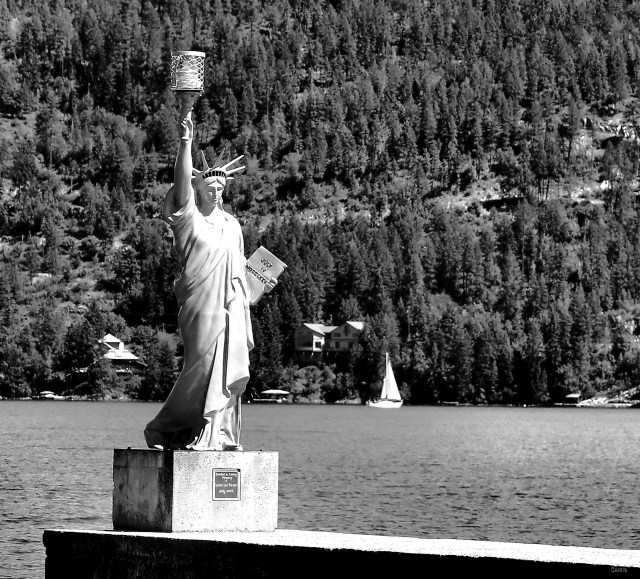
statue of liberty idaho IMG_2240

Look who I found hiding out in Idaho? Well, everyone needs a break, I suppose.

Today, with the news still full of stories about the consequences of the UK’s vote to break away from the E.U., is the day I congratulate my friends to the south on their celebration of breaking away from our common parent country.

Today I am also sorting through stuff in my basement and I’ve come across a file of genealogy research – the family history of breaking away. It seems my grandmother’s great-grandparents broke away from the Americans.

Every once in a while it’s a good idea to ask, “How did we get here?” It’s all quite bizarre really.

Warning. I’m going to overgeneralize, but I’m talking about roots and patterns in the big picture. Usually, the way something is established is the way it is maintained.

I discovered, quite by accident, that my father’s grandmother was not First Nations as we supposed. Her surname was Towne and the Towne family line in America is so well researched the genealogy sites don’t bother to charge for the information. I could follow a straight line from Andrew to Andrew Elijah to Andrew to Stephen to Stephen to Jacob to Jacob to William Towne and his wife, Joanna Blessing, who were part of the new Puritan colony in Massachusetts. Three of their daughters were tried as witches in Salem. Two were hung.

This shocked me! I was raised in an environment that was anti-American. I had no idea I had American roots, let alone connections to the Mayflower Puritans and the Salem witch trials! Our source of Canadian identity was the statement “We are not Americans!”

Then I followed the trail and realized that sometime between the American Revolution and the War of 1812 my ancestors broke away from this new independent country and moved to Renfrew county in Ontario where the United Empire Loyalists settled. Violence and persecution chased them.

When my great-grandmother was a child her mother died. Her father was away working as a logger and when he returned he found the children alone in the cabin having buried their mother themselves. Since he couldn’t care for them he split the children up amongst distant relatives. One of his daughters was sent to live with a family in New York. Apparently she was treated cruelly. She was not permitted to go to school and slept in the barn. At the age of thirteen she ran away and headed north looking for her father.

After living on her own in the bush all summer Algonkin people found her. They took her in and raised her, teaching her the skills of living off the land. Later she married a Scottish hunter/trapper and raised her own family thirty miles from the nearest road. She had skills. Dad says at an old age she made him moccasins and was still an incredible sharp shooter. Her N.Y. experience added (unfairly) to the family lore about the nature of Americans. How easy it is to pass on the burden of our pain to our children.

At the same time I learned the reason we couldn’t trace one family line past a certain grandfather was that there was no record of his father. An astute cousin did notice, however that his mother and maternal grandfather had the same surname. It was not uncommon for illegitimate sons of wealthy Englishmen to be given a tract of land in Canada as their hidden inheritance.

Now I don’t believe in generational curses. That’s Old Covenant stuff. Jesus sets us free from the law of sin and death, but I do see patterns of temptation that follow family lines – especially when unforgiveness is passed on. I noticed this when studying church history as well. It is amazing how often a group that breaks away in protest manifests problems in the same area that caused them to break away within two or three generations. When we insist that “we are NOT them” we set ourselves up to become them.

My husband was invited to a Southern Baptist Independence Day/Sunday school picnic while he was working in Phoenix one summer. He told me about someone getting up and reciting the entire Declaration of Independence.

“I had no idea this thing goes on and on about why they hated the British so much and especially the king. I thought it was about their vision for their country. No. It’s mostly about protesting their treatment by the British government. It’s rather bitter.”

We have many friends in Canada who were either born in the USA or who had a parent born there who recently found themselves in deep trouble with the IRS. Apparently they were supposed to have filed tax returns in the States even though some of them had never lived or worked there.  The tax collectors demanded that foreign banks turn over private information on these folk. It cost some shop owners thousands in accountant fees to prove they owed nothing. When they were advised to contact their congressman about the threat of heavy fines (and other heavy-handed consequences the tax people are known for) they protested, “We don’t have a congressman! We don’t live there anymore. This is taxation without representation!” Oh, the irony.

When my ancestors broke away from religious tyranny they had no intention of becoming tyrants themselves, and yet in less than one generation a government backed by crazy fear-based religion hung innocent people accused of witchcraft.

When the United Empire Loyalist forefathers broke away because they opposed solving disputes with violence they ended up being part of the crew that burned down parts of Washington in the war of 1812.

Both countries, which in the 19th century were run by descendants of landless non-eldest sons and bastard sons and peasants craving property, have a history of taking for themselves land legitimately belonging to First Nations people. Sometimes they used violence, and more often, in Canada, fraud, legal loop holes and long delays. They even deliberately plied with whiskey, introduced disease, and destroyed the family unit by forcing children into residential schools.

Yesterday I read a report that ordinary people can’t afford to live in cities like Vancouver anymore because the best land is being bought up by foreigners who are even craftier than they were. Oh, the irony.

Both countries are now populated, for the most part, by the children of refugees and immigrants who fled the hopelessness of rigid class structure and rule by the elite. Now descendants of these very people have become the new oligarchy, the ones who hold the wealth and power and who decide who will be in charge of the government, the courts – and the tax office. Oh, the irony.

How do we break the pattern? By recognizing it, confessing to sin we have accepted as a normal way of doing business, by offering repentance (metanoia -change) on behalf of our forefathers and choosing to think differently. Where possible we need to issue apologies and make restitution.

The same goes for denominations formed as a result of protest, rebellion, sneakiness and lack of honour for those who have given us our roots. If you leave a legalistic church without reconciling differences don’t be surprised if your children or grandchildren have problems with rules -either having too many or too few. If you leave because a church is wealthy and doesn’t care for the poor your grandchildren could find themselves in a mega-church with catered prayer meetings at $25 dollars a pop, or becoming professional beggars looking for more ways to fund raise..

Just watch. I’m not making this up.

I’ve done this before, but I want to make it public again today. I forgive the British government for depriving my ancestors of the right of freedom of religion and recognition as sons. I forgive the American government for acting violently toward my ancestors. I forgive the family that abused my great-grandmother. I forgive the church I was raised in for not understanding the needs of the poor among them. I want to break the pattern of both distrust and complacency that I have accepted as normal in relationships with authority of all kinds.

Especially today, I want to apologize to Americans for decades of dinner discussions that expressed fear and distrust and offered more criticism than prayer. I have dedicated myself to praying for you for the past few years and I will continue to pray

GOD BLESS AMERICA!

Save

Save

Save

Save

Save

Acknowledgment


IMG_7427 Caesarea Maritime fortress

If we must “feel” God’s presence before we believe he is with us, we again reduce God to our ability to grasp him, making him an idol instead of acknowledging him as God.
– Craig S. Keener

Choking Hazards

IMG_2958 choling hazard warning


I bought my granddaughter a jewellery-making kit with 25,000 colourful beads. When I took it out to wrap for her birthday, I thought a while, then put it back in the closet and bought her something else. I was pretty sure she would like it, that was not the problem. The problem? A little sister who got into everything and sometimes put those things in her mouth. Depending on a child’s age this box contained either 25,000 pieces of potential pretty jewelry or 25,000 potential choking hazards.

I was also an eldest child. I know what it’s like to have younger kids’ needs veto mine, but I looked at my granddaughter’s harried mother and her incredibly curious toddler sister and decided to choose safety this time.

But it bugged me. It wasn’t just the memories of having to forego activities because of offendable siblings (because as a mother and grandmother I’ve done this many times without complaint); this time it triggered something else. I realized it represented another problem I am struggling with – when potential choking hazards limit older believers’ spiritual growth, when topics are kept simple to avoid offending people who are still toddlers in their spiritual growth (and I do love toddlers).

Many years ago I volunteered to help a large family. I assumed the mother must really like kids to have so many.

“Actually it’s the babies that I love,” she told me. “When they start getting independent my arms feel empty. I just adore cuddling babies. I can’t imagine home without little ones. They are so much easier to manage than teenagers. If they don’t want to move you just pick them up and move them yourself.”

I looked around. This home was completely centered on the needs of the youngest children. No potentially dangerous toys or tools and definitely no boxes of beads or junior chemistry sets. The older children were expected to look after the younger.  Some of them were remarkably responsible. But some of the teenagers were unhappy and rebellious. No one had time to encourage their individual interests and talents or listen patiently to questions that would lead to long that-depends kinds of conversations. They were set adrift to learn on their own. Some of the older kids did not fare well. They left home as soon as they could, but lacked preparation for life outside the nursery.

I realized that some church communities I have been part of could be a bit like this. When the emphasis is on producing new Christians and teaching them only to the point where they can turn around and serve the needs of the less mature, a kind of stunted growth becomes the norm for some and restlessness begins to emerge in others. Often those who fit into the niche of evangelism and service giftings are happy. Often those who tend to pose hard questions are not.

Service is a very worthwhile undertaking. The problem arises when older “children” in the family lack the opportunity to go beyond the basics, to learn about and explore everything Jesus said and the apostles taught, when they are expected to be satisfied with milk because meat is a choking hazard. They don’t develop discernment because the messy stuff and complicated stuff is kept on a high shelf in the back of the closet, or out of the house completely. The result is often apathy, vulnerability to the world’s philosophy, learned helplessness, and a whole bunch of people dependent on an overworked pastor/parent figure who is just trying to maintain a safe environment where everyone can play nicely.

The writer of Hebrews expresses it this way when trying to explain a deeper understanding of Christ-centered faith: We have much to say about this, but it is hard to make it clear to you because you no longer try to understand. In fact, though by this time you ought to be teachers, you need someone to teach you the elementary truths of God’s word all over again. You need milk, not solid food! Anyone who lives on milk, being still an infant, is not acquainted with the teaching about righteousness. But solid food is for the mature, who by constant use have trained themselves to distinguish good from evil. Therefore let us move beyond the elementary teachings about Christ and be taken forward to maturity… (Hebrew 5:11-14; 6:1 NIV)

Some of the “elementary teachings” mentioned later in this chapter are not even taught as basics in a lot of church family circles these days. More complex concepts can’t be packaged in a Sunday morning twenty-minute sermon or a week day Bible study with accompanying fill-in-the-blank, tell-me-what-the-author-thinks-verse-six-means study guides. Some questions have answers that require years-long conversations and don’t fit into blanks designed for one sentence. Not even close.

Research shows that a large category of people leaving institutional churches are the ones who have served for years. They are actually looking for more God. (A.B. Simpson called it “The Deeper Life” and in his day had to leave the established church in which he was ordained to pursue it.) These folks are not saying “I’m done with faith.” They love the Church – the body of Christ, the family of God. They are just saying,  “Hey, wait a minute. Is this the glorious church, or is there more, Lord?” They often feel torn between love for family and a drive to pursue more.

If you’re looking for an answer to the question of how to be considerate of people yearning to learn and grow to maturity as well as nurturing new believers vulnerable to choking on hazards or frightened by voices who don’t agree, I don’t  have one – only more questions: What is love? What does grace look like in a household of faith? When do we emphasize security and when do we exemplify freedom? How does honour build everyone up to become God’s temple of living stones?

All I know is that a loving family is concerned about making disciples and equipping all its members to be everything God intended them to be. And we have room to improve.

Stuffed to Bursting

Monopoly money 2 ch rs IMG_0807


“We sometimes come to God, not because we love Him best, but because we love our possessions best; we ask Christ to save Western civilization, without asking ourselves whether it is entirely a civilization that Christ could want to save. We pray, too often, not to do God’s will, but to enlist God’s assistance in maintaining our continually increasing consumption. And yet, though Christ promised that God would feed us, he never promised that God would stuff us to bursting.”
– Joy Davidman


Last night while we were chatting with friends, my husband joked that we have updated the old Ten Commandments package and reissued it as The Ten Commandments Lite. Thou shalt have no other gods before me – as long as you recognize them as gods. Thou shalt not bear false witness – unless it would interfere with business practices or increase your taxable earnings. Thou shalt not kill – unless someone threatens your way of life… or your portion size…

One commandment, he pointed out, we have abandoned almost entirely: Thou shalt not covet.

At least one industry, advertising and marketing, exploits our tendency to want what what someone else has. Our entire economy depends on consumerism that labels products as “dated” and in need of replacement by the latest variation on the market. Instead of saying, “Wow! These shoes have lasted ten years!” we say, “I can’t wear these shoes. They’ve been out of style for two years!”

There is an open-sided shed at our waste disposal and recycling center. People can leave items there if they don’t want to make the effort to drop them off at one of the thrift shops a few blocks away. I was dismayed to learn that if no one takes them within a day or two they go into the pile of uneaten food and packaging and construction material destined for the landfill. Trucks carry away a lot of items doomed to dumping for the crime of being “dated.” A great deal of the stuff we toss in the landfill are things we absolutely had to have five years ago – like plastic and synthetic objects made from limited resources.

I suddenly realized that sometimes we are willing to take children’s daddies away for months or years, then document their return (with PTSD) in tear-jerking surprise reunion videos just to protect “our way of life.”

Joy Davidman’s statement shook me. Have I ever actually asked the Lord if this way of life with its increasing consumption model is something he wants to assist us to maintain? He has said he will prosper us, but does he agree with our definition of prosperity?

We were just goofing around last evening when my husband talked about The Ten Commandments Lite, but this morning this passage in scripture came to my attention:

 Behold, this was the guilt of your sister Sodom: she and her daughters had pride, excess of food, and prosperous ease, but did not aid the poor and needy. (Ezekiel 16:49 ESV)

If a wave of God’s kind of blessing hits us, will we recognize it for what it is?


Until Spirit touches spirit

St Eugene window 2 DSC_0014  ch

“Forms and rituals do not produce worship, nor does the disuse of forms and rituals.

We can use all the right techniques and methods, we can have the best possible liturgy, but we have not worshiped the Lord until Spirit touches spirit.”

-Richard J. Foster

It’s the light that gives stained glass it’s beauty. Caught a bit of it shining through the old St. Eugene’s church on the mission.

Spreading My Wings

Nasa Dyin' with an astronaut resize

Thank you to the women at Ishshah’s Story for inviting me to contribute to their team. I am honoured to be a part of a beautiful group of time-tested Jesus followers.

This week’s blog: Dyin’ With an Astronaut: When There is More to the Story

Disturbing the Present

building fire burn leamington IMG_8748_edited-1


There is no improving the future without disturbing the present.
-Catherine Booth

The lot across the street from my mother-in-law’s apartment building is a mess. A gaping whole exists where the bank used to be because, one dark night, the old empty Leamington  Mansions burned down. When she heard about about plans architects and engineers have to fill in that space with a higher, more modern luxury apartment and shopping complex she was worried about losing her view, but right now she has a view of a huge muddy hole surrounded by burned rubble.

I don’t always look forward to change, especially when it’s noisy and messy and disrupts my life, but if it weren’t for change we would still be living in powerless, cold, makeshift huts on dirt streets with knee-high horse droppings in the middle of the road.

Something is up. I feel it. Spiritual growth sometimes means building  and sometimes it means trusting God and letting go of the familiar. A lot of other people I talk to also feel a holy discontent with ways of thinking and doing that have, until recently, been perfectly good – or good enough. Letting go of the past before we have a firm grasp of the future is scary.

The Leamington Mansions building was charming, but empty. It sat next to a little branch bank building which couldn’t handle the high traffic of the downtown area of a major city. It looked more like it belonged in a suburban strip mall than on Jasper Avenue. It’s time for change.

I have had dreams of crowds of street people, of women and children, of First Nations people, of marginalized people leading the edge of a great wave of souls who discover freedom, forgiveness and joy in Christ. They won’t fit in the structures of the past.

What if there is more? What if God has bigger plans? Has he given you a view of the future? What do you need to let go of first?

Nor Sit in the Seat of Scoffers

chair door window ch IMG_8877

For some reason this chair in front of a windowed door caught my eye. I snapped a photo of it and continued on my way. Later, while I was experimenting with editing dud pics and wondering what it would look like in black and white, I heard this phrase in my spirit.

Nor sit in the seat of scoffers.

This is from the first verse in the book of Psalms: “How blessed is the man who does not walk in the counsel of the wicked, nor stand in the path of sinners, nor sit in the seat of scoffers.”

Other translations call scoffers mockers, deriders, the scornful. People who are familiar with social media call them trolls.

I’ve been thinking about scoffers and the temptation to sit in that seat. How many of us no longer read comments on news sites or have ceased joining discussions in formerly interesting groups because scoffers have entrenched themselves there? Scoffers block the way to greater insight the way the troll in the children’s’ story blocked the three billy goats from reaching greener fields.

Scoffers don’t move. They sit.

Mocking, scornful deriders have been around for a long time, and they sit in the middle of many pathways. Sometimes you don’t realize you have been dealing with scoffer until they are gone. It’s like the moment when someone shuts off the persistent background noise of a loud fan. Peace. During their rare absences, quarrelling, abuse, strife, doubt and dishonour are also absent — until someone else decides to sit in their chair. Sometimes that empty chair is hard to resist.

The book of Proverbs has a lot to say about the scornful.
“He who corrects a scoffer gets dishonour for himself,
And he who reproves a wicked man gets insults for himself.
Do not reprove a scoffer, or he will hate you.”

Contrast that with the next sentences:
“Reprove a wise man and he will love you.
Give instruction to a wise man and he will be still wiser,
Teach a righteous man and he will increase his learning.”
(Proverbs 9)

A scoffer presents him- or herself as someone seeking wisdom, but who can’t recognize it when it is plainly demonstrated to them. Arrogance blocks their own view. Arrogance is the inability to esteem others more highly than yourself. A mocker has no grace for anyone “not up to their standards” and will miss the wisdom of children and folks they consider to be of lower status.

My brother and I were only a year apart. Teachers in our junior high school loved his class and hated mine. His class had natural leaders (my brother was one) with a great sense of humour and sense of comaraderie that honoured classmates. Our class was greatly influenced by two extremely intelligent, but rather bitter scoffers. From the first day they so intimated the other students (I was labeled “hairy arms” by one of them) that we felt we needed their approval before cooperating with any project a teacher suggested. They rarely gave it. Secretly, many of us envied their power and wanted to be like them. For three years we turned into an entire class of cross-armed witty, but nasty, skeptics who dared the teachers to engage our enthusiasm. Scorn is contagious.

To make things worse, one year our home room teacher announced a seating plan based on academic merit. Every month we all knew exactly how we ranked when he re-assigned numbered desks. Those two boys never lost their seats in the first row. The teacher actually joined them in his derision of the last row. He believed he could shame the “low” achievers into trying harder, and that “healthy competition” would stir them on to greater things.

It didn’t work. For a couple of students the results of this experiment were tragic. Not all gifts can be measured by percentages on a test. Names stick.

I found scoffers entrenched in universities as well. One would think that in an environment dedicated to  new ideas and daring research would be highly honoured. Many discouraged potential PhD candidates and their supervisors can tell you how often a project is dismissed by a scoffer with power who sits in front of the door to research grant approval.

I’m not surprised by scoffers and mockers of those who don’t believe in God or Jesus Christ. It’s a lifestyle. What surprises me is the number of scoffers who identify as believers. Now I’m not holding up naivety or gullibility as virtues; good questions lead to knowledge and wisdom. If you have a hole in your boat or those jeans really do advertise that your backside looks like a barn door you need to know. But some questions don’t lead to answers. Some questions are only meant to mock and deride and discourage and stop folks who want to press on.

Paul quoted the Old Testament prophet Habakkuk when he spoke in the synagogue at Pisidian Antioch. “Behold, you scoffers, and marvel, and perish; for I am accomplishing a work in your days, A work which you will never believe, though someone should describe it to you.’” (Acts 13:41.)

I’ve met people in churches who insist there is no proof that God still does miracles today. When provided with documentation they dismiss it or ignore it. Scoffing makes it hard to believe. Scoffing entrenches disbelief because the scornful cannot give up the power of the scoffer’s seat and turn to see the light shining behind them.

Wait. What?

I was about to finish up this essay when I heard the Lord say in my spirit, “You’re still in the scoffer’s seat yourself, you know.”

“What? How so?”
“Why do you find it so hard to believe what I’ve told you about the way I see you, about your identity in Christ.”

I’ve been struggling with writing a short bio for a project I am joining. It’s sometimes easier to ask someone else to write these things because it does stir up the scoffer’s stopper question, ”Who do you think you are anyway?”

Oh boy. Busted.

Change is hard, but it’s time to kick the scoffer out of her chair and open that glass door by faith. Here goes.

Ok Lord, I am no longer a hungry caterpillar crawling on my belly. I am a butterfly who is learning what wings can do.

I am, like Snow White, one who appeared to be dead, now raised to new life by the kiss of the Prince of Peace.

I am learning about the power of love because You love me and by Your grace I am still subject to change.