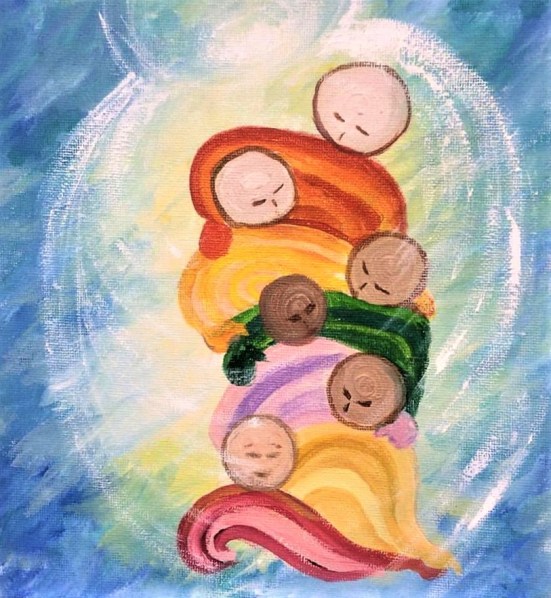
Confident Vulnerability

painting look to the interests of others (3)

I heard a young woman say, “I guess if I’m going to be a writer, I’m going to have to develop a tougher skin.”

I used to think that way, chiding myself for being too sensitive, apologizing for getting my face in the way of someone’s hand. Then I stopped. Well, at least I decided it was time to change my mind on that subject.

“The world doesn’t need more tough-skinned people,” I told her. “Look around. There are plenty of tough-skinned writers here. You can tell by the number of people scurrying for cover when the tough ones start hammering on their keyboards.

The world needs more courageously tender people. The world needs more risk-taking, gentle, loving people whose fearlessness comes from a deep relationship with God. They know his love for them never fails. He is always for them. The result is betach – confident security. People who know they are loved unconditionally can afford to be vulnerable.”

Hmm. I think I need to put that on a sticky note above my desk.

Let Me Help You

dirty feet IMG_4615

“Two-gun Pete with the stinky feet!” my husband crooned as he tickled his baby grandson’s toes.
“What? Where did you learn that?” I asked.

The baby laughed one of those contagious giggles that makes you repeat what ever action brought on the delightful response.

“Two-gun Pete with the stinky feet!” he chanted again, blurbling the soles of Baby’s chubby feet. “It’s something my Granny used to sing,” he added, smiling at our precious boy as if he were passing on a profound family secret.
“Is there more to this song?”
“That’s all I remember.”

The ‘baby’ is wearing size nine gym shoes now. If stinky is involved, it’s his problem.

You know, the oddest things fall off the shelves in my brain when I give my head a shake. The Pete’s Feet ditty started playing on my internal music machine while reading the story in the Bible about Peter refusing, at first, to let Jesus wash his feet. I wondered, if Peter possessed two guns that night if he would have used them instead of the sword he wielded to cut off someone’s ear when they came to arrest Jesus. He seemed the type.

The Passover meal they ate marked the last evening the whole gang spent together before the crucifixion. Jesus knew what was about to happen, so everything he did and said carried importance the way last conversations before partings do, even when nobody else recognizes its seriousness.

At one point, Jesus got up, grabbed a basin with water, tied a towel around his waist, and washed the other disciples’ feet. He came to Peter. Peter protested.

Peter looked at Jesus and said, “You’ll never wash my dirty feet—never!”
“But Peter, if you don’t allow me to wash your feet,” Jesus responded, “then you will not be able to share life with me.” (from John 13 in The Passion Translation)

When Peter refused, Jesus confronted him sternly. This was important. This was so important that Jesus said Peter could not be a part of him if he did not let Jesus wash his feet. That’s a harsh thing to say to someone who has given up everything to follow you. Why did Jesus insist?

I’ve always looked at this foot-washing act as a demonstration of the need to imitate Christ in his willingness to minister to others as a humble servant. That lesson is certainly there, but lately I’ve seen more in this story.

Pete probably had stinky feet, sanitation being what it was in the days of dusty roads and animals in the streets. Jesus was his Lord. One simply does not plop one’s unattractive stinky parts in the lap of someone one is trying to worship, and probably impress.

Peter saw himself as a servant, someone who was ready to honour and protect the man he recognized as the Son of God. He carried the sword they scrounged up at the last minute and he used it in defense of his Master.

He came from a culture with a pecking order where people knew their place. He was ready to play the part of looking after Jesus. He announced his intentions to do so. He followed the rules. But Jesus had different expectations. He was asking Peter to see things differently. Like me, Peter needed serious nudging to provoke change.

At the last supper Jesus told his disciples that he didn’t call them servants, like most would expect. He called them friends.

“You show that you are my intimate friends when you obey all that I command you. I have never called you ‘servants,’ because a master doesn’t confide in his servants, and servants don’t always understand what the master is doing. But I call you my most intimate friends, for I reveal to you everything that I’ve heard from my Father.” (John 15:14, 15)

When we first came to faith in Christ many of us approached as orphans, grateful for shelter and nourishment. A lot of people remain content with that level of relationship. Others move on to become servants out of gratitude and respect and sincere desire to demonstrate love. Many of us secretly hope, through self-sacrificing servanthood, to secure a place in the Lord’s affections by becoming useful in the Kingdom.

Jesus wants something else. He wants us to participate in intimate friendship with him.

What did Jesus ask of his disciples?

“So this is my parting command: Love one another deeply!” (verse 17)

Loving one another deeply requires mutual submission. Submission is not a word I like. Surrender is even worse. Both bring back memories of ‘play’ fights with my brothers that didn’t end until someone said ‘uncle’ or someone was hurt or humiliated — often all three.

By washing their feet, Jesus demonstrated a serving attitude in leadership as opposed to the usual “lording over” attitude of religious and political hierarchies. By confronting Peter he also gave the clear message: Unless you are willing to accept help — my help — you can’t be a part of this.

More than the message, “Help others,” Jesus also preached, “Let others help you,” and specifically, “Let Me help you.”

I realized this is the aspect of submission that I missed for so many years. I didn’t understand what the word means. Submission doesn’t mean being a doormat to someone who would take advantage. Submission means saying, “How can I extend myself to help you to become all Christ means you to be?” Submission also means responding to Christ in others when he says through them, “Let me help you.”

Submission means becoming vulnerable, but becoming vulnerable to God’s goodness.

Can I admit one of the more horrifying aspects of my health adventures in the past two and a half years has been the humiliating need to sometimes present for examination embarrassing parts of my body I prefer to keep under wraps? There’s nothing like both major gynecological and bowel surgery in one year to put a large dent in one’s sense of decorum. When you live in a small city that can involve the participation of your friend’s husband guiding a camera on the end of a probe, or a former student wiping your butt with a damp wash cloth, or a visiting relative holding a basin.

I understand Peter. I don’t want people I hold in esteem to have to deal with my less-than-attractive parts. I feel entirely too vulnerable. I would much rather see myself as someone who helps than as someone who needs help.

Lately, I have needed help. I am learning to quit dropping subtle (and sometimes whiney) hints and admit when I can’t do something.

I have learned, in this process, that I am not the only one in the crowd with metaphorical stinky feet (and other inglorious bits.) The more we become family as we connect with the Holy Spirit in each other, the more people trust us by being honest about their own messy lives. When we can offer the same grace we have received, relationships develop and love grows.

Perhaps it is not until we have been in a position of needing help that we begin to understand how to offer help in a way that preserves the dignity of both the giver and the receiver.

I wonder if some people who find themselves in prolonged seasons of feeling inadequate for the task (as Peter did after he discovered his deeply disappointing weakness), are in training for positions greater influence. I wonder if the story of Jesus washing his friends’ feet was as much about learning to receive graciously as to give graciously.

At the very least, I hear Jesus’ gentle chiding, “I dearly want you to be able to share life with me. But first, let Me help you.”

When It Hurts

boy fist pain when it hurts ch rs bwDSC_0111

Sharing the sufferings of Christ involves the experience of the deep emotions, agony, and passion he continues to experience for the least, the last, and the lost by his indwelling Spirit. All followers of Jesus were once least, last, and lost. When we forget that, we stop feeling.

– Dr. Mark Chironna

Snap

Written over three years ago, applicable this week.

Charis Psallo's avatarCharis: Subject to Change

IMG_9827

I delete a lot of photos. Because the camera lies.

I have deleted photos of people with eyes half closed, limbs twisted in odd configurations and facial expressions from disgust to lust, none of which reflect the personality of the subject. They were snapshots of moments in time, captured moments on the way to more meaningful moments.

I kept this photo in my collection because I find it visually interesting. Some photos are like poems and condense an expression of an entire day into a moment. Some photos suggest cause for judgment where there is no actual cause. It is a snapshot. That is all.

Yesterday I realized how easy it is to make a snap judgment based on one moment. Social media can set these snap judgments in concrete. Mob justice is a terrifying thing. Mobs don’t have the time to make an effort to see the larger context. They grab…

View original post 206 more words

Wisdom Plays

boy on beach bw ch rs IMG_9520

Man is most nearly himself when he achieves the seriousness of a child at play.”  ~Heraclitus

I nestle into a warm form-fitting spot on a colourful beach towel and watch the children. This boy has a plan. He has a vision. He digs. He moves the earth, forming mounds and channels with shovels and pails and his own bare hands. Towers grow on foundations he creates. Monuments to industriousness spring up where only impressions of bare feet dented the wet sand before he arrived. He pats towers into temporary permanence.

No one tells him what to do. When he finished throwing stones into the water, a ritual  all boys must follow, he picked up his tools and got to work, as oblivious to the calls of his siblings as he is to the seagulls.

They both steal his potato chips. It doesn’t matter. He is creating. He creates because he was made to create. It’s who he is. He builds because he must build. It’s who he is becoming.

The Creator made him in His image. He carries the Creator’s purpose somewhere deep inside. He is a child of God and must be about his Father’s business. His play is his work.

I watch and remember the Spirit of Wisdom saying:

I was there, close to the Creator’s side as his master artist.
Daily he was filled with delight in me
as I playfully rejoiced before him.

I laughed and played,
so happy with what he had made,
while finding my delight in the children of men.

(Proverbs 8:30,31 TPT)

It is the nature of the Godhead to laugh, to play, to find delight in each other, to find delight in their creation.

I can see the source of their joy in this boy, on this beach, on this day.

I watch the children play on the beach under the warm summer sun. Cool water laps against the division of water and land. The afternoon breeze skims over the lake and rises to play with trembling aspen leaves and sing through fir tree branches. Ospreys soar in a blue sky too full of light to see with unshaded eyes.

The boy straightens up and stands like Colossus with sand-covered legs astride the harbour. His hands, like mighty David’s hands, still hold pail and shovel, his weapons of praise at rest.

“Look what I made!”

He smiles. He is proud. He knows.

I feel God’s pleasure.

Joy.


Putting God to a Test

marking test red pen IMG_5060.jpg

We adults pulled our chairs into a circle in the back yard near the barbecue. The kids talked loudly and simultaneously at a table nearby. We decided the cousins needed the flat surface more than the adults -preferably some distance away. I watched our tribe balance coleslaw and hamburgers on paper plates that tilted at precarious angles on bare knees.

This clan of brothers, sisters, parents, and in-laws soon engaged each other in an enthusiastic exchange of ideas. Shop talk. Honestly, I would choose them as friends even if we weren’t related. I’m very fond of them.

Our family events are never quiet. If you hesitate to jump in when someone takes a breath there may not be another chance for several minutes. It’s like a double Dutch skip rope conversation with unwritten, but understood rules of rhythmical verbal exchange for entering and exiting a discussion. No one is shy. All of them are accustomed to speaking in public. They do it for a living.

Looking around, I realized we have a lot of teachers in our extended family. Some of our kin studied medicine or the arts, but most found their place in combining their field of interest with education in one form or another.

I admire all of them, whether they’ve guided at-risk children in preschool, juggled the needs of gifted and learning-challenged kids in the same classroom, instructed their own kids around the dining table, taught adults in a university lecture hall, tutored overseas pupils online, demonstrated songs to adolescent musicians in the studio, or communicated important concepts from a pulpit. We share a common drive to impart knowledge — and maybe just a bit of common need to be the expert.

The conversation this time centered on performance evaluations for both teachers and students. The bane of all classroom and online teachers – marking assignments and tests– arose as more than theory. Two of the on-line summer school teachers needed to leave the party to grade tests. The physics teacher offered to help the math teacher work his way down the pile sitting in his computer inbox. The volunteer asked if there was a marking key. There was.

My divergent mind started to wander off in another direction.

A marking key has all the answers. Both teachers put on their reading glasses, opened their laptops and got down to the business of comparing the students’ answers to the key. No arguments. Correct. Incorrect. Total grade. Pass. Fail. Next.

The art teacher didn’t have as simple a task. Each submission required consideration of abstract symbolic statements and knowledge of the student’s personality and skill level. Her job was to evaluate how they expressed a concept, but not to tell them what to say. She tried to stay unbiased while giving a grade based on predetermined criteria she herself established for this assignment.

This is where my rabbit trail veered sharply toward the woods. I remember someone preaching about the dangers of using a marking key with God when we put him to a test. God invites us to try him to see whether or not His promises are true. Some translations of the Bible use the expression “Test Me.” This kind of Test Me is different than putting God to a test. Putting God to a test is like comparing his responses to a marking key which we have made up ourselves. We decide what the correct response should be before he answers.

Then the accuser transported Jesus to the holy city of Jerusalem and perched him at the highest point of the temple and said to him, “If you’re really God’s Son, jump, and the angels will catch you. For it is written in the Scriptures:
He will command his angels to protect you and they will lift you up so that you won’t even bruise your foot on a rock.”

Once again Jesus said to him, “The Scriptures say: You must never put the Lord your God to a test.”
(Matthew 4: 5-7 TPT)

The accuser determined the acceptable answer which would decide whether Jesus passed the test for proving he was God’s son. Angels caught him, he passed. Angels didn’t catch him, he failed.

Could angels have caught him? Of course, but when the accuser made himself the judge of what God’s behaviour should look like, he put himself in the position to judge of the King of the universe with an authority he definitely did not have.

We often hear people say, “If you really love me you will _________.” Children and narcissists love this game.

If you really love me you’ll buy me a pony.

If you really love me you’ll let me go to the party.

If you really love me you’ll let me spend our savings on a boat or a vacation — or anything else I want.

If you really love me you will never challenge me or cause me to feel stressed.

Way back in the years of my youth, Janis Joplin performed a satirical song (at least I hope it was satirical) about what she expected God to do to prove himself.

Oh Lord, won’t you buy me a night on the town.
I’m counting on you, Lord. Please don’t let me down.
Prove that you love me and buy the next round.
Oh Lord, won’t you buy me a night on the town.

If you recall, she also expected a Mercedes Benz and a colour TV.

We laugh, but the truth is we sometimes set up a key for marking assignments we give God. Instead of praying in alignment with his purposes we sometimes hand him a list of requirements that look like the instructions an entitled rock star’s agent might submit to a concert manager. Bottled water from Fiji and a dish of red M & M’s only or he walks. We want personal peace, a perfect partner, and a palace on Paradise Boulevard.

Sometimes He answers with the stuff we want because he’s a good Dad and enjoys giving good gifts to his kids. Sometimes he answers with a character-building test of his own – an inescapable obligation, an impossible co-worker, an incomplete map.

We pray, “If you are really a good God prove it by buying the next round.” And he does – in the form of a flood, or a forest fire, or a false accusation, or a failed career, and includes a free blank sheet of foolscap and a pencil.

We compare his response with our marking key. None of these circumstances qualify as correct answers. In fact, they don’t even make the A, B, or D multiple choice list of close but wrong options.

We are confused. We cry, “God would not do that, therefore he is not God.” We walk away because God failed the test. We continue to consider ourselves the ultimate authority who prepares the correct answer on our own marking key. When  answers fail to match our marking key, our bitter interpretations dwindle down to A) absence B) anger C) apathy D) all of the above.

God is a good father and cares more about our character than our comfort. He could easily make things easy, but he doesn’t always. He loves us too much.

I’ve lived long enough to be disappointed with God many times. There were years when I only spoke to him in times of desperation because, well, the other options were worse. He loved me anyway. He is devoted to my eternal well-being. One day he invited me to take a chance on him. I did. He showed me aspects of himself I could not have seen if he had responded the way I wanted and expected him to.

Here’s the thing: God is God and I am not. He is smarter and wiser and more compassionate than I am. His perspective is from a place beyond eternity. His thoughts are higher than my thoughts and his ways greater than my ways. He wants relationship, which means he wants to connect and be understood. Tests are about learning what we have learned and what we have yet to learn. We need them. God doesn’t.

“How can these trying circumstances help me understand you, Lord?” I ask.

“Sit down. Pick up that pencil and the sheet of foolscap. Take notes,” he says. “I’ll show you.”

There is more.

Wide-eyed

boy pool ball painting ch IMG_5038

When I painted this portrait of our son at about seven years old I never imagined sitting with him beside a pool watching his own son who is now about the same age. Children are wonderful gifts and grandchildren doubly so. They teach us so much about the eagerness to learn and discover.

Jesus called a little one to his side and said to them, “Learn this well: Unless you dramatically change your way of thinking and become teachable, and learn about heaven’s kingdom realm with the wide-eyed wonder of a child, you will never be able to enter in.”

(Matthew 18:2,3 TPT)

May we never lose our wonder.

Who’s Fault Is It?

boy's eye bw crop IMG_3306

It’s four o’clock in the morning and I am trying to console two terrified children. They want their mother. I am a stranger, and this is not their home. They came to the door in the middle of the night with a sleepy-looking social worker accompanied by a very big policeman in a squad car that looked just like the one that took their mommy away.

I know nothing about these children. Their ages, their health needs, their favourite foods, and their familiar comfort items are a mystery. I don’t even know the youngest boy’s name. He is either too young, too delayed, or too frightened to speak.

His pants are wet. Is he toilet-trained or do I need to find a toddler diaper? His sister screams and hits me when I try to take his soiled clothes off to clean him and put on a borrowed pair of dry pyjamas. She is sobbing so hard her entire body shakes.

I try to be kind and gentle. I speak softly and move slowly, but no matter what I do it is wrong, because I am the wrong person. I am not Mommy. They shouldn’t be here. They are traumatized.

By five a.m. they are exhausted enough to fall asleep. Their bodies jerk with sobs even in their sleep. I put them in the same bed for mutual reassurance and give them a piece of bread to hold because I have learned that in the absence of their own blankie or teddy bear, food is the next best comfort item. This whole thing is a game of “the next best.”

The other children in our foster home will start to wake soon. No use trying to go to bed now. I start to play the senseless game I have played before – the game of who’s fault is it?

I know if the media told this story they would cast me in the role of horrible foster-mother who only does this for money, treats the children with indifference, imposes my values, and makes two kids sleep in one small bed. They would use the situation to back which ever political faction they were supporting or philosophical ideal they were trying to fly in the continuing saga of Us and Them.

I am angry with their mother for making choices that foists her pain onto little kids, but I also wonder what injustices might have led to her desperate actions and put her in prison.

Where is their father? Is he also incarcerated? Does he have a substance abuse problem as well? Shouldn’t he be caring for his own kids in an emergency? What kind of father abandons his little ones?

Some people would blame the social worker for bringing them here or the government for not providing a receiving home with paid staff and enough private bedrooms for all the kids who need placement within an hour in an isolated northern town.

Was it the fault of the police officers who took the mother away and separated the children from her?

Was it the fault of the judge for imposing the law? How many times had she been in his courtroom before she used up all her chances? Was it the fault of the lawmakers who placed no responsibility on the men who treated her as a commodity or the pimp who terrorized her or the drug dealers whose wares kept her placated or the local gangs with their warlord-wanna-be leaders who ran more than we cared to know about?

Could I blame a bullying school system with teachers like the one who prophesied failure for one of my foster kids because of his race? Did they fail to teach the children’s mother how to succeed?

Were her parents there for her when she was a terrified three-year old or were they victims of someone who was raised in a residential school back in the old country himself? Were their parents and grandparents victims of aggressors and fraudulent schemes to grab their resources and break up families?

I want to know where on the chain to pin the blame because there are two helpless little victims here in my home and somebody besides them needs to pay. I want justice!

Eventually, as usual, I realize that we are all victims of someone else’s pain. Without hope, without someone who can break the chain of sin (and yes, let’s call it what it is) consequences of living out of the order God intended us to live in, a life of caring for each other based on love, not selfish gain, play on. The best we can do is assign blame and choose the victim who will carry the weight of all of this.

We are all victims of a victim of a victim going back to the first people who chose to believe the father of lies when he asked, “Did God really say…?” The whole thing plays out like a Rube Goldberg device with one thing knocking over another and doesn’t stop until it lands on the lowest, least powerful members of society.

Those children entered my life years ago. I can’t forget them. Not everyone can make room in their homes for needy children. I burned out, physically and emotionally. I couldn’t do it anymore. I couldn’t keep pushing my bio kids’ needs aside to try to clean up another mess. I was becoming alternately callous and shrill. The need is endless and I had a responsibility to my own first.

I felt like a failure, but it was exhausting. I didn’t like what I was becoming. I was in danger of turning into the stereotypical foster-mother who avoids attachment. I quit because empathizing with the children’s pain began to trigger my own pain. I quit to go get healing.

Jesus was there for me. He still heals hearts. He has the power to break every chain. He can break the cycle.

Yes, I see the reports of children separated from their parents on the border between Mexico and the USA. Yes, I hear the children’s cries and yes, I hear condemnation of Christians who supposedly don’t care. I have been reluctant to jump into the discussion because I have been on both sides of the line.

I have worked to re-unite families and I have defended the law and hidden victims of crime from their parents. I have shared my space and given everything I could and I’ve had to set boundaries to protect my family’s needs as well.

I believe that except for Jesus’ life-transforming power, there is no solution that does not make another human the consequence-bearer at the end of this chain, because this entire mess (and it is an unendurable mess) is the consequence of the sins of many people for a long time.

Who is to blame? We all are.

There are no white hats in this scenario – only varying degrees of grey hats. We have all sinned and fall short of receiving everything God provided for us to be who he created us to be. We can try to alleviate suffering, but we can’t go back and deal with the root causes. Without divine intervention we can only offer the next best thing, and, when we fail to transform hearts with well-meaning charity and political power, lower our standards and offer the next best thing… and the next… and the next…

Our best hope, our only hope, is to let go of each other’s throats, raise our empty hands to God, and cry, “Help!”


Like a Baby

Baby Solomon

But in the depths of my heart I truly know
that you, Yahweh, have become my Shield;
You take me and surround me with yourself.
Your glory covers me continually.
You lift high my head when I bow low in shame.

I have cried out to you, Yahweh, from your holy presence.
You send me a Father’s help.

Pause in his presence.

So now I’ll lie down and sleep like a baby—
then I’ll awake in safety, for you surround me with your glory.
 
Even though dark powers prowl around me,
I won’t be afraid.

(Psalm 3:3-6 The Passion Translation)