
“The church of Jesus needs to wake up from the exile of passivity and embrace liminality and adventure or continue to remain a religious ghetto for culturally co-opted, fearful, middle-class folk.”
-Alan Hirsch

“The church of Jesus needs to wake up from the exile of passivity and embrace liminality and adventure or continue to remain a religious ghetto for culturally co-opted, fearful, middle-class folk.”
-Alan Hirsch

I’m coming out of a year of more disappointment and loss than I have experienced in most of the past decade. The losses were not as dramatic as the death of my father, or moving away from a city full of friends I loved. The losses have been like an incessant, low, slow prairie wind blowing away a summer garden bit by bit. I’ve lost more friends, relatives, and former colleagues to death in the past few months than through the entire time of the pandemic. The count is at fourteen since spring flowers bloomed. Many were not as close as immediate family, some I spoke or wrote to regularly, and some I had not spoken to in months, if not years, but they still had an influence in forming who I am and we had a connection. The degree of pain from their loss surprised me. I want another deep conversation, another project to work on together, another evening of laughter.
This past month, I have taken time to process these and other losses before heading into the new year. Recently, I have also been disappointed by people, including myself, (especially myself) who promised more than they could deliver. I’ve seen exciting possibilities fade and blow away like dried leaves of grass and brittle browning petals. It’s hard to let go.
Usually I head into a New Years Day with optimism and a declaration that this is the year of breakthrough into greater things. I do believe that greater capacity to hold on to love and the empowering grace of God lies ahead. I do believe that his unfailing kindness will be with me all the days of my life and that I will see more of his goodness in the land of the living, but there is a bittersweet aspect to the view from here. In this place of the now and the not yet, there is a reconciling with the fact that all of us eventually die and the world goes on without us.
When my father was old and knew he didn’t have much time left on this earth, he talked to me about feeling the responsibility of keeping memories of dear ones alive. He was the last one who remembered his little brother and baby sister who died the same year and whose wooden grave markers in an untended cemetery have long since disintegrated in the harsh northern climate. He reminisced about characters who were old when he was just a lad. One time, without realizing it, he reached down to pet the dog, long since gone, who saved his life once. He warned me to prepare my heart to let go when I reached an age when old friends departed more frequently. “All flesh is grass,” he said, “but our spirits live on. I know I will see them again.”
It’s in seasons of leaving the past behind and choosing to move on that we realize how much comfort comes from knowing that whether we live or die, the Lord never forgets us. He never leaves us. His love is eternal. His mercies are ever new. Because He lives, I can face tomorrow.
As a father has compassion on his children,
so the Lord has compassion on those who fear him;
for he knows how we are formed,
he remembers that we are dust.
The life of mortals is like grass,
they flourish like a flower of the field;
the wind blows over it and it is gone,
and its place remembers it no more.
But from everlasting to everlasting
the Lord’s love is with those who fear him,
and his righteousness with their children’s children—
with those who keep his covenant
and remember to obey his precepts.
(Psalm 103:15-18 NIV)

Be still, my soul: the Lord is on thy side.
Bear patiently the cross of grief or pain.
Leave to thy God to order and provide;
In every change, He faithful will remain.
Be still, my soul: thy best, thy heav’nly Friend
Through thorny ways leads to a joyful end.
Be still, my soul: thy God doth undertake
To guide the future, as He has the past.
Thy hope, thy confidence let nothing shake;
All now mysterious shall be bright at last.
Be still, my soul: the waves and winds still know
His voice Who ruled them while He dwelt below.*
It’s hard to have hope and confidence when things seem dark and deep. It’s hard to leave the what-ifs behind and not allow your confidence to be shaken.
It’s hard, but grace empowers you to be who God sees when he looks at you. It is God’s abundant grace that activates hope so can say with confidence, “All now mysterious shall be bright at last.”
In every change, He faithful will remain.
*(From Be Still My Soul, music from Finlandia by Jean Sibelius, Lyrics by Catharina von Schlegel, translation to English by Jane Laurie Borthwick)

When I consider the heavens,
the works of your fingers,
the moon and the stars that you have made,
who am I that you are thinking of me?
Psalm 8
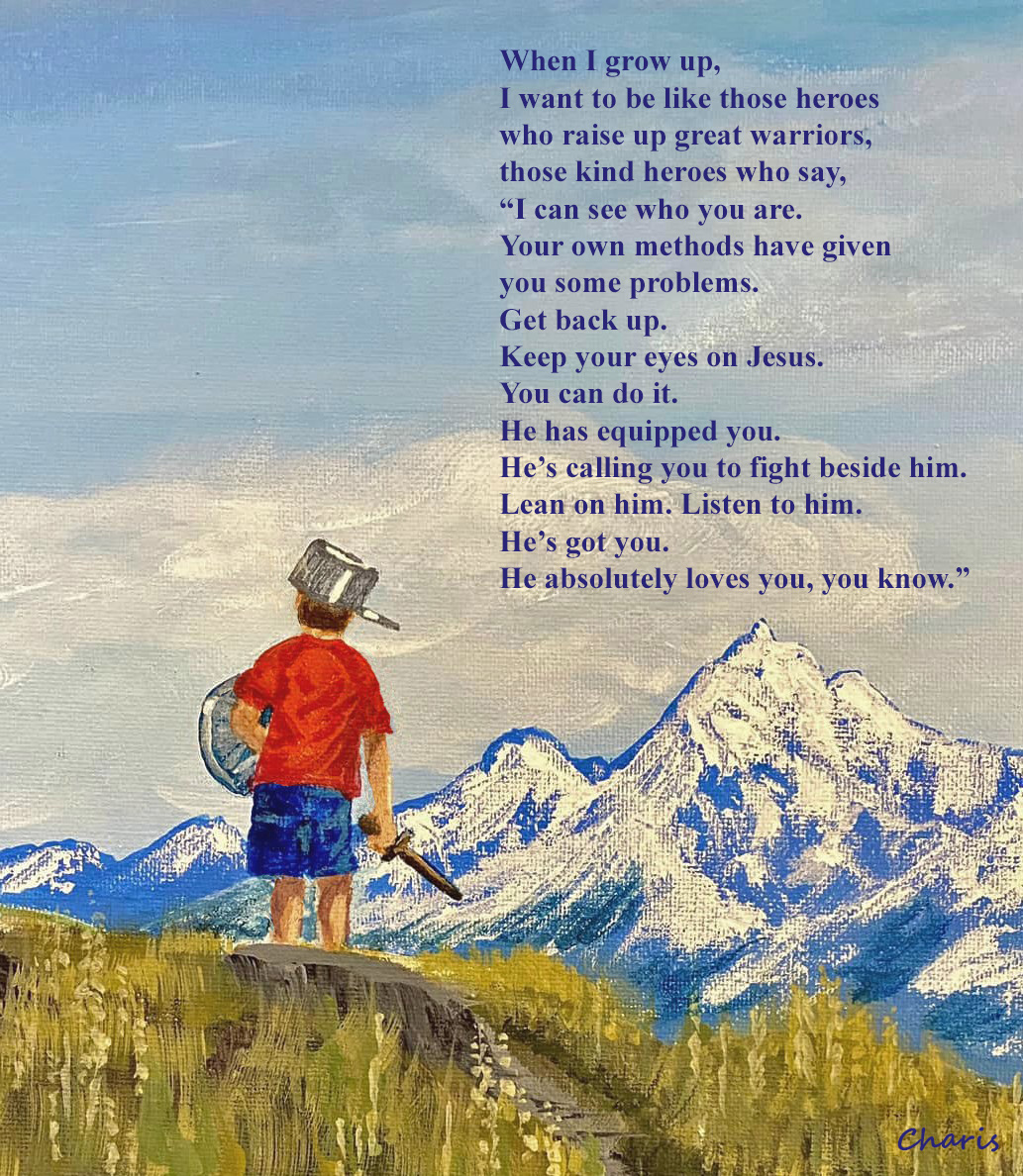

A new song for a new day rises up in me, every time I think about how he breaks through for me.
Ecstatic praise pours out of my mouth until everyone hears how God has set me free.
Many will see his miracles; they’ll stand in awe of God and fall in love with him!
(Psalm 40:3 TPT)

Sometimes what we label as humility isn’t humility at all.
Sometimes real humility means abandoning the careful avoidance of becoming a target.

The lesson in our painting class was on portraits. Portraits are hard! One slightly wrong proportion can change an identity. One difference in angle can create an unintended expression. After an embarrassing failure some years ago, I thought I was ready to try again.
I can assure you that this painting does not look like the model. I didn’t throw it out though, because there was something about the expression that did look like the model’s. I changed details like hair, face shape, colouring, and clothing so she couldn’t be identified, but I kept the expression. The side glance and slight sneer reminded me of the look of jealousy. The painting sits on my dresser as a reminder that jealousy is not becoming to anyone, no matter how attractive they are physically.
I’ve often wondered why Jesus told people not to tell anyone about what he had done for them when he healed them. It would seem like a good P.R. move to advertise by featuring the familiar lame man’s new dance moves or the mute woman’s singing. In the early days of his ministry, Jesus emphatically did not want the kind of attention fame brings.
Fame can bring attention and revenue and influence, but just as often fame creates toxic atmospheres and attracts hatred. As Proverbs 27:4 says, “Wrath is cruel, anger is overwhelming, but who can stand before jealousy?”
A few moments spent reading the comments section of almost any popular publication will reveal that. I am convinced that a great deal of nasty criticism and slander aimed at popular Christian speakers and writers is not motivated by the belief that they are irredeemable charlatans, rather it is propelled by jealousy toward the target that success and attention has painted on their backs.
People may insist that they are merely “rightly dividing the word of truth” or “just being Bereans” or “declaring the whole counsel of God” when they walk away from the bullet-point ridden body left bleeding in the dirt, but jealousy, envy, or covetousness lingers in the eyes and on the lip. It tells you there was no love in this exchange, no desire to create a relationship that encourages change or growth or rewards indications of acts of greater goodness. The jealous want the object of their envy to be hauled away and never heard from again.
We’ve seen it before amongst people who want to maintain control. When Paul and Barnabas spoke in Pisidian Antioch, the religious people in charge there “were filled with jealousy. They began to contradict what Paul was saying and heaped abuse on him.” (Acts 13:45)
Acts 7:9 tells us the patriarchs were jealous of Joseph and sold him as a slave to rid themselves of their young brother whose favour with their father annoyed them to the point of violence.
The story of Jesus’ crucifixion contains this important piece of information about Pilate’s politically-motivated choice to release Barabbas, the career criminal, instead of Jesus: “For he [Pilate] knew that it was out of envy that they [the religious leaders] had delivered him up.” (Matthew 27:18)
God’s jealousy for us is a passionate loving zeal that we would not be seduced and pulled away by the evil one. Human jealousy is uncontrolled passionate hate that would harm and destroy. It is the result of already being under the influence of the evil one who said, “Oh, you’re worried that there is not enough love to go around. I can help you with that.”
The moment we become aware of that voice we have a choice to make. We can turn and run to God and ask him to heal our wounded hearts with his abundant grace and fill our empty places with his relentless love, or we can submit to a power that destroys not only the object of jealousy but our own souls.
I guess that’s why I keep this painting. It’s a reminder that every day I have the choice to bless or curse and how easy it is to make the wrong choice. I can bless because I am blessed. I don’t have to curse. I don’t work for that boss anymore. I am not authorized to listen to his voice. Jesus freed me. He is enough.

Lord God, unlock my heart, unlock my lips,
and I will overcome with my joyous praise!
For the source of your pleasure is not in my performance
or the sacrifices I might offer to you.
The fountain of your pleasure is found
in the sacrifice of my shattered heart before you.
You will not despise my tenderness
as I bow down humbly at your feet.
Psalm 51:15-17 TPT
There’s a setting on the photo editing software I use that lets me make a kaleidoscope-style image using bits and pieces from my own photos. The photo I used here was of a barren tree in a snow-covered field at sunset. It feels like spiritual transformation to me.
Have you noticed that God gave many people their assignments in his Kingdom when they were at their lowest? God is more impressed by our willingness to offer him the broken pieces of our failures than the efforts that made us successful in other people’s eyes. A shattered heart? Now that he can use. He takes our locked hearts and disappointments in ourselves, tosses them around, and lets us see through a lens that transforms and multiplies our offering into something beautiful.
He takes our limitations and opens our eyes to limitless possibilities. He’s good that way.
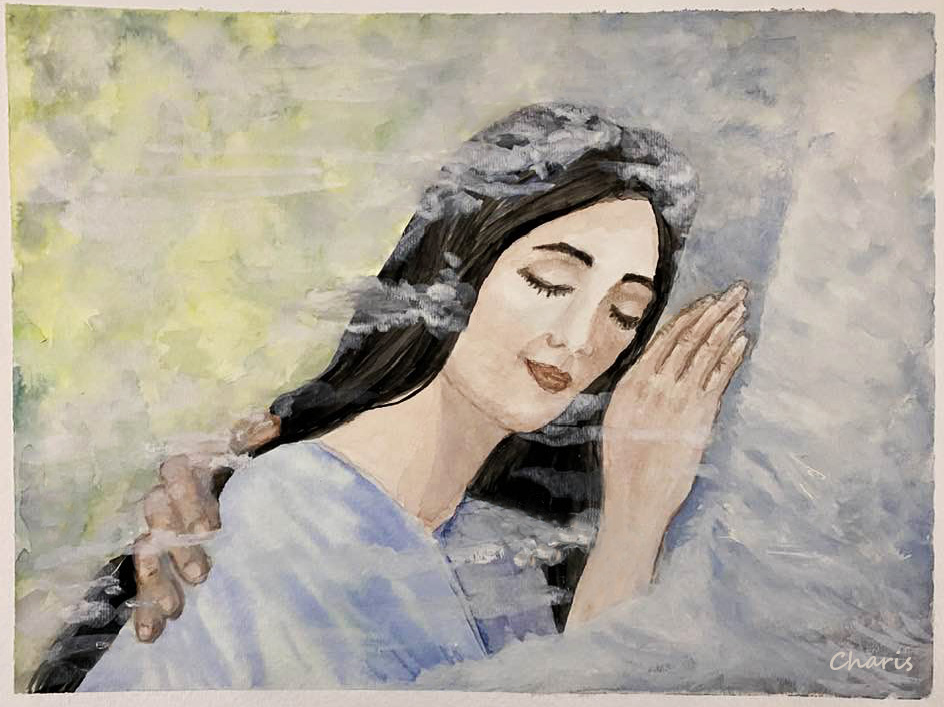
“The secret of the Lord is with those who fear Him, and He will show them His covenant.”
Psalm 25:14 (NKJV


 Charis: Subject to Change