Last night my son and husband and I were talking about worship, and about how worship springs, not from our efforts to do something for God, but “Christ in us” jumping up to acknowledge the presence of the Father (who I call Abba.) It’s like the way the baby John the Baptist leapt in his mother’s womb when the Holy Spirit within him was conscious of the presence of God in Mary. Worship is being conscious of God making us his temple and of the perfect love and unity between Father, Son and Holy Spirit. Worship is what we carry in us. Worship is a gift God fills us with so we have something to give to Him. Music, art, dance, brick-laying, whatever, are merely the vehicles to express our praise.
Unity is when we are conscious of Christ in us, and the perfect Oneness of the Godhead, so we can recognize Christ in others and thus desire to worship together -because it is who we are. It’s in our new DNA.
This morning I had a dream of Jesus giving his children a gift that looked like maggots (ew) but it turns out they were living seeds. They just had to move it, move it, move it. Then he gave me a pack of playing cards and I heard the song, “Take a Chance on Me” -by Abba.
Jesus singing and dancing to Abba. I love his humour.
I’ve known many pianists, but very few excellent accompanists. It’s a rare and beautiful talent that not only requires skill, but also outstanding sensitivity and a willingness to put someone ahead of oneself. It’s not fair, but that’s the way it works. As I thought about it I realized that good accompanists demonstrate servant leadership.
The topic came up for me as I stumbled upon a Youtube video in which a famous conductor was playing piano accompaniment for an equally famous singer. It was a great performance including several of my favourite lieder by Brahms (and became even better when another famous conductor made a brief appearance as page turner.) When I listened a second time to the song, Von Ewiger Liebe (Of Eternal Love), I could hear the accompanist’s ego asserting itself as he kind of dragged the singer along during a display of passionate virtuoso playing. Brahms is not easy to play, and if I could do it I would probably take off with the music too, but as a singer I remember what it feels like to be in competition with an accompanist who is bounding for the finish line ahead of me.
The worst accompanist I ever had will remain nameless. The event planners hired him and assured me he was a competent musician who played professionally. I sent the music on weeks in advance. Travel delays and bad directions meant we only had half an hour to rehearse.
“So how does it go?” he asked, sitting at a piano with no music in sight.
“You did get the music, didn’t you?” I said with a sense of panic about to introduce itself. “I sent it to you weeks ago.”
“I don’t read music,” he stated, seemingly without concern. “Just sing a few bars and I can pick it up.”
Now I appreciate jazz and most other forms of music, but with classical music one simply does not “pick it up.”
OK. Change of plan.
“Um…. how about a spiritual?” I was grabbing at whatever came to mind. “Sometimes I Feel Like a Motherless Child?” I did feel rather like crying for my mommy at that point. “It is slow and sad …it has a kind of blues feel,” I added just trying to be helpful, which it turns out was not.
We worked it out and added some more well-known music and rushed to the venue. I admit I was nervous and could have handled it with more aplomb had I any inkling that this guy’s professional piano experience was playing blues in a bar. I sang three verses of a two verse song and he kept playing, improvising…and improvising…and improvising. If this had been in his bar I could have enjoyed the two drink minimum while he did his thing without me, but instead I just stood around trying not to look surprised or fifth-wheelish and waited for an opportunity to jump back in. Eventually I rushed in and sang a big ta-da ending to a song which is meant to fade into a pianissimo -just to let the guy know that I, at least, was done.
At the end of the evening I took my compliments and my check and checked out.
Apparently the group invited him back for another gig. They didn’t invite me. (Although I did sing in a sold-out concert hall in that city later, with an orchestra which was too cumbersome to just “pick it up.”)
Once, when I was only about fourteen and singing in a large church I accidentally aspirated some saliva and choked right at my entry of the second verse -in front of God and everybody. The woman at the piano acted as though she heard nothing amiss as I coughed and cleared. She skilfully raced to the finish line without me. I slunk sheepishly off the stage swearing I would never do that again. (Thank God for an older gentlemen who encouraged me later when everyone else was too embarrassed to say anything.)
Here’s the thing. I did not feel honoured by either of those pianists because neither of them were listening. The only part that mattered was theirs.
Years later, to my horror, the same choking thing happened -and in front of folks who actually paid real money. This time my accompanist (who I freely admit was a superior musician) circled around, adding an improvised passage in a style consistent with the song to give me time to recover, and then modulated back into the introduction again. He swooped by like a hero on horseback to scoop me up and we rode off together, most of the audience none the wiser.
Once when he and I were looking at potential pieces for a concert I showed him the music for a song I liked but explained it was too low for me. He sight-read and transposed the unfamiliar piece of music at the same time. My jaw dropped. Later, when this guy gave musical advice, I listened. He was not a singer, but he was full of great advice.
Accompanists are often better musicians than the “soloist” (loathe as we singers are to admit that.) Sometimes they are also coaches or conductors. They know all the parts, not just their own. Making music is a collaboration and rehearsals are the place for discussion and compromise, but in performance a good accompanist lets the singer take the lead and will cover for things like rhythm errors and memory glitches. In private they are not afraid to call them out and work through a problem area, though.
When I hired professional accompanists for students the inexperienced often complained privately that the accompanist had played the piano too slowly in a performance.
“That’s because he’s much better than I am,” I explained. “You’re used to a teacher making heavy suggestions from the keyboard. Not only does this guy play all the notes -and accurately- he is listening and breathing with you. He’s just a hair behind you because onstage you are the one who sets the tempo. If he’s playing too slowly it’s because you slowed down waiting for him to do everything.”
When I thought about this singer/accompanist relationship I made a connection with leadership in the church. Ministry is not about doing it right, or drawing attention to oneself. It is not without honour or respect and actually requires superior understanding, skill and sensitivity -even nice clothes- but the job of a minister (whether apostle, prophet, teacher, evangelist or pastor) is to raise other people up to their potential in their own service to the Great Composer. It’s not to draw attention to themselves, nor even to do everything “right” by constantly taking control because others are not up to their standards.
Gerald Moore was a well-known accompanist. His love of music was greater than his love of recognition, although he was not a shy person. He teamed up with some of the greatest artists in the past century. In some videos only his hands were in the frame. He deserved more respect. The singer or instrumentalist received (and still receives) top-billing. He made them sound good, but anyone who has ever worked with an accompanist knew this man was a giant among musicians.
May those who desire to lead in the church raise others up with the same spirit of excellence and confident humility.
This is an example of his work. Morgen is a setting of a poem by the German poet John Henry Mackay (a story in itself) by Richard Strauss with Janet Baker before she was a Dame. Somehow Moore makes us forget that the piano is a percussion instrument. The song is about the hope of seeing a loved one again in the morning.
Another outstandlingly bright rainbow appeared over my garden this week. I put down my work and just reveled in its beauty for a while. After the three that showed up on the same day, (here) it was another over-the-top reminder of the keeper of promises.
We don’t need to give up our day jobs and permanently park at signs of beauty or grieve when they fade though. Signs point to something greater than themselves.
I heard a new musician lately -well, new to me. It seems a lot of worship groups are comprised of attractive, energetic young people with strong, healthy bodies, thick shiny hair and impressive orthodontic work. I appreciate a praise band made up of members who look like they’ve been around the block. There’s an authority there. Some young people get it, but usually only time spent in the trenches gives a singer/songwriter the right to sing about endurance and promises kept. I had been listening to Bob Book’s song, Relentless, when the rainbow showed up.
Sometimes I find myself down in the valley
And the shadow is hanging so low.
I can’t see my way to tomorrow.
There’s something I know:
There’s a deeper magic ,
There’s a higher truth than these eyes of flesh can see
And I’m holding on,
My hand in Yours,
You are the greater reality.
Relentlessly good,
Relentlessly kind,
Unendingly patient to the questions we find.
Even the bad can work for the good.
Relentlessly faithful,
even when You’re misunderstood.
In a world where nothing seems certain
Your love is relentless.
Oh my God, You’re relentless!
-Bob Book from Relentless, from the album A Divine Conversation
I’m never bored in the mountains. They are always the same, yet different with every moving cloud, every angle of sun, every shift of season.
I am never bored with God. Like the mountains he never changes, and yet I see many different views of him depending on what aspect of himself he wants to reveal in this season of my life and how willing my heart is to pay attention.
I found myself wanting to jump into a heated discussion about which is more in the character of God, giving his adopted children prosperity and perfect health or teaching them through poverty and suffering. As often happens each side made assumptions about what the other side meant without taking time to listen to their definitions and explanations of terms. I think they were closer than they thought, but somewhere between the lips of one and the ears of the other words morphed into strange bloated thought clouds from another source. Straw men make great flashy bonfires and due to volatility tend to erupt into conflagrations which usually produce more heat than light.
Still, they prompted me to research what the Bible says about the topic. There is a lot of material in there on the dangers of the love of money, the blessings of abundance, the abuse of power and resources, the rewards of trust, the ugliness of selfish wealth, the riches of the Father’s house available to all his children, the unacceptable neglect of the poor … Finding verses to back each person’s hobby horse (proof-texting) is easy.
The following passage caught my attention. (This was after the warning story of the man who hoarded his wealth in new barns only to die that night.):
Then he added to the disciples, “That is why I tell you, don’t worry about life, wondering what you are going to eat. And stop bothering about what clothes you will need. Life is much more important than food, and the body more important than clothes. Think of the ravens. They neither sow nor reap, and they have neither store nor barn, but God feeds them. And how much more valuable do you think you are than birds? Can any of you make himself an inch taller however much he worries about it? And if you can’t manage a little thing like this, why do you worry about anything else? Think of the wild flowers, and how they neither work nor weave. Yet I tell you that Solomon in all his glory was never arrayed like one of these. If God so clothes the grass, which flowers in the field today and is burnt in the stove tomorrow, is he not much more likely to clothe you, you little-faiths? You must not set your heart on what you eat or drink, nor must you live in a state of anxiety. The whole heathen world is busy about getting food and drink, and your Father knows well enough that you need such things. No, set your heart on his kingdom, and your food and drink will come as a matter of course.”
“Don’t be afraid, you tiny flock! Your Father plans to give you the kingdom. Sell your possessions and give the money away. Get yourselves purses that never grow old, inexhaustible treasure in Heaven, where no thief can ever reach it, or moth ruin it. For wherever your treasure is, you may be certain that your heart will be there too!” (Luke 12)
Some people read this and say, “See? The poor have more faith. So God wants you to be poor.”
Someone else reads it and says, “See? The wealth of the kingdom is ours! Receive it now by faith.”
Someone else says, “See? The point is to obsess about neither poverty nor wealth, but to trust God, give generously and be content.”
I was thinking about this when I drove by these mountains. Storm clouds, caught by high winds near Pincher Creek, changed the look of the range every few minutes. By the time I found a place to stop my car, they shifted again. The view reminded me that every time I think I have some aspect God figured out he obscures the familiar and comfortable and shows me another side of his character.
God is not only good, His ways are not our ways, His thoughts are not our thoughts. He is very, very big and has very, very many facets. One snapshot, or one verse of scripture, or one experience is true about him, but perhaps does not reveal the whole truth. There is more. Much more.
But sometimes it is the storms in life, when the familiar is obscured by dark clouds, that reveal important truths about God that we missed before.
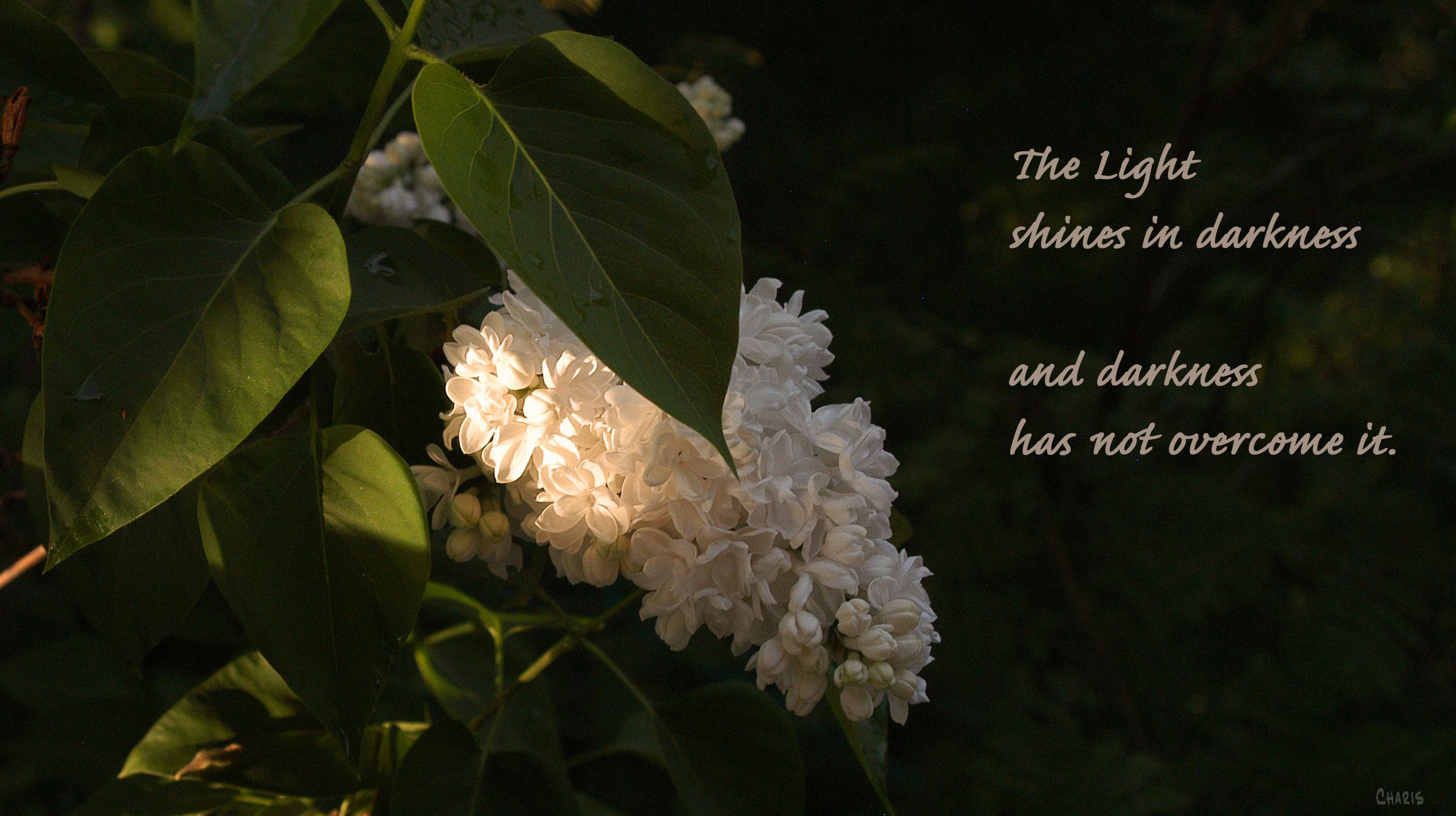
In the beginning was the Word, and the Word was with God, and the Word was God. He was with God in the beginning. Through him all things were made; without him nothing was made that has been made. In him was life, and that life was the light of all mankind. The light shines in the darkness, and the darkness has not overcome it.
(John 1)
We hear much of love to God; Christ spoke much of love to man. We make a great deal of peace with heaven; Christ spoke much of peace on earth.
– Henry Drummond
The one who fears punishment has not been completed through love.
We love because He has first loved us.
(1 John 4:18,19)
The thing about fear is that once you are influenced by it you can be convinced to distrust your own sense of who God is and who you are and hand over spiritual discernment to “the experts” because they claim “extenuating circumstances.” This is how every major cult has started (including the philosophical movements that claim to be non-religious). It’s uncanny how often it manifests first in paranoia-based views of the future, followed by rigid authoritarian hierarchical structures, then strange attitudes toward sex and marriage and family structure. History repeats itself.
The thing about love is that it does not manipulate or coerce. Jesus’ love sets us free.












 Charis: Subject to Change