Moralism and Grace


Black and White
Black and White

“Postmodern people have been rejecting Christianity for years, thinking that it was indistinguishable from moralism.”
– Timothy Keller

It made grammatical sense to me. When I was little, I added an “er” to the word bug when referring to my even littler brother, because he was bugging me.

Mom washed my mouth out with soap for my efforts to extend my understanding of linguistic principles. I didn’t know it was a bad word. That event made such an impact on me that I remember it all these years later. I resolved as a three year old that when I was a grownup I would explain the rules to my kids before dishing out consequences for violating them. Unfair! It was a justice issue for me then. It still is.

My husband and I were discussing the question of how to teach the principle of grace to young children in a Christian education setting. We both taught Sunday School for years and became frustrated with pre-packaged lesson plans that required every Bible story to have a moral. Nearly every one of them was a moral about behaviour — shoulds and should-nots. A lot of them were stories from the Old Testament that did not take New Covenant grace into consideration. Be like the good guys. Don’t be like the bad guys, because God is watching. (How do we explain that everyone, except Jesus, was both good and bad without glossing over the embarrassing details the Bible does not gloss over?)

What we truly believe becomes evident when we distill it down to concepts we try to teach to little ones. But how do we teach the concepts of grace and forgiveness to children (or others) who don’t yet know the difference between right and wrong?

Grace is not a laissez faire message that sin has no consequences. Skipping that truth is really unfair. Sin is not okay. Never has been. Never will be. I do think there is a difference between sin (defying God’s principles) and un-wise actions though. Sometimes even though you have been working at a job for 32 years, and know it inside out and backwards, a boss will require you to do something that you know is stupid. It will cost you great inconvenience later to clean up the mess, but the boss is in authority, so you do it. It’s not a sin; it’s just un-wise on the boss’s part. If the boss asks you to eliminate a competitor in the back alley, however, there is no question. That is sin. You refuse to submit, no matter the cost.

Sometimes we choose unwise actions of our own volition. When we come to our senses it involves changing our minds and policies, and probably offering some apologies, but it’s not the same as deliberately choosing to disobey Jesus’ command to love your neighbour, for example.

The Pharisees asked Jesus what the greatest commandment was. Children need to be taught what he said: “And you shall love the Lord your God with all your heart and with all your soul and with all your mind and with all your strength.’ The second is this: ‘You shall love your neighbour as yourself.’ There is no other commandment greater than these.” (Luke 12: 30-31 ESV).

Four times in his final charge to his disciples Jesus said loving him and being his friend meant keeping his commandments. Then this: “This is my commandment, that you love one another as I have loved you.” (John15:12).

Sometimes love means being quiet and leading by example. Sometimes love means letting children learn the discipline of natural consequences. Sometimes love means tackling a kid who is big for his age before he hurts himself or somebody else. How this plays out in your life depends on the wisdom God gives you when you ask Him.

By the time a child can think for himself he knows he has missed the mark. Holy Spirit speaks to them too. Even as a child I knew that labeling my brother according to his on-going temptation to bug me was not loving him — even if I didn’t use the right word.

When I was depressed and in the midst of burn-out from trying to earn God’s approval a counselor asked me, “What does grace feel like?” I gave him the Bible school definition. He said, “No. I asked what grace feels like.”

I had no idea. I was a product of moralism. After a search in which I asked many other people this question – including some joyless Christians I did not admire – I came to an understanding. Grace to me now is climbing up on the lap of the Creator of the universe, (someone who has the power to annihilate me in a flash), resting my head on his chest and knowing I am perfectly safe because he loves me. Grace lets me know I am forgiven and enables me to change because he whispers encouraging words and tells me who I really am in his eyes. He loves me because he loves me because he loves me. The Creator sent his son, who lived as a man, who both accepted and spoke the truth to those caught in sin, chose to die at the hands of those he came to save, and conquered death just to prove it.

How do we teach children (and others) about grace? By demonstrating it. By speaking the truth about the way God sees them -as lovable. By loving them the way we are loved, including setting wise boundaries, teaching them to base their choices on love (and not mere tolerance) and becoming who they are meant to be. We teach by extending a grace that costs everything the way Jesus extended grace to us.

Greater love has no one than this, that someone lay down his life for his friends. – Jesus Christ

Save

Save

Utterly Pure Wisdom

DSC_0046 peony bud


The wisdom that comes from God is first utterly pure,

then peace-loving,

gentle,

approachable,

full of tolerant thoughts and kindly actions,

with no breath of favouritism

or hint of hypocrisy.

And the wise are peace-makers who go on quietly sowing for a harvest of righteousness—in other people and in themselves.

(James 3: 16,17 Phillips)

When Hope is Hidden in Disappointment

DSC_0024 mock orange sunlight ch

His divine power has given us everything we need to experience life and to reflect God’s true nature through the knowledge of the One who called us by His glory and virtue. Through these things, we have received God’s great and valuable promises, so we might escape the corruption of worldly desires and share in the divine nature. (2 Peter 1:3,4 The Voice)

I knew a dear lady who became profoundly disappointed with God. She made a bargain with him, that if she threw herself into church work to the edge of her physical energy he would give her the desires of her heart — a husband and children. He didn’t keep up his end. When menopause hit and she realized she would never have a child and would probably remain single she was devastated. Her hope was the hope that disappoints.

I’ve realized lately that many of us test God with our presumptions. We tend to present him with bargains of our own design and don’t hang around long enough to find out if he agrees.  It hit me last night that praise and worship services can fall into this category as well. I went to a large gathering of believers at a conference not long ago. I was really looking forward to it because I had heard stories about how “God showed up” last year. I had hoped that if I joined in singing loud rock-style praise songs for 55 minutes, if I knelt or waved a flag or swayed or shouted, whatever, I would feel experience a sense of God showing up — because it happened to those guys over there.

I felt nothing and was profoundly disappointed because I had thrown my whole heart into it. Other people seemed to be experiencing some sort of ecstatic moment while I felt nothing.

The truth is, I was presenting God with a bargain presuming that he would agree to it. “If I move out of my comfort zone and really get into this music even though it is a style and volume I personally find irritating, if I stretch out of my introverted personality and do things I fear would draw uncomfortable attention, if I sacrifice my time and money to be here, You will give me the desires of my heart, right, Lord? Because this is the way praise and worship is done, right? Because if You are pleased with my efforts You will take away the feelings that come with burying my dad yesterday and fill me with happy happy joy joy and allow me to experience Your Presence, right? ”

Can I confess I was actually angry when I left? I spent days wondering what is wrong with me that I was more aware of an out-of-tune guitar string than the majesty of God. Then I remembered an experience I had in Israel.

I was standing in the shell of an abandoned building in Gibeah — that place that was known as “The School of the Prophets” in the time of Samuel. I was excited when I found out this would be included on the itinerary, because the story in the Bible was that the presence of God was so strong there that even King Saul prophesied. I was secretly hoping for some special experience — at least some goose bumps.

Nothing.

The same thing at Bethel… and Shiloh… and Jerusalem. I told the Lord I was disappointed I didn’t have a sense of his presence there. That’s when I felt him say, “Because I’m not there. I’m in you now.”

In the past God has made his presence known in a burning bush, in a wind, in a voice like thunder, and in other ways. I believe that he has delighted the hearts of many people who have gotten together to offer him full-out singing and playing, but he doesn’t visit them by “showing up” like he did for a few in the Old Covenant. He inhabits them now. We are his temple. Worship is not something we do to earn a feeling. Using singing-style worship to manipulate our emotions so we can escape the unpleasant ones is making ourselves the object of worship. If I feel good this must be God, right? No. I was treating a praise and worship service like a drug.

I was wrong.

It made me re-think the point of actions we turn into rituals. It’s like giving a loved one the same birthday gift every year because we remember how happy their reaction made us feel the first time we gave it to them. We sensed God`s pleasure and his presence in us when our hearts turned to him and we expressed it through contemporary music. Now every meeting starts with obligatory rituals of a praise band and repeated choruses  — because that worked before. For those whose hearts are in the right place it still does, but it’s not the method that connects them; it’s the heart.

Yesterday I read Psalm 109. It is not a feel-good psalm. In fact it’s rather embarrassing the way David spills out his feelings. I wish that one had been edited out. But in spite of his intense anger, grief, and disappointment, the psalmist offers the sacrifice of his right to want revenge and offers it to God.

Perhaps that is what would have made a finer gift of praise that day at the conference — my tears, my grief for what would never be on this earth ( a fully restored relationship with my dad), my honest feelings — the pure distilled worship of lament that says, Nevertheless I will give You first place in my heart because I choose to trust You. Christ is in me, and right in the middle of my disappointments You continue to show me the hope of glory.

Worship is acknowledging that God is God and he is good.  And that does not require a sound system.

Save

Instead

IMG_3041 wild roses woods


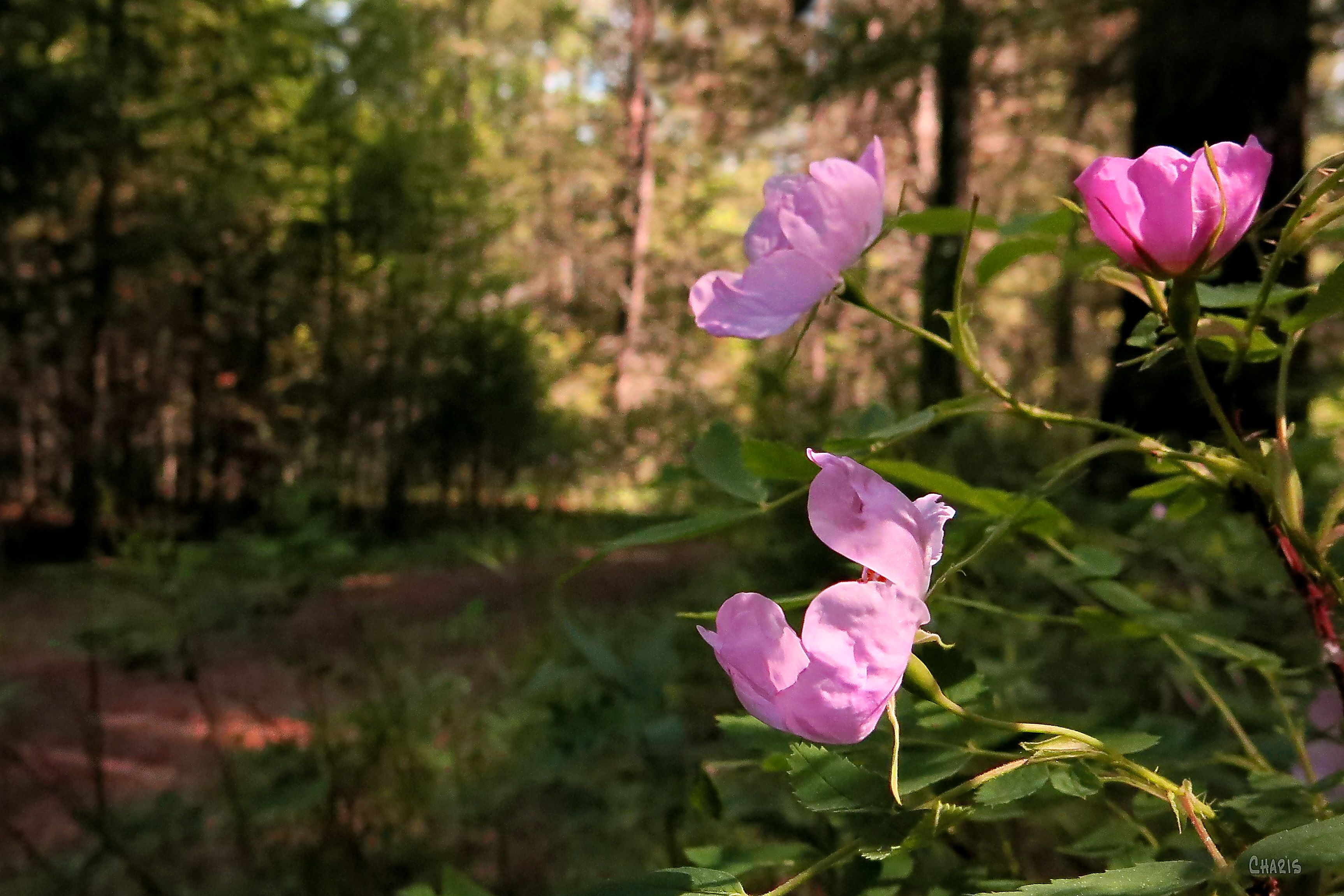
My rose bush produced one measly flower this year, yet in the forest, untended and uncoddled, the wild roses bloom freely.

Sometimes I fret and rush about trying to make things grow when and where I decide they ought to, when really I’m not in charge at all. I can’t force relationships to bloom when and where and how I want them too either.

The roses in the woods remind me that Jesus said, “Which of you by being anxious can add a single hour to this span of life?”

“Instead, seek his kingdom and all these things will be added to you.”

This Is Not Who You Are

Great Great Grandpa Robert


Have you ever tried to ditch a nickname? It’s not easy. Some people have had to move to get away from less than complimentary labels.

My granddaughter and I are working together on a genealogy project for school. We lucked into some work that other people had already done and were willing to share. She typed as I read names and birth and death dates out loud. Robert… William… Robert… William… Robert… Robert… Robert… William

“Wow. These people had no creativity at all when it came to names, “ she observed.

I agreed. A singular lack of imagination. Like many families in previous centuries, our ancestors apparently chose from a very small book of baby names, unlike in this century when my Dad couldn’t recognize or spell any of his great grandchildren’s names. Robert, William, Robert, William. That was the expectation and that’s where nicknames came in. There had to be a way to tell them apart.

Now I say this with apologies to all the Roberts in my extended family (and there are many) since names are something you rarely get to choose for yourself, but nearly every one of them has spent their adolescent years trying to ditch the name, “Bobby” and replace it with Bob or Rob or Robert. Bobby is not a bad name and many guys have decided to keep it into adulthood. It’s certainly not like other nicknames assigned by insensitive 10-year old friends with a predilection for bodily function humour, but it’s hard to change and even when you reach retirement age your mother will still be calling you Bobby. She can be as proud as the dickens that you are now Dr. Robert or President Robert or the Right Honourable Sir Robert, but she will still call you Bobby in front of your colleagues.

Reputations can be like that. Some people have to move to get away from labels people have hung on them – even “good” labels. The pretty one, the athletic one, the klutsy one, the unreliable one. Labels can hang on long after they are applicable. Sometimes the people who most want us to change and mature are the least likely to remove the old label and the expectations stapled to it.

I’m still working on understanding the word consolation (earlier musings here) and I’ve been wondering about what the character of Joseph of Cyprus (Joey, Joe?) was like. Why did his friends give him the nickname, “Son of Consolation” – Barnabas in their language.

Two incidents stand out to me, although Barnabas had already earned his honorary name before these occurrences. The first is when he took Saul the persecutor and introduced him to the new believers in Jesus Christ and leaders of the new church in Jerusalem. He laid his own reputation on the line to vouch for serious change in the guy who had tried to silence and even kill them. More than that, he again acted on his perceptions when he invited Saul – who later changed his own name to Paul (small) to come help him with a thriving community in Antioch, where believers were first called “Little Christs” – Christians.

The second incident has always caused me problems. Years later, after many adventures together, Barnabas and Paul had “a sharp disagreement” over including John Mark (a cousin or perhaps nephew of Barnabas) on the missions trip because he had chickened out once before. Had Mark changed by that point and Paul didn’t believe it? Did Mark need more one-on-one counseling and inner healing so Barnabas took him back to Cyprus for “restoration therapy”? Was Mark really the issue or was Paul still upset with Barnabas over the not eating with Gentiles incident? Was Barnabas bothered by the fact they were now called Paul and Barnabas and no longer Barnabas and Paul? Did the Lord allow “the sharp dispute” to send them in a wider direction, apprenticing more disciples and developing greater influence in the process? Were they both right? Were they both wrong? Was it a mix? I don’t know.

What I do know is that the label, “Useless Deserter,” hung on Mark turned out to be totally inaccurate. Later he wrote the gospel of Mark and Paul even sent for him because he was “useful.” Perhaps Mark’s true calling was to be a writer and not a missionary. (I like to encourage myself with that thought anyway.)

The outstanding trait of Barnabas in both situations seems to be his ability to see people’s potential, to see them as God saw them. As an apostle, a father, he was willing to nurture, protect and advance people who carried “nicknames” from their immature years. He was a facilitator of change. I wonder if this was the character quality that contributed to his own new label – Son of Consolation, Son of Encouragement.

I was surprised to find out that in the Greek that the word translated consolation here is parakletos – the same name that Jesus used for the Holy Spirit when he said The Comforter is coming! There was something in Barnabas that people recognized as a characteristic of Holy Spirit – consolation, comfort, empowerment.

Could it be that one aspect of the consolations that delight our souls (Psalm 94:19) is that God sees us for what we will become? He removes old labels and goes before us to defend us – to ourselves, and to others. He shows us our true identity. He is a facilitator of change.

He gives us a new name.

And it’s probably not Bobby.

Consolation Prize

baby comfort bw DSC_0096 ch

When I think about the word consolation I have in my mind an image of Miss Congeniality.

“Well, you lost, but here’s a trophy for being nice. Thanks for playing.”

My next thought would be of platitudes spoken to console a bereaved person when you really don’t know what to say, but feel you really should say something so you blurt out a bunch of words anyway (a common source of pitifully bad theology).

“Well, I guess God needed a good plumber.”

But I keep running into that word lately – consolation. In my heart I hear the Holy Spirit, in the accent of Inigo Montoya from The Princess Bride, saying, “You keep using that word. I do not think it means what you think it means.”

It started with Psalm 94:19 which I quoted in Weeding Out the Noise. “When my anxious thoughts multiply within me your consolations delight my soul.”

Other translations use words like give me cheer or joy, or make me glad, or lighten my soul. They all agree, consolation brings good feelings.

I’ve gone looking for it, the meaning of the word, I mean. In Hebrew it is something like tanchuwm. It shows up in the last chapter of Isaiah where God promises to comfort his people like a mother. One translation talks about nursing from “the breasts of consolation.”

That ye may suck, and be satisfied with the breasts of her consolations; that ye may milk out, and be delighted with the abundance of her glory. For thus saith the Lord, Behold, I will extend peace to her like a river, and the glory of the Gentiles like a flowing stream: then shall ye suck, ye shall be borne upon her sides, and be dandled upon her knees.

As one whom his mother comforteth, so will I comfort you; and ye shall be comforted in Jerusalem. (Isaiah 66: 11-13 KJV)

I mentioned to someone that I was musing over this image. She thought I was making it up. I heard her muttering as the door slammed, “God the Father is not female. He does not have boobs!”

Literal minds have problems with this poetic language stuff. I shrugged (after I winced) and reminded myself of the dangers of being a verbal processor.

I kept looking. Another similar verse came to mind.

Surely I have calmed and quieted my soul, Like a weaned child with his mother; Like a weaned child is my soul within me. (Ps 131:2 NKJV)

Marty Goetz, the modern-day psalmist, phrased it this way in his song version of Psalm 131.

Oh Lord my heart is quieted
My thoughts are not too proud
The shadows flee, my eyes can see You now
I do not occupy myself
With things too great for me
Here in Your stillness, is where I long to be

And I have calmed my troubled heart,
I have quieted my soul,
Like a child at its mother’s breast,
I find my strength and take my rest
In the shelter of Your arms,
There is life to make me whole
I have calmed my heart and quieted my soul.

One of my best memories is sitting in the big comfy rocking chair in the middle of a cold winter’s night nursing my sweet baby. There were some nights when I felt exhausted, but this was not one. Aggressive winds whipped up the snow and tossed it against the window, but inside the house was warm and still. The boys were asleep and there was no new mom anxiety distracting me. I whispered to my child telling her how beautiful she was and all my hopes for her. I prayed for her and blessed her as she drew sustenance from me. When her little tummy was full she pulled back, looked me in the face and gave me a smile that all mommies wait for. Then she fell asleep in my arms, warm, dry, full and contented.

I wonder if there is something about the ability to receive consolation from Holy Spirit that involves us coming simply as wee children, hungry, messy, cold, and bewildered, to draw sustaining life from him. I wonder if the virtues we tend to associate with the feminine are also essential characteristics of God and if, when we allow him to draw us near, he wants to clean us up, hold us, fill the empty places in our hearts with warm nourishing milk, and, in the stillness, whisper blessings and his plan for us into our ear. Jesus called Holy Spirit “the Comforter,” the parakletos, the one who comes beside.

This week in my dreams, and as I woke to a clear June sunlight streaming through the window, I heard this song in my heart.

Lord I come to You
Let my heart be changed, renewed
Flowing from the grace
That I found in You.
And Lord I’ve come to know
The weaknesses I see in me
Will be stripped away
By the power of Your love.

Hold me close
Let Your love surround me
Bring me near
Draw me to Your side.
And as I wait
I’ll rise up like the eagle
And I will soar with You
Your Spirit leads me on
In the power of Your love.

(From The Power of Your Love by Geoff Bullock)

There is more to this idea of comfort and consolation that I am exploring, but for today, I am learning to rest here in the stillness and let his love surround me.

baby bw ch

Beyond the Reach


IMG_3473 sunset june 11 4

All consolation that does not come from God is but desolation; when the soul has learned to receive no comfort but in God only, it has passed beyond the reach of desolation.

– Madame Jeanne Guyon

Why Are You So Sensitive?

DSC_0009 leaves string rain drops ch

“One of the most beautiful ways for spiritual formation to take place is to let your insecurity lead you closer to the Lord. Natural hypersensitivity can be an asset; it makes you aware of your need to be with people and it allows you to be more willing to look at their needs.”

– Henri Nouwen

Sometimes I feel like a raw nerve ending. It’s more than being an introvert. Visual and auditory distractions seem more demanding and hurtful words seem to go deeper for me than for people who can shrug them off and get back to work with a what’s-your-problem glare of disapproval. It’s not only my own irritations that slow me down, I seem to pick up other people’s emotional stuff and without always realizing that it’s not mine. Merely sensing the atmosphere as I enter a place can make me want to scurry back from whence I came. I may not be constantly overwhelmed, but I am, at the least, perpetually whelmed.

Do you know what I mean? If so, have you ever thanked the Lord that he made you that way and for the privilege of being able to hurt deeply?

I’ve not always been happy to be a sensitive person. Sometimes – no, quite often – I run from it, or try to shut it down, or hold it at arm’s length for scientific evaluation, forgetting the promises Jesus gave of provision to meet not only my needs for consolation, but to give me the ability to comfort others and point them to the One who loves them perfectly.

Self-protection leads to self-absorption and puts distance between us and others. Jesus’ love encourages us to connect, first to him, then to others. Sensitivity makes us capable of experiencing deep joy as well. When I quit blocking out the pain I also quit blocking out the joy – and I hear the Voice of comfort I most need to hear.

It’s our weaknesses that can propel us to the Lord, and it’s his kindness that turns them into strengths.

And by his grace, I am still subject to change.

I am at peace and even take pleasure in any weaknesses, insults, hardships, persecutions, and afflictions for the sake of the Anointed because when I am at my weakest, He makes me strong. (2 Corinthians 12:11 The Voice)

Thank you, Lord.

Weeding Out the Noise

IMG_3224 forest second lake

When my anxious thoughts multiply within me, Your consolations delight my soul.

(Psalm 94:19)

I took a different path from my usual road-less-travelled route in the forest. I was talking to God about some of the many concerns on my heart, one of them being as essay I promised someone on “hearing God’s voice.” I explained to God that it’s rather embarrassing to talk about hearing his voice if I can’t hear it. I haven’t heard much from you lately, Lord, in case you haven’t noticed.

Then the thought came, “Meditate on scripture.” OK. Which scripture?
“Be still and know that I am God,” came immediately to mind.

That’s one I chose to meditate upon a few years ago – because it was short and easy to memorize. Was that thought just from me, because that verse was  familiar, or was it from God? There was no audible voice answering my question. I don’t know. This is frustrating.

My meditation didn’t last a full minute before I was back obsessing about whether or not I said the right thing, or if I remembered to pray for everyone on my list, or why so many jets from the south seem to be flying over our remote valley lately, or if I left that important prescription I can’t find in the bottom of a shopping bag, or if I got the garden planted in time and ISIS! Oh, God, your people are being slaughtered! How do I pray about this?

It can be very noisy in my head.

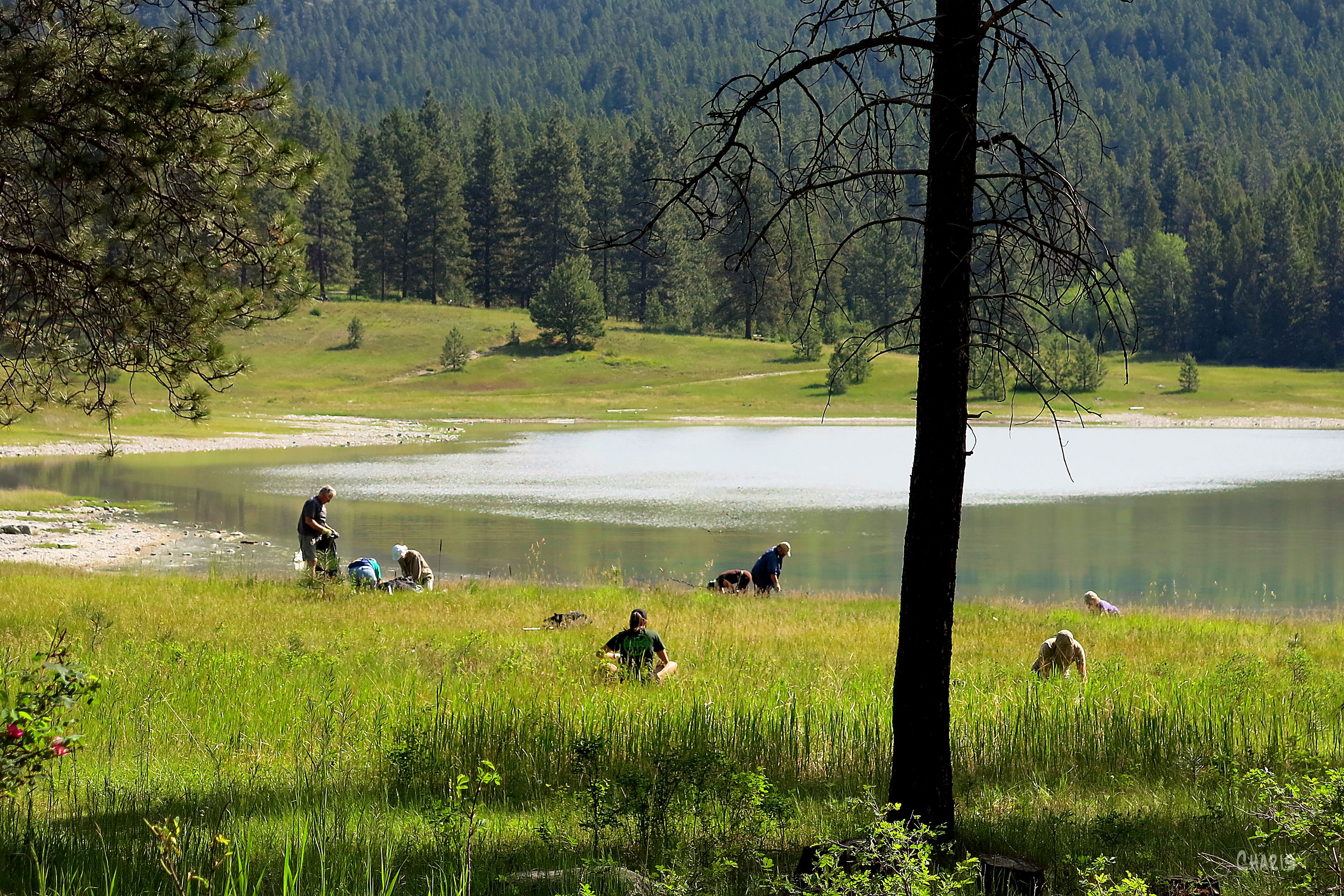
I came around the bend near the meadow by the second lake and saw a group of people down in the grass looking like they were searching for something. I asked someone what was happening and a woman explained to me that they were digging out noxious and invasive weeds.

IMG_3231 noxious weed gathering

“Dalmatian toadflax and St. John’s wort mostly,” she told me. “There’s a bit of knapweed which of course is noxious, but today we are mostly concerned with other invasive weeds. St. John’s wort has its uses but it doesn’t belong in this environment and will soon take over if it’s not rooted out.

I went away thinking about them. In nearly thirty years of walking in these woods I have never run into any sizable group of people doing anything but walking dogs and giving visitors a tour. I’ve seen evidence of bush parties, but never evidence of parties of environmentalists digging invasive weeds out of the meadow. I felt I needed to pay attention.

I walked down another shaded trail thinking about invasive weeds and remembered some one-issue people I’ve known. I began composing a blog in my head about the way some people with a cause based on a perfectly good justice issue, or an over-looked aspect of theology, or an unmet practical need in the world “invade” an environment so that other people’s favourite causes are not given space.

I decided to sleep on it and woke with a song in my head that I have not thought of in many, many years.

Lord, I have shut the door, Speak now the word
Which in the din and throng could not be heard;
Hushed now my inner heart, whisper Thy will,
While I have come apart, while all is still.

“What are you saying, Lord?”
“It’s not about them.”
“Huh?”
“It’s about you. Your thoughts are like noxious and invasive weeds. Some are just bad, and although many concerns are useful in their place, when your anxious thoughts invade our quiet place you can’t hear. Be still and know that I am God.”

Psalm 94:19 came to mind: When my anxious thoughts multiply within me, Your consolations delight my soul.

It’s not that I don’t need to pray about these things; I do! It’s when they, and the fear attached, invades my inner heart, the place where I have invited Christ to dwell, that they multiple and drown out his voice – his consolations. God is speaking all the time but unless I learn to be still, I’ll have trouble hearing him – and even when I do, I may make the mistake of thinking it’s for them and not me.

Sometimes hearing God’s voice is not only about making connections, it’s about learning to turn down the volume on noxious and invasive noises and root out obsessive thoughts that invade the sacred space so his consolations have room to thrive.

IMG_3242 forest wild rose

Oh, That We Might Know


DSC_0026 leaf rain drop_edited-2


Oh, that we might know the Lord!

Let us press on to know him,

and he will respond to us as surely as the coming of dawn or the rain of early spring.

(Hosea 6:3 TLB)