“Gratitude as a discipline involves a conscious choice. I can choose to be grateful even when my emotions and feelings are still steeped in hurt and resentment. It is amazing how many occasions present themselves in which I can choose gratitude instead of a complaint. I can choose to be grateful when I am criticized, even when my heart still responds in bitterness. I can choose to speak about goodness and beauty, even when my inner eye still looks for someone to accuse or something to call ugly.”
-Henri Nouwen
I am pleading with the Eternal for this one thing,
my soul’s desire:
To live with Him all of my days—
in the shadow of His temple,
To behold His beauty and ponder His ways
in the company of His people.
His house is my shelter and secret retreat.
It is there I find peace in the midst of storm and turmoil.
Safety sits with me in the hiding place of God.
He will set me on a rock, high above the fray.
God lifts me high above those with thoughts
of death and deceit that call for my life.
I will enter His presence, offering sacrifices and praise.
In His house, I am overcome with joy
As I sing, yes, and play music for the Eternal alone.
I want a lifetime of holy moments. Every day I want to be in dangerous proximity to Jesus. I long for a life that explodes with meaning and is filled with adventure, wonder, risk, and danger. I long for a faith that is gloriously treacherous. I want to be with Jesus, not knowing whether to cry or laugh.
When my uncle from Saskatchewan came to visit I took him to one of my favourite lookouts to see the mountains. I asked him what he thought. He thoughtfully stroked the stubble on his cheeks that reminded me of the stubble covering his flat fields after harvest.
“They’re okay I guess, but they kind of block the view, ” he said.
A talented musician I once worked with told me she had a similar reaction. She grew up in The Netherlands and although she had seen pictures of mountains she never actually climbed even a hill until a visit to Scotland when she was eighteen.
“The mountains in Canada make me feel claustrophobic,” she said. “I miss the sky.”
I must admit that when I take trips back to the prairies I appreciate the sky and the marvelous sunsets, but I feel so exposed. My Dad joked that on his childhood farm he could see the train coming two days away and it was this environment that necessitated the invention of the outhouse.
Communication involves so much more than the facts of terrain and topology. Words and images don’t always contain the same meanings to different beholders.
I loved the annual “Missionary Convention” at my church when I was a kid. The missionaries on furlough brought costumes and articles from far away exotic cultures and told stories of eating local comfort foods that made kids raised on Jello and Wonder bread gag. I remember one guy telling us the problems he had translating the Bible into the language of a society whose only previous outside contacts had been oil and mining company workers and anthropologists. He wondered how to translate, “Behold the lamb of God.” Somehow “Behold the fuzzy creature of God” didn’t seem appropriate. “Behold the little pig-sized animal covered with curly whiskers like the ones on Jake the geologist’s face” seemed too cumbersome to repeat more than once. He finally went with “Behold the piglet of God” because these people raised pigs and often took the little ones into their homes as pets. He knew that word could be shocking in other cultures, but it conveyed the meaning of something innocent, valued and loved. A lamb, in a way, was like their piglet, but then again, not really. There are limits to how far an analogy can go. Sometimes you need more than one.
Jesus told stories to explain a kingdom outside the experience of the people who gathered around him. “The kingdom of God is like a pearl. It’s like a coin. It’s like…”
“The disciples came up and asked, “Why do you tell stories?”
He replied, “You’ve been given insight into God’s kingdom. You know how it works. Not everybody has this gift, this insight; it hasn’t been given to them. Whenever someone has a ready heart for this, the insights and understandings flow freely. But if there is no readiness, any trace of receptivity soon disappears. That’s why I tell stories: to create readiness, to nudge the people toward receptive insight. In their present state they can stare till doomsday and not see it, listen till they’re blue in the face and not get it. I don’t want Isaiah’s forecast repeated all over again:
Your ears are open but you don’t hear a thing. Your eyes are awake but you don’t see a thing. The people are blockheads! They stick their fingers in their ears so they won’t have to listen; They screw their eyes shut so they won’t have to look, so they won’t have to deal with me face-to-face and let me heal them.”
(Matthew 13: 10-15 The Message paraphrase in modern clichés)
God still speaks to us today in stories and similes that come from our own cultures. His language is not always English nor any other spoken language. He can speak through nature and pop music and babies and even international politics – and many other ways that connect us with his heart – but most people don’t hear because his imagery means little without a desire to understand the story-teller. His language is relationship. He is the Word.
I’ll be honest and say that I enjoy poetry and I write poetry, but I don’t read a lot of it. It’s work and I want to know the poet has something of value to say before I invest mental energy in interpreting the imagery. You can’t read poetry (except perhaps limericks) without taking time to ponder over what the writer is trying to communicate. Taking time to listen to God develops eyes to see and ears to hear what the kingdom of God is like, but more importantly what the Lover of our Soul is like.
“But you have God-blessed eyes—eyes that see! And God-blessed ears—ears that hear! A lot of people, prophets and humble believers among them, would have given anything to see what you are seeing, to hear what you are hearing, but never had the chance.” (verses 16-17)
“Oh Lord my God, when I in awesome wonder consider all… I see… I hear… Then sings my soul, my Saviour God to Thee.” (How Great Thou Art)
It is good to give thanks to the Lord,
to sing praises to the Most High.
It is good to proclaim your unfailing love in the morning, your faithfulness in the evening, accompanied by a ten-stringed instrument, a harp, and the melody of a lyre.
You thrill me, Lord, with all you have done for me! I sing for joy because of what you have done.
O Lord, what great works you do! And how deep are your thoughts.
Only a simpleton would not know, and only a fool would not understand this:
Though the wicked sprout like weeds and evildoers flourish, they will be destroyed forever.
But you, O Lord, will be exalted forever.
(Psalm 92: 1-8 NLT)
I suppose the guitar is the modern equivalent of the harp and lyre. Recently I found the music of the marvelous guitarist, Rodrigo Rodriguez (was he born to this?) Here he plays “How Great is Our God.” Enjoy.
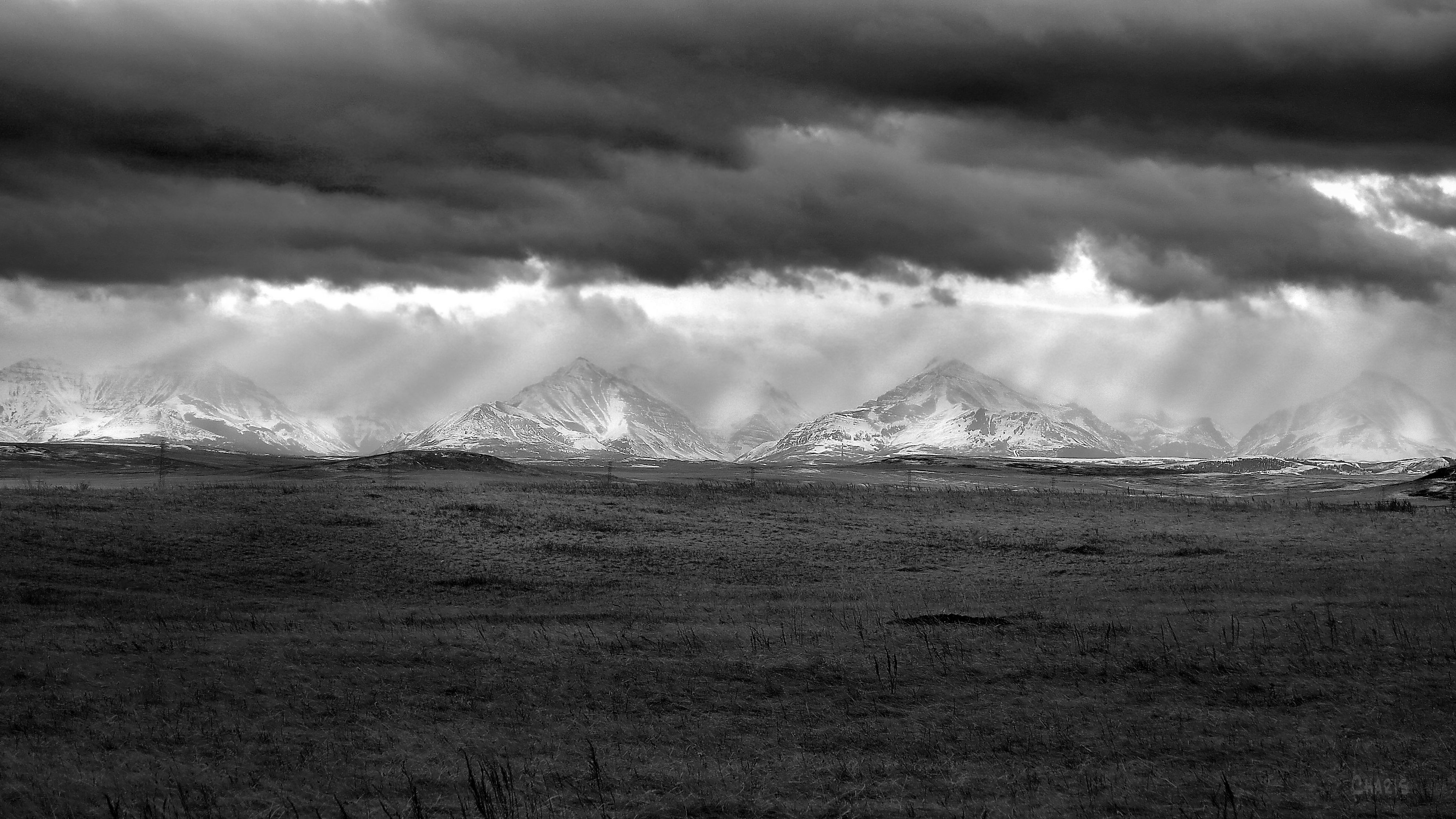
Dramatic light in Kootenay National Park this weekend.
I’m not a fan of cheesy Christian movies — you know the ones where saints recent and ancient stand around looking holy and emotionally detached from both the darkness swirling around them and the choir-accompanied beams of light shining down upon their humble heads? Yeah, those.
Somehow in my culture self-control/moderation means the denial of all but mildly pleasant expressions of emotion. The other-worldly subtle Mona Lisa smile in the midst of both murky darkness and beaming light. Peace is a placid becalmed sea oblivious to the movement of air currents. Saint Sebastian skewered full of arrows with an expression that looks like he’s wondering if he needs to pick up milk and bread on the way home.
Some in our midst have taken on the role of emotional moderators, rather like volunteer sound techies whose aim is to keep the dial as close to the center line as possible, thus cancelling out any dynamic range the musicians may have intended. “It’s not that bad….It’s not that good… Don’t get too excited…No drama please.” Those who feel deeply learn to hide.
Jesus doesn’t seem to have been hampered by emotionally restrictive parameters.
In the days of His flesh [Jesus] offered up definite, special petitions [for that which He not only wanted but needed] and supplications with strong crying and tears to Him Who was [always] able to save Him [out] from death, and He was heard because of His reverence toward God [His godly fear, His piety, in that He shrank from the horrors of separation from the bright presence of the Father]. Although He was a Son, He learned [active, special] obedience through what He suffered. (Hebrews 5:7-8 Amplified)
Jesus could be loud, passionate, dramatic, and unafraid of tears. He could weep beside his grieving friends and he could be beside himself with joy when he saw how the Father revealed himself to the less-than-mighty. He could be silent. He was not manipulative with his emotional expressions (any parent of a toddler knows the difference between a pain cry and a but-I-wanna cry of protest.) Christ was reverently respectful but emotionally honest.
Dysfunctional families preach the message: Don’t think. Don’t talk. Don’t feel. Violators are shamed. God’s plan is for his family to be lovingly functional.
Our heavenly Father invites us to engage in shame-less communication with him. We don’t need to check our brains or our hearts at the gate or hide behind bushes of reserve. The secret place in his presence is the safest place on earth. He can handle our “drama” in the process of helping us grow in grace and knowledge. He is the perfect Father we all wish we had -and all of the love he directed at his son is also directed at us as we abide in him.
O my God, shine Your light and truth to help me see clearly, To lead me to Your holy mountain, to Your home.
Then I will go to God’s altar with nothing to hide. I will go to God, my rapture; I will sing praises to You and play my strings, unloading my cares, unleashing my joys, to You, God, my God.
O my soul, why are you so overwrought? Why are you so disturbed? Why can’t I just hope in God? Despite all my emotions, I will hope in God again. I will believe and praise the One who saves me and is my life, My Savior and my God.
No, I didn’t get drunk. I chose to pursue my own drug of choice, but it’s the same thing really.
A person I had befriended sent me a prayer request: “Pray that I won’t get drunk tonight.”
“Do you have alcohol in the house?” I asked.
“No.”
“What would you have to do to get drunk?”
“Well, I’d have to go get some beer.”
“So you have to choose to get dressed, get your car keys, drive down to the liquor store, buy a case…”
“Well, actually I’d have to go cash a cheque first…”
“Okay. Then you have to bring it home, open the can…”
“I prefer bottled….”
“Open the bottle, guzzle it down, open another bottle…”
“Yeah. Pretty much.”
“Do you realize how many decisions that involves and how many times you are offered the option of choosing differently this time? You could choose to stay home, choose to not pick up your car keys, choose to turn right toward the movie theatre instead of left to the liquor store…”
“Yeah. I know, but I need you to pray that I choose not to get drunk. My boss is such a jerk.”
“Is there a gun to your head? Is anyone forcing booze down your throat? Because otherwise I can’t pray that. I can’t pray that God will veto your free will, because he already gave it to you – for free – and I can’t take it back on his behalf. I don’t have that kind of power. I will pray that you will be aware of every point where you are faced with a decision and you will realize you are not a helpless victim, but someone who is learning he is no longer a slave to sin. You do not have to make the choice to go down the same old road again. Grace is more than a get out of jail free card. Grace is also the power to be set free from the law of sin and death. Grace is realizing you are free and when you trust in Christ the thing that feels like a gun to your head doesn’t have any bullets anymore. It’s a lie.”
I know there are many dynamics to addiction and cravings make it feel like there is a loaded gun to our heads. Sometimes the ruts to our habitual choices are so deep we’ve got to really hit the gas hard to turn and go down a different road. I get it. But we do have choices.
Here’s the thing. It’s easy for me to talk about not getting drunk because it is not a temptation for me. I hate the taste of alcohol. Don’t bother giving me a fine bottle of wine. I actually prefer grape juice – and I can’t get beer past my nose. I like to be in control of all my faculties, thank you very much. But I realize I did the same thing as my friend yesterday. I sent a message to some friends – intercessors – asking them to pray that I would respond with grace and love to people I feel acted…well, let’s just say they acted without grace and love.
My habitual response would be to seek sympathy, justification for my hurt feelings, and maybe even hope the people I asked to pray would take up my cause and fight for me. Then I would go eat a chocolate bar or something to stifle the feeling of anger, because I really hate feeling angry. Nice Christian girls don’t feel angry, right?
I was asking them to pray that God would veto my own will, and he tends not to do that. Instead he offers us two fruit trees so that we have the opportunity to choose the righteous one. Given that grace gives us the freedom to choose love, joy, peace, patience, kindness, goodness, faithfulness, gentleness and self-control, choosing resentment and lack of self-control is pretty stupid.
I wish I could just pray that I would make the right choice and it would happen, like magic. But this life of freedom is all about choosing relationship with Christ over being a slave to rules. So today I choose to turn right toward him this time, to forgive and offer grace to those who have seemed to be a little short of it. It may require a little donation as well, because we overcome evil with good. Freely we have received, freely we give, because God is not on a budget and there is more love and grace where that came from.
Yesterday my friend and I were driving home through a valley. The hills surrounding us had already descended into dusk and the trees began to accept the blackness of night but the sky still had a warm glow on the edges. Impulsively I turned onto a rough dirt road that led up to Eager Hill. From there we could see beyond the darkness to the height of the Steeples Range which caught the light.
Looking at the photos this morning I was reminded of a passage from Jeremiah 3.
“Call to me and I will answer you and tell you great and unsearchable things you do not know.”
Jeremiah was still a prisoner in chains in the kings’ courtyard, surrounded by the barricades of possessions the people were piling up in a desperate attempt to stop the inevitable. They turned to the prophet. The immediate news was not good. His heart broke as he told them. Then that word that changes our viewpoint: Nevertheless.
“Nevertheless, I will bring health and healing to it; I will heal my people and will let them enjoy abundant peace and security…”
In our dark moments, when things are just getting darker, the Lord invites us to call to him and come up higher. He says, “Yes. This difficult place is where you are. I know. This is tough. Nevertheless I tell you to have hope. I will show you. This beautiful place is where you are going. I have plans for you and they are bigger and better and more glorious than you have ever imagined, because now we do it My way.”

















 Charis: Subject to Change