
It is only imperfection that complains of what is imperfect. The more perfect we are, the more gentle and quiet we become toward the defects of others.
– Francois Fenelon


Twenty degrees! (That’s room temperature for those of you living in the country that doesn’t use Celsius.) Yesterday the sun was shining! I opened the windows! I went out without a jacket!
I had work to do, but the forest paths called to me.
The snow was gone. The birds were singing! The trees were rustling! The scent of pine and fir and cedar is starting to return.
Ahhh
When through the woods and forest glades I wander
and hear the birds sing sweetly in the trees,
when I look down from lofty mountain grandeur
and see the brook and feel the gentle breeze,
then sings my souls, my Saviour God, to Thee,
“How great Thou art!”








Some lovely friends invited me to join them for a painting class on the theme of prophetic art or worship art. What a beautiful group of people! On this particular evening the instructor played worshipful music and asked us to paint the images -or the feelings- that came to mind when we thought of Holy Spirit. I’ve been trying to teach myself to hold a bigger brush more loosely and save sharply focused realism for photography. I did three very quick paintings in one sitting. Two were peaceful and sweet in soft, even feminine colours. Then, without too much thinking, I grabbed some colours and sloshed them on the canvas. This was the result.
Art is an experience between the work and the beholder and can have more than one interpretation. I sometimes see something the artist didn’t intend to say in a work, and sometimes people interpret my paintings differently as well, and I appreciate that. This time I found myself interpreting my own painting. What does this say to me? Tongues of fire are often associated with the arrival of Holy Spirit at Pentecost and many songs are written about wanting to be filled with the passionate fire of God. I’ve seen people laugh and sing and praise God when they encounter his goodness. It’s a joyful experience.
But I have learned that not all God-encounters are fun experiences.
Encountering God’s holiness leaves us stripped of any sense of self-righteousness. We cry out like Isaiah, “Woe is me, for I am a person of unclean lips and I come from a people of unclean lips.” We sing, “Purify my heart, let it be as gold, pure gold…” or “Consuming fire, fan into flame a passion for your name…” but we want Him to do this in soft, comforting, nurturing, happy, happy, joy, joy, soft kitty/warm kitty pastel colours.
Holiness hurts.
Isaiah’s lips were symbolically purified when an angel touched them with a burning coal from the fire of God. Ouch!
Peter wrote:
Blessed be the God and Father of our Lord Jesus Christ! According to his great mercy, he has caused us to be born again to a living hope through the resurrection of Jesus Christ from the dead, to an inheritance that is imperishable, undefiled, and unfading, kept in heaven for you, who by God’s power are being guarded through faith for a salvation ready to be revealed in the last time.
In this you rejoice, though now for a little while, if necessary, you have been grieved by various trials, so that the tested genuineness of your faith—more precious than gold that perishes though it is tested by fire—may be found to result in praise and glory and honor at the revelation of Jesus Christ.
Though you have not seen him, you love him. Though you do not now see him, you believe in him and rejoice with joy that is inexpressible and filled with glory, obtaining the outcome of your faith, the salvation of your souls. (1 Peter 1:3-9)
The end result is praise and glory and honor at the revelation of Jesus Christ. The end result is joy unspeakable and full of glory. The end result is promotion to higher levels of intimacy with the Eternal.
But the process is not always painless. When we pass through the fires that test our faith all the false ideas we treasured are revealed for the mere counterfeit paper copies they are. Sometimes it means choosing, by faith, to lay the unreliable handholds of the past down on the altar before we have any firm handholds for the future. Without a theology that includes suffering we lack the motivation for perseverance that leads to mature character and true hope. Our sense of entitlement makes us avoid pain and equips us with a type of hope that is entirely too flammable. Without an understanding of the role of suffering we are blown away by adversity and crushed by disappointment.
True hope does not disappoint.
Since then it is by faith that we are justified, let us grasp the fact that we have peace with God through our Lord Jesus Christ. Through him we have confidently entered into this new relationship of grace, and here we take our stand, in happy certainty of the glorious things he has for us in the future.
This doesn’t mean, of course, that we have only a hope of future joys—we can be full of joy here and now even in our trials and troubles. Taken in the right spirit these very things will give us patient endurance; this in turn will develop a mature character, and a character of this sort produces a steady hope, a hope that will never disappoint us. Already we have some experience of the love of God flooding through our hearts by the Holy Spirit given to us. (Romans 5:1-5 Phillips)

I found one!
The first lone crocus I saw this year was not in a forest clearing but in the middle of a construction zone. At the end of every winter I go out looking for signs of life. I have a lot of photos of crocus flowers in my stash because they give me such hope. When I was a child I picked bunches of them to bring inside, but they soon flopped over the side of the jam jar. A wild crocus is not easily domesticated; it is meant to be out in the dead cold field poking its optimistic head through patches of snow. It is a forerunner of better things to come.
I was thinking about forerunners the other day, those people who can see what is coming next before anyone else does. Hawk-eyes, scouts, prophets, innovators, preparers-of-the-way. In the art world Van Gogh was one of these. In his lifetime he never sold a painting, never received recognition, never found a place where he “fit.” That boy was “different.” It wasn’t until many years later his paintings sold for millions. Forerunners don’t run to be popular.

John the Baptist was a forerunner. He was also “different.” He didn’t have a complete picture of the One who was to come, forerunners seldom do, but he knew with certainty in his heart that there was a change coming, and his assignment was to prepare hearts for change. Like a farmer who prepares the field for planting he set about tearing out obnoxious weeds that had been there so long folks had accepted their presence as part of the landscape. He preached the message of repentance. Repentance is not the same thing as penance, (trying to make up for wrongs done by some sort of demonstration of self-administered punishment or public humiliation, although, for some making public apologies and announcements of plans to repay what they stole may be an indication of their intent to change.) Repentance often involves grief, but primarily repentance (metanoia in Koine Greek) means change. Repentance is admitting our thinking has been off and coming into agreement with God that we have missed the mark he set (hamartia, the Greek word for sin means just that -missing the mark.) Repentance means having a better thought and adjusting our aim. Repentance means leaving the past behind and doing things differently.
The basic mission of forerunners like John is to poke a finger into embarrassingly sensitive, and often hidden, parts of our lives and ask the question, “And how’s that workin’ for ya?”
There are forerunners amongst us now, folks with an antsy sense that change is imminent, but who don’t know exactly what that change will look like. They go through life awkwardly, never really fitting in anywhere, annoying themselves and others with their inability to find contentment with accepted ideas and practices that don’t quite line up with both the Holy Spirit’s whisperings and with Scripture. They are not easily domesticated, and often pop up in places where dormancy is “normal.” They stand out because they are different and the light shines through them in colours we haven’t seen for a long time.
Yet somehow we are drawn to them. They are messengers of hope.


This duck can glide smoothly through what looks like turbulence because the water is actually calm. The peaceful surface of the water merely picks up the image of the atmosphere around it.
Sometimes I fail to enjoy the peace the Lord has granted me because I am caught up in the turbulence of the lives of people I care about. It’s a hazard for empathic people whose sensitivity causes them to pick up other people’s emotions. The Bible calls it the gift of mercy. It can be a useful tool, but it is a tool, not a reward, and it needs to be used with skill and wisdom. One of the great frustrations in my life has been the seemingly callous attitudes of people who are oblivious to the pain of others. Nothing stirs up my self-labeled righteous indignation more than non-compassionate people who shrug in the presence of suffering and say, “Not my problem.” It makes me furious!
James 2:14-17 says it’s a useless faith that walks past suffering and says, “Go in peace; keep warm and well-fed,” or as Dickens wrote, “Are there no workhouses?”
But this week the Lord has been smacking me upside the head (ever so lovingly) about misaligned compassion that is actually a lack of faith on my part.
I have discovered 1 Corinthians 12:9,10 to be true in my life.
“My grace is sufficient for you, for my power is made perfect in weakness.” Therefore I will boast all the more gladly of my weaknesses, so that the power of Christ may rest upon me. For the sake of Christ, then, I am content with weaknesses, insults, hardships, persecutions, and calamities. For when I am weak, then I am strong. ” (1 Corinthians 12:9,10)
It’s not a matter of self-imposed martyrdom or false humility, but I am learning that it is in the areas where I have been, quite frankly, an utter failure that God is most able to communicate his goodness through me. His goodness amazes me and I love to talk about it. But this is where he called me up on the carpet this week.
“Why, when you have experienced My goodness, do you think that I am not able to do the same thing for others?”
“When did I say that?”
“When you keep jumping in to fix things for people. How will they learn to call on Me when they can call on you? Why do you assume I don’t care? Maybe I’m allowing some of the troubles in their lives for a purpose. I want them to ask Me, to know Me. I’ve called you to pray, to intercede. I want you to stand in the gap, not stand in the way.”
I admit, I’m bad at the whole boundaries thing. I was an over-responsible eldest child and had my personal boundaries violated so often I don’t have an innate sense of when I need to step back and let God be God. (Yes, Lord, I realize that is an explanation and not an excuse.) I’m still learning.
I noticed that parents of my students who applied “tough love” as their go-to position used it on teens who had known precious little “gentle love” in the first place. I felt agony for overachiever-types who were locked out of the house for being five minutes late for a 10 p.m. curfew. On the other hand I have also seen far too many young people grow up with a sense of learned helplessness when their parents ran defense for them with excuse after excuse for their kid’s lack of self-discipline. I’ve also been caught, more than once, pouring more effort into changing someone’s circumstances than they themselves put into changing the habits that got them there. I’ve seen people who haven’t been tempered by adversity presume on the grace of God with a sense of entitlement that reveals a shallow unloving relationship where the Creator of the universe is viewed as their personal Santa Claus. Someone told me the sin of presumption David recognized as a problem in Psalm 19 is assuming God is here to serve your agenda, instead of you being here to serve God’s.
But God forgive me, sometimes I’ve been the enabler, and it’s been the result of my own lack of faith.
Like everyone else I tend to hear what I want to hear. The folk who easily gravitate to “tough love” need to hear the message “Whoever closes his ear to the cry of the poor will himself call out and not be answered.” (Proverbs 21:13) and the folk who rush in, striving to fix the world themselves need to hear, ““I am the Lord, the God of all mankind. Is anything too hard for me?” (Jeremiah 32:17)
The last one is me. One couple I admire who have cared for thousands of orphans and fed the hungry and healed the sick and introduced millions to the goodness of God is Heidi and Roland Baker of Mozambique. Heidi repeats, “God is God. I am not.”
This is what I am learning: God gives plentiful grace for our own circumstances. He has grace in overabundant supply for anyone who asks Him. He does not necessarily give me grace to deal with problems that are not mine. When I am overly influenced by the turbulent atmosphere all around me I lose my peace and when I am worried or afraid I can’t move. I’m no help to anyone. My joy becomes forced and my ability to love is limited to my own willpower. I need to be on solid ground myself before I can throw a lifesaver to a drowning person. I need, like this duck on the lake, to appreciate the peace that is mine in Jesus Christ and move on that.
Sorry, Lord. Give me discernment to stand with you and not for you. Your grace is sufficient for all the people I care about as well. I trust you.
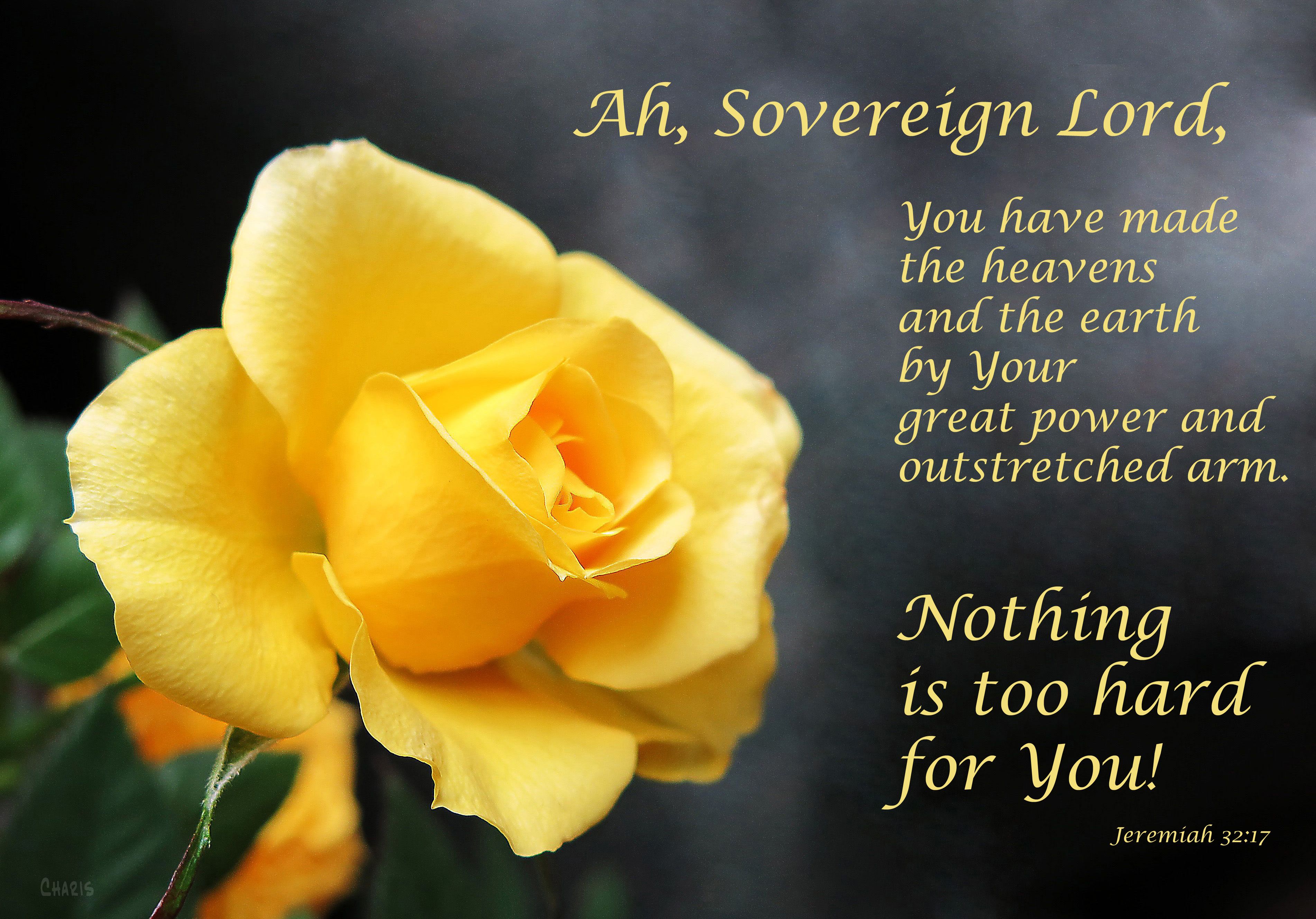
Jeremiah didn’t get it. Essentially He complained to God, “You asked me to go pay good money and sign legal documents to purchase a piece of land that you already told me will be captured by foreign invaders. I can see the destruction that’s coming; you made me a prophet, remember? This does not seem like good stewardship to me.”
“You don’t get it because you’re too short-sighted, Jerry. I have a plan that goes beyond your generation, a plan that will bring long-lasting peace and prosperity and a renewed relationship with me. You weep and wail and get depressed because you see the immediate pain of loss. I see the joy of restoration,” God answered.
“You just prayed, ‘Ah, Sovereign Lord, nothing is too hard for You.’
Were you even listening to yourself? I’m asking you an obviously rhetorical question here. ‘Is anything too hard for me?’
Care to answer?
Trust me, Jerry.
….And that is not a suggestion.”
(My very, very loose paraphrase of Jeremiah 32)

The essence of optimism is that it takes no account of the present, but it is a source of inspiration, of vitality and hope where others have resigned; it enables a man to hold his head high, to claim the future for himself and not to abandon it to his enemy.
– Dietrich Bonhoeffer

“Lord in my confusion all my strength is giving in.
My adversary’s everywhere.
It seems that there’s no way to win.
Then, I hear Your voice all through me
Telling me this battle’s Yours, not mine.
I have no choice left to me, but to yield to Your design
As You take it from my hands what can I do
But lift them up in sacrifice to You?
O Lord, Your loving kindness is everlasting,
That’s why I sing.
O Lord, Your loving kindness endures forever
And You are able to deliver me.
Deliver me!”
(From Song of Deliverance by Marty Goetz)








 Charis: Subject to Change