Even the Nights Are Better

DSC_1119 (2)

Another painted prayer from last weekend.  As I met with friends who also feel an urge to pray for our city, our valley and for our country, I kept hearing the phrase, Even the nights are better.

We talked about our experiences. Most of us are familiar with night seasons. Some in our group wake during the night hearing a call to pray for someone or something that burdens their hearts.  For others, struggles with pain of all sorts seem more intense at night; loneliness, loss, and physical pain arise in the darkness. Circumstances that confront us with the unknown can take us to a place where the façade of being in control impresses no one. But everyone agreed, the night season has its beauty.

In that quietness, in that place void of daytime distractions, we can learn to enter another type of rest — that is, when we stop protesting long enough to hear to the still small voice that whispers comfort.

While the band played and the people sang, I picked up my brush and quickly painted the picture in my mind. It reminded me of the beauty of the night season when the Lover of my soul, my Keeper, my True Hope comforts me with his songs and when I can respond to him with my own.

Yes, Lord. In your presence, even the nights are better.


Yet all day long God’s promises of love pour over me.
Through the night I sing his songs,
for my prayer to God has become my life…

So I say to my soul,
“Don’t be discouraged. Don’t be disturbed.
For I know my God will break through for me.”
Then I’ll have plenty of reasons to praise him all over again.
Yes, living before his face is my saving grace!

Psalm 42:8, 11 TPT

Incognito

mannequin bw sq dsc_0725


When I saw this mannequin in a country store she reminded me of someone going incognito. Incognito is Latin for unseen, unknown. The goal of going incognito is the opposite of intimacy, something else I’ve been thinking about lately.

The problem with writing about intimacy with God is that when you use the word intimacy, people think you are talking about sex. Intimacy in current usage is very much about being seen and being known by someone of importance.

We see articles about improving intimate relationships in marriage and advertisements for intimate apparel, which have their place, but there is a greater intimacy with the Creator that goes beyond the physical and the emotional. I’ve been trying to figure out how to describe this kind of intimacy without alluding to sexual intimacy, but as I read the Bible, I notice something. God is proficient in the language of symbolism. He doesn’t avoid talking about sex, so why should I?

Sexual intimacy is a metaphor for something even bigger and better.

When God created man and woman they stood before each other naked and unashamed. The Bible says Adam knew Eve and she conceived. According to Strong’s, yada’, the word often translated knew means:
1. to know, learn to know
2. to perceive
3. to perceive and see, find out and discern
4. to discriminate, distinguish
5. to know by experience
6. to recognise, admit, acknowledge, confess
7. to consider

The first act of seduction and the first act of unfaithfulness was when the serpent, the creator of lies, convinced these two humans that if they ignored God’s instructions and ate from the tree, they would become like gods themselves. They would yada’ good and evil.

The first bit of knowledge they perceived, learned and experienced (yada’ again) after they chose to believe the serpent, was that they were naked – and ashamed. The Hebrew word for ashamed also carries the connotation of disappointment. Sin brought a sense of disappointment in themselves and disappointment in each other as part of the package deal. That profound disappointment is called shame. They needed a layer of protection to try to keep their shame from being seen. They covered up. They hid from God. They tried to go incognito. Unseen. Unknown.

The plan failed. It’s been failing ever since because God came looking for them.

One of the key verses for my life is Philippians 3:10 and 11: “… that I may know Him and the power of His resurrection and the fellowship of His sufferings, being conformed to His death; in order that I may attain to the resurrection from the dead.”

The problem is that knowing him intimately means confronting the problem of shame that piles up like stinky laundry in front of the door. Can I be honest and tell you that a life-time of sin-awareness has not made me less sinful, but more aware of my shame? I’ve watched an entire industry based on the design, fabrication, and marketing of fashionable religious cover-ups expand in my life. I’ve watched it burgeon in the lives of people around me too.

The thing is about sexual intimacy is that involves us standing naked before someone and exposing our less-than-perfect parts. Am I the only one who has noticed, after many trips to the beach, that I am not the only one with scars and rolls and, um, a disappointing shape? I won’t even mention smells and sounds.

Sexual intimacy requires a lot of trust. One of our greatest fears is taking a risk and later experiencing rejection or betrayal as a result. That’s why Jesus said that when a person claiming to represent God betrays the trust of a vulnerable person, they have committed a heinous crime. If a victim thinks God is on the side of the perpetrator, they are hindered from turning to God for healing. It may take years and many demonstrations of unconditional love before they can regain a sense that God will not also betray them. So many people have believed lies about the nature of God as a result of abuse. I believe God wants to uncover truth about who he really is through his goodness.

Spiritual intimacy also requires trust, perhaps even more than physical intimacy. When we make a spiritual connection we give access to the deepest, most vulnerable part of our being.

Entire literature and film genres cash in on crimes of passion based on fear of rejection and betrayal. It is easier to approach God covered with a thick bullet-proof mantle of religiosity,  to speak in tones of formal scripted recitation, and to never let him get between us and the exit than it is to drop defenses.

But God makes a way.  He deals with shame by inviting us to consider it dead. He makes us into someone new. He shows up with his goodness and covers us with his own righteousness. Jesus’ humiliating experience of hanging naked on a cross as he bore our shame purchased that righteousness for us.

Intimacy requires the participation of two naked people with nothing hidden, nothing held back. Because God makes the first move by exposing his heart for me, I can drop my own attempts at cover-up. I am free to expose my heart to him. His righteousness becomes mine. In his eyes I am beautiful.

The passage before the verses I’ve claimed as my life theme goes like this:
“…I count all things to be loss in view of the surpassing value of knowing Christ Jesus my Lord, for whom I have suffered the loss of all things, and count them but rubbish so that I may gain Christ, and may be found in Him, not having a righteousness of my own derived from the Law, but that which is through faith in Christ, the righteousness which comes from God on the basis of faith…” (Philippians 3:8 & 9)

As I was thinking about daring to respond to God’s invitation to increased intimacy, a line from an old song came to mind:

“…dressed in his righteousness alone, faultless to stand before his throne.”*

Trust involves risk. For so many years, I found it difficult to trust someone I was told wanted to punish me for not loving and obeying him perfectly. It was too risky to trust. That’s because I didn’t know him. Eventually I took the risk. Trusting someone who demonstrated love by giving his life for me is worth the risk. To be known and loved down to the cellular level by the One who created me is priceless.

It’s worth the cost of dropping disguises — that I may know him.


*From My Hope Is Built On Nothing Less by Edward Mote

You Are Loved

flowers pink yarrow ch crop IMG_5125 - Copy

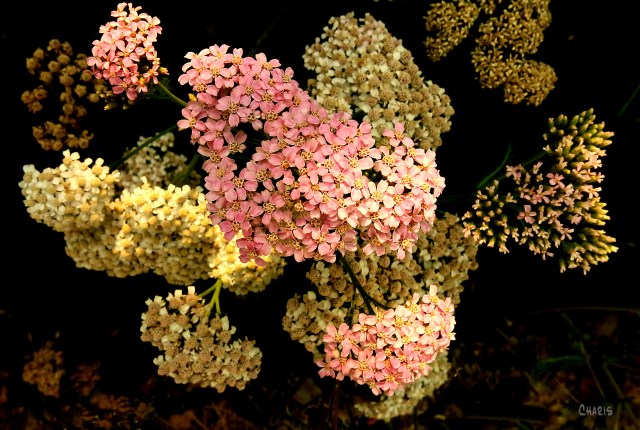
I like this photo of yarrow because it reminds me that all of us are at a different stage in life. Some blossoms are at their colourful peak, some are fading, and others are yet to emerge. Like the flowers of the field that Jesus told us were cared for by a loving Father, our place in the kingdom of God is not determined by anything other than his generous love and our response to him.


The Father’s love is greater than fear of not “being a winner,” not being at one’s peak performance-wise, or not being noticed for one`s efforts. Our success relies simply on knowing Him and abiding in his love.

Now may our Lord Jesus Christ Himself and God our Father, who has loved us and given us eternal comfort and good hope by grace, comfort and strengthen your hearts in every good work and word. (2 Thessalonians 2:16,17)

Do you feel overlooked? God sees you.

He knows you. He absolutely loves you. Receive his comfort, drink in the sunlight of his grace, live in hope, and let him love you the way you are meant to be loved, wherever you are this day.

Be who you are meant to be — a much loved child of God — and you will do what you are meant to do.


Heart

DSC_0832 (2)

Little grandson: I brought you a pretend present, Nana. Open it.
Nana: How lovely. What is it?
Grandson: It’s a shirt. It’s pink. You like pink, don’t you?
Nana: I love it.
Grandson: It has words on it.
Nana: What does it say?
Grandson: It says, “I love everyone.”

This kid’s got a big heart and he knows how to touch mine.

Where I Am, As I Am

winter road fence dh ch dsc_0648_edited-1

My trust in God flows out of the experience of his loving me, day in and day out, whether the day is stormy or fair, whether I’m sick or in good health, whether I’m in a state of grace or disgrace. He comes to me where I live and loves me as I am.

-Brennan Manning

Tell It Like It Is

DSC_0137
When I was a teenager my long dark straight hair, parted in the middle Juliet-style, almost reached my waist. I was so proud of it.

My mother hated it. She showed me borrowed magazines full of photos of the cute curly-permed styles she would have loved as a teen, if only her stepmother had allowed her to cut her hair. It seems the fashion pendulum swings its way into the middle of independence struggles in every generation.

My mother did not approve of my skirt length either, but neither did I approve of hers – although I would never dare to say so out loud. We compromised. Rather, I compromised by wearing the skirts she bought and waiting until I reached the bus shelter before rolling them up at the waist.

Miniskirts were not designed for girls living on the prairies in Canadian winter. The January wind in Calgary left more than one of us enduring geometry class amid the distraction of chilblains on our thighs. That factor bore no influence on my need to not look like my mother`s generation, nor did the hazards of wearing fashionable unlined boots with absolutely no traction on ice. I bore frozen toes and ripped stockings with feigned nonchalant flare deserving of an Oscar – at least in front of Mom.

We quarrelled over music as well. I studied classical music and sang in my first opera at 14 (The Dew Fairy in Hansel and Gretel). “Old” music was not the problem. Our problem – ok, my problem – was old church music.

“Listen to this!” I said to her in a voice that was probably too loud for the living room. I played the last two bars of every song in a book called The Church Soloist, High Voice which she bought for me with her own hard-earned money. Banging out insensitive interpretations on the piano I complained, “Except for key changes every single song sounds the same as every single song we have sung in church since the Reformation.”

I don’t remember what she said. I wasn’t listening anymore. Door slamming may have been involved. I could be a horrible, emotional teenager. I knew she loved me, but sometimes I felt like I was fighting for my life. In a way, I was.

Years later I felt the same frustration my mother must have felt when my own kids rejected my taste. I was grateful for parenting classes that explained that the work of adolescents is to discover their own identity and forge their own relationship with God. Sometimes the only thing a young teen knows is that they are not their parent. The separation process begins at birth and accelerates in the years before leaving home.

My grandfather died before I was born. I heard stories about him, but I had no relationship with him. I could see photos and a gravesite, but he was like a mythical figure to me. My Mom had a relationship with him. I didn’t. I could see his influence, but I couldn’t see him.

God has children. God does not have grandchildren. In order to relate to him with a sense of integrity emerging independent young adults need to wrestle with him, interact with him, and enact their own faith by worshipping in a way that engages their own hearts. Parents get to pray a lot, get an opportunity for upgrade in their own faith, and get to try not to take rejection too personally.

The memory of the music battle came up today after I read that Kurt Kaiser died this week. Kurt Kaiser and Ralph Carmichael wrote Christian music that shocked our parents and convinced my grandmother that we were on the road to perdition. Their songs seem so innocuous, even embarrassingly bland now, but back then the adults didn’t like it, which meant we could. I remember practising the choral work for youth called “Tell It Like It Is” with my friends at church and feeling like this was cutting edge, daring stuff.

I found a recording of the musical on Youtube today. It sounds as cutting edge as an ice cream scoop now, but at the time it began to give a sheltered fourteen-year old hippy-wannabe an opportunity to express doubts and claim fledgling faith in my own way.

Anyway, I want to honour Mr. Kaiser and his friend Mr. Carmichael for noticing us. It was a start in making cultural connections. He showed me, before I reached that awkward spot in my parenting journey, that every generation needs to sing their own songs their own way. Bonus points if your parents don’t adopt it.

One song Kurt Kaiser wrote stayed with me. In words as simple as a nursery rhyme set to a tune that still had a range greater than a third, (my old person jab there) it communicates the most important message of all time: Jesus loves you and Jesus loves me.

Oh, how He loves you and me, Oh how He loves you and me.
He gave his life, what more could he give?
Oh, how He loves you; Oh, how he loves me; Oh, how he loves you and me.

Even Mom would have liked this arrangement.

Thank you, Mr. Kaiser.

Love, Beauty, Faith, Life

broken fence ch rs DSC_0235

The opposite of love is not hate, it’s indifference. The opposite of art is not ugliness, it’s indifference. The opposite of faith is not heresy, it’s indifference. And the opposite of life is not death, it’s indifference.

~Elie Wiesel

I prayed this week about creeping indifference in my own heart. I asked God what he wants to replace it with. Then I heard:

Love

Beauty

Faith

Life


Bold

sunflowers impasto ch rs

I become bolder as I grow older — about things that matter.

“You could have a greater following if you didn’t talk about the, like, God stuff, you know,” people have told me.

I know. I know people regularly follow then unfollow me. But I also know some people read what I write because honesty and the faith journey in real time matters to them as well.

As I grow older some things become less important. I let them go. Most couple’s squabbles are not about destinations; they are about the fastest, most economical, or most enjoyable methods of getting there. Does it really matter? I’m letting go of discussions of methods and looking more toward the drive to understand where and to whom I am being drawn.

I read, with some amusement, an impassioned plea from a young woman with a keen sense of fashion right and wrong. She begged older women with less-than-pretty feet not to wear sandals that exposed thickened cracked heals or obvious veins. Our feet offended her sense of aesthetic at the sidewalk café.

She also advised against the donning of bold colours that drew attention to crepe-skinned necks or sagging upper arms or aged-spotted hands.

There was a time when I would have surrendered to her sensitivities and clad myself in sombre tones and closed-toed sensible footwear. Then there was a time when I would have worn scarlet and tangerine and royal purple accessorized by jeweled flip-flops just to annoy her. Either way it doesn’t matter anymore. Both were reactions to someone who has not yet had the time to develop deeper values.

She may care. I don’t.

Am I mellowing or just realizing that the time left to me is more precious than ever? As the attributes that once gave me identity and place in a competitive society fade I realize how flimsy that identity was. And the place moved like shifting sand.

There were times when I walked boldly across a stage with my head held up and my tummy sucked in. I mainlined applause. I felt confident. For a while. But it was always a race to keep up to changing standards I never understood. “Do this and you will be good enough for us to love,” turned out to be a lie, because as soon as I did it another requirement popped up.

When I was a teenager I joked that our family motto was, “What will people think?” The joke was on me because the question voiced itself continually throughout my life as I tried to guess what was required to be accepted by people whose values, I finally realized, I did not admire.

A kind of freedom envelopes those who find their confidence in a firmer foundation. I have messed up too many times in my life to believe that I am always right or that this is the final resting place of most of my opinions. But this I know: the One who began to transform my life is still editing the poem, the masterpiece He already sees. That’s where my confidence lies. In the Master Creator.

Like the brilliant flowers in the garden, I can wear whatever bold or subtle colour God has created — and he thinks it’s lovely. I can be quiet. I can be loud. The only rule is the rule of love – for God, for others, and for myself. And it all originates with Him.

We have full confidence in Jesus Christ. Our confidence rises as the character of God becomes greater and more trustworthy to our spiritual comprehension. The One with whom we deal is the One who embodies faithfulness and truth — the One who cannot lie.

~A. W. Tozer


Please, Won’t You Be My Neighbor

road Samaria ch rs IMG_0246

My heart is breaking. I see the rancour and the division and the excuses for symbolic acts of violence amongst my own friends on social media. Hatred damages the hearts of both the hater and the hated. We have thousands of years of recorded history to prove that.

It doesn’t matter which side of the political divide you stand on. When you start to see your neighbor as an enemy and dishonour them, or slander them, or dismiss them because of their political or philosophical or racial/ethnic alignments, you have already lost influence for good. Conversation over.

Jesus lived in times of uncivil unrest. He understood. He grew up in the middle of unjust circumstances worse than ours. And yet…

On one occasion an expert in the law stood up to test Jesus. “Teacher,” he asked, “what must I do to inherit eternal life?”

“What is written in the Law?” he replied. “How do you read it?”

He answered, “‘Love the Lord your God with all your heart and with all your soul and with all your strength and with all your mind’; and, ‘Love your neighbor as yourself.’”

“You have answered correctly,” Jesus replied. “Do this and you will live.”

But he wanted to justify himself, so he asked Jesus, “And who is my neighbor?”

In reply Jesus said: “A man was going down from Jerusalem to Jericho, when he was attacked by robbers. They stripped him of his clothes, beat him and went away, leaving him half dead.

A priest happened to be going down the same road, and when he saw the man, he passed by on the other side.

So too, a Levite, when he came to the place and saw him, passed by on the other side.

But a Samaritan, as he traveled, came where the man was; and when he saw him, he took pity on him. He went to him and bandaged his wounds, pouring on oil and wine. Then he put the man on his own donkey, brought him to an inn and took care of him. The next day he took out two denarii and gave them to the innkeeper. ‘Look after him,’ he said, ‘and when I return, I will reimburse you for any extra expense you may have.’

“Which of these three do you think was a neighbor to the man who fell into the hands of robbers?”

The expert in the law replied, “The one who had mercy on him.”

Jesus told him, “Go and do likewise.”

~ The Bible NIV

A cheesy old pop song has been stuck in my head for some time. “Love Will Keep Us Together.” I am learning to pay attention to thoughts and songs that repeat incessantly. Maybe there is a reason.

This line: “Look in my heart and let love keep us together.”

We can’t do it on our own. The best our own efforts can produce is a cruel kindness that offers little hope. Perhaps the real problem is not determining who is right and who is wrong. Perhaps there is a need for more goodness in the world. Instead of taking up verbal weapons look in Jesus’ heart and let his love fill your heart and overflow through you to your neighbor.

There is more.