
You are my hiding place.
You will keep me out of trouble
and envelop me with songs that remind me I am free.
(Psalm 32:7 The Voice)

You are my hiding place.
You will keep me out of trouble
and envelop me with songs that remind me I am free.
(Psalm 32:7 The Voice)

When I think about the word consolation I have in my mind an image of Miss Congeniality.
“Well, you lost, but here’s a trophy for being nice. Thanks for playing.”
My next thought would be of platitudes spoken to console a bereaved person when you really don’t know what to say, but feel you really should say something so you blurt out a bunch of words anyway (a common source of pitifully bad theology).
“Well, I guess God needed a good plumber.”
But I keep running into that word lately – consolation. In my heart I hear the Holy Spirit, in the accent of Inigo Montoya from The Princess Bride, saying, “You keep using that word. I do not think it means what you think it means.”
It started with Psalm 94:19 which I quoted in Weeding Out the Noise. “When my anxious thoughts multiply within me your consolations delight my soul.”
Other translations use words like give me cheer or joy, or make me glad, or lighten my soul. They all agree, consolation brings good feelings.
I’ve gone looking for it, the meaning of the word, I mean. In Hebrew it is something like tanchuwm. It shows up in the last chapter of Isaiah where God promises to comfort his people like a mother. One translation talks about nursing from “the breasts of consolation.”
That ye may suck, and be satisfied with the breasts of her consolations; that ye may milk out, and be delighted with the abundance of her glory. For thus saith the Lord, Behold, I will extend peace to her like a river, and the glory of the Gentiles like a flowing stream: then shall ye suck, ye shall be borne upon her sides, and be dandled upon her knees.
As one whom his mother comforteth, so will I comfort you; and ye shall be comforted in Jerusalem. (Isaiah 66: 11-13 KJV)
I mentioned to someone that I was musing over this image. She thought I was making it up. I heard her muttering as the door slammed, “God the Father is not female. He does not have boobs!”
Literal minds have problems with this poetic language stuff. I shrugged (after I winced) and reminded myself of the dangers of being a verbal processor.
I kept looking. Another similar verse came to mind.
Surely I have calmed and quieted my soul, Like a weaned child with his mother; Like a weaned child is my soul within me. (Ps 131:2 NKJV)
Marty Goetz, the modern-day psalmist, phrased it this way in his song version of Psalm 131.
Oh Lord my heart is quieted
My thoughts are not too proud
The shadows flee, my eyes can see You now
I do not occupy myself
With things too great for me
Here in Your stillness, is where I long to be
And I have calmed my troubled heart,
I have quieted my soul,
Like a child at its mother’s breast,
I find my strength and take my rest
In the shelter of Your arms,
There is life to make me whole
I have calmed my heart and quieted my soul.
One of my best memories is sitting in the big comfy rocking chair in the middle of a cold winter’s night nursing my sweet baby. There were some nights when I felt exhausted, but this was not one. Aggressive winds whipped up the snow and tossed it against the window, but inside the house was warm and still. The boys were asleep and there was no new mom anxiety distracting me. I whispered to my child telling her how beautiful she was and all my hopes for her. I prayed for her and blessed her as she drew sustenance from me. When her little tummy was full she pulled back, looked me in the face and gave me a smile that all mommies wait for. Then she fell asleep in my arms, warm, dry, full and contented.
I wonder if there is something about the ability to receive consolation from Holy Spirit that involves us coming simply as wee children, hungry, messy, cold, and bewildered, to draw sustaining life from him. I wonder if the virtues we tend to associate with the feminine are also essential characteristics of God and if, when we allow him to draw us near, he wants to clean us up, hold us, fill the empty places in our hearts with warm nourishing milk, and, in the stillness, whisper blessings and his plan for us into our ear. Jesus called Holy Spirit “the Comforter,” the parakletos, the one who comes beside.
This week in my dreams, and as I woke to a clear June sunlight streaming through the window, I heard this song in my heart.
Lord I come to You
Let my heart be changed, renewed
Flowing from the grace
That I found in You.
And Lord I’ve come to know
The weaknesses I see in me
Will be stripped away
By the power of Your love.
Hold me close
Let Your love surround me
Bring me near
Draw me to Your side.
And as I wait
I’ll rise up like the eagle
And I will soar with You
Your Spirit leads me on
In the power of Your love.
(From The Power of Your Love by Geoff Bullock)
There is more to this idea of comfort and consolation that I am exploring, but for today, I am learning to rest here in the stillness and let his love surround me.


“One of the most beautiful ways for spiritual formation to take place is to let your insecurity lead you closer to the Lord. Natural hypersensitivity can be an asset; it makes you aware of your need to be with people and it allows you to be more willing to look at their needs.”
– Henri Nouwen
Sometimes I feel like a raw nerve ending. It’s more than being an introvert. Visual and auditory distractions seem more demanding and hurtful words seem to go deeper for me than for people who can shrug them off and get back to work with a what’s-your-problem glare of disapproval. It’s not only my own irritations that slow me down, I seem to pick up other people’s emotional stuff and without always realizing that it’s not mine. Merely sensing the atmosphere as I enter a place can make me want to scurry back from whence I came. I may not be constantly overwhelmed, but I am, at the least, perpetually whelmed.
Do you know what I mean? If so, have you ever thanked the Lord that he made you that way and for the privilege of being able to hurt deeply?
I’ve not always been happy to be a sensitive person. Sometimes – no, quite often – I run from it, or try to shut it down, or hold it at arm’s length for scientific evaluation, forgetting the promises Jesus gave of provision to meet not only my needs for consolation, but to give me the ability to comfort others and point them to the One who loves them perfectly.
Self-protection leads to self-absorption and puts distance between us and others. Jesus’ love encourages us to connect, first to him, then to others. Sensitivity makes us capable of experiencing deep joy as well. When I quit blocking out the pain I also quit blocking out the joy – and I hear the Voice of comfort I most need to hear.
It’s our weaknesses that can propel us to the Lord, and it’s his kindness that turns them into strengths.
And by his grace, I am still subject to change.
I am at peace and even take pleasure in any weaknesses, insults, hardships, persecutions, and afflictions for the sake of the Anointed because when I am at my weakest, He makes me strong. (2 Corinthians 12:11 The Voice)
Thank you, Lord.

When my anxious thoughts multiply within me, Your consolations delight my soul.
(Psalm 94:19)
I took a different path from my usual road-less-travelled route in the forest. I was talking to God about some of the many concerns on my heart, one of them being as essay I promised someone on “hearing God’s voice.” I explained to God that it’s rather embarrassing to talk about hearing his voice if I can’t hear it. I haven’t heard much from you lately, Lord, in case you haven’t noticed.
Then the thought came, “Meditate on scripture.” OK. Which scripture?
“Be still and know that I am God,” came immediately to mind.
That’s one I chose to meditate upon a few years ago – because it was short and easy to memorize. Was that thought just from me, because that verse was familiar, or was it from God? There was no audible voice answering my question. I don’t know. This is frustrating.
My meditation didn’t last a full minute before I was back obsessing about whether or not I said the right thing, or if I remembered to pray for everyone on my list, or why so many jets from the south seem to be flying over our remote valley lately, or if I left that important prescription I can’t find in the bottom of a shopping bag, or if I got the garden planted in time and ISIS! Oh, God, your people are being slaughtered! How do I pray about this?
It can be very noisy in my head.
I came around the bend near the meadow by the second lake and saw a group of people down in the grass looking like they were searching for something. I asked someone what was happening and a woman explained to me that they were digging out noxious and invasive weeds.
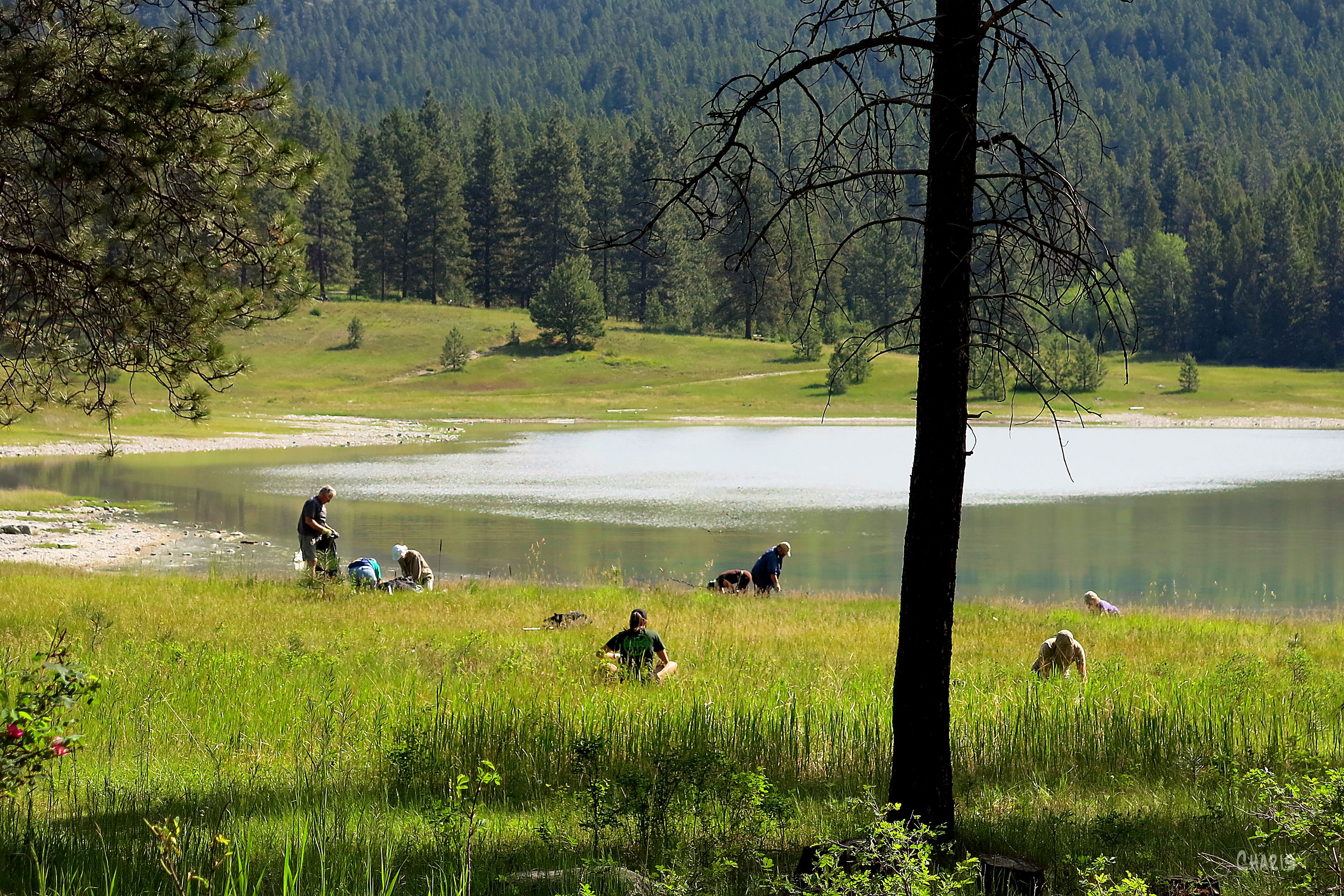
“Dalmatian toadflax and St. John’s wort mostly,” she told me. “There’s a bit of knapweed which of course is noxious, but today we are mostly concerned with other invasive weeds. St. John’s wort has its uses but it doesn’t belong in this environment and will soon take over if it’s not rooted out.
I went away thinking about them. In nearly thirty years of walking in these woods I have never run into any sizable group of people doing anything but walking dogs and giving visitors a tour. I’ve seen evidence of bush parties, but never evidence of parties of environmentalists digging invasive weeds out of the meadow. I felt I needed to pay attention.
I walked down another shaded trail thinking about invasive weeds and remembered some one-issue people I’ve known. I began composing a blog in my head about the way some people with a cause based on a perfectly good justice issue, or an over-looked aspect of theology, or an unmet practical need in the world “invade” an environment so that other people’s favourite causes are not given space.
I decided to sleep on it and woke with a song in my head that I have not thought of in many, many years.
Lord, I have shut the door, Speak now the word
Which in the din and throng could not be heard;
Hushed now my inner heart, whisper Thy will,
While I have come apart, while all is still.
“What are you saying, Lord?”
“It’s not about them.”
“Huh?”
“It’s about you. Your thoughts are like noxious and invasive weeds. Some are just bad, and although many concerns are useful in their place, when your anxious thoughts invade our quiet place you can’t hear. Be still and know that I am God.”
Psalm 94:19 came to mind: When my anxious thoughts multiply within me, Your consolations delight my soul.
It’s not that I don’t need to pray about these things; I do! It’s when they, and the fear attached, invades my inner heart, the place where I have invited Christ to dwell, that they multiple and drown out his voice – his consolations. God is speaking all the time but unless I learn to be still, I’ll have trouble hearing him – and even when I do, I may make the mistake of thinking it’s for them and not me.
Sometimes hearing God’s voice is not only about making connections, it’s about learning to turn down the volume on noxious and invasive noises and root out obsessive thoughts that invade the sacred space so his consolations have room to thrive.


Oh, that we might know the Lord!
Let us press on to know him,
and he will respond to us as surely as the coming of dawn or the rain of early spring.
(Hosea 6:3 TLB)

“When we lose sight of God we become hard and dogmatic. We hurl our own petitions at God’s throne and dictate to Him as to what we wish Him to do. We do not worship God, nor do we seek to form the mind of Christ. If we are hard towards God, we will become hard towards other people.”
— Oswald Chambers, My Utmost for His Highest
Disappointments in life come because we had expectations. Not dreams. Expectations. When we have a picture of love in our heads it can become our definition of love. We may not all say it out loud to parents, or potential partners, or even friends, but we all think, “If you love me you will ____________.” It’s a test that we ourselves mark. And sooner or later we are disappointed. Sometimes profoundly so. Either the false expectation goes, or the relationship slips into the slow death of lost hope.
Sometimes we think we are praying when we are actually putting God to a test. We are saying, in essence, “If you love me you will ___________,” or “If you are really God you will ___________.” When we put someone to a test we have decided in advance what the right answer is. We are putting ourselves in a position of judge over someone when our expectations must be met for them to pass the test. We make ourselves superior.
God doesn’t play that game. You may have noticed.
We have expectations that if he loves us he will give us a good marriage, robust health, intelligent grateful children, a rewarding career, financial security, a life of peace with reasonable neighbours, and a good reputation that reflects our glory. When God doesn’t meet these expectations of our own design it is easy to allow disappointment to harden into resolution. Instead of finding out who he really is we create another false god, one who is uncaring, or capricious, or inaccessible or hard and dogmatic – at least this god doesn’t disappoint us. Instead of searching for God’s true nature we build our own constructs and dogmas, then we preach that god with our actions and attitudes. We can become hard, graceless, or apathetic.
I think disappointment and loss of hope is the greatest pain known to mankind. We can forge through almost anything but hopelessness. Without hope, what’s the point? It takes the courage of hope to take the risk of pursuing God through the pain of disappointment, to humbly admit that we do not hold the answers, to seek the mind of Christ. Sometimes the ultimate form of worship is simply to make an offering of our pain and say, “You are God and I am not.”
When Moses (who up until that point had settled into the disappointment of his life’s circumstances) asked God to show himself, the aspect God chose to show was his goodness, which was so overwhelming Moses had to be hidden in the cleft of the rock. God’s goodness doesn’t always fit our definition. It is something else, because God is Something Else – holy other, entirely unique, and worthy of seeking out. We don’t come to him so that he can reflect our glory, but so that we can reflect his.
We can rejoice, too, when we run into problems and trials, for we know that they help us develop endurance.
And endurance develops strength of character, and character strengthens our confident hope of salvation.
And this hope will not lead to disappointment.
For we know how dearly God loves us,
because he has given us the Holy Spirit to fill our hearts with his love.
(Romans 5:3-5)

Should pain and suffering, sorrow, and grief, rise up like clouds and overshadow for a time the Sun of Righteousness and hide Him from your view, do not be dismayed, for in the end this cloud of woe will descend in showers of blessing on your head, and the Sun of Righteousness will rise upon you to set no more.
– Sadhu Sundar Singh

I love toddlers. Honestly, it may be my favourite age. Yes, I mean the tantrum-throwing, independent, illogical, ill-informed munchkins between walking and reasonable conversation age, the ones who cause their exhausted parents’ hearts to melt when they stand over their kid’s sleeping adorableness before they head out to clean up the day’s mess.
I love to watch them learn. They are voracious readers of everything and everyone. They crave knowledge and are driven to courageously expand their universe, but at the same time want to remain at the center of it.
As a baby a little girl learns that when she hollers Daddy or Mommy come to her. As a toddler she learns the hard lesson that when Mommy or Daddy call she is supposed to come to them.
It’s not an easy transition for anyone concerned. Toddlers are also discovering free will. Anyone who has tried knows you cannot make a toddler eat, sleep, sit still, keep their clothes on or pee where they are supposed to until they decide to do it themselves. You can cut down their options, you can try to pick them up (as they do the floppy noodle) before they dash for the road, but you can’t make them keep the water in the tub or kiss Auntie Bertha or stay out of the Tupperware drawer when company is coming if it is not on their agenda. They will let you know when they have lost patience with your interference.
But I love them. I love the mileage they get out of a few words. I love the excited laughter when they discover how to open, or flush, or unravel something all by themselves. I love the way they imitate older humans and want to be like them. I love them because they are headed somewhere and every day they change. I love them because they don’t stay toddlers.
It struck me the other day that as new believers in Christ we are like a baby who needs milk, shelter, warmth, affection and our heavenly Father obliges. He provides a baby with everything she needs. She calls; He comes. She knows how the system works.
Then one day he doesn’t come when she calls. He calls and holds out his hands for her to move toward him. After she chooses to toddle to his outstretched arms and she is rewarded with kisses and hugs he takes another step back – then another and another. He is becoming more distant. The next thing you know he is withholding her sippy cup until she sits in the chair nicely – wearing a bib that is not of her choice. What a shock!
The toddler Christian is accustomed to feeling that God is there to fulfill her agenda. Now it turns out he has an agenda of his own. Now there is this obedience issue to cope with. It’s a tough transition to make, and that is why many churches are filled with people who never grow beyond two or three years maturity level. It can be fun, but it can also be a wretchedly frustrating stage of growth because it means taking ourselves out of the center of the universe and putting God there.
The Bible says Jesus learned obedience. He grew in grace and in favour with God the Father and with people. When he laid down his Godhead privileges to experience everything we have he also learned as a human child that he had free will. As an adult he demonstrated that he was not doing the works he did because he was incapable of doing otherwise, but because he chose to. He listened to his Father’s plans. From his baptism, to his following the leading of Holy Spirit into the wilderness, to changing water into wine at his Father’s bidding – and definitely not his mother’s – to his battle with his free will in the Garden of Gethsemane he did nothing he did not choose to do. I believe he understands our struggle because he sweat drops of blood before he could say, “Not my will but Yours.” In the end laying down his life at the cross was his choice.
“No one takes it from me, but I lay it down of my own accord. I have authority to lay it down and authority to take it up again. This command I received from my Father.” (John 10:18)
I’ve heard it said that being part of the family of God means never being led into the wilderness (times away from his felt presence to discover and establish our identity as sons and daughters); it means never seeking God’s agenda but brazenly declaring our own want list; it means never being driven by frustration with our old habits to plumb the depths of his grace that changes us, but instead it presumes on our own definition of “grace” that enables stunted growth and self-centered living.
There is power and provision for a hope that does not disappoint, but this is not it. Of course God still loves to give good gifts to his children and to respond to them. Maturity means changing the way we think until we realize it’s not just about God answering us when and how we want him to; it’s also about us responding to him when he calls.
I love toddlers because unless something has gone horribly wrong, they are people in process. If we, as those growing up in faith, never get out of our strollers, demand ice cream for breakfast and holler every time events do not go according to our desired design and timetable, we will not be loved any less and our needs will still be met, but we will miss the joy of mature relationship with our Father God.
I love toddlers because they teach me to keep growing.







 Charis: Subject to Change