Avoiding the Ditch

trailer mountains bw IMG_6439

We who live in the mountains often complain about how slowly tourists from the prairies drive when the road is curvy and about the way they speed up when they come to passing lanes in straight stretches. Unkind words may have been spoken about recreational vehicles that get between locals and their work sites.

The problem is that we have “ditches.” Deep ditches. Deep, deep, deep ditches. Understandably, the thought of speeding down the road a few feet away from the precipice of a gorge you can’t see the bottom of is intimidating to people not accustomed to it.

Okay, it’s intimidating to a lot of us who live here too. Driving over the Kootenay Pass still freaks me out, especially in winter. I wish they would put up barriers on the edge of the cliff, but it probably has to do with the need to shove snow from avalanches over the side.

There are not-as-high high places that used to frighten me when we first vacationed here when I was a child. I don’t even notice the height (or more accurately, the depth) now. I remember being in awe the first time I looked down on a rainbow, still white knuckling my way up a steep incline. I guess driving in these conditions does teach one to be aware of the ditches and the need to avoid going too far in either direction.

I watched one of those road accident close call videos the other day. What struck me is that many incidents of loss of control were the result of over-correction. In order to avoid going into one ditch the driver over-reacted, swerved sharply, and ended up in the other.

I’m fascinated by history and the way a reaction to one extreme ends up becoming another. When people are carried along by the momentum created by unresolved anger even a small correction can set them on a trajectory that lands them in as much trouble as the first problem.

I see this pattern repeated throughout church history. An angry group of people break away in protest to excesses in one area and within a couple of generations find themselves trying to crawl out of the opposite ditch. For example, one group, who rejected the ostentatious benefactor-backed wealth of the monasteries at the time, angrily walked out in protest and went to live in communal poverty on less arable land in remote places. Within a hundred years their work ethic and creative solutions to farming swampland and steep hillsides turned them into wealthy landowners who didn’t handle riches any more generously than the group they rejected.

I see this pattern in parenting. One generation says they will never be as rigid as their parents and the next says it will never be as laissez-faire as their parents were. Flip and repeat.

I see this pattern in the arts. One movement admires painstaking detailed rule-following workmanship and the next reacts by rejecting “derivative work” and going for free-wheeling uninhibited expression. They have labels for each other. Most of them end in “ist.”

I see this pattern in politics. But I’m not going there today. Why? Because when you are in the middle of a drastic course change motivated by angry rhetoric, shots fired from both ditches can be doubly dangerous to moderates. Cross-fire and friendly fire and collateral damage and all that. It can even start wars.

This is what I have learned observing the long view of history: Nothing that is established by reaction and rebellion lasts.

A newly formed splinter group that leaves an old group on bad terms without pursuing forgiveness and resolution to the conflict first is guaranteed to find themselves being similarly divided in time. I think it’s the reap-what-you-sow principle. Worse than that, reactors need “enemies” to continue to justify their stance. Mutual enemies become a common cause and provide a type of fuel. It is easy to create an enemy where there once was merely a friend or neighbour with a different opinion and keep them locked in that position. Hatred can be passed down like clause six in a will. Many wars have at their root unforgiveness over a dispute between neighbours who have been dead for centuries.

Sometimes righteous anger can be a good motivator for change. Often people are not willing to make corrections until the situation becomes uncomfortable enough that they have to get up and move. Anger is a secondary emotion. It is like the warning light on the dashboard that lets us know that something is not working.

The problem occurs when correction is applied in high emotion and movement is catapulted too far by angry reactive rhetoric and blame. Anger congeals into bitterness and hard-heartedness. This has the effect of pushing people further apart and entrenching them in defensive positions that are more extreme than they intended them to be. It also makes life miserable for other travellers on the road who come under pressure to choose sides.

Did you know that moderation (self-control) is a fruit of the Spirit and therefore a weapon that can fight a spiritual foe who desires to divide and conquer? The political spirit behind a lot of conflict is bent on using deceit, seduction, loyalties, alliances, mocking, manipulation, fear -oh, especially fear- to divide, conquer and gain control. It shows up in churches, businesses, charity organizations, and governments and school yards. It operates through bandits and people who mean well. Jesus called it the “the leaven of Herod.” He said to be beware of it, because, like yeast, it can permeate everything.

I remember being told over and over in a dream that it is the nature of God to be creative and not reactive. He created us to create and rather than react. That’s why we are told to return good for evil and as much as is possible with us to be at peace with all men. That’s why we look for creative solutions first (although I personally believe that protecting the innocent against outright evil might require us to sometimes physically stand in the gap.)

Moderation is not about compromising with sin or enabling evil; it is about being transparent and honest about problems without casting blame, loving whilst avoiding taking up other peoples’ offenses, protecting the weak without enabling helplessness, encouraging honourable behaviour toward everyone without forming unholy alliances, and avoiding careening across the road into opposite ditches because of angry reactions.

Because some ditches are very deep.

smokey lake ch storm mountain passIMG_0832

Save

The Hope

Steeples from Mouse Creek mountains winter DSC_0101


You answer us with awesome and righteous deeds,
God our Saviour,
the hope of all the ends of the earth
and of the farthest seas,

who formed the mountains by your power,
having armed yourself with strength,

who stilled the roaring of the seas,
the roaring of their waves,
and the turmoil of the nations.

(Psalm 65:5-7)

Until Spirit touches spirit

St Eugene window 2 DSC_0014  ch

“Forms and rituals do not produce worship, nor does the disuse of forms and rituals.

We can use all the right techniques and methods, we can have the best possible liturgy, but we have not worshiped the Lord until Spirit touches spirit.”

-Richard J. Foster

It’s the light that gives stained glass it’s beauty. Caught a bit of it shining through the old St. Eugene’s church on the mission.

Depuis le jour

crocus garden ch horizontal IMG_0715

My beloved spoke and said to me,
  “Arise, my darling,
    my beautiful one, come with me.
 See! The winter is past;
    the rains are over and gone.
 Flowers appear on the earth;
    the season of singing has come…

(from the Song of Songs)

I was measuring the basement window to make curtains last week when I looked out and saw these little beauties reaching for the light. The snow has barely melted and they have appeared earlier in the year in these mountain parts than I can ever remember. They are still blooming. The first blossoms after a long dark winter feel like love awakening.

In this season of singing a new song I was reminded of Depuis le jour by Charpentier.

Since the day I gave myself
my destiny seems all flower-strewn
I think I’m dreaming under a fairy sky
my soul still intoxicated by your first kiss!
What a beautiful life!
My dream wasn’t a dream!
Oh! I’m so happy!
Love is spreading its wings over me!
In the garden of my heart
sings a new joy!

(translation)

Monserrat Caballé was the master of the pianissimo at altitude.

This Love

sled pull 2

This love of which I speak is slow to lose patience—it looks for a way of being constructive.

It is not possessive: it is neither anxious to impress nor does it cherish inflated ideas of its own importance.

Love has good manners and does not pursue selfish advantage.

It is not touchy.

It does not keep account of evil or gloat over the wickedness of other people. On the contrary, it is glad with all good men when truth prevails.

Love knows no limit to its endurance, no end to its trust, no fading of its hope; it can outlast anything.

It is, in fact, the one thing that still stands when all else has fallen.

(1 Corinthians 13: 4-8 Phillips)

Where Are the Blacksmiths?

black smith fort steele IMG_0373

Dull Christianity is Not Normal

This surprised me when I noticed it one day.

Now no blacksmith could be found in all the land of Israel, for the Philistines said, “Otherwise the Hebrews will make swords or spears.” So all Israel went down to the Philistines, each to sharpen his plowshare, his mattock, his axe, and his hoe. The charge was two-thirds of a shekel for the plowshares, the mattocks, the forks, and the axes, and to fix the hoes. So it came about on the day of battle that neither sword nor spear was found in the hands of any of the people who were with Saul and Jonathan, but they were found with Saul and his son Jonathan. (1 Samuel 13:19-22)

Seriously? The people could not sharpen their own tools? Only Saul and Jonathan had swords? How long had they been putting up with this nonsense?

“This is just the way things are done.”

I thought about the resignation in voices around me this week. How often have we accepted a form of powerless religion as we try to make a difference in our communities?
This is the way business is done.
This is the way politics operates.
This is the way healthcare works.
This is way religious institutions are run.
This is the way we have to educate our kids.
This is the way the rich act and this is the way the poor act.

Occasionally some people bust out of the defeatist attitude and take their tools out to be sharpened – by dragging them down to systems and rulers they don’t trust and paying for the privilege.

Many people don’t even know what their tools are. Even more can’t remember what a spiritual weapon looks like – and they don’t look like the enemies’ weapons.

Did you know that gentleness is a weapon? Did you know you can fight despair with goodness? How sharp and effective is your peace? Can your patience lay siege to a lie a whole society has fortified? Can your joy slaughter cynicism or your love cut racial hatred off at the knees?

Can your gift of prophecy bring the light of truth? Can your gift of healing do an end run on profit-minded hospitals and insurance companies or insufferable waiting lists? Can the knowledge and wisdom the Holy Spirit reveals to you feed the hungry or create jobs? Can your God-given faith move bureaucratic mountains or your ability to discern the kind of spirits motivating propaganda join with those who pray with words beyond their own comprehension to change the course of history?

Can worship set a city on its ear?

Where are the Blacksmiths?

Do you know how to sharpen the tools and weapons Jesus Christ has provided for you? Where are the blacksmiths in our land who can equip the saints to take every thought captive to come in alignment with Christ? (The real Jesus Christ – not the fictitious, inoffensive, mild, straw-man Jesus held up by those who have sort of read about him but have never met the revolutionary who came to change everything by setting us free from the law of sin and death.)

We can trudge on and resign ourselves to feeling like victims of disappointment and subject ourselves to the limited possibilities that the world’s systems offer those who live in gated pockets of temporary personal peace and prosperity. We can guard against the threats coming into our homes with spiritual weapons on the level of blunt sticks and gravel-sized stones. We can shrug as we shuffle off to vote for people we hope will not disappoint us yet again by putting their own interests and philosophies at the top of their list of priorities.

We can complain that this is just the way things are done as we try to cut through walls of thorns with dull knives.

Or we can rise like King David and say “Our hope is in God, our glory and the lifter of our heads! By Him we shall do valiantly!”


For though we live in the world, we do not wage war as the world does. The weapons we fight with are not the weapons of the world. On the contrary, they have divine power to demolish strongholds. We demolish arguments and every pretension that sets itself up against the knowledge of God, and we take captive every thought to make it obedient to Christ. (2 Corinthians 10:3-5 )

Now to each one the manifestation of the Spirit is given for the common good. To one there is given through the Spirit a message of wisdom, to another a message of knowledge by means of the same Spirit, to another faith by the same Spirit, to another gifts of healing by that one Spirit, to another miraculous powers, to another prophecy, to another distinguishing between spirits, to another speaking in different kinds of tongues, and to still another the interpretation of tongues All these are the work of one and the same Spirit, and he distributes them to each one, just as he determines. (1 Corinthians 12: 7-11 )

Seasoned with Grace


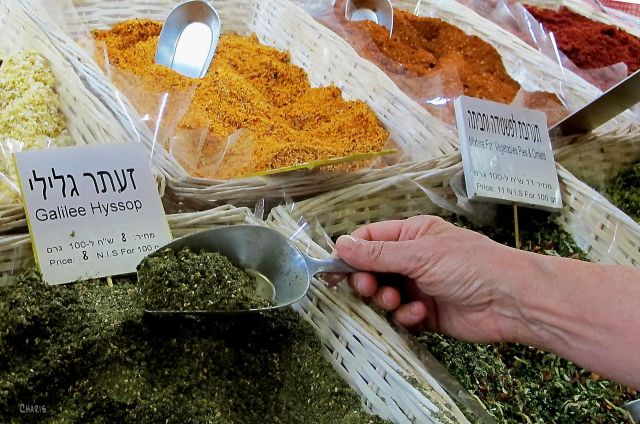
IMG_7691 galilee spice mart ch crop

I find languages fascinating. Why is it that some languages have big fat dictionaries and some have thin? Why do some people need more words than others?

A woman I knew who worked for an international charity learned after one year in language school that she was being assigned work in a different country. Most people would have groaned and been upset with time wasted. She was relieved.

“That language has no polite words!” she said, exasperated. “There is no please, no thank you, no sorry, no kind way to express sympathy. I will be glad to move on.”

In the next language she studied greetings took ten minutes. “And how is your father-in-law? Are your she goats pregnant? Is your second nephew well? And your third nephew, is he well?” Since she is a people person she was much happier and didn’t find these rituals cumbersome at all.

I stayed with my daughter while she was living on a tiny Caribbean island. I never got used to the accepted phone etiquette there.
Ring.
“What you want?”
“Oh, um, hello. I hate to bother you, but is Tina there please?”
“Tina not here.”
Click.

The first time I used the phone I thought Tina’s father was an angry man. Then I discovered nearly all the people born on the island spoke the same way, even in the marketplace. They had no problem with it. They wondered what was wrong with me.

My husband spent some time in the deep south of the United States as a guest lecturer. “Not only do they talk slowly, they act like they’ve got all day. They’ll tell you story after story and offer more drinks until you can’t hold it anymore, then they will finally say what they intended to when they offered you a seat,” he told me when he got home. “Great folks, but how do they ever get anything done?”

“What did they want to tell you?” I asked.
“That I am too blunt with the students and I need to be more sensitive.”

I laughed. My parents both spoke English but they came from cultures with different communication styles. In my father’s hometown no one broached the subject they came to talk about until the second pot of coffee was on the stove or until a hand was on the door knob on the way out. My mother’s ethnic background required a person to make their point quickly and clearly so a person could get on with their work – and there was always work. Dad thought Mom’s family was shockingly blunt. Mom thought Dad’s family was frustratingly long-winded. (I take after my Dad, but I can switch and be ruthlessly direct when under pressure.)

Mom, bless her heart, set herself to the task of learning “tact.” It was not a skill that came naturally, especially since she didn’t understand why some people took offense so easily. “She asked me if I liked her new hat and I said it looked silly on the side of her head like that. It made her head look crooked. I straightened it for her. Well, she asked me. Did she want me to lie? She didn’t have to go off in a huff!”

Mom meant well.

There are two sides to communication: what was intended and what was perceived. If only they were the same.

I’ve run into people who really have to work at understanding that other people perceive differently. Whenever I hear them start with “I don’t have time to say this nicely so I’m just going to say it,” I know it’s time to raise the shields. Incoming! Sometimes “I don’t have time to say this nicely” means “I don’t know how to say this nicely,” and sometimes it means “I can’t be bothered with going to the effort of caring about your feelings.”

They may have meant well. Or they may not. The message could have been a valuable one, but it was lost in translation either way.

Then there are people who enjoy getting a rise out of folks. Their words are intended to be like pokes, or even like the rash thrust of a sword. They are meant to provoke an angry reaction, because to them, an angry reaction is better than no reaction at all.

Then there are those who go on and on and never notice polite smiles starting to droop or eyes furtively checking watches. The message is as lost as a misfiled book in a four story library. (Sorry about that.)

Words seasoned with grace have the hearer in mind. Speaking with grace means honouring the hearer, taking the time to consider how they perceive the message and bringing healing to a heart. It’s about love. Grace usually is.

Let your speech always be with grace, as though seasoned with salt, so that you will know how you should respond to each person. (Colossians 4:6 NASB)

There is one who speaks rashly like the thrusts of a sword,
But the tongue of the wise brings healing. (Proverbs 12:18)

A gentle answer turns away wrath,
But a harsh word stirs up anger.
The tongue of the wise makes knowledge acceptable,
But the mouth of fools spouts folly. (Proverbs 15:1,2)

The Return

fort steele DSC_0169

Then he came to his senses and cried aloud, ‘Why, dozens of my father’s hired men have got more food than they can eat and here I am dying of hunger! I will get up and go back to my father, and I will say to him, “Father, I have done wrong in the sight of Heaven and in your eyes. I don’t deserve to be called your son any more. Please take me on as one of your hired men.”’

So he got up and went to his father. But while he was still some distance off, his father saw him and his heart went out to him, and he ran and fell on his neck and kissed him.

– Jesus, from his story of The Father’s Prodigious Love.

When is Sex Not About Sex?

bride groom wedding ch rs

I’m posting a link to the article “Sing to Me” (click here) because it has come up in conversations several times this week.

When is sex not about sex?

God will use powerful, evocative (and even embarrassing) imagery that we understand on a personal level to communicate truths.


Spreading My Wings

Nasa Dyin' with an astronaut resize

Thank you to the women at Ishshah’s Story for inviting me to contribute to their team. I am honoured to be a part of a beautiful group of time-tested Jesus followers.

This week’s blog: Dyin’ With an Astronaut: When There is More to the Story