Don’t be afraid, I am with you; don’t give way, for I am your God. I strengthen you and I help you; I uphold you with the right hand of my justice. (Isaiah 41:10)
Don’t be afraid, for I have redeemed you. I have called you by your name, you are mine. (Isaiah 43:1)
When he was only two years old and his daddy appeared to be dying in the hospital our little grandson looked into his Mommy’s eyes and said, “We don’t hass to be afraid. We don’t hass to be afraid, Momma, ’cause Jesus is wiss us!”
Sometimes when I look at all the things in my character that need fixing I feel overwhelmed. The word I feel the Lord has given me for this year is “instill.” I want the concepts I have learned about the goodness of God and how much he loves me to be instilled in my heart so my first reaction is trust. I get there eventually but my “knee-jerk reactions” need revision before I open my mouth. When I wonder how long it will take I remember the reaction of a child barely old enough to talk.
Sometimes this journey is not as much about overcoming obstacles as returning to the faith of a child. Restoration is recovering the pure undivided heart of a little one who knows what it is to trust.
Yesterday my grandson’s Daddy taught him how to skate. He learned to balance and glide and turn on the ice rink Daddy built for his children in the backyard. There was much joy!
Be of good courage,
And He shall strengthen your heart,
All you who hope in the Lord.
(Psalm 31:24)
Sometimes strength comes only after taking the first courageous step, not before. It is hope in the Lord that allows us to take one more step when we are not sure of what the next season will bring. Hope is about seeing the big picture – by faith.
Courage is not simply one of the virtues, but the form of every virtue at the testing point.
— C.S. Lewis
We lost our innocence that day on the Sherwood Park freeway. We didn’t know about tornadoes. Of course we had seen pictures and news reports, but we had never experienced a wind that moved oil tanks or leveled factories or wrapped cars around steel lamp standards or sucked people out of their vehicles. On that July day in 1987 we came up from under the overpass on the freeway out of Edmonton moments after the tornado passed and saw the devastation. The tornado was moving on to a residential area where other people, like us, were expecting only a thunder-storm. Many of them died.
There are still arguments going on about whether it was an F4 or F5. Tornadoes are so rare this far north that we had no warning system. All I know is that like the neighbourhood where I used to live, my sense of stability was tossed in the air and dumped in a field of debris somewhere. It could happen here. For years my eyes watched the clouds on hot summer days when we visited family on the prairies. They still do.
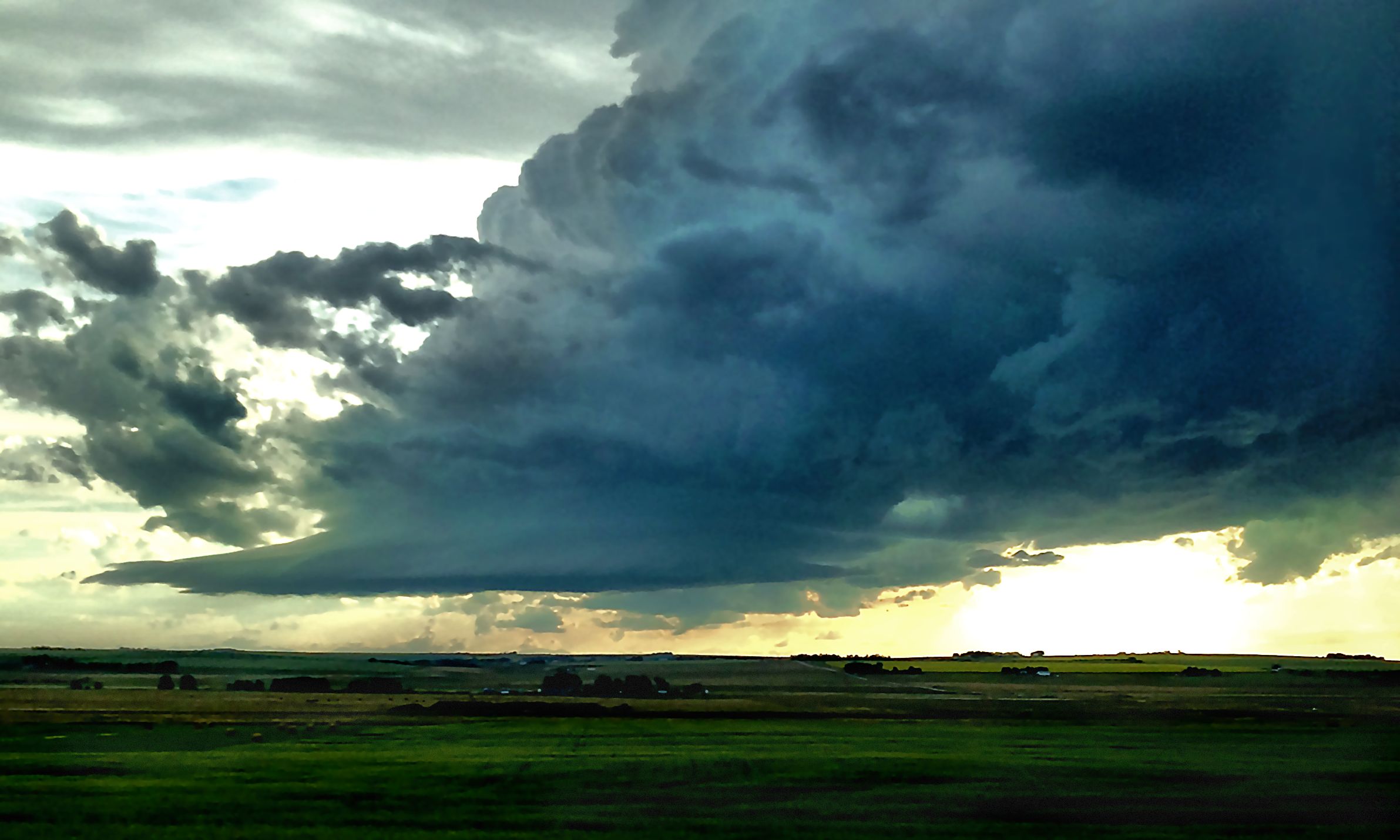
As we were driving from Edmonton to Calgary we were caught in a rainstorm so heavy we had to pull over on the shoulder of the highway until it lightened up. A few miles down the road I saw this cloud. Since I was driving I asked my husband to get a photo out the window on my phone. As much as I love cloudscapes I knew it wasn’t wise to stop. It was wiser to pray and keep moving south. Two of our adult kids and their families were also somewhere on the road oblivious to what a cloud like this might bring. I watched the cloud slowly break up and breathed a sigh of relief when they all showed up at our destination.
The next day our daughter and daughter-in-law and five of our grandchildren were in a van driving into the city when signs beside the highway flashed a tornado warning. They saw the ominous clouds and the beginning of a funnel cloud and decided to turn back. Apparently the tornado did touch down briefly before dissipating. It was a minor event, but I am glad for a warning system we never had in 1987.
We grew up with parents who lost their innocence when they experienced war and famine and economic disaster and epidemics of diphtheria and polio that killed and maimed. Many of us do not understand the courage it takes for some people to go on with their lives after trauma. Some of the people from our parents’ generation learned to walk in freedom from fear or expectation of the same thing happening again; some did not. They lived lives hunkered down in sad negativity, protecting themselves from disappointment.
Some learned to be watchmen and put up early warning systems because they had seen this before. They gave good advice: avoid debt, don’t fall for nationalistic political rhetoric or give a leader too much power; research preventative medical practices and take advantage of things like dentists, vaccinations and vitamins; practise water and land conservation methods; plan ahead for natural disasters; expose and deal with crime and corruption in high places before it becomes systemic; don’t ignore poverty and injustice; make amends; forgive; stop the quarrel before it breaks out.
There are watchmen with prophetic gifts who, like weathermen, can automate warnings, “Turn back. This way danger may lie.” It would be unfair of them not to give warnings if they see that hazards lie ahead like weather conditions that could produce a tornado. But — warnings need to be for the purpose of freeing people and en-couraging the virtues to flourish, so they will not be hampered by fear or overcome with a sense of dis-couraging condemnation.
The warning my daughter and daughter-in-law saw prompted them to go in another direction and take the children swimming at a pool in a town outside the danger zone. They had a marvelous time laughing and splashing and enjoying being together.
I am grateful for warnings, but even more for re-directions that instill courage to live fully.
Leave no unguarded place, No weakness of the soul, Take every virtue, every grace, And fortify the whole.
Don’t be afraid, I am with you;
don’t give way, for I am your God.
I strengthen you and I help you;
I uphold you with the right hand
of my justice. (Isaiah 41:10)
Don’t be afraid,
for I have redeemed you.
I have called you by your name,
you are mine. (Isaiah 43:1)
Some people are so encouraging. Sometimes we don’t even notice how gifted they are until after we walk away feeling more capable and built up by their ability to see what God sees in us. It is then that we feel a bond of love and appreciation toward them.
Here’s a secret for those of you seeking mates. We tend to fall in love with people who help us like ourselves. We long to be around those who respect us and who let us see our own beauty reflected in their eyes. The fun part is that when we learn to bring out the best in people, amazingly, they tend to see the best in us.
When we need to correct our children or our employees or the ones we are privileged to mentor the goal is not to impress them with our competence, but rather to give them an enhanced vision of their own capabilities. This is building people up rather than tearing them down with harsh criticism that comes from a need to prove ourselves.
The reward for winning the game of King of the Hill is possessing the mound alone. The reward for lifting someone else up the hill is that they ask us to join them in their rejoicing on the mountain top. This is the fruit of grace.
Now these are the gifts Christ gave to the church: the apostles, the prophets, the evangelists, and the pastors and teachers.Their responsibility is to equip God’s people to do his work and build up the church, the body of Christ.This will continue until we all come to such unity in our faith and knowledge of God’s Son that we will be mature in the Lord, measuring up to the full and complete standard of Christ.
Then we will no longer be immature like children. We won’t be tossed and blown about by every wind of new teaching. We will not be influenced when people try to trick us with lies so clever they sound like the truth.Instead, we will speak the truth in love, growing in every way more and more like Christ, who is the head of his body, the church.He makes the whole body fit together perfectly. As each part does its own special work, it helps the other parts grow, so that the whole body is healthy and growing and full of love. (Ephesians 4:11-16)
I have the joy of caring for two of my grandchildren this week. They teach me so much.
The three-year old (I’ll call her Daisy) is full of profundities and observations on life. When she said she was hungry I suggested we could take a peek in Nana’s pantry to see if we could find something good for a snack. She looked at me suspiciously, then said softly to her mommy, “But I don’t want to take a peek in Nana’s panties.” (Please read the scenario again carefully if you feel the need to accuse this red-faced granny of improprieties.)
Daisy teaches me about the importance of clarification and that people do not always perceive our offerings the way we intend them to be perceived.
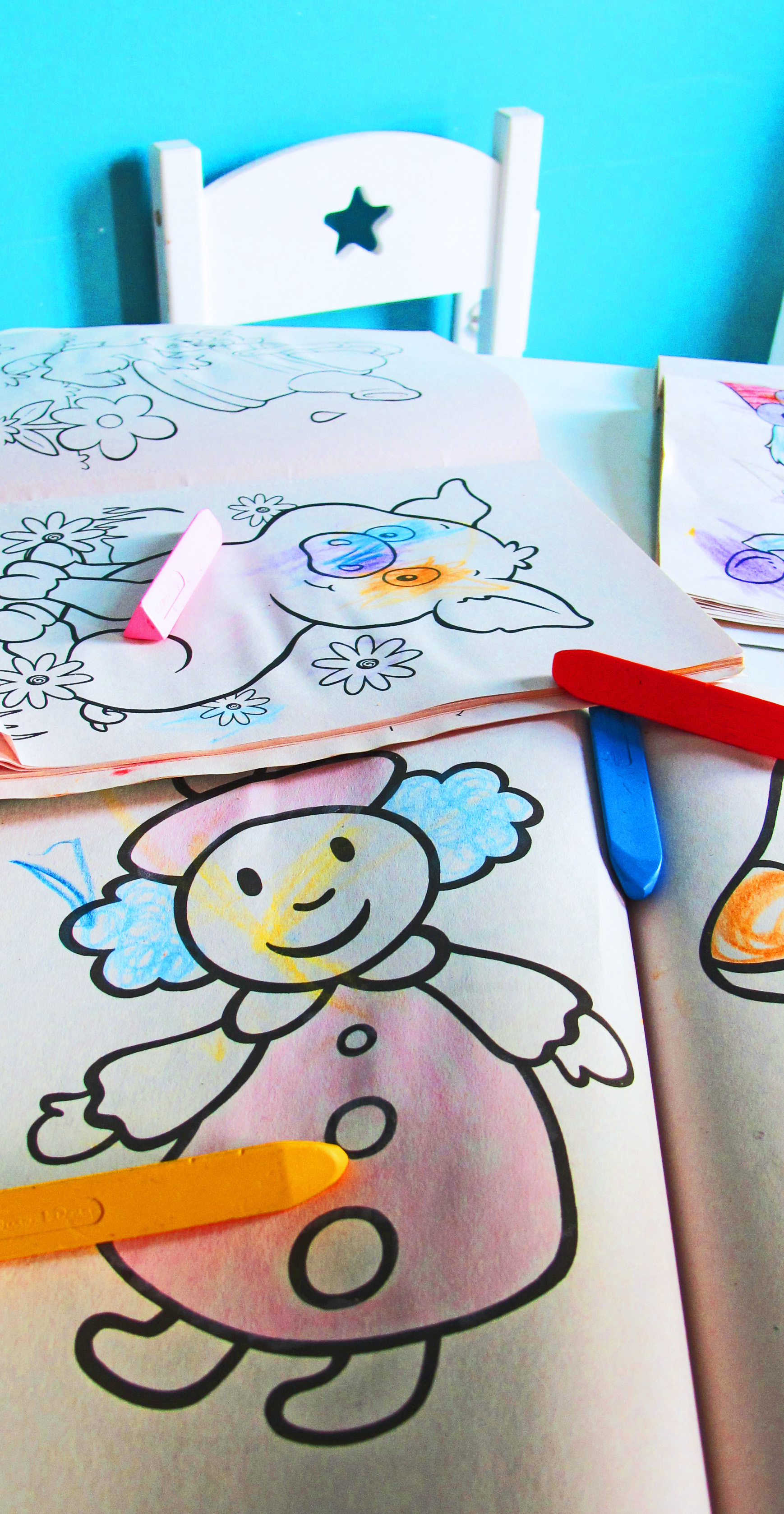
When Daisy told me about all the things she could do on her little white table and chair set –like put puzzles together, play with her tea set, and play the matching game– I asked her if she coloured on her table too.
Again she gave me her patient look as she explained, “No. I don’t colour on the table. Mommy doesn’t let me colour on the table. She says I have to use paper or a colouring book.”
Yesterday she taught me about the difference between making a mistake, and sinning. Making a mistake is colouring outside the lines when you are learning to colour because sometimes even when you try hard your hand slips. Being seriously in error — or sinning is when you know Mommy said to colour in the colouring book, but your crayon doesn’t just slip outside the lines. It slips right off the table and across the room and colours on the glass door to the patio. When that happens you need to take responsibility for your deliberate choice and use the damp cloth Nana hands you to scrub the door until your mess is cleaned up.
I read a book review this week by a popular Christian blogger that upset me for some reason. Usually I shrug that sort of thing off, but this felt like an irritating hangnail that kept snagging on my peace for days.
People have differing opinions on literature, of course. Not everyone appreciates a poetic imagery-bound gift. I’ve heard enough left-brained friends bewail subjective marking styles of English teachers to know poetry baffles them. I hear their frustration with trying to guess what they need to do to get an A when there are no answers in the back of the book. It drives them as crazy as the just-the-facts-ma’am, right-or-wrong-answer-at-the-bottom-of-the-page writing style that bores me into a nap on the desk. I get it. Tomayto/tomahto
The critic later issued an apology on his blog, admitting he lost sight of the fact there was a sensitive human behind the words in the book. Wow. A critic issues an apology? There is a God.
He didn’t back down on his stance on “not recommending” the book, however, because he found some things that did not line up with his theological viewpoint based on his and Et Al’s interpretation of scripture. He also used the guilt by association marking pen when the author admitted to receiving helpful glimpses of insight from people and institutions who did not have evangelical seals of approval stamped on their undersides.
Here’s my problem: this book, like many other books, (or youtube videos) experienced unanticipated popularity. It was not written as a theological treatise at the end of a lifetime of study. Should a book presented for use as a textbook in seminary be subject to rigorous doctrinal examination? I should hope so. Should a book that was intended to be a sharing of the author’s personal experience of endeavouring to change her attitude be subjected to the same scrutiny?
I remember having to fill out a workbook for Sunday School class when I was about eleven years old. It had a lot of those frustrating what-am-I-thinking-of-in-verse-six kind of questions, (I always seemed to see something different from my teacher) but at the bottom of the page there was a big open box which allowed room for “sharing” how I felt about concepts covered in the lesson.
I shared.
My teacher marked it with a red X. WRONG.
Wow, that hurt. I remember telling my dad that I would have understood that red X if I answered the other questions wrong, but who gave her the right to mark my feelings as wrong? My feelings and opinions were my feelings and opinions. Should I lie? (Alas I did learn to lie to pastors and teachers. I told them what they wanted to hear for many years after that. Not a good idea. That habit set me up for a lot of wasted time.) What I needed was a loving, mature person to come along side and help me to reach for a higher goal -not to invalidate my attempts at expression.
Art is an attempt to connect with others. A creative writer’s intent may be more about making connection with fellow sojourners than lecturing on doctrine. It strikes me that when communicating some aspect of experience of God in a deeper way, we need to have a little grace space. To grow in grace we need to be in an atmosphere of grace. Does a child’s work need to be perfect before it may be displayed on the fridge? Are we in the family of God not all children in a process of learning? Did Jesus ever say, “Except ye all become as big old experts ye cannot see the kingdom of God?’ (in archaic English just like that.)
Ideas about God and how he created us to relate to him which ignore the manual handed to us (the Bible) raise alarms all over the place for me too. Indeed, there are times when artwork can be the result of a sinful rebellious attitude, when inappropriate scribbles appear on the patio doors, for example, and when those in a position of caring authority need to lovingly hand the author a wet rag and say, “Seriously? Come on, clean up your mess, sweetie.”
While I do not agree with every thing in the reviewed book, and some ideas are definitely discussion-worthy, I relate to the experience of the writer and appreciate the extremely important discovery of having a grateful heart. I do not believe it is motivated by self-seeking rebellion.
One of the hazards of popularity is that works of people in progress can be suddenly elevated to the level of works of studied authority. (The Bible says “Let not many of you become teachers knowing you shall incur a stricter judgment.” It just doesn’t tell you that most of the critical stricter judgment comes from people who consider themselves more studied teachers.)
My point? Art is an expression of where we are at the moment we create it. It is not the final conclusion of a lifetime of learning. Art fills in the big empty box at the bottom of the page where we have a chance to share how we feel about what we have learned. Art asks the observer, “You know what I mean?” If it goes viral on a giant public fridge with greater exposure than we anticipated when we created it, if it becomes extremely popular because a million people connect with it as a familiar stage of learning in their own lives, the onus is still on the reader or observer to use discernment. I wonder about the need of self-appointed guardians of perfect theology to tear it down publicly and give it “not recommended” status because they do not like the creator’s style or question whether it has stayed within lines the artist may not know about.
Worship of anything or anyone other than God is always idolatry. Yes, pop culture can promote idols, but to assume that a popular work will become an unexamined object of idolatry to other believers is to assume people observing the art are far less discerning than the critic. In an attempt to protect the naive by issuing a public judgment and condemnation of a work for failing to be something it never claimed to be, the present handed to us may not necessarily be a gift tied up in ribbon. It maybe just be an arrogance-bound box of envy.







 Charis: Subject to Change