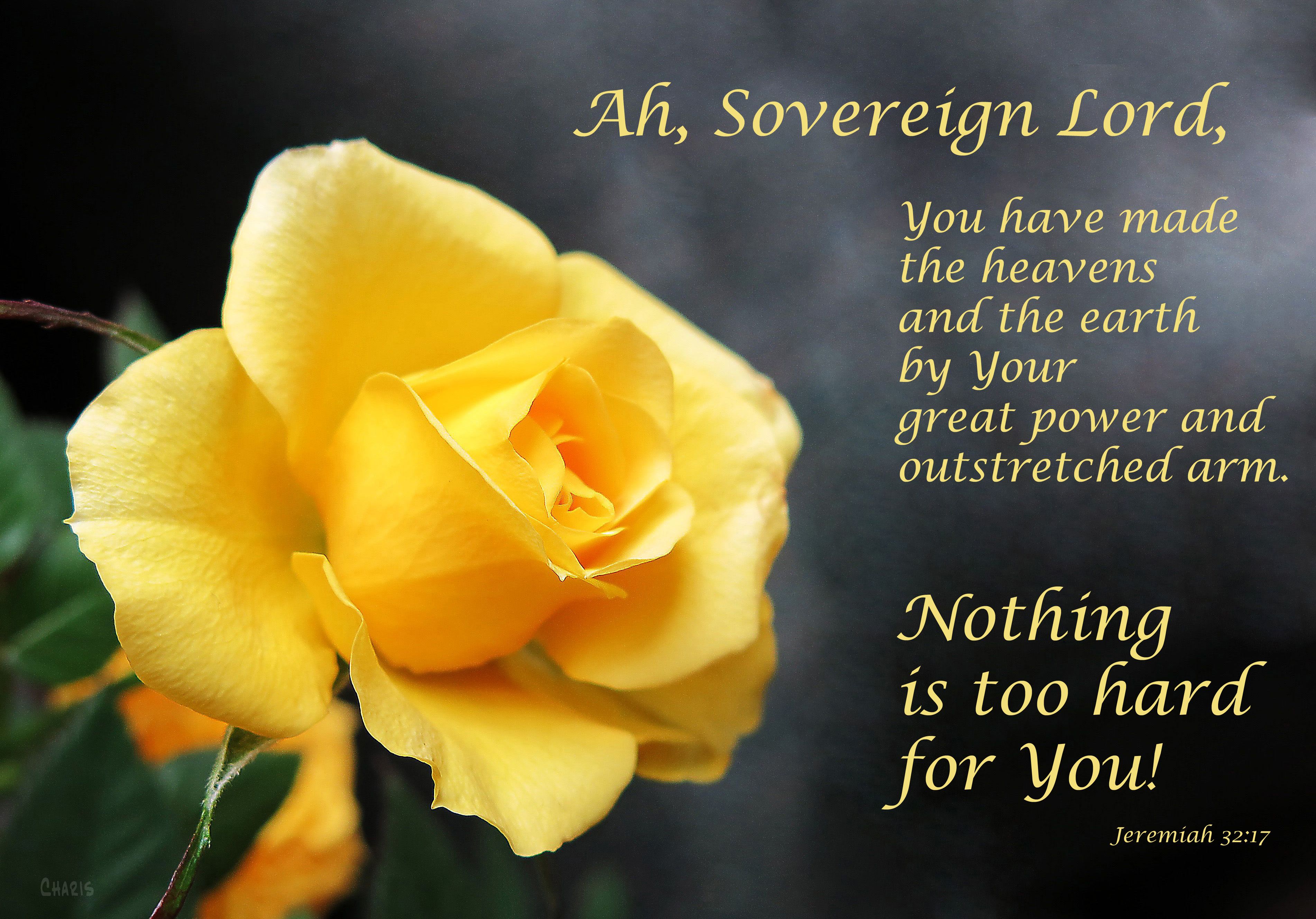
Nothing

nothing too hard ch

Jeremiah didn’t get it. Essentially He complained to God, “You asked me to go pay good money and sign legal documents to purchase a piece of land that you already told me will be captured by foreign invaders. I can see the destruction that’s coming; you made me a prophet, remember? This does not seem like good stewardship to me.”

“You don’t get it because you’re too short-sighted, Jerry. I have a plan that goes beyond your generation, a plan that will bring long-lasting peace and prosperity and a renewed relationship with me. You weep and wail and get depressed because you see the immediate pain of loss. I see the joy of restoration,” God answered.

“You just prayed, ‘Ah, Sovereign Lord, nothing is too hard for You.’

Were you even listening to yourself? I’m asking you an obviously rhetorical question here. ‘Is anything too hard for me?’

Care to answer?

Trust me, Jerry.

….And that is not a suggestion.”

(My very, very loose paraphrase of Jeremiah 32)


Giving It Up

Henderson reflection oil

“Lord in my confusion all my strength is giving in.
My adversary’s everywhere.
It seems that there’s no way to win.
Then, I hear Your voice all through me
Telling me this battle’s Yours, not mine.
I have no choice left to me, but to yield to Your design
As You take it from my hands what can I do
But lift them up in sacrifice to You?

O Lord, Your loving kindness is everlasting,
That’s why I sing.
O Lord, Your loving kindness endures forever
And You are able to deliver me.
Deliver me!”

(From Song of Deliverance by Marty Goetz)


Shelter

IMG_7537 bird's nest

I went down by the creek to look for pussy willows. Instead, I found a nest from last summer.

The inborn urge to fly thousands of miles to a place never before seen must be incredibly strong to make a bird want to leave its familiar nest.

When my friend was dying of breast cancer she told me, “Every day I long to see Jesus more and more. I can’t wait to see him.”

And then she left, leaving her earthly shelter, her broken dysfunctional temporary shelter behind.

The most vital question to ask about all who claim to be Christian is this: Have they a soul thirst for God? Do they long for this? Is there something about them that tells you that they are always waiting for His next manifestation of Himself? Is their life centred on Him? Can they say with Paul that they forget everything in the past? Do they press forward more and more that they might know Him and that the knowledge might increase, until eventually beyond death and the grave they may bask eternally in ‘the sunshine of His face?’ That I might know him! — Martyn Lloyd-Jones

We know that if our earthly house—a mere tent that can easily be taken down—is destroyed, we will then live in an eternal home in the heavens, a building crafted by divine—not human—hands. Currently, in this tent of a house, we continue to groan and ache with a deep desire to be sheltered in our permanent home because then we will be truly clothed and comfortable, protected by a covering for our current nakedness. The fact is that in this tent we anxiously moan, fearing the naked truth of our reality. What we crave above all is to be clothed so that what is temporary and mortal can be wrapped completely in life.  The One who has worked and tailored us for this is God Himself, who has gifted His Spirit to us as a pledge toward our permanent home.  In light of this, we live with a daring passion and know that our time spent in this body is also time we are not present with the Lord.  The path we walk is charted by faith, not by what we see with our eyes.  There is no doubt that we live with a daring passion, but in the end we prefer to be gone from this body so that we can be at home with the Lord.

(2 Corinthians 5:1-8 The Voice)

Every miraculous healing is a foretaste of what God has planned for us. Healing is wonderful, but it is only a sign pointing to the day when the ones Jesus Christ bought with His own blood will no longer need healing, because our frail bodies will be replaced by immortal resurrected bodies.

Go-between

IMG_0119

“Human beings seem to have a perpetual tendency to have somebody else talk to God for them. We are content to have the message second-hand. One of Israel’s fatal mistakes was their insistence on having a human king rather than resting on the theocratic rule of God over them. We can detect a note of sadness in the word of the Lord, ‘they have rejected me from being king over them’ (1 Sam. 8:7). The history of religion is the story of an almost desperate scramble to have a king, a mediator, a priest, a pastor, a go-between. In this way we do not need to go to God ourselves. Such an approach saves us from the need to change, for to be in the presence of God is to change.”
― Richard J. Foster

Create a Miracle in Me

dance


Create in me a clean, clean heart
Create in me a work of art
Create in me a miracle
Something real and something beautiful

Create a miracle in me

You’re not finished with me yet
By Your power I can change, I can change
‘Cause You’re not finished with me yet

You make all things new


I stumbled upon this song yesterday. The lyrics sum up the theme of this blog so well. The music may not be my preferred style, but hey, I can dance to it and celebrate the goodness of God.


Thank you, Lord.

Anticipation

potential

When our characters are refined,

we learn what it means to hope and anticipate God’s goodness. 

And hope will never fail to satisfy our deepest need

because the Holy Spirit that was given to us

has flooded our hearts

with God’s love.

(Romans 5:4b,5 The Voice)

potential in pink

I couldn’t decide, so I posted both photos. Which do you prefer?

Dressing in Layers

IMG_7491snow forest gold creek

Our days are a kaleidoscope. Every instant a change takes place. New harmonies, new contrasts, new combinations of every sort. The most familiar people stand each moment in some new relation to each other, to their work, to surrounding objects.  –Henry Ward Beecher

We are in a season here in the southern British Columbia Rockies where one day it is spring and the next day (sigh) winter again. I’m packing for a road trip and I don’t know what to take – parka, jacket, hoodie?. The weather report includes predictions of a wide variety of experiences which will require flexibility.

It strikes me that when we live among people we care about who, like us, are in a process of change, great flexibility is required. When we’ve made adjustments and developed the habit of tip-toeing around someone’s idiosyncrasies, attempts on their part to change can throw off our own sense of equilibrium. Yes, we want to encourage change, but now we need to readjust. Sometimes we are not prepared. Sometimes we don’t have the appropriate clothing at hand.

Relationships between people who desire to follow God and live out their identity in Him are never static. One day it is spring, and the next it’s back to winter again. We need to be kind to each other, and be flexible. I’ve heard it’s wise to dress in layers.

In Practice

piano keyboard charis_edited-1

I used to tell my singing students “I would rather you didn’t practise your songs at all than to drill them mindlessly. All you will do is reinforce your mistakes. There is no benefit to routine unless you are thinking about what you are doing. All that work is in vain if we have to spend your lesson time blasting a wrong note or rhythm out of the setting concrete that is habit.”

The benefit of routine is that it keeps you from having to think. As my husband reminds me, if I put my keys in exactly the same place every time I won’t have to think about where I left them. Routine saves time and brain space. Repetition and tradition reinforce important basic concepts and give us patterns for instant responses when we don’t have time to think. Practice and repetition are essential to learning, but when worship and prayer become mere repetitive routines, we are no longer engaged in a truly conscious way, mentally, physically, emotionally or even spiritually.

Jesus warned us not to be lulled into feeling super-spiritual by the number of words we repeat to try to impress God. “Vain repetition” the ancient King James version called it.

But thou, when thou prayest, enter into thy closet, and when thou hast shut thy door, pray to thy Father which is in secret; and thy Father which seeth in secret shall reward thee openly. But when ye pray, use not vain repetitions, as the heathen do: for they think that they shall be heard for their much speaking. (Matthew 6:6-7)

I love worship music from the heart. Sometimes the tunes that carry my deepest love for the Saviour may be no more complex than nursery songs and when the heart is engaged can be sung over and over as a profound offering of praise.

And sometimes repeated simple choruses with iffy theology are like singing Ninety-nine Bottles of Beer on the Wall -endlessly.

If God is worthy of our praise he is worthy of our best, thoughtful, skilled, creative, heart-felt praise. Today people with God-given talent like the composers Brahms or Vivaldi or artists Rembrandt or Durer or poet/lyricists Charles Wesley or Isaac Watts often have to go outside the church to find a place where they can praise with their whole beings and where they won’t be accused of “showing off.” Even accounting for the difference in communication styles and artistic vehicles many of us have lost sight of the concept of excellence as a higher form of worship.

No matter the tradition we come from we all have our forms of repetition. Praying differently, mindfully, listening carefully to Holy Spirit as we do so, can be less than placating sometimes.

Lord, be with him…

I never left him.

Comfort her…

She doesn’t need more comfort. She needs to give up the role of perpetual victim and start acting like the brave overcomer I already told her she is.

Let the meeting run smoothly…

There are some old infected wounds that need to be excised first.

Provide for their needs…

You’ve got a fifty in your wallet.

Oh Lord, you are worthy of far more than we tend to give you. Thank you for your forgiveness. Thank you that you are turning our hearts of stone into soft, living beating hearts of love. Thank you that you continue to invite us to fully engage with you with every good thing you have placed in us.

But When I Am Afraid…

forest fog DSC_0329 ch

But when I am afraid,

I will put my trust in you.

I praise God for what he has promised.

I trust in God, so why should I be afraid?

What can mere mortals do to me?

(Psalm 56:3,4  NLT)

One night after praying, I heard, “If I show you where I am going with this, it removes the element of faith.”

I read the great faith chapter in the book of Hebrews today, the one that starts with, “Now faith is the substance of things hoped for, the evidence of things not seen.” (11:1) It goes on to list many faithful people who trusted in God’s promise. It lists what they accomplished by faith. Toward the end of the chapter it says:

 And what more shall I say? For time would fail me to tell of Gideon, Barak, Samson, Jephthah, of David and Samuel and the prophets— who through faith conquered kingdoms, enforced justice, obtained promises, stopped the mouths of lions, quenched the power of fire, escaped the edge of the sword, were made strong out of weakness, became mighty in war, put foreign armies to flight. Women received back their dead by resurrection.

Yes! I thought, Look at what was accomplished by faith in people who were born before Jesus Christ died and rose again to conquer sin and death once and for all. Imagine what kind of things God plans for His church to do now that Christ indwells us and is our hope of glory! Jesus said “Greater works shall you do…

Then I read the next part:  Some were tortured, refusing to accept release, so that they might rise again to a better life. Others suffered mocking and flogging, and even chains and imprisonment.They were stoned, they were sawn in two, they were killed with the sword. They went about in skins of sheep and goats, destitute, afflicted, mistreated— of whom the world was not worthy—wandering about in deserts and mountains, and in dens and caves of the earth.

SAY, WHAT?

Then I remembered the verse in Revelation 12:11 I mentioned in an earlier post, that says “They over came him [the accuser, the evil one] by the blood of the Lamb, by the word of their testimony and they loved not their lives even unto death.”  In Philippians 3:10 (a theme verse for my life) Paul wrote that He longed to know Christ and the fellowship of his sufferings. I would prefer to gloss over those parts, but I can’t. Knowing Christ on a deeper level involves suffering.

Persecution is real and sharing suffering is part of knowing Christ. As Graham Cooke says, “God allows in His wisdom what He could easily prevent by His power.”

A good father will allow his child to face increasingly difficult challenges that strengthen him. A good friend will allow you to share their suffering -and their joy- with them.

When my close friend was dying of cancer she sent many acquaintances away with a cheerful wave, but she gave me the privilege of staying with her through all the ugly parts of her suffering until the end. The last thing she said to me was, “My angel is singing to me.”   Jesus told his disciples they were more than servants; they were friends.

But do we need to live in fear?

I was terrified of childbirth. My mother had many complications and I heard the story of how horrible my birth was over and over. The result was a fear of not only labour and delivery but, eventually, of  even visiting anyone in hospital.  I was steeped in a culture of fear. But after my son was born, which I admit was no picnic, I learned that I was much stronger than I thought, that fear of physical pain did not need to set limits on my happiness. I could endure because I knew the joy that came afterward. (And as I tell young women who are as fearful as I, if the pain was all that bad would so many of us choose to bear more children after the first? Even my mother, who had every complication in the book, chose to have another baby after me.)

If we back up and see the big, BIG picture we can see that eventually, for the believer, all  tears end when we are face to face with our Lord -even for the ones sawn in two. There is more to come. Fear of pain, emotional or physical, need not set the limits of our joy. It was for the joy set before Him that Christ endured the cross and despised the shame heaped on Him. We can trust Him to give us the grace we need for the assignments He has for us. I do not have the grace for a hypothetical trial right now, because, like a train ticket to Novosibirsk, I don’t need it right now. Jesus’ promise to never leave or forsake me means that I can trust that when I do, He will provide it. It would be silly to fret over not having a ticket I don’t (and may never) need.

A lion’s roar is meant to be intimidating. Roaring lions are territorial. The enemy manipulates with fear. Peter warns:

 Humble yourselves, therefore, under the mighty hand of God so that at the proper time he may exalt you, casting all your anxieties on him, because he cares for you. Be sober-minded; be watchful. Your adversary the devil prowls around like a roaring lion, seeking someone to devour. Resist him, firm in your faith, knowing that the same kinds of suffering are being experienced by your brotherhood throughout the world. And after you have suffered a little while, the God of all grace, who has called you to his eternal glory in Christ, will himself restore, confirm, strengthen, and establish you.

Fear not. God is good.