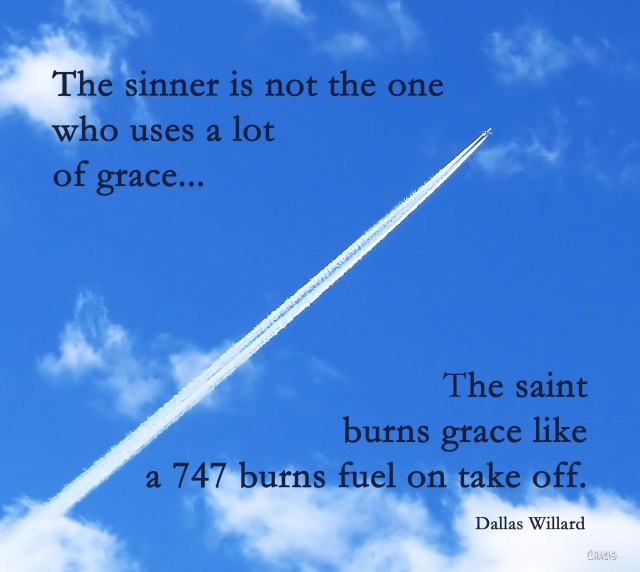
The sinner is not the one who uses a lot of grace…
The saint burns grace like a 747 burns fuel on take off.
-Dallas Willard

The sinner is not the one who uses a lot of grace…
The saint burns grace like a 747 burns fuel on take off.
-Dallas Willard

If we must “feel” God’s presence before we believe he is with us, we again reduce God to our ability to grasp him, making him an idol instead of acknowledging him as God.
– Craig S. Keener
“Never will I leave you;
never will I forsake you.”
(Hebrews 13:5)

I have abandoned all particular forms of devotion, all prayer techniques. My only prayer practice is attention. I carry on a habitual, silent, and secret conversation with God that fills me with overwhelming joy.
-Brother Lawrence

It’s not winter and it’s not spring and in the valley the fields are pretty ugly (oxymoron intended).
Signs of spring are few; some crabgrass is getting a head start on the gardeners, a few little crocus pop up close to the house, and tiny tiny yellow buttercups bloom in the meadow. I take my camera and go out looking for evidence of change, but to be honest, in this shoulder season, it’s very drab out there.
The deer like our garden in the winter. They come late at night and bed down under the bare plum tree. You can tell this is a favourite place because when the snow melts the brown grass harbours dozens of piles of deer poop. (I’ll spare you the photo.)
Brown rotten leaves that I never got around to raking, or that fell after the first snows made raking pointless, gather in the hollows. They lodge between grey branches and add to the dullness of barren bushes and empty flower beds.
Shrinking piles of snow in the corners of parking lots in town look like speckled black slag heaps from old movies about miserable coal miners. The accumulated garbage of a season once blanketed by pristine white snow emerges on the boulevard like guilty memories of junk food binges after you realize your jeans are too tight.

Don’t get me wrong. I see hope. There is nothing finer than the first afternoon warm enough to sit in the sun and enjoy a good cup of coffee. But the reality of once hidden things that need to be dealt with is hard to ignore, especially the day the ground in the stockyards thaws out.
It’s an ugly season, but it too is a season of grace.
Sometimes God sends us a gift we are not sure that we want after a while. A revealing season is one of them. Sometimes he melts the blanket of lovely white snow that has been covering a lot of nastiness. He reveals what has been hiding under there all along. Transitions can be ugly.
Sometimes he sends people (and attached circumstances) who seem to promise great things. When they come into our lives we welcome them eagerly only to discover that the great things are not so great – at least not yet. Their purpose (of which they are probably totally unaware) may merely be to reveal debris and garbage and piles of poop in our lives that need to be cleaned up so they don’t distract from the great things when they do happen. They may just be part of the unwitting transition team.
My friend and I were praying for a ministry which was having an important meeting. We prayed that God would move mightily. He did. The meeting fell into shouting-match chaos when old resentments and bitterness were revealed like piles of poop that had been under the cover of cool politeness for years. It got ugly. They could not move on until things were cleared up. The board members, being thoroughly humbled, set about to do that.
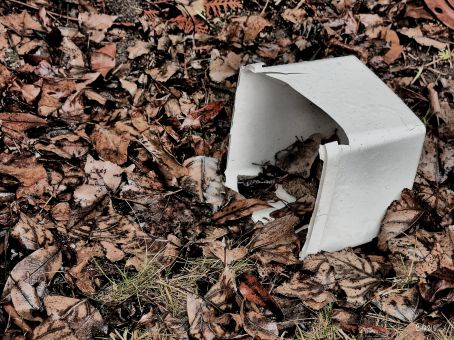 We don’t always appreciate that a promising new boss, who turns out to be more difficult to work with than the last one, or a new political leader, who seems to be more inept than the former office-holder, may actually be in our lives for a reason. Their whole purpose (of which they are probably totally unaware) may be to be the agent that reveals the garbage we need to deal with and the brokenness that God wants to heal next. They may also be a part of an unwitting transition team.
It can be an ugly season when unpleasant stuff is revealed, but we don’t need to lose hope. In time the valley will bloom again. Watch for the signs.


Teach me to love Thee as Thine angels love,
One holy passion filling all my frame;
The kindling of the heaven descended Dove,
My heart an altar, and Thy love the flame.
(from Spirit of God, Descend Upon My Heart by George Croly)

We who live in the mountains often complain about how slowly tourists from the prairies drive when the road is curvy and about the way they speed up when they come to passing lanes in straight stretches. Unkind words may have been spoken about recreational vehicles that get between locals and their work sites.
The problem is that we have “ditches.” Deep ditches. Deep, deep, deep ditches. Understandably, the thought of speeding down the road a few feet away from the precipice of a gorge you can’t see the bottom of is intimidating to people not accustomed to it.
Okay, it’s intimidating to a lot of us who live here too. Driving over the Kootenay Pass still freaks me out, especially in winter. I wish they would put up barriers on the edge of the cliff, but it probably has to do with the need to shove snow from avalanches over the side.
There are not-as-high high places that used to frighten me when we first vacationed here when I was a child. I don’t even notice the height (or more accurately, the depth) now. I remember being in awe the first time I looked down on a rainbow, still white knuckling my way up a steep incline. I guess driving in these conditions does teach one to be aware of the ditches and the need to avoid going too far in either direction.
I watched one of those road accident close call videos the other day. What struck me is that many incidents of loss of control were the result of over-correction. In order to avoid going into one ditch the driver over-reacted, swerved sharply, and ended up in the other.
I’m fascinated by history and the way a reaction to one extreme ends up becoming another. When people are carried along by the momentum created by unresolved anger even a small correction can set them on a trajectory that lands them in as much trouble as the first problem.
I see this pattern repeated throughout church history. An angry group of people break away in protest to excesses in one area and within a couple of generations find themselves trying to crawl out of the opposite ditch. For example, one group, who rejected the ostentatious benefactor-backed wealth of the monasteries at the time, angrily walked out in protest and went to live in communal poverty on less arable land in remote places. Within a hundred years their work ethic and creative solutions to farming swampland and steep hillsides turned them into wealthy landowners who didn’t handle riches any more generously than the group they rejected.
I see this pattern in parenting. One generation says they will never be as rigid as their parents and the next says it will never be as laissez-faire as their parents were. Flip and repeat.
I see this pattern in the arts. One movement admires painstaking detailed rule-following workmanship and the next reacts by rejecting “derivative work” and going for free-wheeling uninhibited expression. They have labels for each other. Most of them end in “ist.”
I see this pattern in politics. But I’m not going there today. Why? Because when you are in the middle of a drastic course change motivated by angry rhetoric, shots fired from both ditches can be doubly dangerous to moderates. Cross-fire and friendly fire and collateral damage and all that. It can even start wars.
This is what I have learned observing the long view of history: Nothing that is established by reaction and rebellion lasts.
A newly formed splinter group that leaves an old group on bad terms without pursuing forgiveness and resolution to the conflict first is guaranteed to find themselves being similarly divided in time. I think it’s the reap-what-you-sow principle. Worse than that, reactors need “enemies” to continue to justify their stance. Mutual enemies become a common cause and provide a type of fuel. It is easy to create an enemy where there once was merely a friend or neighbour with a different opinion and keep them locked in that position. Hatred can be passed down like clause six in a will. Many wars have at their root unforgiveness over a dispute between neighbours who have been dead for centuries.
Sometimes righteous anger can be a good motivator for change. Often people are not willing to make corrections until the situation becomes uncomfortable enough that they have to get up and move. Anger is a secondary emotion. It is like the warning light on the dashboard that lets us know that something is not working.
The problem occurs when correction is applied in high emotion and movement is catapulted too far by angry reactive rhetoric and blame. Anger congeals into bitterness and hard-heartedness. This has the effect of pushing people further apart and entrenching them in defensive positions that are more extreme than they intended them to be. It also makes life miserable for other travellers on the road who come under pressure to choose sides.
Did you know that moderation (self-control) is a fruit of the Spirit and therefore a weapon that can fight a spiritual foe who desires to divide and conquer? The political spirit behind a lot of conflict is bent on using deceit, seduction, loyalties, alliances, mocking, manipulation, fear -oh, especially fear- to divide, conquer and gain control. It shows up in churches, businesses, charity organizations, and governments and school yards. It operates through bandits and people who mean well. Jesus called it the “the leaven of Herod.” He said to be beware of it, because, like yeast, it can permeate everything.
I remember being told over and over in a dream that it is the nature of God to be creative and not reactive. He created us to create and rather than react. That’s why we are told to return good for evil and as much as is possible with us to be at peace with all men. That’s why we look for creative solutions first (although I personally believe that protecting the innocent against outright evil might require us to sometimes physically stand in the gap.)
Moderation is not about compromising with sin or enabling evil; it is about being transparent and honest about problems without casting blame, loving whilst avoiding taking up other peoples’ offenses, protecting the weak without enabling helplessness, encouraging honourable behaviour toward everyone without forming unholy alliances, and avoiding careening across the road into opposite ditches because of angry reactions.
Because some ditches are very deep.

You answer us with awesome and righteous deeds,
God our Saviour,
the hope of all the ends of the earth
and of the farthest seas,
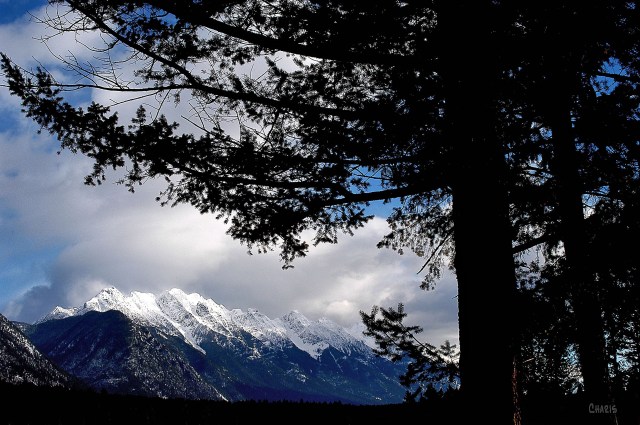
who formed the mountains by your power,
having armed yourself with strength,
who stilled the roaring of the seas,
the roaring of their waves,
and the turmoil of the nations.
(Psalm 65:5-7)

“Forms and rituals do not produce worship, nor does the disuse of forms and rituals.
We can use all the right techniques and methods, we can have the best possible liturgy, but we have not worshiped the Lord until Spirit touches spirit.”
-Richard J. Foster
It’s the light that gives stained glass it’s beauty. Caught a bit of it shining through the old St. Eugene’s church on the mission.
My beloved spoke and said to me,
“Arise, my darling,
my beautiful one, come with me.
See! The winter is past;
the rains are over and gone.
Flowers appear on the earth;
the season of singing has come…“
(from the Song of Songs)
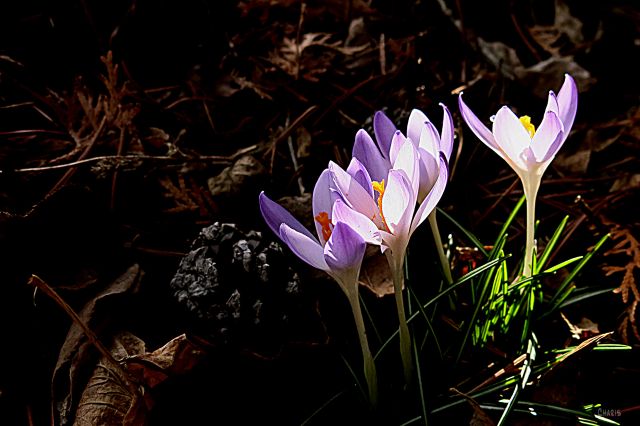
I was measuring the basement window to make curtains last week when I looked out and saw these little beauties reaching for the light. The snow has barely melted and they have appeared earlier in the year in these mountain parts than I can ever remember. They are still blooming. The first blossoms after a long dark winter feel like love awakening.
In this season of singing a new song I was reminded of Depuis le jour by Charpentier.
Since the day I gave myself
my destiny seems all flower-strewn
I think I’m dreaming under a fairy sky
my soul still intoxicated by your first kiss!
What a beautiful life!
My dream wasn’t a dream!
Oh! I’m so happy!
Love is spreading its wings over me!
In the garden of my heart
sings a new joy!
(translation)
Monserrat Caballé was the master of the pianissimo at altitude.

This love of which I speak is slow to lose patience—it looks for a way of being constructive.
It is not possessive: it is neither anxious to impress nor does it cherish inflated ideas of its own importance.
Love has good manners and does not pursue selfish advantage.
It is not touchy.
It does not keep account of evil or gloat over the wickedness of other people. On the contrary, it is glad with all good men when truth prevails.
Love knows no limit to its endurance, no end to its trust, no fading of its hope; it can outlast anything.
It is, in fact, the one thing that still stands when all else has fallen.
(1 Corinthians 13: 4-8 Phillips)


 Charis: Subject to Change