There is More to the Song Than Lyrics

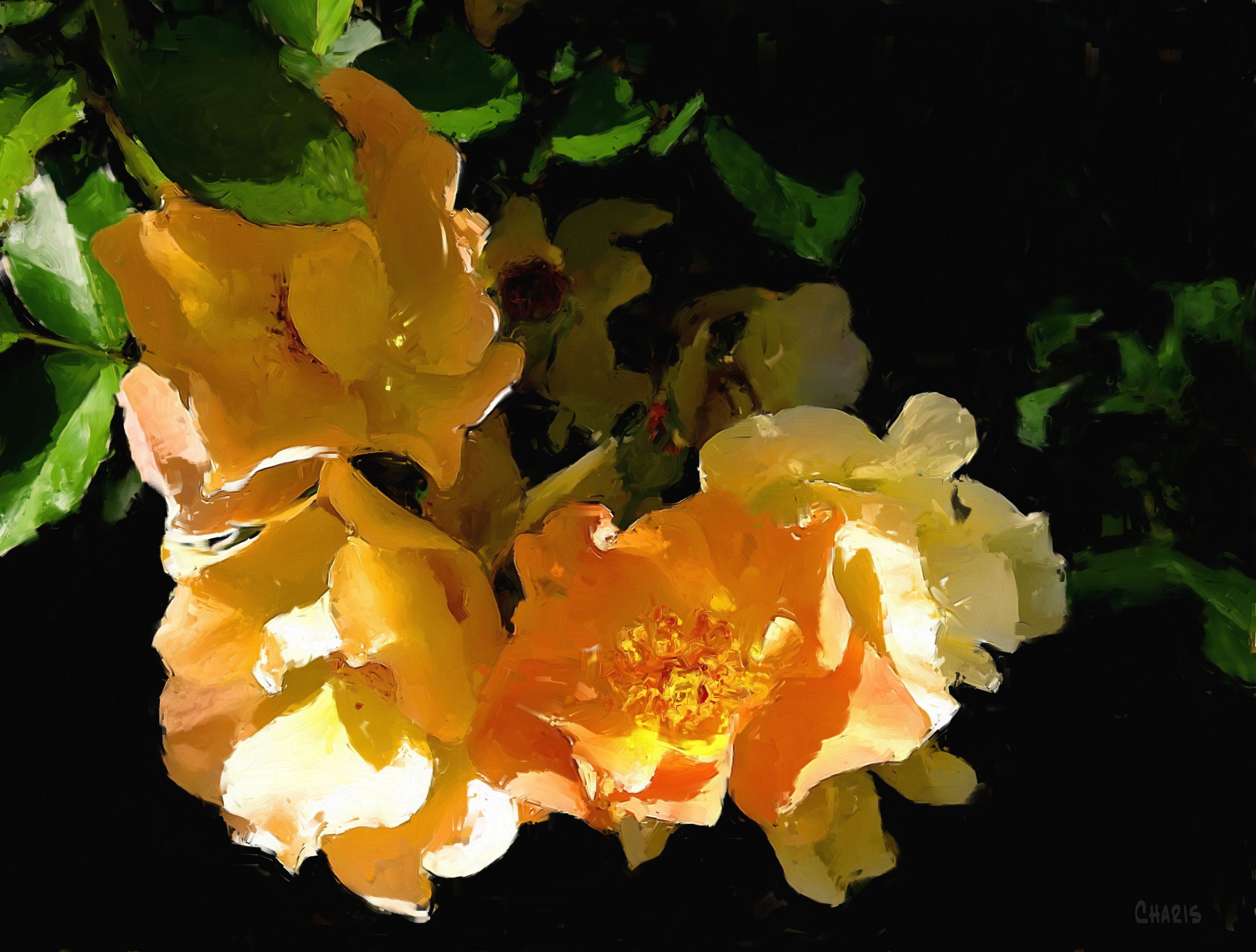
Okanagan roses impasto_daguerrotype

Sometimes my young friends like to post snippets of lyrics to songs in the status box on Facebook. My first reaction is often, “Are you OK, honey?” Then I figure it out – a song has spoken to their heart.

But it has not spoken to mine, and out of context it sounds, well, a little weird. Since I don’t know the song and have no emotional connection to it, the words are often just an interesting record of something that means something to somebody else. Thanks for sharing.

Photos can be like that too. I have my grandmother’s photos here, black and white records of her unnamed friends standing in front of grey rose bushes long since scattered in the wind. I can appreciate that they had deeper meaning to her than they do to me, and I suppose I kept them around out of respect for the things that were important to her, but now I’m paring them down and storing the more interesting ones in waterproof boxes.

For many years I was surrounded by people who told me about the wonderful things God has said. The Bible records them. I read them for myself. But for many years when someone quoted a verse of scripture it felt like reading lyrics to somebody elses favourite song.

Then I heard the Singer.  I heard the Song.

The difference between studying the Bible and hearing the Voice of the Lord for oneself is like the difference between reading the lyrics and hearing the song.

John, the disciple who rested his head on Jesus’ chest, understood. Jesus came, not as more lyrics, but as the song. He told the religious people who studied the puzzling snippets of lyrics they had, that they were about Him, and that there was more to a song than written words. But they had to let go of their “expertise” to hear -and for many that was troubling.

There is more, so much more, to this relationship with God. The difference between reading about the King of the Universe and going for a walk with him is like the difference between looking at photo of the memory of grey roses and actually touching and smelling colourful living roses.

John understood the lyrics when he heard the Voice sing the song:

Before time itself was measured, the Voice was speaking.

    The Voice was and is God.
 This celestial Word remained ever present with the Creator;
     His speech shaped the entire cosmos.
Immersed in the practice of creating,
    all things that exist were birthed in Him.
 His breath filled all things
    with a living, breathing light—
 A light that thrives in the depths of darkness,
    blazes through murky bottoms.
It cannot and will not be quenched.

(The good news of John, chapter one, The Voice)

The Bible is a divinely inspired record of wonderful lyrics. But lyrics alone are not the Song our hearts long to hear. What is He singing over you?
 

Okanagan roses impasto_bak ch

Colla voce. Follow the Voice.

Sometimes Ya Just Gotta Shine

IMG_1119 pretty bug

My grandchildren noticed this amazingly colourful bug on a picnic table bench in the community forest. He was not focused on, nor influenced by their praise for his beauty. He just did what he was designed to do — shine.

The Big Challenge

Rain
Rain


“No circumstance can compete with the favor that God wants you to enjoy in Jesus. God uses all things to upgrade us in goodness and in power. So I love that fact that we’re only ever being challenged by who God is for us. That’s the big challenge on your life. You’re not being challenged by the enemy or by oppositional people. You are not even being challenged by your circumstances. You’re being challenged by the goodness of God. You’re being challenged by the love of God. You’re being challenged by the peace of God. We’re in Christ; we’re only being challenged with the person of God, who is making us like Him.”
-Graham Cooke


IMG_4137 tomatoes fruit

When the Plot Thickens


Kootenay Lake sunset canoe 2 IMG_3869 ch


I couldn’t sleep last night. I was worried.

I was worried about fitting everything into our schedule in the next two weeks. I was worried about a family member’s health. I was worried that I didn’t get the best cell phone deal. I was worried about Ebola patients escaping and looters taking contaminated beds in Liberia. I was worried that I was not able to sleep with a busy day coming up. I was worried about booking a hotel that charged a cancellation fee in exchange for cheaper rates. I was worried about Christians being killed by the thousands around the world. I was worried that someone would challenge me to pour a bucket of ice water on my head.

When I went to bed I was merely worried that Don Diego would discover that Alicia was having an affair with Julio and that the Marquis might find out he was not the father of Alejandro and that Dona Alarcon had slipped Belen’s illegitimate baby into Sophia’s room while Andres tried to hide the identical twin in his tiny servant’s room even though he was the real heir, but his mother Angela was still keeping that a secret.

Ahh —-that’s where it started. I fed my mind on several back-to-back episodes of a Netflix TV show before bed. It is full of intrigue and lies and plot twists that could give you whiplash. You can’t trust any of those characters. It’s fascinating, if not unbelievably contrived, and based on the fact that everyone eavesdrops, but no one bothers to find a private place to have important conversations. I allowed my heart to be sucked in and began to think in the same distrustful way. The problem with hypothetical situations is that you can’t ask for God’s help because you must approach him in spirit and in truth -and there is no truth in a crisis of imagination. Characters are left to their own devices, and the plot thickens (and thickens, and thickens.)

I didn’t do it consciously, but somehow I took the mindset of having to rely on my own devices to bed and at 3:24 a.m. my mind woke up in a panic.

The only way I could find peace again was to read God’s promises, change my thinking, commit my plans to him, trust in him, and pray for his peace replace the anxiety. Then I needed to be still and wait. His presence showed up again and peace was restored — or rather the cacophony of other fearful raucous voices dimmed and I could hear his still, almost silent voice again, because He had never actually left. It reminded me of sitting in a canoe with my best friend on quiet lake at the end of the day.

I’m so glad you are here, Lord.

Commit your way to the Lord;
trust in him, and he will act.
He will bring forth your righteousness as the light,
and your justice as the noonday.

Be still before the Lord and wait patiently for him;
fret not yourself over the one who prospers in his way,
over the man who carries out evil devices!

Refrain from anger, and forsake wrath!
Fret not yourself; it tends only to evil.
(Psalm 37:5-8)

God is good.

He Giveth and Giveth and Giveth Again

dahlias

His love has no limits, His grace has no measure,
His power no boundary known unto men;
For out of His infinite riches in Jesus
He giveth, and giveth, and giveth again.

-Annie J. Flint from He Giveth More Grace

Asking

IMG_3169 chapel bench dutch harbour view lake ch

“Have you been asking God what He is going to do? He will never tell you. God does not tell you what He is going to do; He reveals to you Who He is.”
— Oswald Chambers, My Utmost for His Highest

Fences Around Fences

fences mtn fade bw corel

Nothing is really lost in God’s economy. I learned a lot in my research for the novel I never finished.

I learned that anger is not a good motivator.

I learned that I can change my mind about a group I distrusted.

I learned that suffering is not the only way to gain Godly wisdom. If we pay attention to history and the wisdom gained by other people’s mistakes, we can move on down the road more quickly than if, like recalcitrant teenagers, we have to experience absolutely everything for ourselves.

I was following a discussion on purity and the courting/betrothal movement today. A couple of blogs pointing out some basic assumptions about purity and responsibility made me think.

One of my characters, who had been delivered to a medieval nunnery in my non-existent novel, questioned the high value placed on living without sexual experience as a basis for recognized sainthood for women ( I learned this after I spent a considerable amount of time reading about the lives of saints officially canonized.)

“Why is it,” the young girl asked, “that so many women are honoured for what they did not do instead of what they did do? Why is protecting your virginity until death of more value than raising loving, courageous children, or treating a difficult mother-in-law kindly?”

Even today, the emphasis on purity and “guarding one’s heart” against any undo or premature emotional, or especially sexual feelings, in order to avoid temptation, may seem like a good idea at first. Alas, as is often the case, when wisdom is hijacked by fear the result is usually more rules – fences around fences. For parents who fear that their kids might someday suffer the same negative consequences of giving into temptation like Mom or Dad did, control becomes the new temptation.

In medieval times it was thought that virgins had greater influence with God in their prayers, so families often designated one or two of their progeny to cover the sins of the rest of the gang by shipping them off (often against their will) to cloisters and monasteries. Enclosure behind high thick walls ensured the “purity” of their bodies, if not their hearts.

Some young people are still raised with the notion that any sexual feelings or attractions qualify as impure thoughts and uncontrollable lust, and that merely being alone in the presence of someone of the opposite gender can lead to “defrauding.”  Not only does this skip the opportunity to develop self-control, it often leads to young women feeling responsible for men’s lack of it. The crazy part is, once they are married (when a young man is brave enough to run the gauntlet and seek her father’s permission to formalize a conversation over a plate of nachos  – with a view to marriage) the young woman, who has been told for years that thinking anything other than no, no, no is “defrauding,” is now suddenly “defrauding” if she says anything other than yes, yes, yes. She goes from “You mustn’t!” to “You must!” without passing Go. Legalism can take the fun out of everything.

You can tell that grace is no longer a part of the equation when God’s permission has to be qualified with yeah-but disclaimers and words are re-defined. When impure means having a God-given sexual feeling and lust is merely being attracted to someone, or guarding your heart means shutting it down, fear is running the show. Self-control ( aka moderation) is a fruit that comes from Holy Spirit — whose love casts out fear.

The actions of Godly wisdom and of human fear may look the same for a while, but one leads to freedom and the other to more slavery (the whole point of Galatians). God sees the heart – and there’s a wideness in his mercy.

Love means respecting our own and others personal boundaries. Love means recognizing and respecting our own and others limitations when it comes to resisting temptations to indulge in practices that will not be in our best interest, whether eating, or overworking, or making out without making a commitment to care. The grace of Christ means we are no longer slaves to fear, nor to deliberate choices to act in ways that come from contempt for God, others or ourselves.

The gate may be relatively narrow, but it’s hard to dance on a tight rope of our own making. It is for freedom that Christ has made us free. Let’s not get tangled up in barbed-wire fence rules again.


And for those who can’t contain the yeah-buts, try this.“Do not put child in bag”

The Importance of Gardens

IMG_2237 white pink dahlia corner ch

When my grandfather retired he became the gardener for the property he and Grandma and my parents shared.  This was a good arrangement until the signs of early dementia cropped up. The problem was that Grandpa was a farmer at heart, and not a gardener. As recent memories turned into dust in the wind, he returned to old painful memories and began to see mother’s flowers as weeds that competed for resources with the precious grain crops he fought so hard to grow during the dusty 30’s in Saskatchewan. Before Mom’s prize dahlias had a chance to bloom he hacked them down with his hoe.

Mother was not pleased. She was a farm girl too, and admired waves of wheat in an open field, and vegetable patches dripping with peas and beans as much as anyone, but she also appreciated “impractical”  flower gardens that produced nothing more than visual pleasure.

When there is not enough to go around, survival comes first. The problem is that many of us return to familiar barrenness of past pain, and live our lives in fear of want, as if God is on a budget and there is not enough to go around. Without new memories our relationship with him can be one based merely on survival (what do I need to do to be saved?) and neglect appreciation of his beauty and abundance. Francis Frangipane wrote:

Indeed, Jesus frequently drew revelation about the Father from the observable world around Him. He told His disciples to “consider the lilies” (Luke 12:27) and spoke of God’s love and care, even for the sparrows (v. 6). He saw miracles of life contained within the power of a simple seed, and He made this revelation a centerpiece of His teaching (Matt. 13).

Indeed, many of the Lord’s greatest sermons were presented, not in the temple or behind the pulpit of a local synagogue, but in the cathedral of creation, at lakesides and hilltops.

We think of Gethsemane as the place where Jesus sweat blood in prayer, and so it was. But Gethsemane was a garden, and the Bible tells us that Jesus “often met there with His disciples”(John 18:2). I love the fact that the Lord routinely found joy among flowers and landscaping, and that He “often” brought His disciples there to teach them.

Yet not only was the setting of a garden a familiar place for Jesus while He was alive, but even in death His tomb was set in the midst of a garden (John 19:41). In fact, when He rose from the dead, a distressed Mary thought Him to be the gardener (John 20:15).

Jesus obviously saw the creation as an echo of the Father’s heart. He found in nature a place, a quiet place, to seek and find communion with God. Beloved don’t deny yourself this exquisite pleasure.”

There is more beauty, so much more beauty, in Jesus Christ than we yet know.