Healing

Lord, I will exalt you and lift you high,

for you have lifted me up on high!

Over all my boasting, gloating enemies,

you made me to triumph.

O Lord, my healing God,

I cried out for a miracle and you healed me!

Psalm 30:1,2 TPT

Doctors said my condition was chronic and that I would be on heavy-duty medication for the rest of my life, but God healed me. I was diagnosed as bipolar. I knew hypomanic mountain highs for short periods of time, but I spent years of my life in the darkness of valley lows.

I’ve experienced a lot of painful physical problems in my life —broken bones, many kidney stones, and multiple surgeries for a variety of problems including cancer. Nothing has been as painful as depression. Not even close.

I like to go up into the forest to pray. One day I went up there to pray for my daughter and son-in-law. They were at an event where people were being miraculously healed, or so my daughter told me when she phoned from another part of the world to give me a play-by-play description of what she was seeing. Can I tell you how far this was out of my comfort zone? I was afraid they were getting involved in some sort of cult. That’s what I was praying about. I prayed they would be protected from deception. I was not at all filled with faith for healing. Instead of getting them out of that situation, God healed me.

I heard a voice say “Run!” I argued (how crazy is that?!) that I couldn’t run because of an inflamed ligament in my knee and because I had asthma and left my inhaler in my other coat pocket. Exercise always set off an attack. The urge to run wouldn’t leave, so I sheepishly ran a little way, grateful I was alone because it wasn’t pretty. I could breathe easily and had no pain. I was shocked! I ran all the way back to my car, a distance of about six city blocks. No knee pain, no wheezing. Then I felt the shadows lift off my mind. I felt joy, sweet, calm, non-manic joy.

Over time, I realized that the depression that lifted that day was not coming back. I started reducing some of the meds I had taken for years. Under a psychiatrist’s supervision I eventually got off all of them, including two to control side effects of the other five. The only one I kept taking was a medication for low thyroid.

I’ve been told that no one comes off of medication for mental illness after that many years without some negative effect to cognitive function or going into another tailspin. I’ve been free for fourteen years. Now I experience a normal range of emotions appropriate for the situation.

Since then, I have prayed for people and seen God heal them of various problems. Four times I have seen patients who were on their death beds in hospital recover within days and get up go home.

This question always arises when I tell people my story: What about the ones who were not healed? My answer: I don’t know. I just know that people who pursue God see more healings than people who say, “It is what it is,” or “Healing doesn’t happen anymore. That was just for Jesus and the disciples.”

I have been healed of other problems and still have some conditions that are not yet healed. I know how much it hurts to be blamed for having an unhealed disease. “You don’t have enough faith. You must have unconfessed sin or ‘a root of bitterness.'” “You must be benefitting from the attention or something.” “You said, ‘I have cancer” so you just cursed yourself with your words.” Ouch! Mercy, people, please!

God is God and I am not. Experiencing Him and learning more about His character gives me a deep desire to know Him. It makes me want to have more encounters with the One who heals and gives me a longing for deeper understanding.

Meekness means praying, “There are so many things I don’t understand, Lord. But I know you are good, and your love is perfect. Teach me.”


Sorrow and Joy

From then on Jesus began to tell his disciples plainly that it was necessary for him to go to Jerusalem, and that he would suffer many terrible things at the hands of the elders, the leading priests, and the teachers of religious law. He would be killed, but on the third day he would be raised from the dead. (Matthew 16:21 NLT)

Sometimes I wonder what it must be like for people coming to Canada from tropical countries. If you have never seen it, would you believe it if someone told you, “There is a season coming when all the trees and plants and grasses will die? The world will be too cold for them to live and if you are not careful to find shelter and a source of heat you could die too. But don’t worry. After a few months of cold and long nights, they will come back to life again.”

I wonder if someone who has never heard of this or experienced it before would respond, “How exciting!’ or would they say, “No way! We will protect our gardens nd fields!” Many immigrants have told me their first winter was a shock and felt like it was never going to end.

Jesus told his disciples clearly, and more than once, precisely what was going to happen. When it did, they were shocked and dismayed. For all his declarations that Jesus would not be mistreated and killed under his watch, Peter had to face the fact that he was dead wrong. Jesus was arrested, humiliated, abused, and killed. The shock was so traumatizing it took a time before they remembered that he told them he would be raised after three days.  But how? They still had no grid for that.

Yesterday, I passed by a vine-covered wall. There has been no sign of life on those bare branches for months. Now there is. What appeared to be dead is awakening to new life.

Today’s prompt word for Creative Meditations for Lent is Sorrow/Joy. Sometimes terrible things happen. We reel with the shock of photos of bodies in the streets in the Ukraine. We wail at the news of friends dying of Covid and other afflictions after we prayed with fervour and declared they would not die. We make plans for next week, next year, and the next decades and deny as much as possible that we live in mortal bodies that 1 Corinthians 15 reminds us are perishable, even though as believers in Christ we are promised eternal life.

Perhaps the lesson we can learn from new green leaves on a bare vine is this: Even though we have no grid for resurrection from the dead in new bodies, it will happen. There is more to the passage on running the race than I quoted earlier this week.

Therefore, since we are surrounded by such a great cloud of witnesses, let us throw off everything that hinders and the sin that so easily entangles. And let us run with perseverance the race marked out for us, fixing our eyes on Jesus, the pioneer and perfecter of faith.

For the joy set before him he endured the cross, scorning its shame, and sat down at the right hand of the throne of God. Consider him who endured such opposition from sinners, so that you will not grow weary and lose heart. (Hebrews 12: 1-3)

Oh, how I love the spring! What a harbinger of much greater joy!

Flow

On the final and climactic day of the Feast, Jesus took his stand. He cried out, “If anyone thirsts, let him come to me and drink. Rivers of living water will brim and spill out of the depths of anyone who believes in me this way, just as the Scripture says.” (He said this in regard to the Spirit, whom those who believed in him were about to receive. The Spirit had not yet been given because Jesus had not yet been glorified.) 

(John 7:38, 39 The Message)

Creative Meditations for Lent, Prompt word: Flow

Clean

I love a clean house. I hate cleaning.

At various times in my life, I have hired people to clean for me. The problem is, they could never organize for me. I would need a staff for that, and even then it’s hard for them to read my mind.

I never noticed until it was time to pack up to move, that I am a collector of cleaning products – especially the ones that promise less scrubbing and heaven by way of the shower door. Somehow, I thought that by buying all these spray bottles and magic cloths I was creating the potential for spotless bliss.

The problem with that plan was this: Stuff must be moved, cleaning products must be applied and removed, and stuff needs to be dusted/washed/polished before being put back in a better place. All of this requires my participation. It was easier to give everything a quick flick of a damp rag, throw stuff I didn’t know what to do with in the storage room, turn off the light, shut the door, and get on with life.

I realize now that the storage room could be a symbol of every out-of-order thing in my life that I never got around to dealing with, until it threatened to avalanche into the living areas. When it was time to move, I felt overwhelmed. No one could do it for me and yet I couldn’t do it all myself. I had to ask for help.

My life has tended to have pockets of denial where broken, dirty, and embarrassing things collect. It’s easy to try to keep denying their existence until someone wants to look in all the dark corners – someone like Jesus.

Here’s the thing. God forgives because of Jesus, but when sin clutter spills out and blocks the way between us, communication is hindered. It’s hard to be perfectly, nakedly, candidly honest before the Lord when you are struggling to keep sin hidden. John the Beloved wrote about it this way:

Here, then, is the message which we heard from him, and now proclaim to you: GOD IS LIGHT and no shadow of darkness can exist in him. Consequently, if we were to say that we enjoyed fellowship with him and still went on living in darkness, we should be both telling and living a lie. But if we really are living in the same light in which he eternally exists, then we have true fellowship with each other, and the blood which his Son shed for us keeps us clean from all sin. If we refuse to admit that we are sinners, then we live in a world of illusion and truth becomes a stranger to us. But if we freely admit that we have sinned, we find God utterly reliable and straightforward—he forgives our sins and makes us thoroughly clean from all that is evil. For if we take up the attitude “we have not sinned”, we flatly deny God’s diagnosis of our condition and cut ourselves off from what he has to say to us. (1 John 1:5-9 Phillips)

Confession means admitting we have a sin problem. God forgives and cleanses us, but we need to be bravely honest and ask him to take away all the junk hidden in our hearts. I love a clean house, but a clean heart even more.

Creative Meditations for Lent, Word prompt: Clean

Run

As for us, we have all of these great witnesses who encircle us like clouds. So we must let go of every wound that has pierced us and the sin we so easily fall into.  Then we will be able to run life’s marathon race with passion and determination, for the path has been already marked out before us. We look away from the natural realm and we focus our attention and expectation onto Jesus who birthed faith within us and who leads us forward into faith’s perfection. (Hebrews 12:1,2 TPT)

Over the years I have seen many sincere Christians in positions of influence who started well (some amazingly well) but who tripped and fell along the way. Nearly every incidence involved some sort of false idol adopted to comfort an old unhealed wound. Nearly every public figure I know who has fallen lost sight of Jesus and began to compare themselves to other runners. They lost their focus. None of them planned for things to go that way, but the pressures of ministry and the desire to maintain a good appearance or material security put enormous pressure on an unhealed wounded heart. The result was sin like an Argentinian gaucho’s bolo that wrapped around their legs and brought them down –face first.

How do we run this race set before us? First, we need to admit our woundedness and seek the Lord’s healing. We may fall and rise and fall and rise again, but with healed hearts, with passion and determination, and with focus on Jesus Christ, faith gains strength and speed.

A cloud of witnesses who longed to be where you are right now is leaning over heaven’s balcony and cheering you on. Run!

Creative Meditations for Lent, Word prompt: Run.

Watch

You are all sons of light and sons of the day. We are not of the night nor of darkness. Therefore, let us not sleep, as others do, but let us watch and be sober. (1 Thessalonians 5:5,6 NKJV)

Frequently when the Bible uses the word watch, it means to be awake, vigilant, and attentive. Paul wrote these words to the believers in Thessalonica about discerning the times they were living in. He reminds them that no one knows when Christ will return, but they are capable of discerning the significance of what is happening around them if they watch.

Watching to understand the times requires us to see with lenses that are not tainted by our own fears, doubts, and priorities. We need to see the way Jesus sees, through his eyes. We need to pray the way he is praying, with his thoughts.

There are so many distractions and flashing messages right now saying, “Look here and not there!” We need the lens of hindsight, the lens of foresight, and especially the lens of insight. These lenses are available to those who ask and are awake, walking in the light, seriously wanting to understand, and paying attention.

Ask. Watch. Pray.

Creative Meditations for Lent, Word Prompt: Watch

Carry

Creative Meditations for Lent. Word prompt: Carry

There are so many ways I could go with the word carry. Carry out, carry through, carry on, carry over, carry away, carry around…  What I hear in my heart is a line from a song by Selah called “Audrey’s Song.” The part of the song I keep hearing is “I will carry you.”

The song is sung by a mother to her child in the womb. Doctors told the parents that the baby had anomalies incompatible with life and recommended abortion. Instead, the they chose to love their child and honour the life she had, how ever short it would be. (Warning, it’s a tear-jerker.)

https://www.youtube.com/watch?v=1MI9duC9mXQ

I Will Carry You (Audrey’s Song) by Selah from the album “You Deliver Me”

There were photographs I wanted to take

Things I wanted to show you

Sing sweet lullabies, wipe your teary eyes

Who could love you like this?

People say that I am brave but I’m not

Truth is I’m barely hanging on

But there’s a greater story

Written long before me

Because He loves you like this

I will carry you

While your heart beats here

Long beyond the empty cradle

Through the coming years I will carry you

All my life

And I will praise the One Who’s chosen me

To carry you

Such a short time

Such a long road

All this madness

But I know

That the silence

Has brought me to His voice

And He says … I’ve shown her photographs of time beginning

Walked her through the parted seas

Angel lullabies, no more teary eyes

Who could love her like this?

I thought about others in the faith who died young. I have often wondered why Jesus chose James, along with his brother of John – the other half of the sons of thunder— and Peter, to be his three closest companions. Jesus would have known that James wasn’t going to live long. King Herod had him “put to the sword.” In a manner all too common in political machinations, when he saw favourable numbers in the local population’s response to his handling of the disruption caused by these Jesus followers, Herod decided to kill some more of them. Peter was miraculously delivered from prison, but James hadn’t been. James was killed.

Why would Jesus invest so heavily in someone who wouldn’t be around very long? Who can say James’ life was of less value than the life of John who lived to a very old age? Jesus obviously loved him and could have rescued him. James obviously had faith and he was surrounded by the same faithful people who prayed for Peter to be released.

Somehow, we have adopted the idea that a successful life is a long life, that people ought to be valued for accomplishments, or at least potential accomplishments. Baby Audrey lived outside her mother’s womb for only two hours, but I believe God saw her life was as valuable and he loved and appreciated her as much as a 100-year-old woman with many accolades.

God loves us for who we are. He loves us because he loves us. Nothing we do or don’t do can make him love us any more or any less. Can we also take the risk of loving someone who may be leaving life on earth shortly? Being separated from a loved one is extremely painful, but not eternally painful. I admire those who can risk the pain of loss and love freely, carrying another person in their heart because they know they are loved by Love Himself.

He will carry them too.

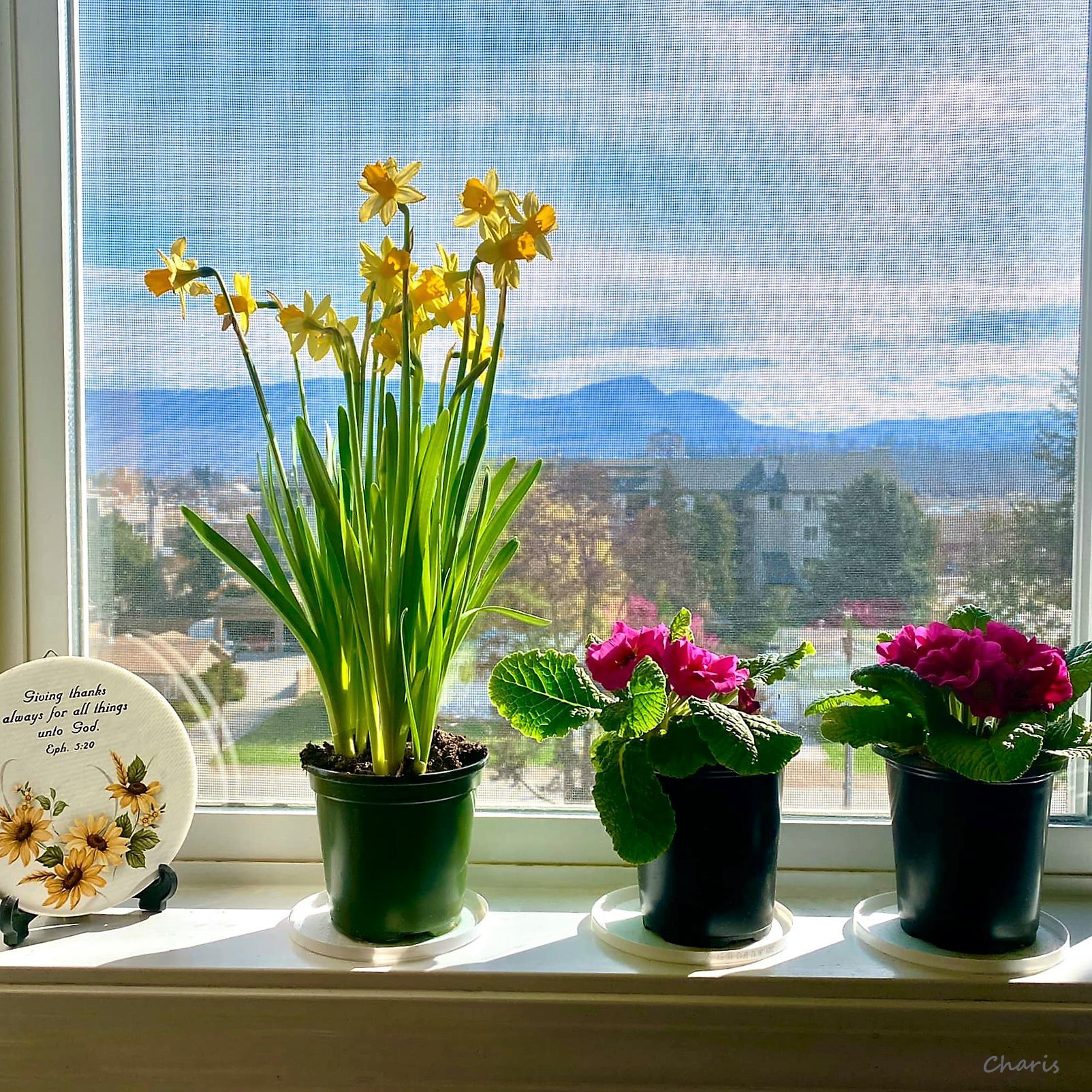
Why the photo of spring flowers on the windowsill? These words in 1 Peter inspired me.

Now that you have purified yourselves by obeying the truth so that you have sincere love for each other, love one another deeply, from the heart.For you have been born again, not of perishable seed, but of imperishable, through the living and enduring word of God. 

For, ‘All people are like grass,
    and all their glory is like the flowers of the field;
the grass withers and the flowers fall,
     but the word of the Lord endures forever.’

And this is the word that was preached to you. (1 Peter 1:22-25)

Awe

Everyone was filled with awe at the many wonders and signs performed by the apostles.” (Acts 2:43 NIV)

Today’s word for Creative Meditations for Lent has taken me in a different direction than I expected. I started thinking about awe in the above verse.

I’ve decided my definition of awe (like most other people’s, I suspect) has been entirely inadequate. We use it so casually as in, “You did an awesome job, kid.”

Other translations of the Bible use the word fear instead of awe. I looked it up. The word in Greek is phobos, the root of ‘phobia’ –a fear so strong it makes us want to run away (like the Children of Israel wanted to run away when God showed up on Mt. Sinai.)

Phobos appears in this passage as well:

People will faint from terror [phobos], apprehensive of what is coming on the world, for the heavenly bodies will be shaken. (Luke 21:26)

If we use the word awe instead of fear it gives a sense of how much the word awe has been devalued.

People will faint from awe.

For years I have sung “Our God is an awesome God” with the same fervour as if the lyrics had been, “Our God is a pretty impressive God.” Some of us have hit the other ditch in reaction to the sermons about a wrathful, vengeful God that neglected emphasis on his overwhelming love, mercy, and grace. Have we gone too far the other way? We can’t ignore the scripture about awe/fear of a God more powerful than we can imagine. Solomon wrote in the book of Proverbs that the fear of the Lord is the beginning of wisdom.

We have no idea what awe really means. But I think we are about to find out.

Wait

Do not be like the horse or the mule,
which have no understanding
but must be controlled by bit and bridle
or they will not come to you.
 (Psalm 32:9 NIV)

There have been times when I felt the Lord was telling me to wait but I took off like a skittish horse. Fear pushed me into do something, anything mode. I then found myself in circumstances where there was nothing I could do but wait.

On the other hand, there have been times when I could see (in hind sight) the Lord was telling me to move, but I didn’t pay attention. Instead I stood my ground like a stubborn mule. That can’t be right, I thought. Sometimes I confused loyalty to people with loyalty to God. And sometimes I was just comfortable where I was, thank you very much. I then found myself becoming object of a divine loving shove.

It may still take me a while, but I’m learning to listen and respond sooner, if not immediately. I still hate making apologies for backing out after over-committing or after showing up late though. Thank God for grace.

Creative Meditations for Lent, Word prompt: Wait

Peace

“I leave behind with you—peace; I give you my own peace and my gift is nothing like the peace of this world.” – Jesus (in John 14:27, Phillips paraphrase)

Most people think of peace as the absence of hostilities or of war. Even when we talk about personal peace, we often mean the absence of things like annoying interruptions, chaos, lack of resources, or worries that something will interfere with our priorities. I wonder if the peace that Jesus offers is not like that. I wonder if his peace is not the absence of something but the presence of something.

What if peace is more like completeness? What if the peace he left us means having all the tools necessary for a task, or being so convinced that God will provide everything we need that we can not only survive storms, but walk into them with assurance that it’s going to be alright?

What if this perfect peace creates an appreciation of divine priorities. What if this peace that passes understanding comes with complete trust that God loves us and allows us to engage with him in his purposes? What if we become aware of perfect peace flowing through us and allow it to help us to perceive the direction of the wind of the Holy Spirit?

What if the peace that is nothing like the peace of the world means Christ has made more available to us than we ever imagined?