Fiery Trials

I took this photo yesterday evening from the condominium where we live. I saw the smoke all afternoon, but when my neighbour across the hall invited me to see the view from her balcony, I saw the flames.

A huge fire caused thousands to be evacuated from their homes across the lake from us here in Kelowna, British Columbia. I have friends and family on the west side and was very concerned for their safety. I assured concerned friends from elsewhere that the fire was over there and we were alright on this side of the lake.

Last night, the fire jumped the lake. Embers flew across the water and landed on the other side in dry vegetation ready to burst into flame. I’m hearing about people we know not far from here evacuating in the middle of the night. It’s more than an opportunity for dramatic photos now.

A couple of days ago, someone asked if you cold sing theology. I think they meant the dry theories about the study of God that people argue over, the kind of hot air balloon detached from any real experience that causes “experts” with large vocabularies to drone on endlessly. I agree that theory devoid of experiential knowledge of the Holy can just be another source of contention. I also believe that theology that is what we think about God, and doctrine that is what we believe about God enough to act on in a crisis is one of he most important considerations we will ever make.

Can I sing theology? Yes I can. I used one of my favourite hymns, How Firm a Foundation, as an example. Today, with flames consuming a nearby hillside as I watch the winds pick up and the flag over the supermarket shift directions, a verse from that song is more relevant than ever.

When through fiery trials thy pathway shall lie,
My grace, all-sufficient, shall be thy supply;
The flame shall not harm thee; I only design
Thy dross to consume and thy gold to refine.

    There is so much in those four short lines. Fiery trials happen. Our cries of “Why God?” are less likely to be answered than “What do you want me to see about you that I couldn’t see any other way?”

    I’ll let you know.

    In the meantime, prayers for our city and its citizens to be come through this time safely are welcome. For that matter, we need prayer for this entire country, especially the west and the northern territories were fires have raged for weeks. Prayers that we would come out as refined gold, freed from the kind of entanglements that hold us back spiritually are even more welcome.

    In Time

    Sometimes I hear God’s voice in unexpected places. Popular music is one of them. I wrote about it here. (Hearing God’s Voice Through Music). This morning I woke with a song in my head. It’s not one that’s on any of my play lists, but it was insistent, so I paid attention.

    Recently I’ve been asking myself why it is sometimes so easy to set a God-given dream aside to collect dust for years. I could say that I’ve been distracted by the cares of life or that I chose to support another person’s dream because I believed it was a worthy and lofty dream. But I think, to be honest, after listening to the song, the Lord is telling me something. I have set the dream aside because taking steps to walk with God toward the dream he put in my heart takes courage. And I have been afraid –afraid of success, afraid of failure, afraid of what critics will think, afraid of letting friends down, afraid of letting God down, afraid of standing alone in the no man’s land in the middle of the social and political and factioned church battles we find ourselves in.

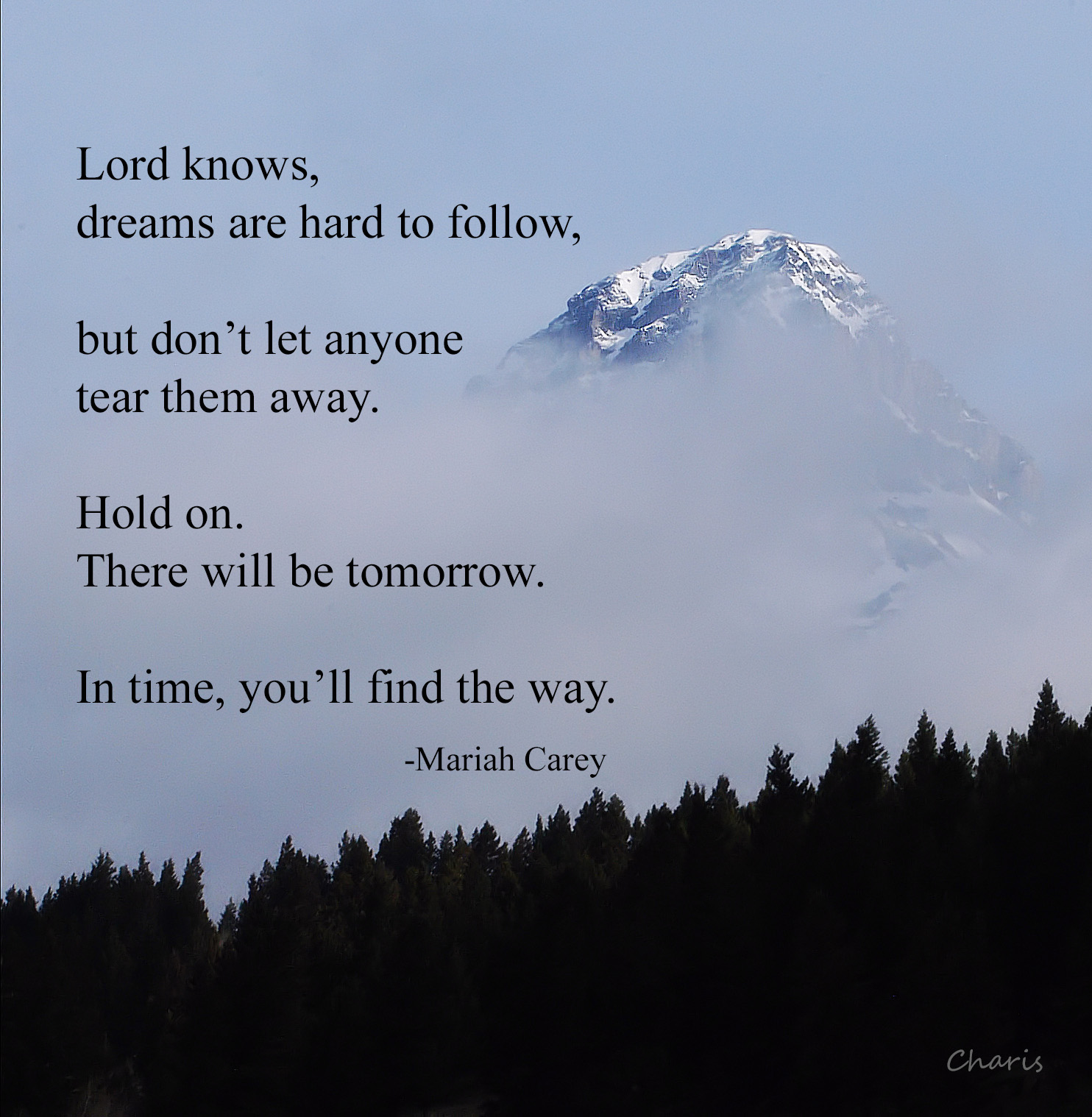
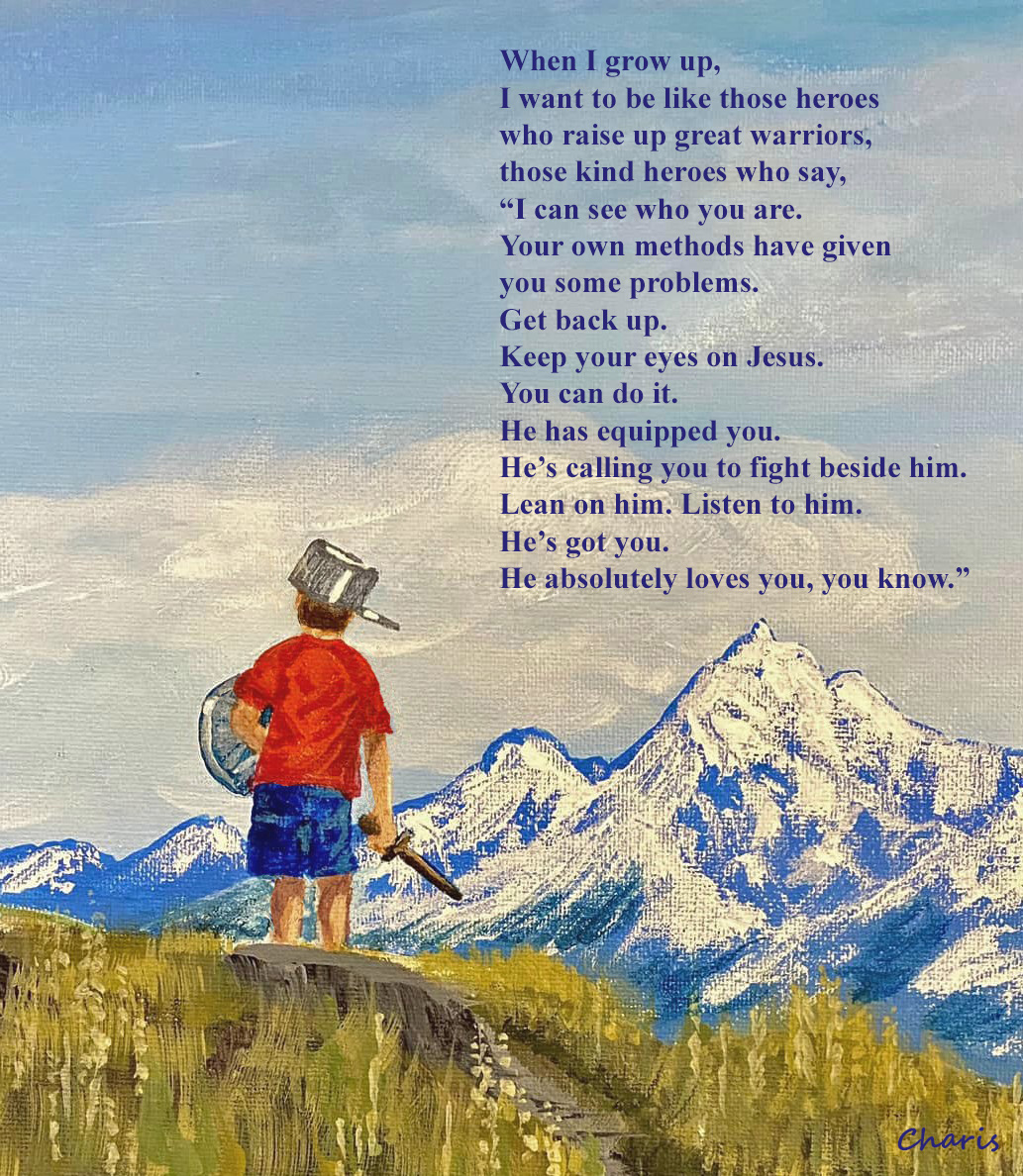
    Mariah Carey’s song is called “Hero.” One of the most profound questions we can ask God is “Who do you see when you look at me?” For many years, I assumed the answer to that question was “a sinner saved by grace.” I was wrong.

    It can be rather shocking when we hear his answer. It’s easy to dismiss it as a figment of an over-zealous ego. When he approached the cowardly Gideon hiding down in a winepress to thresh grain, the angel of the Lord called the guy who thought he held the lowest status in the country, “Mighty Warrior.” Gideon’s response was the equivalent of looking around and saying, “You talkin’ to me?” The way God sees us is much better than the way we see ourselves. Frankly, I discovered, the hard way, that talking about it to friends who don’t understand how God sees them can bring about a jealous response the way Joseph discovered what jealous people can do when he told his brothers about his dream of sheaves of wheat bowing to him. Candour is risky business. Very risky. But maybe it’s step one in trusting God.

    As we grow in grace, God reveals more of how he sees us. I’ve been praying about an updated version of what I call an identity statement (similar to an artist’s statement). When I heard “hero” I felt like Gideon must have felt. I feel like the last person on earth that term could apply to. Then I remember that years ago the Lord spoke to me through the book of Hosea: “‘It will come about in that day,’ declares the Lord, ‘That you will call Me Ishi and will no longer call Me Baali.'” (Hosea 2:16) Ishi means hero/savior/husband. Baali means master.

    It’s about relationship. Through his kindness, his gentle alluring, he has replaced the harsh image of himself as an impossible taskmaster with the image of my hero, my saviour, and the lover of my soul.

    We become what we focus on. If my focus is on other humans who have merely a piece of the picture, I can, at best, become a faint copy of their traits, both good and bad. If I focus on the one who is my hero, getting to know him in a deeper sense, I will eventually become more heroic like him.

    Jesus’ road to hero status involved laying down his right to respect in the ultimate demonstration of humility, but he never let go of the dream to save us and re-connect us with the Father who created us. For the joy set before him, he endured the cross.

    I am very well aware of my tendency to back away when intimidated, to withdraw when stressed, and to try to change who the Lord created me to be to fit in with other people in a desire to belong (what Brené Brown calls the opposite of belonging). On my own, I can’t pursue this dream, but Jesus stood up to injustice. He’s the shepherd who goes after the lost lamb. He pulled me from a pit of guilt and shame and sang a song of grace over me. He invited me –fearful, shame-ridden, voiceless me– to partner with him to set the prisoners of spiritual abuse free. He lives in me. In a world of disappointing would-be heroes, he is my only hope.

    This whole thought is too much for me, but I choose to trust him.

    And then a hero comes along with the strength to carry on and you cast your fears aside…

    Thy Hope, Thy Confidence Let Nothing Shake

    Be still, my soul: the Lord is on thy side.
    Bear patiently the cross of grief or pain.
    Leave to thy God to order and provide;
    In every change, He faithful will remain.
    Be still, my soul: thy best, thy heav’nly Friend
    Through thorny ways leads to a joyful end.

    Be still, my soul: thy God doth undertake
    To guide the future, as He has the past.
    Thy hope, thy confidence let nothing shake;
    All now mysterious shall be bright at last.
    Be still, my soul: the waves and winds still know
    His voice Who ruled them while He dwelt below.
    *

    It’s hard to have hope and confidence when things seem dark and deep. It’s hard to leave the what-ifs behind and not allow your confidence to be shaken.

    It’s hard, but grace empowers you to be who God sees when he looks at you. It is God’s abundant grace that activates hope so can say with confidence, “All now mysterious shall be bright at last.”

    In every change, He faithful will remain.

    *(From Be Still My Soul, music from Finlandia by Jean Sibelius, Lyrics by Catharina von Schlegel, translation to English by Jane Laurie Borthwick)

    Give Them a Chance

    My friend gave me some seed she collected after I complimented her garden last summer. It amazes me to see what can grow from an ugly tiny brown thing in an envelope. I didn’t think I could grow zinnias in a pot on my balcony, but I planted and watered them anyway. Now look.

    May the Lord grant us the ability to see the beauty in people when they are still in their unimpressive stage. May we give them a chance anyway.

    Honouring the Noble Broken Generation

    This is a week of remembering. Yesterday would have been my Dad’s birthday. His birthday came at the same time as the end of the school year. There was always a picnic. Today is the anniversary of my Mom’s passing. My husband’s mother also died this time of year. The picnics those years became “refreshments” in hushed community halls instead. It’s a season of contrasts.

    I’ve been thinking about our parents’ lives. I am grateful for them and the generation that rose from the ashes of poverty and famine in the 1930’s and World War in the 1940’s. They knew tough times.

    Poverty brought poor nutrition and lack of medical care. Poverty meant that when Dad was five-years old two of his siblings died of illnesses easily treat now. Poverty left him as an only child of grieving parents for several years. Grandma told me that one day she found him playing in the dirt. He was burying matchboxes like the boxes they buried his little brother and baby sister in. He would bury them and dig them up repeatedly telling them to wake up.

    My Dad was bullied for being the only boy from an English-speaking family in a school where the other children were refugees from persecution in Russia. The family lost the farm after another crop failed and his father became too ill to carry on. As an 18-year-old my father was preparing to go to war when armistice brought an end to conscription. Lots of young men from the area had already died, so he knew what it meant to be sent overseas.

    When Mom was five-years old, her mother died. The family could not afford a doctor. They had already lost several children to diphtheria and other childhood diseases. The crops had failed that year and the money-lender took several sacks of what little wheat they had managed to glean to feed the family over the winter. They were also grieving the news from the Red Cross that no friends or family left behind in The Crimea had survived Stalin’s cruelty. In his grief, her father turned to alcohol. Later, my mother and her younger brothers suffered bullying at school for coming from a German-speaking family in a country that was at war with Germany even though their older brother was fighting for the allies in the Netherlands.

    My husband’s parents also grew up in harsh environments. His father lived with immigrant parents in a tar-paper shack on a farm during the dust-bowl famine years. He joined the air force when he was old enough and flew reconnaissance in enemy territory at an age when kids now go to college.

    My husband’s mother’s house in Rangoon was bombed by the Japanese and she and her mother and sister barely escaped being sent to a concentration camp by fleeing to India. She spent her teen years inside the walls of a compound there because the people on the outside hated her kind. Since she was a biracial child in the East, she lived in fear as she experienced soul-crushing racism from both sides.

    Our parents, and many others of that generation, had amazing perseverance, but they also had deep scars. It’s hard not to dismiss the influence of either the noble or the broken side of the previous generation on our generation (or the trickle down effect on the next). We see the good side or the bad. We tend to idolize or denigrate. I don’t think we can properly honour our parents (or grandparents or great grandparents) without acknowledging how far they came in their lifetimes. That means both the acknowledgement of how devastating the circumstances of the times could be on mental health and the acknowledgement of how hard they worked toward building a better future for their children.

    By the time they passed, both my parents and my husband’s parents had faith that God loved them. They were trusting Jesus to finish the healing that began here. It will be wonderful when we are all together and we are all completely well.

    I honour them and say thank you for having a vision that extended beyond your lifetime. Thank you for your sacrifice.

    Summer Night

    When I consider the heavens,

    the works of your fingers,

    the moon and the stars that you have made,

    who am I that you are thinking of me?

    Psalm 8

    The Mark of True Maturity

    You are always and dearly loved by God! So robe yourself with virtues of God, since you have been divinely chosen to be holy.

    Be merciful as you endeavor to understand others, and be compassionate, showing kindness toward all.

    Be gentle and humble, unoffendable in your patience with others. 

    Tolerate the weaknesses of those in the family of faith, forgiving one another in the same way you have been graciously forgiven by Jesus Christ.

    If you find fault with someone, release this same gift of forgiveness to them. For love is supreme and must flow through each of these virtues.

    Love becomes the mark  of true maturity. 

    Colossians 3:12-14 TPT

    Many of us long to be understood. We want to explain the background behind the reasons for our actions. As I often told my children, and now my grandchildren, an explanation is the history behind a decision. It is not necessarily the validation of a decision. An explanation is an explanation, not an excuse. Whether we hurt someone intentionally or unintentionally, their pain is still pain.

    A young child hits back. A mature adult doesn’t need to.

    Somedays I need to do an accounting. I need to remember times when I have been forgiven for doing or saying things meant to hit back. I write down memories of times when grace was extended to me for my graceless acts of immaturity. I give thanks for people who showed me kindness when I was flailing in pain, striking out at anyone I perceived as a potential threat and when it seemed only the foolish would trust again. Instead, they gently, humbly, and patiently demonstrated God’s true nature.

    When I look at the people who have had the greatest effect on healing the deep wounds in my heart, they are all people God brought into my life to show me there was such a thing as love that was not self-serving. They made time. They listened. They were not put off by my raging. They were not afraid of how being associated with me would make them look. They made it possible to believe in more than the disappointing behaviour I had seen demonstrated by immature or false Christians. They showed me the kind of love that drives away fear and nurtures fertile ground for faith to grow.

    On these accounting days, when I look, when I see, when I understand how costly it was to love someone in as much pain as I used to be, how can I justify offering less mercy than I have received?

    Today I am thankful for the mature ones who patiently extended love to nurture my spiritual growth. Twenty years ago, when I told one of them I was losing faith, he said he would hold onto faith for me because he knew I would eventually begin to comprehend how much God loved me.

    I want to be like Jesus because that guy let me see Jesus in him.

    Lessons Learned

    Today’s events are tomorrow’s history, yet events seen by the naked eye lack the depth and breadth of human struggles, triumphs and suffering. Writing history is writing the soul of the past… so that the present generation may learn from past mistakes, be inspired by their ancestor’s sacrifices, and take responsibility for the future.

    Epifanio de los Santos

    Lessons learned at great cost are too valuable to forget.

    One In the Spirit, One in the Lord

    A song came to mind today. I remember linking arms with friends as we sang it around the campfire when I was young and naïve, and perhaps a little too trusting. The song is “We Are One In the Spirit.”

    I believed in the ideals in the song. I still do. Fifty years later, having observed at least fifty demonstrations of decimating attacks on “each man’s dignity and each man’s pride,” and experiencing lots of opportunities to forgive, I still cling to the hope of the unity the Apostle Paul describes in Ephesians 4.

    So Christ himself gave the apostles, the prophets, the evangelists, the pastors and teachers, to equip his people for works of service, so that the body of Christ may be built up until we all reach unity in the faith and in the knowledge of the Son of God and become mature, attaining to the whole measure of the fullness of Christ.

    We have some maturing to do. In the same chapter he writes:

    I urge you to live a life worthy of the calling you have received. Be completely humble and gentle; be patient, bearing with one another in love. Make every effort to keep the unity of the Spirit through the bond of peace. There is one body and one Spirit, just as you were called to one hope when you were called; one Lord, one faith, one baptism; one God and Father of all, who is over all and through all and in all.

    Are there good reasons for separating? Of course. Dangerous people who refuse to change remain dangerous. A parent who loves two children will move an aggressive bullying sibling away to another room protect the other. The object is protection for one and restoration for the other. We have far too many examples of situations where habitual abuse in churches was covered up using 1 Peter 4:8 “love covers over a multitude of sins,” as justification while ignoring Ephesians 5:11, “Have nothing to do with the fruitless deeds of darkness, but rather expose them.” One is about extending grace for growing-pain type sins and the other is about not tolerating a pattern of serious sin with potential long-term consequences, whether for one person or for thousands.

    One instruction has grace for the faults of immaturity while the other prevents harmful, ungodly ideas and practices from becoming established. That discussion requires more time and space than this blog post allows today. I’m talking today about the chafing that occurs when we rub shoulders with fellow-believers who still have rough edges, in other words, all of us.

    I saw these roses in the landscape patch between an apartment building and the sidewalk as I walked to the grocery store. I grabbed a photo on my phone because I liked the circle they formed. Usually, I edit out the flaws in my flower photos before I publish them. I tell people that if a photo of mine doesn’t have a time/date stamp on it, assume I have adjusted something. I did zap a couple of aphids on this one, but I left fading colour, browning edges and uneven pigment just the way it was. To me, the image represents a circle of unity with grace for imperfection.

    I heard a wedding sermon in which the officiant gave a pep talk to the bride and groom. He talked about the admonition to forgive and forbear. (Colossian 3:13)

    “Who knew that forbearing the daily annoying stuff would be harder than forgiving the exceptional major stuff?” he asked, speaking of his own experience.

    I’ve noticed that one of the major reasons for splits in places where people once gathered with every intention of bearing with one another in love, are often triggered by the opposite character qualities of humble, gentle and patient. Instead, they jostled each other with arrogance, harshness, and impatience.

    Sometimes we find ourselves side by side with prickly people. Graham Cook calls them “grace-growers.” Their presence in our lives is not so that we can fix them (or develop protocols for their removal), but so the Lord can allow the annoying qualities that continually rub us the wrong way to smooth our own rough edges.

    Jesus said we would be recognized as his disciples, but not for our ability to shun the flawed and those who fail to fall in line with shunning practices. We will not be visible representatives of Christ for developing perfect theoretical doctrine, for “maintaining the pure DNA” of our particular sect, for either indulging sinful practices or condemning people still in process, or for becoming successful by the world’s definition. He said his followers would be recognizable. You’ll know who they when you hear people say, “Look how they love one another!”

    It’s like they are one in the Spirit or one in the Lord or something.

    One in the Spirit by Joseph M. Martin