Kootenay River
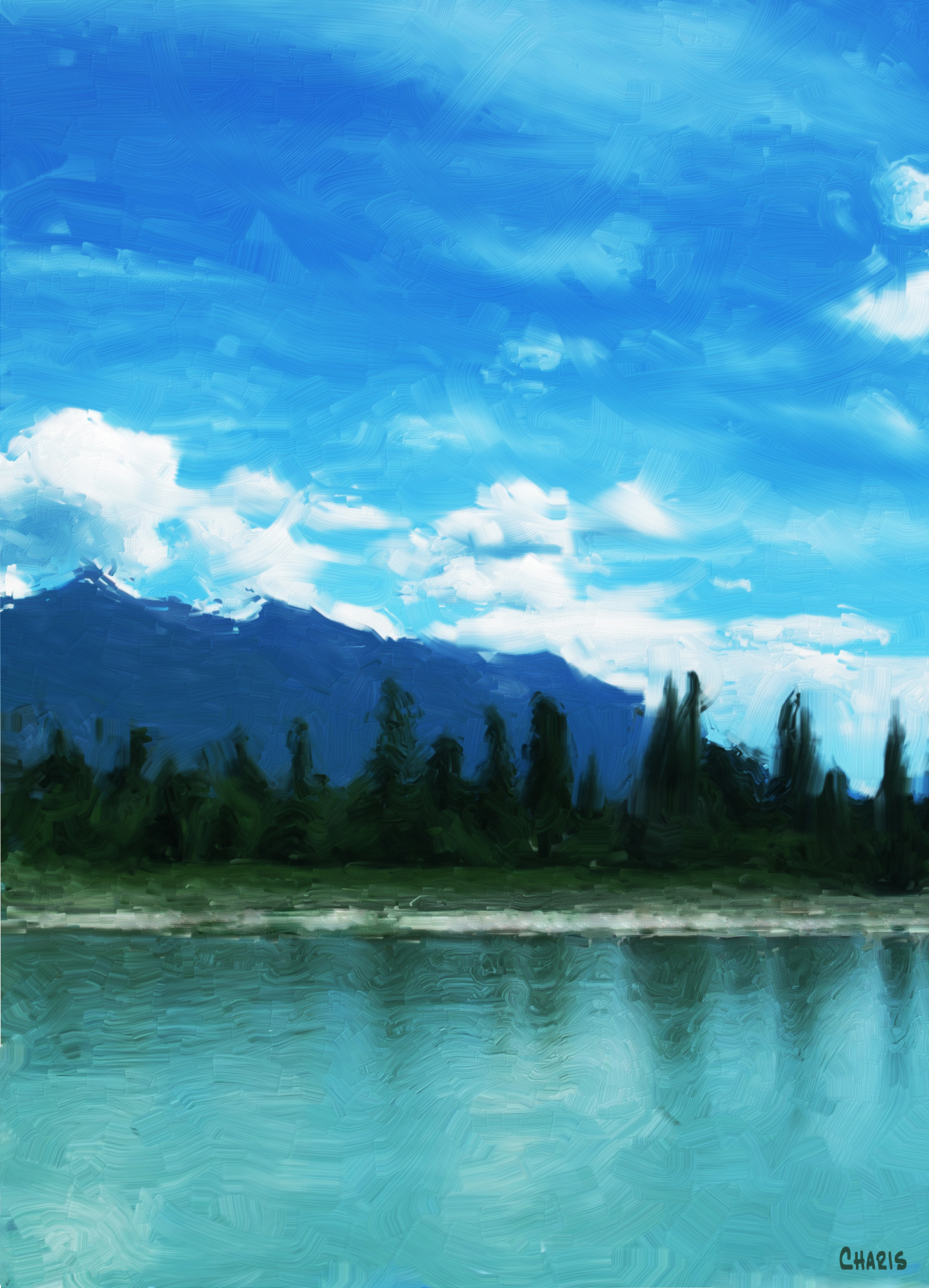
You visit the earth and water it; you greatly enrich it; the river of God is full of water.
(Psalm 65:9)

Kootenay River
You visit the earth and water it; you greatly enrich it; the river of God is full of water.
(Psalm 65:9)
Kootenay Lake

Bluer than Blue
The artist leading the workshop in the desert city looked at my paintings and asked, perhaps facetiously, “You use a lot of blue. Are you depressed?”
I looked around at the other participants’ work mostly done in earth tones –beiges, browns, greys –with occasional splashes of red and yellow. Desert colours.
“No,” I said, “Not anymore. I just come from a place that is mostly blue.”
When I arrived home in the Rocky Mountains of Canada a few months later, deep lavender blue skies, shifting azure-blue lakes, paler and paler layers of blue mountains and sparkling blue snow shadows seemed even bluer than the paintings.
Bluer than blue.
I come from a place that is mostly blue.
To some blue communicates serenity. To some blue communicates depression. I come from a place that was mostly depression.
A while ago I was told in a dream, “Look to the area of your greatest failure, for therein lies your greatest success.”
There was that night.
That night I bowed on a stage before a large audience jumping up to shout “Brava” and throw flowers. Most of them didn’t know that underneath a gorgeous costume I was balancing on one leg the whole time. I had broken the other one only a few days before.
Then there was that night.
That night, I cowered in a locked ward where a silhouetted person behind a flashlight peered in my room every fifteen minutes to make sure I was still alive.
That night on the stage, the night of “my greatest success,” was actually my greatest failure. That was the night when I identified myself as a strong-willed, disciplined overcomer. That’s when I was foolish enough to think that if I just worked hard enough I could earn love, respect, and adulation.
The night on the ward, the night of “my greatest failure,” was actually the night of my greatest success. That was the night when I admitted it took more courage to live than to die. I was fresh out of courage. That was the night when my tank hit empty, when I had no will power, no self-discipline, no hope. That was the night when grace pulled me deep down into those depths of blue and began to show me that freedom means nothing left to lose. Freedom means letting go of self-sufficiency, self-righteousness, and self-promotion. That was the night when Jesus Christ took me by the hand and lifted me up toward the light. Drowning in emptiness and being lifted up to a new life of hope was a kind of baptism.
It took a while to get on my feet. I had a lot of forgiving to do. Forgiving myself was the hardest test of wrestling pride, reputation, and the albatross of potential to the ground. I still have to remember to punch it in the beak regularly.
Blue means freedom, revelation, and serenity now. I understand better what Paul meant when he wrote:
Yet every advantage that I had gained I considered lost for Christ’s sake. Yes, and I look upon everything as loss compared with the overwhelming gain of knowing Jesus Christ my Lord. For his sake I did in actual fact suffer the loss of everything, but I considered it useless rubbish compared with being able to win Christ. For now my place is in him, and I am not dependent upon any of the self-achieved righteousness of the Law. God has given me that genuine righteousness which comes from faith in Christ. How changed are my ambitions! Now I long to know Christ and the power shown by his resurrection: now I long to share his sufferings, even to die as he died, so that I may perhaps attain as he did, the resurrection from the dead.
Yet, my brothers, I do not consider myself to have “arrived”, spiritually, nor do I consider myself already perfect. But I keep going on, grasping ever more firmly that purpose for which Christ grasped me. My brothers, I do not consider myself to have fully grasped it even now. But I do concentrate on this: I leave the past behind and with hands outstretched to whatever lies ahead I go straight for the goal—my reward the honour of being called by God in Christ.
(Philippians 3)
Only Someone who knows the plans He has for us has the courage it takes to show us how to die so that we might live.
Photo: Tam O’ Shanter Creek
So much of art, music, and poetry
is learning to leave spaces,
observe rests,
and reserve words.
So much of maturity
is learning to leave spaces,
observe rests,
and reserve words.
So much of faith is learning
abundance is
not needing to eat the whole feast
today.
In the Kingdom of God
there is time
to savour his goodness.
His loving kindness endures forever.
Photo: *Doot doot doo, lookin’ out my back door* (OK not my own back door but the back door of the place where we hung out with great friends this week.)

And so I tell you, ask and it will be given you, search and you will find, knock and the door will be opened to you. The one who asks will always receive; the one who is searching will always find, and the door is opened to the man who knocks.”
(Luke 11:9,10)
Photo: looking north

(Click on photo for larger version)
The far mountains in this photo are about an hour away.
We tend to measure distance in terms of time in this vast country. It will take an hour to drive to the village at the base of those farthest mountains. In one hour the time will be here and the place will be now –and the details will be much clearer.
We live in the present but have an awareness of the future lying just one step further ahead on this journey. God is present-future. When he forgives our past, it is forgiven. He sees who we will become as clearly as if it were today. He knows the plans he has for us and calls us by our future name. He desires us to see ourselves from his viewpoint so we will have the courage to walk in our new identity.
He remembers the future. He shows it to us by his words and allows us to say, “This is a picture of me when I was older.”
But God, being rich in mercy, because of the great love with which he loved us, even when we were dead in our trespasses, made us alive together with Christ— by grace you have been saved— and raised us up with him and seated us with him in the heavenly places in Christ Jesus, so that in the coming ages he might show the immeasurable riches of his grace in kindness toward us in Christ Jesus. For by grace you have been saved through faith. And this is not your own doing; it is the gift of God, not a result of works, so that no one may boast. For we are his workmanship, created in Christ Jesus for good works, which God prepared beforehand, that we should walk in them. (Ephesians 2)
So let us know, let us press on to know the Lord.
Photo: Pond near 100 Mile House All I need is the air that I breathe and to love You.
Photo: The Mission
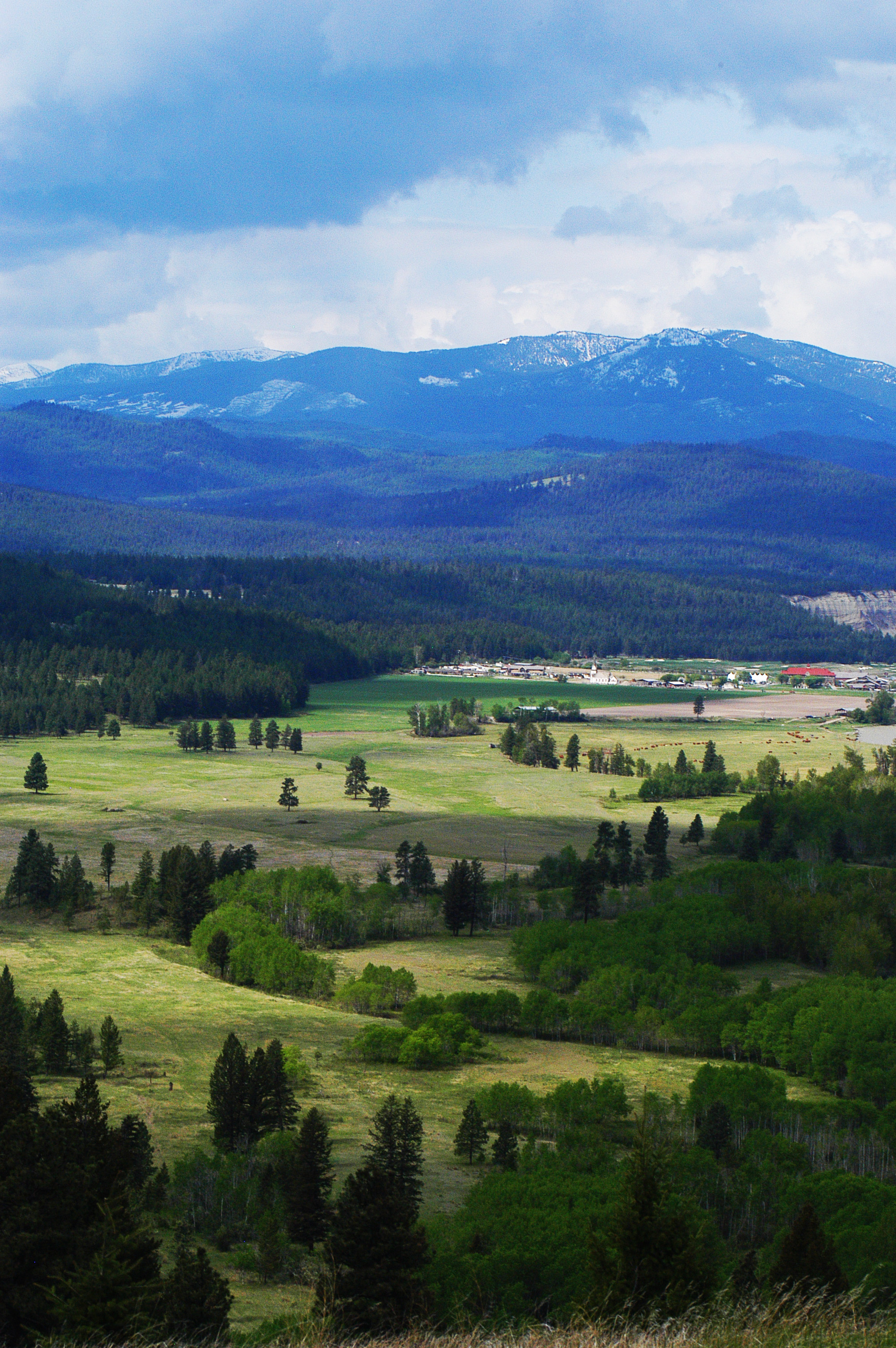
Your mission, should you choose to accept it
The woman told me to be careful because there were nails sticking up in some places, but that most of the floor boards that could break had been replaced.
“That was a classroom,” she said, stepping over a pile of debris, “And this is the room where kids went to die.”
“What?” I said.
“Mostly T.B., but other stuff too. The other children weren’t supposed to know, but they did. Kids who went in this room just disappeared.”
She was showing me the old residential school on the St. Eugene Reservation. This was years before the Band’s greatest source of shame and sorrow transformed into their greatest asset.
Much has been written of the horrors of the residential schools in Canada where First Nations children were removed, sometimes forcibly, from their parents and placed, not always gently, in dorms and classrooms where they were raised by people who couldn’t speak their language or understand their culture or who had even had children of their own. It is our national tragedy, our national source of shame.
It would be easy to hate the perpetrators of this cultural fiasco, but many people, misguided though they may have been, thought they were leaving their own comforts behind, living in the wilds to try to improve the lot of children who were not educated to cope with European ways.
Alas, one may leave one’s comforts behind, but one’s discomforts and old wounds come along. This is why we call it baggage. Our methods of coping with baggage are the chief source of collateral damage to succeeding generations.
Some of the people who found their way to teach in isolated residential schools were pure evil, no doubt.
I think many others meant well, after all this is how many Europeans treated their own children. They still do. We still romanticize the boarding school concept in books like Harry Potter. Missionaries’ children are still routinely flown off to walled English-speaking compounds in another country to be raised by people who have sacrificed the comforts of their own homelands to raise other people’s children.
Many refugees of institutionalized European upper crust bullying continue to bully as adult leaders in government institutions and multinational corporations. Some guilt-proofed adult children of the foreign fields, who felt they mattered less than the people their parents were trying to reach, still bear scars as well –even though their substitute parents meant well.
I think it may actually be easier to forgive someone who drives over your foot intentionally than someone who drives over it accidentally. If a person you love and respect drives over your foot accidentally, then expresses how terrible, awful, horrible, miserable and wretched they feel, the victim can forget that they were the victim in the effort to comfort the driver. Some people think forgiveness is saying, “That’s okay. It was no big deal,” when it was a big deal. Whether your foot is crushed accidentally or intentionally you still have pain and you still limp, and if that injury is never given proper attention and healing you limp for the rest of your life.
Then there is the matter of what to do with the anger.
If only everyone who hurt us was the picture of pure evil we could aim all our screaming, kicking and ranting at them. This is why novels have villains. Oh how we love to hate a well-constructed villain. But what do we do with a best friend who drove drunk just that one time? How do we remember a teacher who said one stupid, cruel thing that devastated us for years? How do we forgive a parent who was usually kind, but in a war-time flashback saw us as the enemy? How do we forgive and yet still acknowledge the tremendous pain that resulted from these choices?
Forgiveness is complicated, but ignoring pain causes us to take it out on the next generation. Unresolved anger hides in our suitcase ready to lash out at any curious child who opens it.
The First Nations people on the St. Eugene Mission have done the most remarkable thing. They have inherited the rights to the old mission property, one of the most beautiful places in the world, on which sits a big old stone building that had a room where kids went to die. They have taken the most painful memory of their people’s history and transformed it into a luxury hotel. Some people see only the beautiful setting. Some people see only the memory of horrid pain, but these outstandingly gracious people see both. The object of hatred, the old residential school, has been reborn as a source of education (no denial of pain) and of hospitality (reaching out). They have opened their doors to the world.
What an example. When I took this photo yesterday as I stood on a hill over the Mission it was as if I heard: Yes, you have pain, you have anger, you have scars. You have been hurt by people who meant well, but who had never dealt with their own pain. You have a choice about what you do with that thing in your life that sits like a big red-roofed stone building in the middle of an otherwise beautiful inheritance. Your mission, should you choose to accept it, is to make something useful, beautiful, and hospitable of your inheritance, both good and bad.
God bless the Ktunaxa.
 Historic St. Eugene Mission church in winter




 Charis: Subject to Change