On the one hand I grieve over the way some self-appointed guardians of the extra narrow way are quick to disqualify other writers and speakers when they discover flaws; on the other hand I do worry about the under-use of the gift of discernment and a tendency for some people to turn those with a certain amount of insight into heroes or even idols.
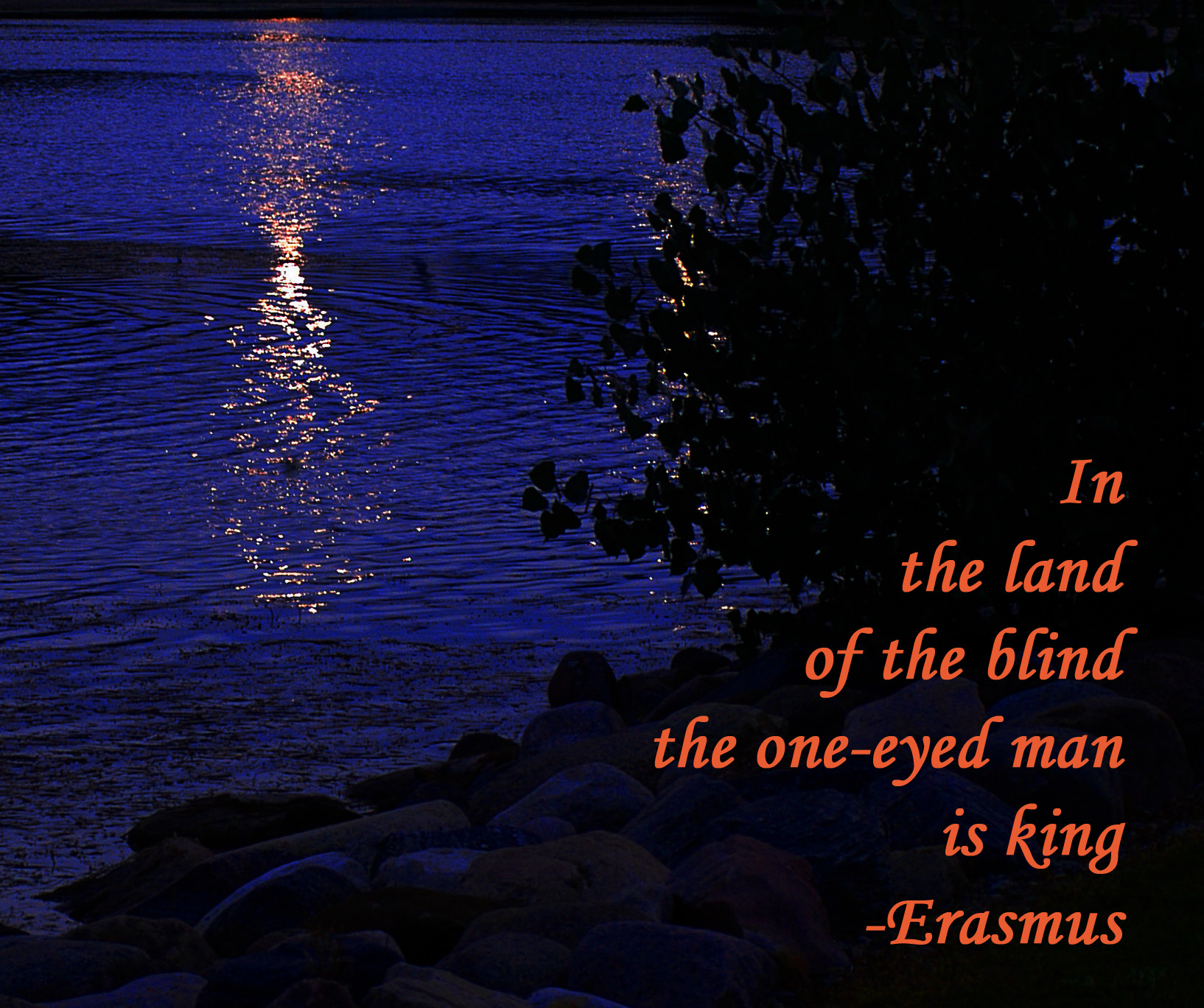
Do we tend to place some people on a pedestal that is too high because they are like one-eyed men in the country of the blind? Do we ourselves install some people as gods and then stone them when we discover they are frail humans?
Perhaps the problem is not the person with greater, but still imperfect vision. Perhaps the problem is that not enough people realize they can learn to see better as well. Perhaps we need to pursue the Healer himself. Perhaps if we combined our glimpses of truth we could all see better.
Perhaps all of the adopted children in God’s family are meant to be royalty.
Let the peace of Christ rule in your hearts, remembering that as members of the same body you are called to live in harmony, and never forget to be thankful for what God has done for you. (Colossians 3:15)
An attitude of thankfulness allows us the freedom of vulnerability. It is only when we begin to comprehend the richness of God’s love that we can dare to be transparent before Him and others and allow Him to do a deep work in our hearts. It takes a lot of trust to expose the lies we have believed and the lies we told others –or ourselves.
Deep ain’t cheap. But Jesus Christ paid the price.
After a downpour in the Pass yesterday, the air was still and smelled so sweetly of pine and new aspen sap. After the storm the lake glistened with hope.
I have the joy of caring for two of my grandchildren this week. They teach me so much.
The three-year old (I’ll call her Daisy) is full of profundities and observations on life. When she said she was hungry I suggested we could take a peek in Nana’s pantry to see if we could find something good for a snack. She looked at me suspiciously, then said softly to her mommy, “But I don’t want to take a peek in Nana’s panties.” (Please read the scenario again carefully if you feel the need to accuse this red-faced granny of improprieties.)
Daisy teaches me about the importance of clarification and that people do not always perceive our offerings the way we intend them to be perceived.
When Daisy told me about all the things she could do on her little white table and chair set –like put puzzles together, play with her tea set, and play the matching game– I asked her if she coloured on her table too.
Again she gave me her patient look as she explained, “No. I don’t colour on the table. Mommy doesn’t let me colour on the table. She says I have to use paper or a colouring book.”
Yesterday she taught me about the difference between making a mistake, and sinning. Making a mistake is colouring outside the lines when you are learning to colour because sometimes even when you try hard your hand slips. Being seriously in error — or sinning is when you know Mommy said to colour in the colouring book, but your crayon doesn’t just slip outside the lines. It slips right off the table and across the room and colours on the glass door to the patio. When that happens you need to take responsibility for your deliberate choice and use the damp cloth Nana hands you to scrub the door until your mess is cleaned up.
I read a book review this week by a popular Christian blogger that upset me for some reason. Usually I shrug that sort of thing off, but this felt like an irritating hangnail that kept snagging on my peace for days.
People have differing opinions on literature, of course. Not everyone appreciates a poetic imagery-bound gift. I’ve heard enough left-brained friends bewail subjective marking styles of English teachers to know poetry baffles them. I hear their frustration with trying to guess what they need to do to get an A when there are no answers in the back of the book. It drives them as crazy as the just-the-facts-ma’am, right-or-wrong-answer-at-the-bottom-of-the-page writing style that bores me into a nap on the desk. I get it. Tomayto/tomahto
The critic later issued an apology on his blog, admitting he lost sight of the fact there was a sensitive human behind the words in the book. Wow. A critic issues an apology? There is a God.
He didn’t back down on his stance on “not recommending” the book, however, because he found some things that did not line up with his theological viewpoint based on his and Et Al’s interpretation of scripture. He also used the guilt by association marking pen when the author admitted to receiving helpful glimpses of insight from people and institutions who did not have evangelical seals of approval stamped on their undersides.
Here’s my problem: this book, like many other books, (or youtube videos) experienced unanticipated popularity. It was not written as a theological treatise at the end of a lifetime of study. Should a book presented for use as a textbook in seminary be subject to rigorous doctrinal examination? I should hope so. Should a book that was intended to be a sharing of the author’s personal experience of endeavouring to change her attitude be subjected to the same scrutiny?
I remember having to fill out a workbook for Sunday School class when I was about eleven years old. It had a lot of those frustrating what-am-I-thinking-of-in-verse-six kind of questions, (I always seemed to see something different from my teacher) but at the bottom of the page there was a big open box which allowed room for “sharing” how I felt about concepts covered in the lesson.
I shared.
My teacher marked it with a red X. WRONG.
Wow, that hurt. I remember telling my dad that I would have understood that red X if I answered the other questions wrong, but who gave her the right to mark my feelings as wrong? My feelings and opinions were my feelings and opinions. Should I lie? (Alas I did learn to lie to pastors and teachers. I told them what they wanted to hear for many years after that. Not a good idea. That habit set me up for a lot of wasted time.) What I needed was a loving, mature person to come along side and help me to reach for a higher goal -not to invalidate my attempts at expression.
Art is an attempt to connect with others. A creative writer’s intent may be more about making connection with fellow sojourners than lecturing on doctrine. It strikes me that when communicating some aspect of experience of God in a deeper way, we need to have a little grace space. To grow in grace we need to be in an atmosphere of grace. Does a child’s work need to be perfect before it may be displayed on the fridge? Are we in the family of God not all children in a process of learning? Did Jesus ever say, “Except ye all become as big old experts ye cannot see the kingdom of God?’ (in archaic English just like that.)
Ideas about God and how he created us to relate to him which ignore the manual handed to us (the Bible) raise alarms all over the place for me too. Indeed, there are times when artwork can be the result of a sinful rebellious attitude, when inappropriate scribbles appear on the patio doors, for example, and when those in a position of caring authority need to lovingly hand the author a wet rag and say, “Seriously? Come on, clean up your mess, sweetie.”
While I do not agree with every thing in the reviewed book, and some ideas are definitely discussion-worthy, I relate to the experience of the writer and appreciate the extremely important discovery of having a grateful heart. I do not believe it is motivated by self-seeking rebellion.
One of the hazards of popularity is that works of people in progress can be suddenly elevated to the level of works of studied authority. (The Bible says “Let not many of you become teachers knowing you shall incur a stricter judgment.” It just doesn’t tell you that most of the critical stricter judgment comes from people who consider themselves more studied teachers.)
My point? Art is an expression of where we are at the moment we create it. It is not the final conclusion of a lifetime of learning. Art fills in the big empty box at the bottom of the page where we have a chance to share how we feel about what we have learned. Art asks the observer, “You know what I mean?” If it goes viral on a giant public fridge with greater exposure than we anticipated when we created it, if it becomes extremely popular because a million people connect with it as a familiar stage of learning in their own lives, the onus is still on the reader or observer to use discernment. I wonder about the need of self-appointed guardians of perfect theology to tear it down publicly and give it “not recommended” status because they do not like the creator’s style or question whether it has stayed within lines the artist may not know about.
Worship of anything or anyone other than God is always idolatry. Yes, pop culture can promote idols, but to assume that a popular work will become an unexamined object of idolatry to other believers is to assume people observing the art are far less discerning than the critic. In an attempt to protect the naive by issuing a public judgment and condemnation of a work for failing to be something it never claimed to be, the present handed to us may not necessarily be a gift tied up in ribbon. It maybe just be an arrogance-bound box of envy.
This morning I read in Romans about how God used Pharoah. It says God actually raised Pharoah up to that position for a reason. I wonder if God allowed a megalomaniac to rise to a position of power because it was time for a public show-down with a human who actually believed he was in charge. God told Moses what to do and what to say, then added, “Oh, by the way, Pharoah won’t listen.” Moe probably felt like middle management.
Pharoah refused to change because he refused to learn. He arrived at the point of contact with Moses and Aaron in a state of being incapable of changing his mind.
It just so happens this cat in the photo is named Ramses, after a Pharoah of Egypt. He is an exceptional cat because he does play fetch — with an alarmingly realistic replica of a dead mouse — but he deigns to participate in this exchange with us mere humans on his own terms and in accordance to his mood swings only. He performs for no man.
His demeanor reminds me of people who consider themselves to be experts in all fields which matter. If they are not experts in a particular field, it is because that area, in their opinion, is not of importance.
Like most cats, Ramses is not known for his eagerness to learn new tricks. (Can you tell I’m a dog person –although I admit a certain admiration for his regal bearing and alluring appearance.)
The Bengal breed is beautiful. Their markings remind us they are not that far removed from the wild. They are gorgeous animals and tend to be more aloof than the typical house cat, but like most cats they are not compliant. They are not meek. Woe betide if breakfast is late.
I don’t think , when meekness is mentioned as a positive character trait in the Bible, that it refers to a doormat, a milk toast, or a namby pamby, wishy washy victim. I think it refers to a person who humbly admits he or she is not an expert, but is confidant in her or his potential and knows she or he is capable of learning.
I love this description of meekness. A meek person knows how to lose nobly at chess. He does not distract his opponent and tip the board or demand best of three or twenty-three or a hundred twenty-three grudge matches. When confronted with a check he lays down his queen and says, “You are better than I am, but I can learn. Teach me.”
Don’t mistake meekness for mildness or timidity. True meekness is unswervingly honest, ferociously courageous and undauntedly thorough. Meek people are never resigned to hopeless stagnation in mental, emotional or spiritual slavery. They realize that gain comes through the willingness to let go of lies which have remained unexamined for too long.
A lack of meekness was the central weakness in Pharoah’s character. He was the victim of an attitude that was not teach-able. It was an arrogant attitude that mistook stubbornness for perseverance. I believe the attitude developed as his own original choice, but after it became entrenched, God chose to exploit it, and hardened his heart further. Only God knows at what point some people’s rebellion solidifies into unmovable arrogance. Not my job. Not going there.
My job is to remain soft-hearted, malleable, willing to admit ignorance, and to be confidant that I am capable of learning — meek. My job is to be honest about my weakness and co-operate in the mind renewing process.
But his reply has been, “My grace is enough for you: for where there is weakness, my power is shown the more completely.” Therefore, I have cheerfully made up my mind to be proud of my weaknesses, because they mean a deeper experience of the power of Christ. I can even enjoy weaknesses, suffering, privations, persecutions and difficulties for Christ’s sake. For my very weakness makes me strong in him. 2 Corinthians 12:9, 10
Today as I awake to Pentecost Sunday I feel like blind Bartimaeus.
I sit by the roadside.
I’ve tripped again.
I cry out, “Jesus, son of David have mercy on me!”
I feel like I am an annoyance and embarrassment to everyone around me,
but I don’t care.
Jesus, son of David, have mercy on me!
Master, this is what I want:
I want to see You.
I see all the needy people around me.
I see my inadequacies.
I see my sin.
How can I help anyone on this journey when I keep falling down myself?
Master, fix my eyes that I might fix my eyes on You!
Surrounded then as we are by these serried ranks of witnesses, let us strip off everything that hinders us, as well as the sin which dogs our feet, and let us run the race that we have to run with patience, our eyes fixed on Jesus the source and the goal of our faith. Hebrews 12:1
While on a recent road trip my husband and I were discussing how discernment should operate in an atmosphere of love and grace. Just then a car pulled out in front of us as it turned left onto the highway. My husband had to hit the brakes to avoid a collision. He let out a heart-felt, “Whew! Lord, help that guy!!”
I felt the Lord say, “Like that.”
As I thought about it, it came to me that our vehicle had the right of way. We were in the right. The vehicle that pulled out ahead of us was clearly in the wrong and it was his responsibility to yield. Had we continued going the speed we were going, and had there been a collision the other driver would have been charged –but we both would have been wounded -probably very seriously.
I realized the Lord is teaching me that in discerning wrong teaching or a wrong spirit we have the option of restraining ourselves, even if we are perfectly right, to makes allowances for a brother or sister’s error in judgment.
I think this person driving the other vehicle just made a bad judgment call. Perhaps they were inexperienced, or tired, or just plain inconsiderate; perhaps they had an emergency we knew nothing about. Now had it been obvious that they were drunk and careening about the road in a grossly unsafe fashion, obviously being a threat to their own or others safety, we would have gotten their license number and called the police. Had the driver been someone under our authority, one of our kids or a student we were teaching to drive, we would have made a u-turn and followed them until we could have pulled them over, found out what on earth they were thinking (or not) and given them a kind but honest talking-to, or even taken their keys if the situation called for it. Had the driver been a close friend we may have done the same, but perhaps would have appealed to them to be more careful.
Sometimes, in the church Body, we are called to do that, but not often. Sometimes we need to warn others, but most of the time we need to apply the brakes, make concessions, let them by, pray for them and trust Holy Spirit to police the roads. He’s the one who brings conviction. Neither party would gain anything by ramming them to teach them a lesson. In fact, both would lose and the journey would be greatly hindered.
It’s not as if no one has ever had to apply the brakes for me. As much as it hurts I’d rather have a friend come along side, pull me over, speak kindly and honestly to me, and bring the consequences of my choices to my attention, than to read about “some people” on Facebook or read a rant about my heretical beliefs on a blog, or overhear “concerns” in a hallway. “Faithful are the wounds of a friend; profuse are the kisses of an enemy.” Proverbs 27:6
Today I read, “…pursue righteousness, faith, love and peace along with those who call on the Lord from pure heart. Have nothing to do with foolish ignorant controversies; you know that they breed quarrels. And the Lord’s servant must not be quarrelsome, but kind to everyone, able to teach, patiently enduring evil, correcting his opponents with gentleness. God may perhaps grant them repentance leading to a knowledge of the truth and they may come to their senses and escape the snare of the devil after being captured by him to do his will.” 2 Timothy 2: 22b-26.
There are, indeed, some reckless, inconsiderate, inexperienced people with too much power out there on the road. Be alert. Be ready to step on the brakes. Drive carefully. Pray.












 Charis: Subject to Change